The post Culturally-Inclusive Nature Programs that Honor Culture, Explore Justice, and Unearth Joy appeared first on Rethink Outside.
]]>I have always enjoyed the outdoors. Whether it was exploring camping with our all-Black Girl Scout troop, spending summers on my grandparents’ farms, running through sprinklers with our neighbors, summer camps in the mountains of North Carolina, or adventuring in New Zealand through a summer exchange program, I loved the outdoors! It never occurred to me that I would one day couple my love of the outdoors with my career path.
You see, I went to college to be an educator. I started out as a Montessori teacher, then became an early childhood professor, and later on, a non-profit leader focused on program development for families. In the midst of growing my career, I continued spending time outdoors, eventually becoming a volunteer Outdoor Afro leader in Nashville. Outdoor Afro is an organization dedicated to inspiring Black connections and leadership in the outdoors. Through that experience, I learned the power of Black stories connected to nature and how they serve as an opportunity to see ourselves in the outdoors and reconnect us to nature.
As I continued to lead outdoor events in 2020, like many folks, I was also experiencing a personal and professional transformation. Shortly after the pandemic began, I like to say I was liberated from my job as a program director, and this gave me the opportunity to pause and reflect deeply on what I wanted to do next. I knew that whatever it was it had to center JOY. During this period my son, who was in kindergarten, was no longer going to school, like many other children across the country. I used this time of freedom as an opportunity to use the outdoors as our classroom. I realized his questions served as our foundation for learning which I could build upon through books, art, podcasts, experiments, and other creative projects.
As summer came to an end, I embraced that I was enjoying our outdoor learning experiences and wanted him to continue to experience learning through nature, so I started looking into nature-based education programs. I quickly, but not surprisingly, realized how white these spaces were, both in the people who were leading these programs as well as the curriculum that was being delivered. I wanted my child to have nature-based experiences but ones in which he could see himself and that were grounded in the stories and people of our community.
As it turns out, I had already been creating a foundation for the work I would do next. We had been volunteering at a community garden/urban farm that is owned by a Black woman, Ms. Pearl. I learned about other farmers she was connected to such as Ms. Cynthia, a former trauma nurse, turned poultry farmer. After visiting with Ms. Cynthia at her farm, I shared the idea of inviting other families and creating a learning experience. I invited some families who I knew were also homeschooling and looking for community and as we say, the rest is history.
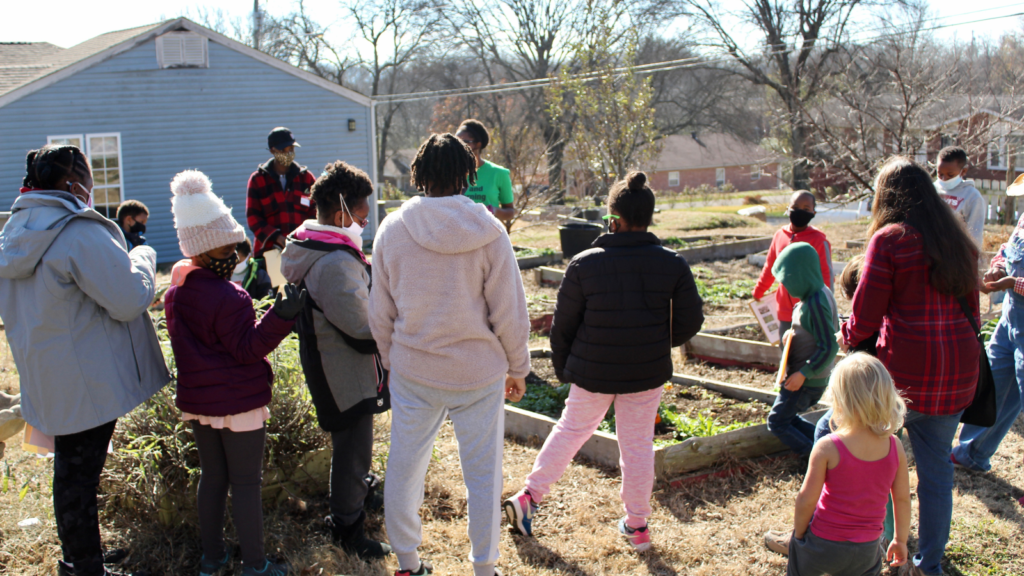
That one experience turned into a 6-week series in the spring called Gardening for Food Justice at the community garden. Then, in the fall of 2021, I created a series called Skills for Liberation in which we explored what is often referred to as “wilderness skills” but are really just skills many of our ancestors had to know in order to live and thrive (plant medicine, foraging, building fires, navigating with the stars, etc.). Since then, I have created a Creative Arts in Nature series to explore different types of art and its connections to nature such as drumming, photography, print making, etc. All of these experiences are led by Black and Brown people in the Nashville community as well as our attending parents to honor their knowledge and gifts.
The goal of the programming I have created is really to challenge what counts as nature and yes, to rethink outside, including how we engage with the outdoors and who gets to engage in the outdoors. It is not always a kayak or a hike that is appealing but rather stories, a sense of community, the arts, and joy are also central for a lot of people’s engagement in the outdoors; hence why I eventually named the business Unearthing Joy.
I get asked all the time if I am going to expand the programming that I offer and my response is usually no, because my goal was never to be the one leading programming in neighborhoods across the city or country but rather to spark conversations about what culturally-inclusive nature programming can look like in YOUR community, and encourage folx to co-create their own programs WITH their neighbors. Through workshops and consulting I get the opportunity to share the strategies I use to create my community-based programs that can be applied in your own community. These strategies are grounded in multicultural education and culturally responsive frameworks from the education field.

The majority of the work for Unearthing Joy is collaborating with nature-connected organizations such as garden education programs, early childhood organizations, funders, schools, and parks and recreation, to rethink their programming efforts so they are more culturally-inclusive of the past and present stories, roles, and contributions of Indigenous, Black and other people of the global majority. And I want to be clear that culturally-inclusive programs are necessary, regardless of the demographics you work with, in the effort to build understanding that our stories not only matter but have greatly shaped and contributed to the work connected to the outdoors. These stories and our knowledge hold great promise for providing solutions to our greatest injustices we are all facing related to climate, environment, health, and food systems.
Our primary goal at Unearthing Joy is to honor culture and explore justice to unearth joy. To learn more about how you can transform your curriculum and programs to be more culturally-inclusive, contact us for our signature workshops for your organization on our website, or follow us on Instagram or Facebook @unearthingjoytogether.
Ashley Brailsford, Ph.D. is an early childhood educator and nature enthusiast who launched Unearthing Joy to guide the development of culturally-inclusive, nature-based programming for families, community groups, and organizations that center the stories and contributions of Indigenous, Black, and other people of the global majority. Her experiences in teaching, professorship, curriculum development, and leadership in education coupled with time spent as an outdoor guide informs her programming and development process to create outdoor spaces into inclusive spaces that honor culture, explore justice, and unearth joy.
The post Culturally-Inclusive Nature Programs that Honor Culture, Explore Justice, and Unearth Joy appeared first on Rethink Outside.
]]>The post Forging connections in the LGBTQIA+ community through the outdoors appeared first on Rethink Outside.
]]> webinar highlighting Pride in the Outdoors. Access it here.
As a queer person, my relationship with myself is always growing and changing. There is so much to understand and still so much to pull into the light that I’ve unknowingly pushed down over the years in order to better feel like I fit in. Sometimes I feel sad that I didn’t get to be my complete self from an early age because we just didn’t have the language to talk to children about gender identity and queerness when I was growing up.
But then I remember the moments I had as a child when I was completely free to be who I was – and these are usually memories of playing outside.
The outdoors was where I felt, as a child, that I could most be myself. It was as though there were fewer expectations and restrictions at play, even down to what I was allowed to wear and how I could behave. I remember the feeling of being outdoors as one that was always exciting and freeing. Even when I was being reluctantly dragged on a walk with my parents! This feeling remains as an adult, and going for a walk outside is still my favorite way to escape and feel better about life.
In 2020, whilst working on LGBT policy in the UK Government, I started to wonder what I could do for my community that was more immediate and tangible than the debates I was getting tied up in at work. I knew it had to be something that improved well-being and offered a place of joy and fun for queer people, and so the idea for Queer Out Here was born. We hosted our first walk in the Peak District with around 12 people on a wet and windy January day. Gradually, the word spread around our local area and more people began to come along.
Queer Out Here provides a space for queer people to connect with each other and with nature in a joyful and healing way. We organize regular hikes in the North of England currently -now in groups of between 25 and 50 people. We’re hoping to spread across the rest of the UK in the future!
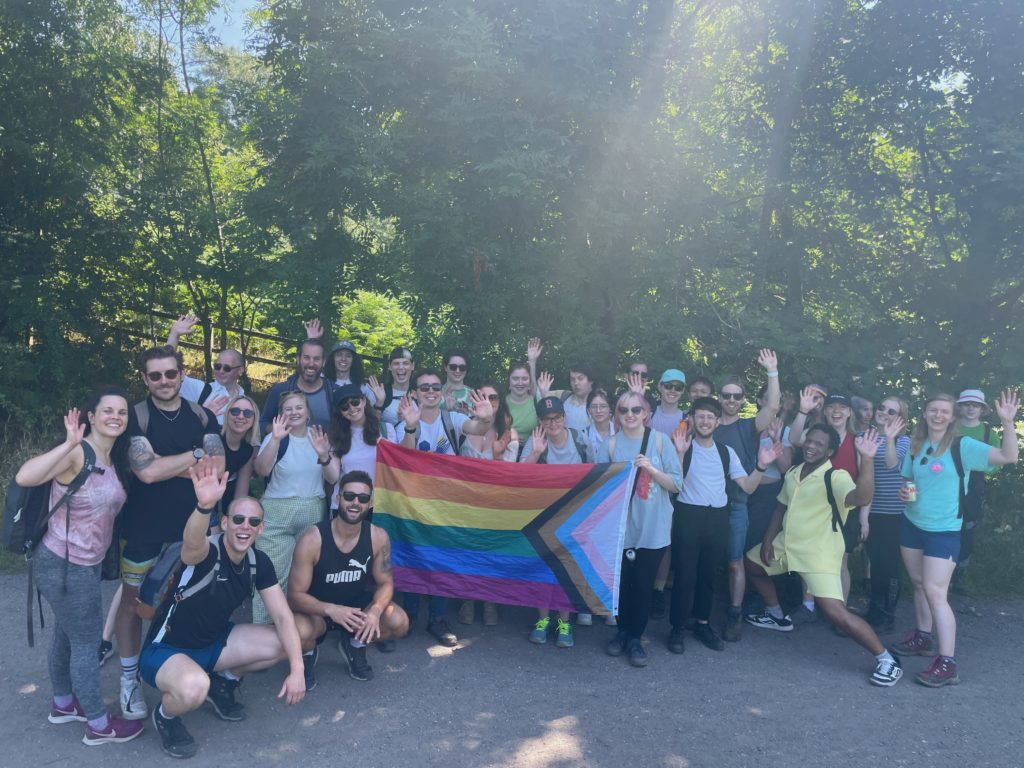
We go walking together because being outside helps us to reconnect with our bodies and our community. Our big group walks are a fun and easygoing way to meet new queer friends who may have similar interests. And the nature of a long walk means we have plenty of chances to chat with different people and mingle with different groups. Lots of people come along to our walks on their own, which means that there is a lot of potential for new friendships to be struck up by the end of the hike.
In the LGBTQIA2S+ community, many of us have at some point felt like we don’t belong. Whether because we grew up in a small rural village, we have family that doesn’t accept us, or simply because society still expects most people to be heterosexual l and cisgender – at some point we have all felt different. So having friends and community around us who understand our experiences is extremely validating and important.
Being out in nature kind of gives us that same feeling as well: the feeling of being accepted just as you are. Getting outside connects us to ourselves, to each other and to the beautiful world around us, reminding us that we are part of a much bigger picture than our own small existence. I find that comforting – and at the moment that comfort feels really necessary! On a personal level, I need to remember that my journey of exploring my queerness and my identity might just be easier if I choose to go for a walk outside and see what happens. I’d encourage anybody who is feeling like they need to get in touch with themselves to try the same. 
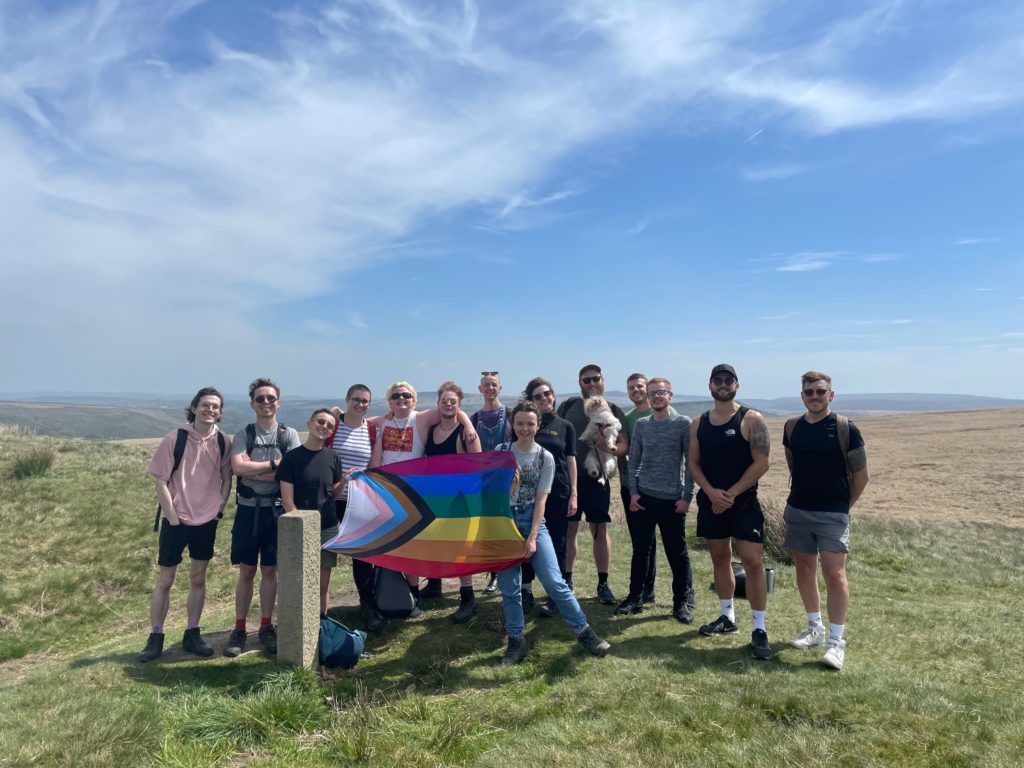
Ailish is a consultant, coach and trainer with expertise in building inclusion and equity for the LGBTQIA+ community, particularly trans and non-binary people. Their work focuses on ways to uplift and empower the queer community – and on inspiring others to do the same. They’re originally from North Yorkshire and now live in the Peak District, UK.
The post Forging connections in the LGBTQIA+ community through the outdoors appeared first on Rethink Outside.
]]>The post Their Ancestors’ Wildest Dream: A Weekend with Camping to Connect appeared first on Rethink Outside.
]]>One evening in July, after the crickets had awoken and all the s’mores had been eaten, eight teenage boys—strangers to each other a few days earlier—stood around a glowing campfire with linked arms and repeated after an adult counselor:
“I am beautiful!” he said.
“I am beautiful!” they called out in unison.
“I am valued by my community!”
“I am valued by my community!”
“I am more than what the world says I am!”
“I am more than what the world says I am!”
“I am my ancestors’ wildest dream!”
“I am my ancestors’ wildest dream!”
For all of these teens, young Black and Brown men from New York City and Philadelphia, it was the first camping trip of their lives. Over seven days in the Delaware Water Gap National Recreation Area, in western New Jersey, they were taught how to pitch a tent, build a campfire, and about “Leave No Trace” principles. They splashed around in a lake—one teen confessed it was his first time in a body of water other than a bathtub—and learned to navigate the Appalachian Trail using a paper map.
They also discovered yoga and meditation, wrote in journals, and shared intimate personal stories with each other. A black bear visited the campsite one morning. In a short time, strangers had become brothers.
“You build bonds with people that you didn’t know, and now this is like our ‘hood,” said DeVaughn, a 15-year-old from Queens. “Our ‘wood hood.’”
It was a typical trip for Camping to Connect, an experiential mentorship program we founded in 2018 that guides young men of color into nature and teaches them outdoor and life skills. In the quiet of the forest, we hold conversations on topics like race, masculinity, and mental health that tackle the meaningful issues these youth face in America’s cities. Camping to Connect’s facilitators are all Black and Brown men from Mastermind Connect, a nationwide collective of progressive men of color who support one another to become the best versions of themselves. As participants continue with the program and grow into young adults, they gain access to this wider network of male support.
But having Black and Brown men as outdoor trip leaders also sends an important message to the kids: The great American outdoors belongs to them, too.
“Historically, there’s been a very different relationship between people that look like us and the outdoors,” Camping to Connect’s co-founder Manny Almonte explained to participants on the first day. “Nature is going to offer us a space of communion, as well as the peace you don’t find in the city.”
Author Richard Louv coined the phrase “nature-deficit disorder” to reflect the idea that there are human costs of alienation from nature. Louv cites a growing body of scientific evidence finding that this deficit leads to diminished use of the senses, attention difficulties, conditions of obesity, and higher rates of emotional and physical illnesses.
For people of color, especially, nature is hard to come by. Black, Hispanic, and Asian communities are three times as likely as white people to live in nature-deprived areas, according to a 2020 analysis by the Center for American Progress. But it’s not just a matter of access. Throughout the last two centuries, Black and Brown people were systematically excluded from outdoor recreational spaces (many state and national parks up until the late 1950s posted signs that read “For Whites Only”). In addition, the outdoors can call up associations with slave labor for Black communities, which carries generational trauma and shame.
All this has fed a narrative that urban communities of color internalized about who participates in outdoor activities. Camping to Connect is trying to upend that story and show our young participants and their families that America’s outdoor spaces are safe and theirs to benefit from, too. “These are the experiences that we want these kids to see as normal, because this is what we’re often told we can’t do,” says Carlos Davila, a Camping to Connect mentor.
Davila, who grew up in The Bronx, had never gone camping before joining a Camping to Connect outing as a trip facilitator two years ago. He’s since enrolled his two sons in the program, and now includes hiking and outdoor recreation among the activities his family enjoys. We’ve seen a similar ripple effect among other families whose children participate in our program.
In the past two years, many leading outdoor brands have begun grappling with the fact that their marketing and advertising have long excluded communities of color by putting forward a single story of the typical outdoor user as overwhelmingly white, male, and able-bodied. AllTrails, Klymit, Biolite, Vasque, Buff USA, and others are among the outdoor brands supporting our efforts at Camping to Connect to advance inclusion and representation in the outdoors. We’re also proud to be part of the National Park Foundation’s ParkVentures program, which supports equity-focused outdoor leaders and organizations.
With a grant from Patagonia, we recently produced a short documentary film about our work with urban young men of color. We titled it—naturally—“Wood Hood.”
Get to Know the Authors and Filmmakers:
Andy Isaacson:
Andy Isaacson, a Brooklyn native and freelance outdoor journalist, is a co-founder of Camping to Connect and a Board member of Young Mastermind Initiative.
Manny Almonte:
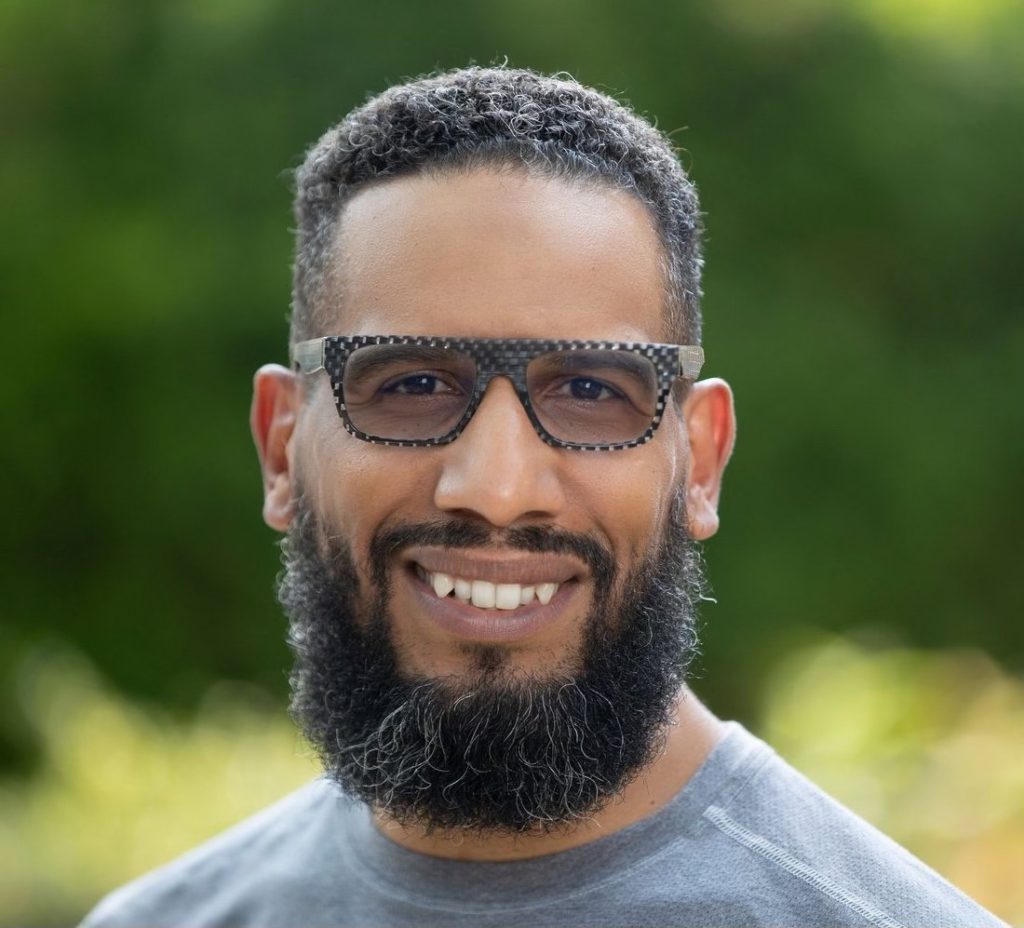
Manny Almonte is president of Young Masterminds Initiative, a nonprofit organization that promotes leadership and positive self-awareness for young men of color through unique experiences that teach them the value of brotherhood, community, and the pursuit of excellence. An avid outdoors and cycling enthusiast, Manny is also co-founder and CEO of Mastermind Connect, a collective of men of color who are striving to fully embrace the essence of becoming the best versions of themselves.
The post Their Ancestors’ Wildest Dream: A Weekend with Camping to Connect appeared first on Rethink Outside.
]]>The post Scaling Climate Change Education: A Case Study in New Jersey appeared first on Rethink Outside.
]]>There is a broad consensus that climate change education can be a powerful tool to mitigate the worst effects of climate change. According to a 2020 study included in the National Library of Medicine, we could reduce individual yearly carbon emissions by almost 19 gigatons if all secondary school students were taught about climate change.
Despite this knowledge, climate change education has thus far not made its way into mainstream education, and oftentimes, the education that students do receive about climate change is of poor quality.
When the National Center for Science Education and the Texas Freedom Fund graded each state on its teaching of climate change in its science standards, 24 states earned no better than a C+, and some of the most populous states (such as Pennsylvania and Texas) received failing grades. While many states have adopted the Next Generation Science Standards, which include instruction on the science of climate change at the middle and secondary levels, these standards are science-specific and not representative of the full scope of content areas and grade levels. Moreover, even when educators do choose to incorporate climate change into their classrooms, they face numerous barriers as most do not have ample time to sift through the vast resources on climate change, determine what is credible, and carefully add this information into their lesson plans.
We propose that there is an efficient way to incorporate widespread climate change education into schools, and we are applying our methods in New Jersey, which is the first state to require that climate change is taught across grade levels and subjects. By sharing our methodology, we hope that other states will adapt our models to their contexts and that climate change education will become the norm across the nation.
Paving the Way in New Jersey
In 2020, NJ First Lady Tammy Murphy announced that New Jersey would be the first state in the US to integrate climate change standards across grade levels and content areas, starting in September 2022. To facilitate this, the New Jersey School Boards Association and Sustainable Jersey created a Climate Education Thought Leadership Committee to determine appropriate next steps. Their recommendations ranged from short to long-term recommendations and centered around:
- Supporting professional learning
- Providing curricular resources
- Implementing place-based climate change education that is relevant to local communities
- Facilitating support from boards of education.
The New Jersey Climate Change Education Initiative (NJCCEI), consisting of The College of New Jersey School of Education, National Wildlife Federation, New Jersey Audubon, New Jersey School Boards Association, SubjectToClimate (StC), and Sustainable Jersey, was formed to implement short-term recommendations and address the four key areas of need outlined by the Committee through an online hub called the New Jersey Climate Change Education Hub. The NJ Climate Change Education Hub (www.njclimateeducation.org) is an online portal that connects educators to the resources they need to integrate climate change into their curriculum for all subject areas and grade levels.
Action #1: Creating a Database
A lot of teaching resources about climate change already exist, so we do not necessarily need to create a plethora of new materials. As such, NJCCEI’s first action was to create a database of vetted resources for educators to utilize as they incorporate climate change education into their classrooms. As part of NJCCEI, StC spearheaded this effort by adapting its online platform to be relevant to New Jersey educators; this effort included aligning climate-related teaching resources with the New Jersey Student Learning Standards (NJSLS) and identifying NJ-centric resources.
In meetings with New Jersey stakeholders, we found that the most important criteria are scientific credibility, alignment with NJSLS, pedagogical effectiveness, ease of use, accessibility, emphasis on local and regional climate change issues, and inclusion of historically marginalized communities. The most efficient solution (efficiency being a necessity for implementing New Jersey’s new standards in a timely manner) is to connect educators with a variety of curated resources and provide them with an easy-to-use search tool so that they can find the resources they need.
Action #2: Organizing a Teacher Taskforce for Exemplar Lesson Plans
We firmly believe that teachers must be integral in this process as they are the ones who know what is best for their classrooms. Exemplar lesson plans developed by New Jersey teachers serve as illustrations of how climate-related resources can be integrated into existing curricula rather than being viewed as something additive. Furthermore, these lessons are place-based and reflect what is happening in the students’ communities, making climate change more relevant.
StC has created a subset of its teacher task force that is made up of New Jersey educators to ensure that they are included in every step of the process. We invited them to help us determine the criteria for an exemplary lesson plan. The resulting rubric garnered 80% agreement in an evaluation of its reliability, indicating that the exemplar lesson plans that will be aggregated for teachers will be evaluated reliably amongst a variety of educators.
Ultimately, teachers are our best assets, as they possess the most relevant knowledge on appropriate lesson plans and curricula. In addition, including teachers in the process creates buy-in, making them much more likely to incorporate these resources and standards into their classrooms.
Action #3: Connecting Schools to Professional Learning Opportunities
Placing teachers at the center of our efforts includes supporting their professional development, another key part of NJCCEI’s action plan. According to a 2021 report by the Brookings Institution, nearly 60% of teachers don’t teach about climate change because they feel that it is outside of their subject area. As such, they do not feel confident in their abilities to instruct on this complex and often charged subject. Thus, we have curated professional learning opportunities where educators can find reliable, foundational knowledge about climate change, as well as articles on pedagogical practices. In addition, we are presenting further professional development options as they continue to progress in their own knowledge of the subject.
Action #4: Supporting School Boards and Administrators
Finally, we will provide support to school boards and administrators to facilitate the adoption of climate change education in their schools, thereby constructing a whole-school approach to climate change. As a first step, we will devise a communication document for school boards with standardized language for describing climate change, illustrating the benefit of climate change education to students (specifically, how it prepares them for future careers), the need for community support in bringing climate change education to public schools, and responses to potential questions from community members. We will also help prepare school board members to be advocates for climate change education to superintendents by providing resources such as links with instructions about greening facility operations and suggesting helpful questions to ask superintendents about the progress and effectiveness of new climate change education standards.
In conclusion, this case study of New Jersey shows that one way to move forward on climate change education is to connect interested parties, namely educators and others working at or involved in public schools, with ample, credible resources about climate change. We are optimistic that New Jersey will set an example for the rest of the country, and the world, that climate change education is both potent and possible. As we prepare New Jersey educators for the upcoming school year, we will be documenting the process and summarizing a sample of baseline data regarding how prepared educators feel and how schools are integrating climate change into their curriculum. In the future, we hope to more rigorously monitor and evaluate the outcomes through impact assessments.
Overall, we aim to harness the potential of climate change education to dramatically shift our climate outcomes, by making educational resources accessible and easy-to use for all education. We believe that this approach is universally applicable and can be adapted to fit various state contexts, thereby facilitating climate change education to make it widespread. However, in order to do this, schools, districts, nonprofits, and higher education institutions will need adequate funding from the government and the community at large so that we can truly unlock the potential of climate change education.

About the Authors:
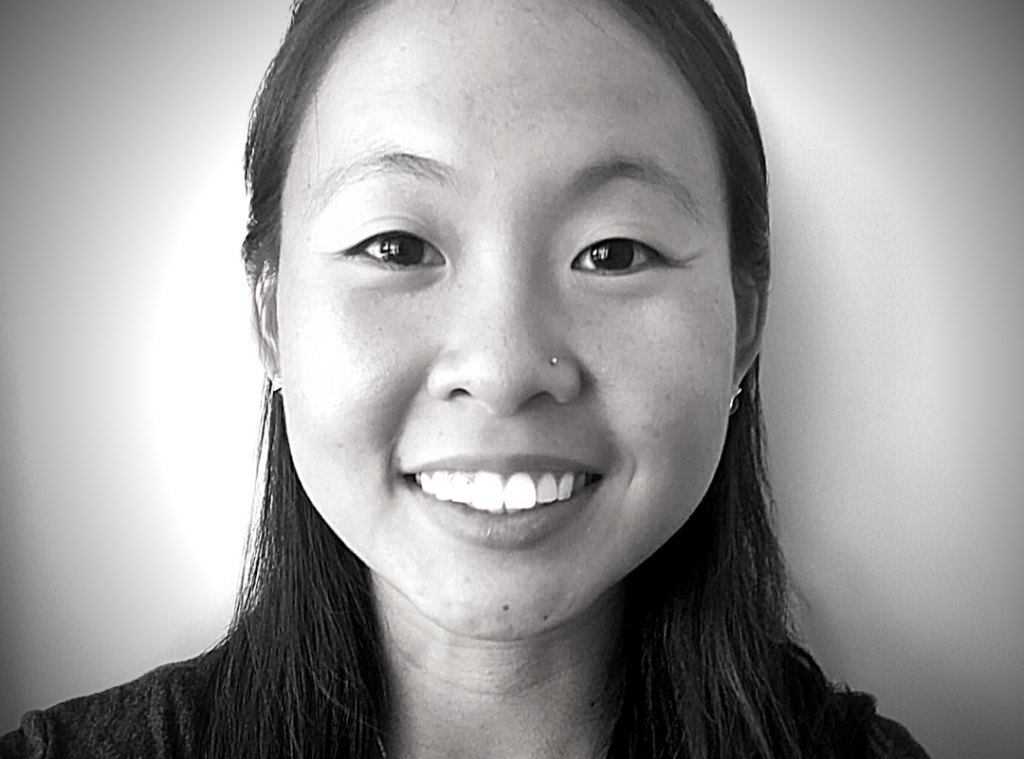
Margaret Wang is the co-founder and COO of SubjectToClimate. Previously, she was a high school social studies teacher, who loved integrating climate change in her economics, business, entrepreneurship, and history lessons. She received her teacher preparation certificate from Princeton University and her M.Ed. from Harvard Graduate School of Education.
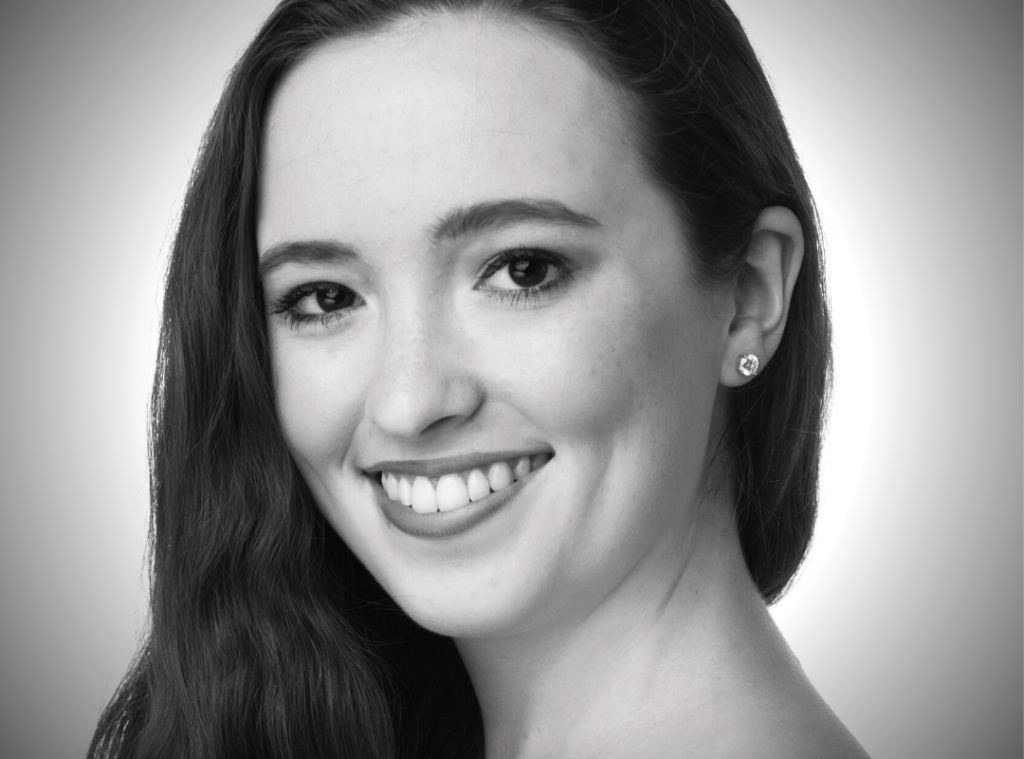
Julia Turner is a Senior Research Associate at SubjectToClimate, a nonprofit organization that provides resources to teachers looking to incorporate climate change. Julia graduated from Harvard Extension School, where she received her Bachelor of Liberal Arts with a major in Economics and a minor in English. Julia has been a research associate on numerous affordable housing and community redevelopment projects, primarily working for Carras Community Investment.
For more information, please contact [email protected]
About the Supporting Organizations:
The National Wildlife Federation is America’s largest and most trusted conservation organization, that works across the country to unite Americans from all walks of life in giving wildlife a voice. since 1936, they have fought for the conservation values that are woven into the fabric of America’s collective heritage.
New Jersey Audubon is a privately supported, not-for profit, statewide membership organization. Founded in 1897, and one of the oldest independent Audubon societies. New Jersey Audubon is committed to connecting all people with nature and stewarding the nature of today for all people of tomorrow.
New Jersey School Boards Association
The New Jersey School Boards Association (NJSBA) is a non-partisan, state-created federation of boards of education founded in 1914. It provides mandated governance training to the board of education members representing 580 public school districts and the trustees representing the majority of the state’s charter schools.
SubjectToClimate is an online connector for K-12 teachers of all subjects to find credible, unbiased, and engaging materials on climate change. Their goal is to enhance climate knowledge and inspire action by making climate change teaching and learning accessible to all.
Sustainable Jersey is a network and movement of municipalities, schools and school districts working collectively to bring about a sustainable New Jersey. Acting with state agencies, non-profit organizations, foundations, academia and industry, Sustainable Jersey researches best practices for what communities could and should do to contribute to a sustainable future.
The College of New Jersey, School of Education
Founded in 1855 as the first teacher-training school in New Jersey, and the ninth in the nation, The College of New Jersey has a long commitment to the transformative power of education. Today, the School of Education is the steward of this legacy, and continues the college’s original mandate to prepare active, informed, and self-reflective educators committed to the right of all students to learn, grow, and thrive.
The post Scaling Climate Change Education: A Case Study in New Jersey appeared first on Rethink Outside.
]]>The post The Healing, Transformative, and Rehabilitative Effects of Nature via Gardening appeared first on Rethink Outside.
]]>My given name is Lashun, although I am most commonly known as Jamala, which means proud in Swahili.
I am formerly incarcerated, having served 31 years in state prison, 15 of those years served in Pelican Bay’s security housing unit (solitary confinement). I entered prison as an 18-year-old boy. I left prison as a 49-year-old man who had served nearly every day of my adult life in a cage (prison).
Nearly every day of my childhood and as an adult has been spent surrounded by and involved in crime, drugs, gangs, and violence.
The foundation for my criminal lifestyle was formed as a child, cemented as a teenager, and built upon as I entered prison. When I entered prison there was no such thing as “rehabilitation”, prison was more akin to “criminal college”. I went to prison and became a better criminal. I became more disciplined, determined, and committed to rising within the criminal ranks.
I didn’t know it at the time, but I was searching for the things I did not have as a child-like love, acceptance, family, and approval. At 15 years old, I became a drug addict, which fueled the crime spree that would see me sentenced to 99 years to life! Yes, I was sentenced to live, grow old and die on the floor of a concrete cage. During this time (1990), California prisons did not parole lifers. Which meant lifers lived with the reality that we would die in prison. Can you imagine the helplessness and hopelessness we lived with? My actions reflected this reality, how could it not, in my mind, I had nothing to lose! I saw no value in my life, which made it impossible for me to value the lives of others. I truly became entrenched in prison politics and lost in the forest of my hopelessness. As a result of my criminal activities and suspected membership in a prison gang, I was removed from the general population and placed in solitary confinement in Pelican Bay State Union (PBSU) Security Housing Units (SHU). I was given an “Indeterminate SHU” term, which meant that I would spend the rest of my life in solitary confinement.
I remained in solitary confinement for 15 years (2000-2015). Can you imagine a space designed in the depths of the darkest hearts and minds of mankind? PBSP/SHU was designed to remove as many external stimuli as possible from the men housed there. There are no windows in the cells, there is no sunlight, grass, dirt, soil, or trees. We were intentionally separated from nature, we were deprived of the healing effects of sunshine. The irony is that PBSP is built in the middle of the Redwood National Forest, which is some of the most beautiful landscapes on the planet, while inside the walls of the SHU compound there is nothing but steel and concrete. For 15 years, I lived in this concrete tomb.
In June of 2013, the incarcerated citizens housed in solitary confinement planned and executed a massive hunger strike that quickly spread throughout the California prison system. We brought the prison system to its knees. This was the first time in all of my decades behind the walls that I witnessed the various races, gangs, and groups put aside decades of hate, violence, and mistrust to pursue a common goal, and it worked!! This would set the precedent for the “End of Hostilities” agreement that remains in effect to this day. I am proud to say that I was a part of this revolutionary movement.
How Nature Healed My Wounds
In 2015 I was released from solitary confinement. I was sent to California State Prison, Los Angeles County (CSP-LAC). I had been removed from external stimuli for so long, I was completely overwhelmed. In those first few weeks, I can recall sitting in the back of my cell with the lights out, overwhelmed by sound and movement. My once outstanding ability to connect with other human beings was gone! In solitary, social skills are unnecessary as social interaction is intentionally minimal. As the old saying goes “If you don’t use it, you will lose it”, and I did !! I could no longer relate to or even tolerate the presence of other human beings. And then it happened.
One day while standing in the dayroom (alone), I saw a signup list on the bulletin board. It was for a class called Insight Garden Program (IGP). After spending 15 years in an artificial environment surrounded by metal and concrete, I wanted nothing more than to touch soil or plant something. I had no idea what IGP was, I simply wanted to touch and feel. Little did I know this was the first step toward my “awakening”!
My reintroduction to nature would eventually teach me to feel again. That 2-hour class every Friday became my “safe space”. Greenery and good soil brought calm to the chaos that is prison. I thrived in this setting. Our group consisted of approximately 15 people. Slowly, I began to unwind and decompress as we sat in a small room discussing gardening, landscaping, nature, and life. We even had a small greenhouse, in desperate need of repair, but it was ours.
The fruit of my reintroduction to nature would form the foundation of my ability to address other core issues in my life like addiction, anger, and gangs. Without my reconnection to nature, I would never have been able to conquer those particular demons. This is at the core of the peace and tranquility that I live with today.
I am sometimes amazed when I think back to the day I signed up for IGP thinking it was simply gardening. It turned out to be my salvation. IGP used nature to assemble a group of men who taught me to think introspectively and gave me the courage and security to speak my truth. Nature in its purest form is curative. IGP reintroduced me to nature and that reintroduction fueled my transformation as a human being. There was a time in my life when many considered me cold, callous, apathetic, and violent. They would not be wrong!
As a direct result of IGP’s reintroduction and my reawakening, my life has truly come full circle.
Today, after 31 years of incarceration, I am a free man, I am finishing up my BA in Sociology and I am blessed to have the love and support of family and friends. I work for IGP as a Reentry Coordinator. What began as a job has become my calling. IGP has given me the opportunity to help others reenter society as IGP once helped me.
Who would have ever thought that a signature, a reintroduction, a reawakening, and ultimately my transformation would lead to freedom and prosperity? I help people! I am healed!!
Jamala Taylor is formerly incarcerated, having served 31 years overall and 15 years in solitary confinement as a lifer. Jamala was released in 2020. Today, he’s finishing up his BA in Sociology, working as a reentry coordinator at Insight Garden Program, and thriving in freedom.
The post The Healing, Transformative, and Rehabilitative Effects of Nature via Gardening appeared first on Rethink Outside.
]]>The post Tale of Two Community Schoolyard Projects: From Chiloquin to Tacoma appeared first on Rethink Outside.
]]>The following story provides two examples and models of successful private-public partnerships, working at the intersections of outdoor access, education, health, and equity. Written by Erin Borla (Executive Director, Roundhouse Foundation) and Fabiola Greenwalt (Program Officer, The Russell Family Foundation), these collaborations highlight how meaningful experiences outdoors improve people’s quality of life, health and social wellbeing, and in turn, their communities become stronger and more sustainable.
During the last two years of the COVID-19 pandemic, there has been an increased demand for the outdoors and green spaces. However, not everyone is lucky to have access to green spaces that bring joy, and opportunities to destress, play, and be in the community.
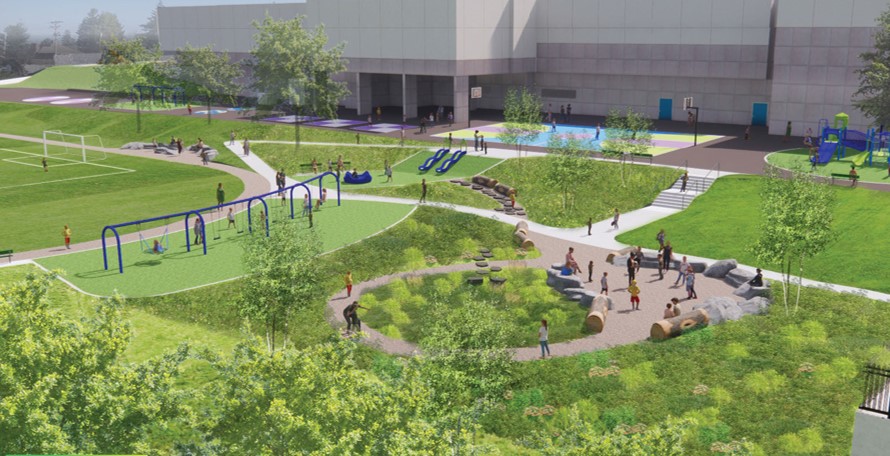
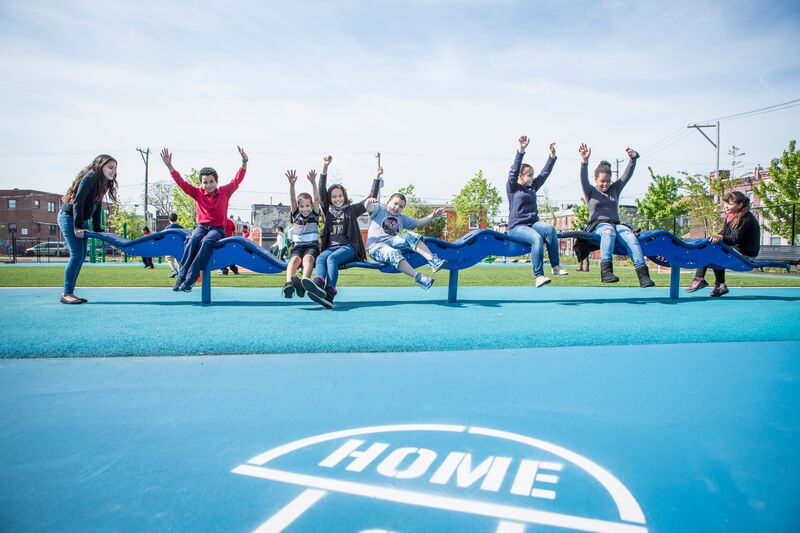
Trust for Public Land (TPL) is working across many cities and towns in the United States to redevelop schoolyards to better serve students during learning hours and transform them into accessible parks after school. TPL’s long-term vision is to make community schoolyards a standard practice, serving as a hub for community empowerment, improved health and education, and climate resiliency. Not every community has a park, but nearly every community has a school on land that the public already owns. Transforming schoolyards into shared public parks is a common-sense, cost-effective solution to America’s park equity problem.
Here are the stories of two places in the Pacific Northwest (Oregon and Washington), both rural and metro, where TPL and community partners are developing new community schoolyards.
Chiloquin Schoolyard Project
Roundhouse Foundation was introduced to TPL and the Chiloquin Schoolyard Project in late 2020.
With the support of the Klamath Tribes, residents, and the school district, the schoolyard at the local elementary in rural Chiloquin, Oregon, population 710, is being redeveloped into a green schoolyard and community gathering space. The community’s goal with this project is to promote community building, healing, and health by transforming the 8 acres into a vibrant space representative of the people, place, and culture of Chiloquin.
Chiloquin sits just north of the California-Oregon border outside of Klamath Falls. This once booming community originally served as the heart of The Klamath Tribes (Klamath, Modoc, Yahooskin). It has a history of inequities including the termination of Tribes in 1954 where their federal recognition was lost, leading to the condemnation of their 1.8-million-acre reservation. In 1991, the mill at the heart of Chiloquin was closed, leading to increased challenges for the community.
Despite living amongst the towering ponderosa pines at the merger of the Sprague and Williamson rivers, Chiloquin residents today have challenges accessing parks and locations to gather, play, and connect. Through the connection with TPL and their community building process, the reimagined schoolyard broke ground with a blessing from Klamath Tribal Chairman, Don Gentry, in late 2021.


The new schoolyard includes a fantastic mural created by artist Len Wilder, a 1965 graduate of Chiloquin High School, that livens up the space and reflects the student-selected theme – Chiloquin past, present, and future. The renovated schoolyard includes an impressive pole barn that will provide cover for the new basketball court. The grand opening celebration is planned for late August 2022 in conjunction with The Klamath Tribes’ annual Restoration Celebration event.
Rural and frontier communities are often located amongst the trees with seemingly consistent access to outdoor spaces. he reality is, barriers to accessing these spaces exist for all communities. Roundhouse Foundation (Sisters, OR) recognizes the need for access to close-to-home nature across the spectrum and supported a lead gift to TPL’s new program, building on the learning from the Chiloquin Schoolyard Project, which will support three additional, high-need communities in rural Oregon.
Programs like the community schoolyard projects are indicative of the spirit of rural and frontier communities – but the connections, opportunities, and financial support for projects like these are so often reserved for more metropolitan spaces. Roundhouse Foundation Trustees and staff were honored to help make rural communities a priority for this work.
The near-term goal is to redevelop three schoolyards to serve students and provide community parks outside of school hours. Long-term, this is an opportunity to develop a case study to drive changes to how capital funding is allocated and increase investments in schools serving rural communities while providing a model for partnerships and collaboration to maximize the community impact of these projects.
To select the next project locations, TPL has developed criteria for identifying communities of greatest need in Oregon’s rural and frontier areas. TPL will apply a prioritization framework using metrics for health, education, and equity. Project prioritization will align with TPL’s National Community Schoolyards Program, and be tailored to local needs and opportunities in rural Oregon. TPL will use these and other research tools to determine where investment would make the most significant impact on the lives of underserved populations while setting the stage for more systemic change in the state. The Schoolyards Program will give special consideration to school districts serving Native American communities.
The success of the Oregon Schoolyards Program depends on having strong local relationships and effective community organizers. In Chiloquin, TPL’s partners include Oregon Health and Outdoors, the Ford Family Foundation’s network of Field Coordinators, and the Oregon Community Foundation’s program staff. With the new program, TPL will collaborate with partners and community leaders to identify communities that would benefit the most from the Community Schoolyards program.
Kristin Kovalik, TPL’s Oregon Director said that Roundhouse Foundation’s investment in the Oregon Community Schoolyards program has enabled TPL to take on an ambitious effort to revitalize and reimagine schoolyards in three new rural Oregon communities. Longer-term, they believe this work can shift how schoolyards are viewed across the region and build a case for increasing state funding for improvements to school grounds in rural communities.
Tacoma Community Schoolyard Projects
Located in the South Puget Sound region, Tacoma has the largest park access gap of any major city in Washington. In Tacoma’s Eastside and South End neighborhoods, one in three residents does not have a high-quality park close to home and residents have some of the state’s lowest life expectancies and higher rates of obesity, asthma, and heart disease. All told, 65,000 people do not live within a 10-minute walk of a park. Approximately five years ago, TPL started to work with communities in the Eastside of Tacoma to explore the potential of developing green and community-centric schoolyards to expand park access.
The Russell Family Foundation has been pleased to support TPL’s Tacoma Community Schoolyard projects since 2018 through grants from its Puget Sound Program. The focus of the Puget Sound Program was to help reduce the amount of runoff entering Puget Sound waters, which is the number one cause of pollution in our region. From the smallest creek to raging rivers to the Salish Sea and beyond, our region’s waterways have long supplied our people with a most basic need – water. So, protecting our waterways is vital for the vibrancy of the region’s current communities and future generations. Green schoolyards provide a great opportunity to stop polluted water from entering the Puget Sound and TPL is leading the change by creating community schoolyards that incorporate green infrastructure that boosts climate resilience.
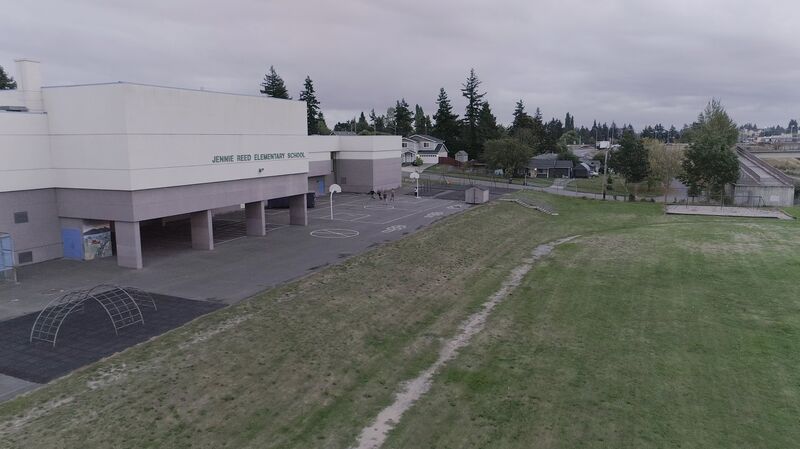
TPL has been working in partnership with Metro Parks Tacoma and Tacoma Public Schools to renovate five pilot schoolyards that will all be open by 2023 as part of their game-changing solution to America’s park equity problem and that support climate resilience by capturing tens of thousands of gallons of stormwater runoff. This partnership will provide more than 40,000 residents access to new local green spaces. A key component of these projects is to ensure that these spaces are open not only to the students at the five schools but to their families and other community members that live within a 10-minute walk.
The process of developing these schoolyards starts with community engagement and more specifically, student engagement in the classrooms with students taking the lead to design the schoolyard. Student ideas and designs incorporate the goals of the teachers, fellow students, and the greater community while addressing local climate challenges and adhering to a budget.

Sarneshea Evans, TPL’s Northwest Parks for People Director said their team enjoyed working closely with the students at each of these five pilot schools and with local community members and groups to develop their vision for what is possible in their new community schoolyard. New amenities such as running tracks and walking paths, basketball courts, outdoor classrooms, and more trees will make a big difference to residents and ensure they have a great new community gathering space.
To learn more about the program, you might enjoy this 3-minute video or the Tacoma Schoolyards program page on TPL’s website.
Opportunity to Learn More
If you’d like to learn more about the power and potential of schoolyards nationwide, you might enjoy TPL’s recent special report: “Community Schoolyards Projects: A game-changing solution to America’s park equity problem.”
Also please feel free to contact [email protected] to learn more about their Community Schoolyards projects across the United States.
The post Tale of Two Community Schoolyard Projects: From Chiloquin to Tacoma appeared first on Rethink Outside.
]]>The post On the Rio Verde appeared first on Rethink Outside.
]]> Storyteller Leeanna Torres’ experience on the Green River in 2021, which was supported by the FreeFlow Institute and American Rivers.
[On the Green River, Colorado River Basin, Gates of Lodore Canyon near Vernal UT, 2021]
Floating on Tyler’s raft, we ask him endless questions about geology, place names, his guiding company. As he rows us through this rio named Verde (Green), I notice his scruffy flip-flops and faded PFD, once cherry-red, now bleached into a soft maroon by years of river-sun.
It had been nearly 14 years since I’d been on a raft, and I’d never been on the well-known Green River, near Vernal, Utah.
“Morgan formation…Lodore Sandstone…” Tyler gives names to the rocks, and we listen. Some of us take notes. We ask more questions. And he is generous with his answers, and I think about the constant small talk – river guides must not only endure, but initiate, much like dental hygienists, maybe, awkward yet necessary. How many times has he retold his story, or endless facts, to strangers, rowing them down this river he calls home?
I think of my own experience, how it began not as an adventurous river guide, but a river worker, a grunt, a wanna-be-fishery-biologist, and how small-talk did not exist in this world, nor was it necessary. No lengthy or generous or even awkward conversations. Instead, imagine the constant white noise rumbling of a generator at the back of the raft, one person rowing, the other netting atop a metal deck. No small talk, just work. No time to look up at the canyon walls, keep your eyes on the water, hands on the net, look for fish. Then net them up, one by one, and into the metal live-well. A two-man job for mile after river mile.
I used to catch fish and take notes. Net and row, take measurements, and at night, drink. All of this with salty men, teaching me as much as making me prove I was worthy enough to be there. But here I am now, a full decade removed, floating for “pleasure” rather than work, not really knowing how to exist in this kind of space. Without scheduled tasks and to-do’s, who am I on this river? Tyler the river guide rows, makes it look easy, and “clients” lounge easily at the front of the raft, easing into blue.
FreeFlow Institute, a Montana-based collaborative company/organization, claims to offer “wilderness arts workshops” including seminars, workshops, and adventures for creative people in Earth’s wildest classrooms.
“By offering intelligently structured, professionally catered trips into wild spaces, FreeFlow Institute affords established and emerging writers, artists, and leaders the time, community, and inspiration to take their practice outside and build creative cohorts of advocates for thoughtful, strategic environmental preservation.”
When I first heard about this company, I quickly searched for their website, but then disappointingly saw the high price tag for the river trips they were offering. I couldn’t afford such a “craft-based-adventure”. The only “adventure” I knew at that point was through work, not recreation, nor leisure, nor learning. In my childhood, nor even early adult-hood, my upbringing did not make space for such formalities as “recreation”. On Papa’s farm/ranch we worked, and when I emerged from college, I worked some more, introduced to rivers in this way. Not through recreation. But when the FreeFlow Institute began offering “Emerging Writers Scholarships”, I knew I had to try. Something urged me to try. (https://freeflowinstitute.com/ )
It’s one thing to “try”, to put effort out into the world. I’d been doing so for years, trying to build a writing life for myself by literary submission here and there, here and there, rejection after rejection. But this time, yes this time, someone/something had given me a chance.
“…We are thrilled to offer you the 2021 Southwest Emerging Artists Scholarship. We hope that the Gates of Lodore Workshop will help you bring your Gila project to fruition, expand your community of writers, and increase your capacity as an advocate for wild rivers.” Explained the acceptance email from FreeFlow Institute and American Rivers(org).
In essence, there ARE organizations out there intentionally “creating equitable outdoor experiences” for people of color and/or from marginalized populations.
There are groups making beautiful spaces for us.

Women on the raft crack open a beer in Echo Park, just as we reach the confluence. Nicole chooses a PBR, T. a Sierra Nevada Ale. And me, I choose only water, the thin-blue-plastic strap, connecting the lid to my Nalgene bottle – broken – but I’ve replaced it with a piece of Papa’s echete. This orange strand left-over from a used bale of hay, borrowed from Papa’s stash in the cochera. This string – echete taken from my home in Nueve Mexico, mi querencia – holds lid to water bottle, its bright orange out of place, out of context, but strong.
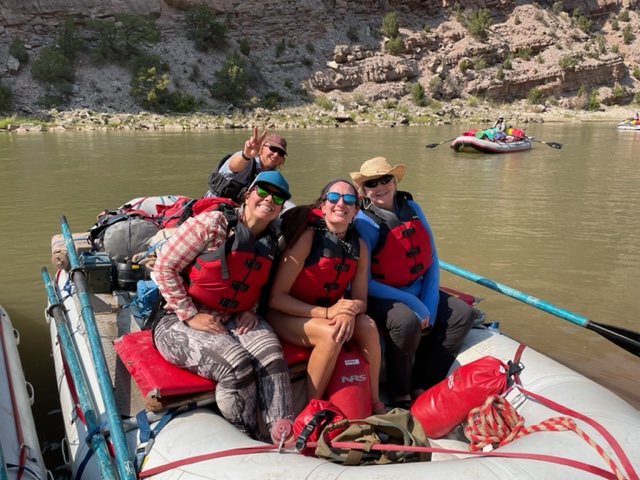
At the confluence of the Green and Yampa rivers, our eyes spot a heron. And as the rafts float by, the river guides intentionally slow at this point, their movement of pause indicating importance.
The heron flies away, and T. takes another sip from her beer, and they both seem to lean into daylight with such ease that it makes a part of me achy, angry. Or maybe not angry, but something else I don’t yet have a name for.
I crouch down in the raft, reach my arm up and over the side, and greet the Yampa River with this small gesture.
Quien somos aqui? Who are we in this place, this space, this journey down the Green River?
*
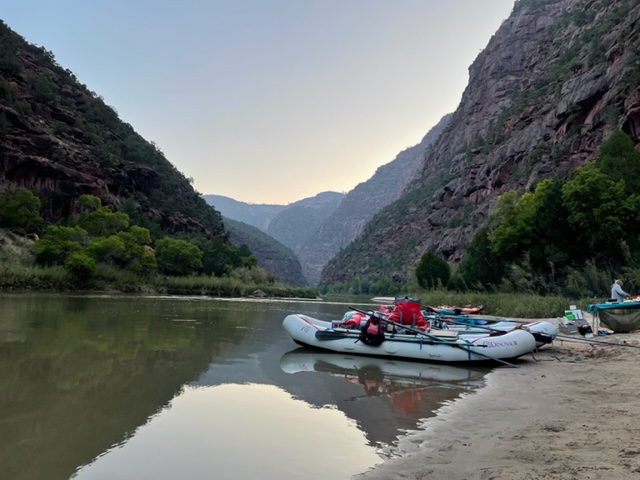
During lunch on the third day of the trip, I observe as T. drifts off over to the farthest shore and sits in a way that I’d guess she’s meditating. Chandra and Ashley sit in the sun, bathing their torsos, browning as they wear only shorts and sports bras. And still, T. mediates, a small figure in the distance, flanked by the green of cottonwoods below the canyon wall, then sky. She is so small in this monumental back-drop, and yet, her pose graciously asks for attention. She is small in this landscape. Meditating, seated in the sand, she keeps her back to the sun. A therapist from Vermont who is taking time away from clients in the recent wake of her father’s death. A woman flanked by deep geologic time. And it is nearly time for lunch.
*“How can we make the general public want to save wild places?” asked Chandra Brown, founder and director of Freeflow Institute, and my scribbled response in a small field notebook goes something like this; “Do the work that’s assigned to you, do the work, whatever form that work might take – write the article, make the podcast, share the experience with your Tia or prima at the dinner table – but just DO your own work…that’s all you can do…”
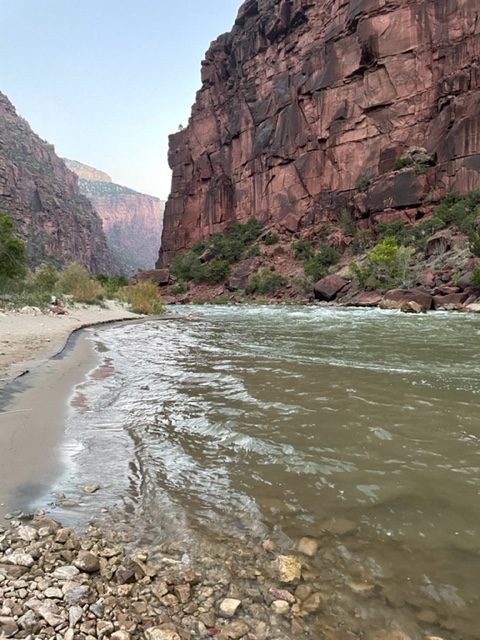
Watch the little merganser (duck) allow his little body easily approaching the rapids. The top of his head with feathers-all-a-mess, like the little kid who hasn’t combed his hair, wild, disobedient, or maybe just careless. Why doesn’t this little duck just fly over the rushing water rapids? Instead, he floats into the turbulent water letting the rapids appear, allowing the moving chaos of water take him quite easily, and he bobs, up and down, up and down, until he’s down-river and out of sight.
*
On our last evening on the river, during what Chandra called “the Magic Hour” (twilight), two beavers made an appearance on the shoreline across from camp. Watched them eat grass, then slowly enter the water, un-disturbed by our presence. Then they swam away. About 10 minutes after this, two deer, like ghosts coming off shoreline and into the water. A buck and a doe. They remained in the water until twilight darkened, one scarcely seen drifting back onto land, the other still in the water until it was too dark to make out even his shadow.
That night I slept without a tent. My rental sleeping bag – a Marrmott “Sorcerer S.R.” with a deep Army green body, black interior, and lime green strip along the zipper line – wasn’t warm enough for the last night outside of the canyon. Tyler had warned us that without the protection of the high canyon walls we’d experienced thus far, it would get cold. And he was right. And so my tiny shivering body buckled and tightened inside the green Marmott sleeping bag, the galaxies revealing themselves across the kettle-black sky. And then strange dreams again; my Tio Max in the dream this time, and a morning sky revealed the constellations Orion and my favorite, the Seven Sisters.
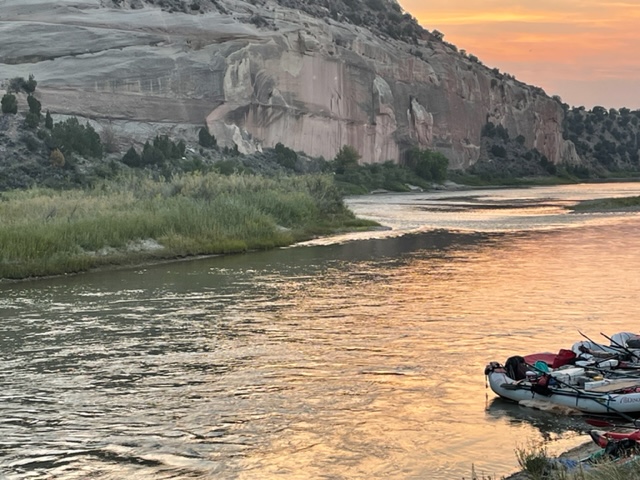
We are so often (maybe too often) looking for answers, looking for the key, looking for ways to make it all right, to save, to keep, to protect. But what a weight, and I watch the semi-glassy eyes of the two youngest river guides, the truth found in the way they slouch into the sand so easily, knowing just then, that all they want is a beer. We can’t make people care or change. We can only share our experience of a place, invite them in. A red cooler sits in the center of our group circle as we write, and we linger over the power of place as the river runs freely in the very space where there would have been, nearly was, a dam.
*

Jacobe the river-guide keeps his plastic bottle of “Old Crow” whiskey in the interior of the NRS “strap” bag to his left of this throne at the oars. “It’s actually pretty good cheap whiskey,” is his response when I ask him about the brand. And I imagine how snug and comfy that bottle must rest, cradled and hugged against the mess of blue-ribboned NRS straps of all sizes; a hard liquor, liquid-honey-brown against straps size length 6,3,9,12, and maybe even 2 and 14 feet.
We pass big-horn sheep grazing on river-left, eleven females grazing, while a lone, single ram, lays in the grass. And I snap a photo of Jacobe’s whiskey in the strap bag, not sure why. The eleven female rams grazing near the water’s edge, their white rumps distinct on their bodies in this bright sun.
*
FreeFlow Institute and American Rivers made it possible, and continues to make it possible for someone like me to experience an epic journey on the Green River. By offering FULL TUITION scholarships to ‘emerging’ writers and/or artists from the Southwest (including NM, AZ, CO, or UT), these well intended groups are putting actual funding efforts into promoting and inviting more participation by communities or groups often left in the margins. For example, the annual scholarships intentionally invite BIPOC applicants.

It is organizations such as these – FreeFlow Institute & American Rivers – that are intentionally and carefully making space for other narratives. I experienced it myself, and am a better person because of it.
The opportunity they provided was a chance to experience a river simply as joy and newness and recreation, rather than work, the only way I’d ever known. These organizations provided the opportunity of experience, simply experience.
So how will I now pass it on? By writing and sharing, by expanding the circle, by exploring the rio in all its forms.
*

Between Triplets Falls rapids and Hell’s Half Mile I watch Chandra move through the water in her kayak. Black helmet, no sunglasses, and a blue-body-grey sleeve kayak dry top jacket. Kayak colored a bright (but sun-worn) turquoise; and room for a bit of pink at the top front of the craft, something typical for the Dagger-brand kayak perhaps. While paddling, she is straight-backed and solid, confident like a samurai, but also so curious, cautious, and respectful of the water and rapids. In her kayak her posture and form perfected, her double-grip on the black paddle tight and solid when running through rapids, loose and soft in the slower water. After making it thru Hell’s Half Mile, and just past the rock named “Lucifer”, she quickly maneuvers herself behind a rock, an eddy, just below the rapid, then waits there and watches, her turquoise craft bobbing lightly in the wake behind the massive rock, and she waits, watches, ensuring all three of the ladies in the inflatable kayaks make it through the rapids safely.
“Is this your first time kayaking Lodore?” [me]
“Yeah, it is. This is actually also only my second time here on this river…the first time was in 2019 with Freeflow’s course with Pam Houston.” [Chandra]
“So you didn’t have your kayak on that trip?” [me]
“No, I didn’t. I was a passenger. It’s hard for me being a passenger…Also being on a kayak, you get to experience the river very differently…it’s much more intimate…” [Chandra]
Chandra Brown’s FreeFlow institute is a LEADER in what it means to make space for marginalized groups/people in recreation. “It’s hard for me being a passenger,” she admitted to me during a sandbar conversation on the Rio Verde, and so I realize now, many months after this adventurous trip, her intent then is to be a leader, to make that space, to grant experiences to those of us who would not otherwise ever have them.

Our last night on the river, I noticed Tyler, the elder river guide, was the only staff member who did NOT follow the rest of the river guide’s time-honored tradition – to dress up silly or wild or flamboyant. Instead, he remained in his usual, casual, ever dependable river-uniform: quick-dry shorts, sandals, quick dry t shirt, and a ballcap. By far, he was the oldest river guide on the trip. I wondered how many miles he’d put in, all these years, all those long river miles. As twilight approached, his demeanor remained calm, approachable, but reserved and quiet, unless asked a question. He seemed to know and honor the wordlessness of the river space – an ecosystem driven and given life by one main element – water.
Agua.
In my beloved home, the desert Southwest, water is more than life – it is sacred. Sagrado.
During what Chandra named/called “The Magic Hour” (twilight), two beavers made an appearance on the shoreline across from camp. Watched them eat grass, then slowly enter the water, undisturbed by our presence. Then they swam away. Soon after, two deer, like ghosts coming off from the bank-shoreline, made their way into the water, into the river. A buck and a doe. And we watched the animals wade in the water, up to their bellies, watching them until it became too dark to see them.
I used to catch fish and take notes. Net and row, take measurements, and at night, drink. All of this with salty-men, teaching me as much as making me prove I was worthy enough to be there.
But here now, on the Green River, I was learning – very differently, but always the same – the sacredness of water, redefining my own relationship to rivers and water.
*
Our last day, our last river-mile on the Green river, it isn’t Tyler the river guide I float with, yet still, I watch him in the raft behind ours. I crouch down in the raft, reach my arm up and over the side, touching the water with such a small gesture I hope no one else sees.
I think back to the men who introduced me to rivers – their persistent stubbornness, showing me where to find fish, the read of riffle-pool-runs. All science, no nonsense.
And then there is Tyler, the lead river runner, showing strangers the heart of a river.
“My grandfather was a river-guide too” explains Tyer, straight backed and rowing, his voice laced with unabashed pride, easy and calm. What he offers is generous, genuine, and I offer him nothing back except my lazy presence on this raft. And his hands on the black oars, a grip as old as stone itself.
THE END.

Leeanna T. Torres (she/her) is a native daughter of the American Southwest, a Nuevomexicana who has worked as an environmental professional throughout the West since 2001. Her essays have appeared in publications including Blue Mesa Review, Tupelo Quarterly, Eastern Iowa Review, Minding Nature, High Country News, Ofrenda Magazine, High Desert Journal, and Ruminate Magazine. More recently, she has an essay in Torrey House Press First & Wildest; The Gila Wilderness at 100 (2022) anthology. She is also currently at work on a creative-non-fiction book manuscript centered-on landscape, culture & querencia.
The post On the Rio Verde appeared first on Rethink Outside.
]]>The post The Places That Shape Us appeared first on Rethink Outside.
]]>At first, it was our backyard, where the sunshine met the swingset. I gripped the metal once, only to find a wasp that stung. After that, I learned to look before I touched when I was outside. Gradually, it became the sidewalk in the front yard. When I played in the back the boys across the alley would shout at me, making fun of my pigeon-toed gait that ballet hadn’t yet fixed.
The front was different. I was warned about safety and only allowed to ride my bike 3 houses down. I would ride slowly, so I could snake around the cracks in the sidewalk that made it harder to bike past house 3 anyway, even if my mom wasn’t looking. Maybe that’s why biking in a straight line is hard for me now. Why I’m afraid of biking in the city.
As we grew, we started to visit places – both far away and nearby. Sometimes there would be a field trip to a park. My mom took our girl scout troop to the nature preserve a few times. I remember following the naturalist’s footsteps and looking at what she pointed out with curiosity. If we were lucky, we’d go on a short drive to the beach. A few times we’d visit family in Texas – the beaches were much different than those of Indiana. The ground at my grandpa’s had less grass, more sand, and more things that poked than what I was used to at home.

At some point, we moved to a town not too far away. The people were different there though, and it was cool to go to the beach. At first, I only went with friends who wanted to sunbathe or climb the dunes. As a teenager learning how to navigate depression, I learned that nothing softened the voices inside my head quite like the sound of waves hitting the shoreline. As I sat I noticed how the sand felt under my fingertips, how it looked in the distance coming up against the water. Many times I’d visit the lake and look at the Chicago skyline in front of me or the stars up above. I’d often stare at the cottonwoods trembling in the wind behind me, the marram grass along the dune ridges, and the smokestacks from the steel mills in the distance.
I’ve been searching for the comfort I felt at the Dunes ever since I left home. During my time as an undergrad student I felt lost in the people and experiences around me, it was hard to go outside beyond sitting on a friend’s porch or reading in the campus arboretum. As part of a class in grad school, I visited a wetland that I returned to over and over again because the sound of the frogs gave me peace. I found solace in connecting with plants whose names I learned over the years – and when the sun shined on my baseball cap as I walked the boardwalk.
I’m better at finding those spaces now, the ones that help me feel grounded in myself and my community. It only took me four months when I moved to D.C. to find a place that gave me the plants, sky, and sound of water I need to keep visiting. Of course, the skies aren’t so starry and the streets aren’t so quiet, and perhaps no space will ever be as soothing to me as the Indiana Dunes – but I can always go home.
Kasandra Richardson (she/her) is a queer, mixed-race Chicana, environmental and reproductive justice advocate, and amateur botanist. She works as the Equity and Justice Communications Manager at National Wildlife Federation. (email: [email protected])
The post The Places That Shape Us appeared first on Rethink Outside.
]]>The post Abolitionist Environmental and Place-Based Education appeared first on Rethink Outside.
]]>Abolitionist Environmental and Place-Based Education
Providing environmental and place-based education in K-12 schools can be challenging, and doing so with a focus on justice and equity is even more so. Researchers Scott Morrison and Dani Toma-Harrold reconsider ways in which environmental and place-based education can be a form of what Bettina Love calls abolitionist teaching. In the blog post below, Scott and Dani share how all educators — especially classroom teachers — can Rethink Outside in ways that dismantle harmful practices and offer healing and restoration.
For the past few months, we have been interviewing self-identified justice-oriented environmental and place-based educators across the United States. They include classroom teachers, farm and garden educators, food justice advocates, and community organizers. We have asked them to share their approaches to curriculum and instruction, to reflect on the ways they integrate nature and place, and to describe the ways that their work could be considered antiracist. What we are learning from these interviews is that “getting outside” has layers of meaning, and that there is potential for environmental and place-based education to contribute to what Bettina Love calls abolitionist teaching. That is, “getting outside” might be one way to dismantle educational policies and practices that cause harm and move toward restoration and healing.
Worldwide attention on racial injustice, systemic inequality, and white supremacy has increased in recent years. The murders of Ahmaud Arbery, George Floyd, Breonna Taylor, and so many other Black Americans prompted calls for change, like defunding police and removing resource officers from schools in favor of more mental health and counseling services. Countless organizations, programs, and schools showed their solidarity with the #BlackLivesMatter movement with statements posted on websites and social media, and many expressed explicit commitments to equity and antiracism. The American Psychological Association, for example, acknowledged the need to dismantle racism in its field. Likewise, we have been reflecting on the history and presence of racism in education broadly and in environmental and place-based education in particular.
Generally, environmental and place-based education tends to be dominated by white voices and their concerns (Stapleton, 2020). When whiteness is the norm, detecting and eliminating implicit bias, microaggressions, and cultural incompetence is more challenging. As Dillard (2019) explains, whiteness can function as a weapon that targets Black and Brown students in schools. For example, Black and Brown students are often expected to dismiss their home cultures and conform to white norms as a means of survival. If not, they face considerably harsher punishments than their white peers for similar or smaller infractions. Curriculum violence and standardized tests (see Kendi, 2016) can also be sources of racialized trauma and emotional harm.
While there have been many attempts to improve access to quality education and produce more equitable outcomes for all students, from charter schools to positive behavior systems to technology integration, there has been little meaningful change. Research has shown for decades that race is salient in both environmentalism and education. Culturally relevant pedagogy is a theoretical framework for equity that has helped Black and Brown students leverage their home cultures as assets and therefore thrive in academic settings (Ladson-Billings, 1995). Unfortunately, too many educators struggle with being culturally relevant, which makes sense because the education system was not designed to be so (Spring, 2016). Moreover, without acknowledging the socio-political aspects of curriculum, instruction, and assessment, schools will not be able to address the presence and power of white supremacy (see Ladson-Billings, 2021).
In her 2019 book entitled We Want to Do More Than Survive: Abolitionist Teaching and the Pursuit of Educational Freedom, Bettina Love proposes abolitionist teaching as a possible remedy for the root causes of inequities in education. Abolitionist teaching is a response to the educational survival complex — the myriad ways that schools rob students of color of their humanity and prepare them for lives of exhaustion and trauma. Abolitionist teaching works to challenge and dismantle white supremacy in schools by eliminating zero-tolerance policies in favor of restorative justice, integrating students’ cultural and community knowledge into curriculum (see Yosso, 2005), and ensuring all students have ample opportunities to move and play. Abolitionist teaching is about making schools humane and welcoming and empowering for everyone.
In our research study so far, we are seeing some intersections between abolitionist teaching and environmental and place-based education. Getting students outside of classrooms and schools and connected with nature, land, people, and communities can push back against oppressive norms and practices. To date, we have interviewed about 20 people and have over 60 more to be scheduled. We have been recruiting participants via email and social media, and we are especially interested in talking to more Black, Indigenous, Latinx, and people of color involved in environmental and place-based education broadly defined. Data collection will continue for the next few months. Here is a link for anyone interested in being interviewed: https://bit.ly/antiracistEE2021.
Our preliminary analysis of the data shows some common themes, which we hope illuminates what abolitionist environmental and place-based education can look like.
- Everyday, everywhere — We interviewed people who came from completely different backgrounds and experiences, and all had unique ways of utilizing nature and place in their work on a daily basis. Regardless, all were able to offer rich educational opportunities for students. This is happening across regions, ages, and programs.
- Intentionality — Although there might be unintentional antiracist benefits of getting outside, like experiencing the mental and physical effects from being in nature, some of our participants expressed concern surrounding what may happen (and what has happened) when educators are not intentional about centering antiracism. One person mentioned that going outside in nature isn’t necessarily anti-racist because white supremacy does not disappear outside; it has to be intentionally dismantled wherever you are.
- Reclaiming space — Race shapes our connections to land. Many of the Black participants have talked about reconnecting with nature as a means of reclaiming space that was once unavailable to them or primarily a place of oppression. Nature can be very restorative, but it is complicated at the same time. For our Black participants, just being in nature and reclaiming space was anti-racist.
- Community expertise — Tapping into community expertise is a way of shifting who traditionally has knowledge and what knowledge is most valued. One participant, a classroom teacher, seeks out people in the community to serve as co-teachers during every unit of study. Others find ways to learn about students’ and families’ cultures, interests, needs, and brilliance. Integrating local history and current issues keeps students engaged and rooted in place.
- Mattering — All participants shared that student mattering was one of their main goals. Love (2019) describes mattering as feeling valued, appreciated, and safe. Connecting students and their community cultivates a more authentic context for learning.
- Curricular exploration and inquiry — Co-teaching and co-creating with students also helps tap into the expertise and passion that all students possess (see Emdin, 2016). By not putting limitations on students, they can deviate, make mistakes, and be curious. A few of our participants use walks to explore local areas with students, and their inquiries on their walks are starting points for further curricular exploration.
- Centering Black joy and genius — All of our participants mentioned something about centering Black joy and genius and not merely teaching about oppression and trauma. One participant emphasized the importance of Black students seeing themselves in the curriculum and for all students to notice the joy and genius of Black people in their community.
- Skill development — Most participants talked about the value in teaching specific skills, whether academic or social or related to citizenship and activism. Some participants mentioned literacy and numeracy skills that can be taught using gardens, while others alluded to science knowledge, ecological awareness, agricultural practices, and political organizing.
In addition to interviews, we plan to conduct a few visits with educators doing antiracist and abolitionist environmental and place-based education to observe what they are doing, what is working well, and what others can learn from them. Our hunch is that environmental and place-based education might help create “a vision for what schools will be when the educational survival complex is destroyed” (Love, 2019, p. 89). Please share this link with anyone who may be a good interviewee for our study. If you’d like to learn more about this research project, feel free to reach out.


Scott Morrison, Ph.D. spent 11 years as a 6th grade English and social studies teacher in Blowing Rock, North Carolina. His research focuses on ecologically minded teaching, everyday environmental education, and the uses of social media in teacher education. Scott joined the faculty of Elon University in August 2013. (email: [email protected]).
Dani Toma-Harrold is an undergraduate student at Elon University studying elementary education with minors in African and African American studies and environmental education. She is originally from Atlanta, GA. (email: [email protected]).
The post Abolitionist Environmental and Place-Based Education appeared first on Rethink Outside.
]]>The post Connecting Military Families and the Outdoors appeared first on Rethink Outside.
]]>Connecting Military Families and the Outdoors
The following story is written by Nicole Rawlinson, a Blue Star Families DEPLOY Fellow and 2021 Rethink Outside Fellow. In her roles, Nicole works to connect military families and people of color with the outdoors.
Every year, 600,000 military families pack up their entire lives into shipping crates, moving trucks, or storage pods and relocate to another part of the country, or even another part of the world. We call it PCS season. Permanent Change of Station — except it isn’t ever permanent. Most military families will find themselves relocating every 2 to 5 years. They are sent where the needs of the military require, not to places of their choosing.
The resilience of military families is extraordinary — just like the extraordinary resilience of nature. Military families have so much in common with the land and nature all around us. We lose our leaves and grow new ones, we find soil to set our roots down, even in difficult environments to grow, we experience our lives in seasons and learn to thrive in each of them.
I know this because I live this life. As a military spouse, I have uprooted my family seven times in the last ten years — but every time we land in a new place, with new surroundings, we take root in that soil and find a way to grow. I remember the first time we moved across the country as a young couple with a baby and just the beginnings of a set of household goods. As we drove across the interstate, we took detours to survey the land that my husband swore an oath to protect and that I was proud to call my home. We explored the national treasures cared for by the National Park Service and found connection, comfort, and stability in knowing there was an abundance of natural resources to experience and explore as we continued on our journey of military life and moves.
In our world full of change, our constant, as a family has been our connection to the outdoors. In every place we have lived we created opportunities to spend time outdoors together to connect with the land, reconnect with each other, and develop bonds within the community. I found my space and my sense of place hiking in the Olympics in western Washington, digging my toes in the sand of the Atlantic Ocean in Newport, Rhode Island, and paddle boarding down the Occoquan River in northern Virginia. I feel so fortunate to have found that sense of stability and consistency for my family, and I want to invite more military families to also feel that sense of belonging, welcoming, and consistency when they arrive in a new community and can look to the outdoors as a place of respite and wellness.
At Blue Star Families, I have the opportunity to engage in this essential work of developing opportunities and creating space for families to connect with each other and their communities in outdoor spaces. I understand that advancing toward a more equitable experience in the outdoors will require putting in work, learning about the history of exclusion in outdoor spaces, and proactively approaching our work from a place of recognition, empathy, and inclusion. I was honored to support the development of a curriculum around the lack of representation, history of exclusion, and structural racism that has created barriers to equitably accessing and enjoying public lands and outdoor spaces, which is being delivered to our program facilitators and fellows across the organization. I have also had the opportunity to acknowledge and highlight people of color as leaders and experts in the outdoors as we develop our program offerings.
Through my work at Blue Star Families this year, I will deliver a year-long cohort-based program of outdoor adventures along with opportunities for connection and education to 100 families across the country that represent a broad spectrum of our diverse and vibrant population of military families. I hope that each family finds a space, a connection, and a continued sense of belonging in the outdoors as a result of this program. I want to ensure military families of color are not only informed of the outdoor opportunities we provide, but invited into a community of outdoor explorers through thoughtful approaches to recruitment and encouragement to participate. It is the reflection of a personal commitment I have made to the communities with whom I share parts of my own identity and is why I do the work I do. I’m working to be the invitation to the outdoors, personified, to military families who have never been invited, or who haven’t seen themselves represented in the outdoor narrative. I want to help other families shape their connections and stories while introducing them to spaces that have been carved out for all of humanity and look to welcome them with open arms.
With all we have in common with nature — our resilience, our strength, and our collective diverse beauty — we all deserve a personal connection to it and all the outdoors have to offer.
Get to Know Nicole

My name is Nicole Rawlinson. I am a mother, daughter, spouse, sister, friend and colleague. My roots were shaped all over the globe by my ancestors of African, Caribbean, Icelandic and Romanian heritage. I am connected to many places that I have called home, and I have found that my connection to the outdoors has been shaped by each and every one of those places. Professionally, I have the honor to work with military families at Blue Star Families, an organization dedicated to supporting families as they navigate military life and finding connections to combat the feelings of isolation that come with constant moves to new communities. My position at Blue Star Families is one of the first of its kind. I am a DEPLOY (Diversify and Expand the Pipeline of Leaders Of Your military community) Fellow. As a cohort of eleven women of color, we collectively advance the initiative of Racial Equity and Inclusion within the organization, and within the military family experience. I am also honored to be a Rethink Outside Fellow for its inaugural cohort, and to be a part of the shared narrative of Rethink Outside, as I work to uplift the experiences of military families who may find a renewed sense of connection and belonging through a relationship with the outdoors.
The post Connecting Military Families and the Outdoors appeared first on Rethink Outside.
]]>