As part of Roeslein’s long-term vision, diversification across multiple industries has become a cornerstone strategy. By broadening capabilities and deepening expertise in key market verticals, Roeslein aims to serve a wider customer base, mitigate risk, and unlock new revenue opportunities. The creation of the Industrial Manufacturing division is a direct response to evolving market dynamics and underutilized domestic capacity, particularly as global operations expand and U.S. export volumes shift.
“For more than 15 years, our Business Development team has successfully pursued modular systems work across the U.S.,” said John DeMoulin, Vice President, Business Development & Marketing. “With this new division, we’re formalizing our commitment to the industrial manufacturing space and positioning ourselves to lead in this rapidly evolving market.”
To spearhead the division, Roeslein has made four strategic hires: Dave Mills, President, Industrial Manufacturing; Scott Rahn, Senior Vice President, Industrial Manufacturing; Jake Naeger, Director, Process Engineering; and Carl Grass, Project Director. Together, they bring more than 80 years of experience in industrial manufacturing, having worked with leading brands such as Kraft Heinz, PepsiCo, Coca-Cola, Sherwin Williams, Nestlé, Mark Anthony, and Anheuser-Busch. Their expertise spans Consumer Products, Advanced Manufacturing, and Mission Critical sectors.
“Dave, Scott, Jake, and Carl’s deep industry knowledge and client-first approach, combined with Roeslein’s strengths in prefabrication and modular manufacturing, create a powerful foundation for this new division,” said Brian Sneed, CEO of Roeslein & Associates. “As customer demand for speed to market and turnkey solutions grows, we are uniquely equipped to deliver agile, efficient, and dependable results.” The launch of the Industrial Manufacturing division represents a pivotal moment for Roeslein, reinforcing its position as one of the few vertically integrated Engineering, Procurement, Fabrication and Construction (EPFC) providers in the industry. This expansion not only strengthens the company’s business but also opens new opportunities for employees and partners alike.
About Roeslein & Associates
Roeslein & Associates was founded in 1990 and is a turnkey solution provider with more than 35 years of industry-leading experience, starting in the Container Manufacturing sector and expanding its footprint through the Renewables, Traditional Energy, and Industrial Manufacturing markets. With more than $500 million in annual revenue, Roeslein is regionally situated to provide a prefabricated and preassembled project approach for any industry. Its more than 1,200 employees are spread across North America, South America, Europe, and Asia. To find out more, please visit www.roeslein.com.
Contact
John DeMoulin, Vice President, Business Development & Marketing
]]>Driving global market expansion
In this role, Mr. Raderchak will lead the planning and implementation of strategic business development initiatives across the global canmaking industry, focusing on both existing and emerging customer relationships.
Mr. Raderchak brings a wealth of experience in identifying and pursuing project opportunities, coordinating with executive leadership on strategic planning, and driving proposal development and contract execution. His leadership will be instrumental in supporting Roeslein’s continued growth and commitment to delivering high-quality, safe, and timely project outcomes.
Enhancing customer relationships
“Mike’s deep understanding of the canmaking industry and his ability to foster strong customer relationships make him a valuable addition to our leadership team,” said Brian Sneed, CEO of Roeslein & Associates Inc. “We’re excited to add Mike’s subject matter expertise to our organization and believe our customers will find real value to his equipment knowledge compiled with Roeslein’s system integration know-how.”
Mr. Raderchak will interface with domestic and international clients, support proposal coordination, and collaborate closely with Roeslein’s management team to convert sales opportunities into successful projects. His efforts will directly influence Roeslein’s performance in securing and executing business across all global market sectors.
About Roeslein & Associates
Roeslein & Associates was founded in 1990 and is a turnkey solution provider with more than 35 years of industry-leading experience, starting in the Container Manufacturing sector and expanding its footprint through the Renewables, Traditional Energy, and Industrial Manufacturing markets. With more than $500 million in annual revenue, Roeslein is regionally situated to provide a prefabricated and preassembled project approach for any industry. Its more than 1200 employees are spread across North America, South America, Europe, and Asia. To find out more, please visit www.roeslein.com.
Contact
John DeMoulin, Vice President, Business Development & Marketing
]]>International Maritime Organization’s Net-Zero Framework May Offer Long-Term Solution for U.S. Farmers Through Biofuel Demand
ST. LOUIS, Mo. (Sept. 29, 2025) — Rural America is under mounting financial pressure as commodity prices for corn and soybeans have fallen 40-50% from recent highs, while production costs remain elevated. A recent National Corn Growers Association survey shows that nearly half of U.S. farmers believe the nation is on the brink of a farm crisis.1 For many, 2025 marks the third consecutive year of negative profitability, threatening both food security and the stability of local economies.
Industry leaders stress that short-term fixes will not be enough. Instead, new and durable demand markets are required to restore profitability for America’s farmers. A potential breakthrough may come this October, when the International Maritime Organization (IMO) is expected to finalize its Net-Zero Framework, requiring large ocean-going vessels to cut greenhouse gas (GHG) emissions beginning in 2027.2
Read the full press release here.
]]>Read the full press release from the Missouri Prairie Foundation here.
]]>The certification represents a critical step in expanding market access for U.S.-produced RNG in fast-growing international renewable energy markets. It also opens new revenue opportunities and supports rural and agricultural economies.
“With agricultural trade deficits likely to reach record highs in 2025, unlocking new export markets for U.S.-produced renewable natural gas can be a critical part of the solution,” said Bryan Sievers, director of government relations for Roeslein Renewables.
]]>By planting similar grasses to those naturally found in the ecosystem, we are able to provide a valuable resource for the area’s birds, insects, and animals to thrive in these areas. The emphasis on perennial grasses to mimic the natural conditions for these grasslands helps to provide ongoing food and water resources for the animal and bird population. Restored prairies provide nectar that supports insects to benefit pollinated food crops in nearby fields.
Seasonal harvesting of the restored grasses allows for their use as a valuable biomass feedstock while encouraging new growth to maintain biodiversity.
Why Prairie Grasses?
Without native plants and their deep roots, heavy rain quickly turns to run-off resulting in rapid rises in water levels, taking with it fertilizers used for farming and destroying nature’s natural habitats.
Who Benefits From Restoring Prairie Grasses?
Native plants on the Missouri plains have been largely removed over the past 200 years, replaced with farmland, a practice that over the decades has had many serious and unforeseen consequences.
Making a Change for the Better
One of Roeslein Alternative Energy’s main missions is to restore and convert 30,000,000 acres of marginal land to native prairie grasses in just 30 years, it’s called the 30/30 Vision. This vision benefits farmers economically and positively impacts surrounding ecosystems by creating homes for various types of wildlife, providing erosion control, and preventing flooding. Currently, Roeslein Alternative Energy is undergoing multiple prairie restoration efforts with Smithfield Hog Production.


What Others are Saying


Grassland Restoration to Renewable Energy
Roeslein Alternative Energy is coming up with another crop for farmers: the natural prairie grasses that have grown here for thousands of years. This is the solution for challenges like protecting water quality, preventing soil erosion, safeguarding pollinator services and increasing wildlife habitat.
Roeslein Farms: Restoring Natural Habitats
Roeslein Alternative Energy founder, Rudi Roeslein, has spent a decade restoring prairie grasses and natural habitats across his 2500 acres of farmland in Missouri. He has worked to not only benefit the natural ecosystem of the area but to also restore the habitat of flora and fauna to the area.
Marginal Land Becoming Showcase of Good Stewardship
It is remarkable how quickly land can bounce back from years of poor management. The Roeslein Farms Savanna Restoration is an example of what can be done to a landscape that had high soil erosion and was quickly on its way to becoming another northern Missouri farm of marginal land with limited possibilities.
Restored grasslands on marginal lands by our farmers plays a pivotal role in many ways. It improves farming economics by reducing irrigation, erosion, reservoir sedimentation, chemical and fertilizer applications and runoff while increasing carbon sequestration.
Grasslands can restore our water aquifers while reducing the potential floods created by torrential rains. Grassland restoration improves the health and wellness of our families and neighbors. It preserves watersheds, wildlife, and grassland birds. Restored grasslands also provide alternative biomass sources for conversion to bioenergy products enabling a balanced and sustainable society for generations to come.
RAE & STRIPS
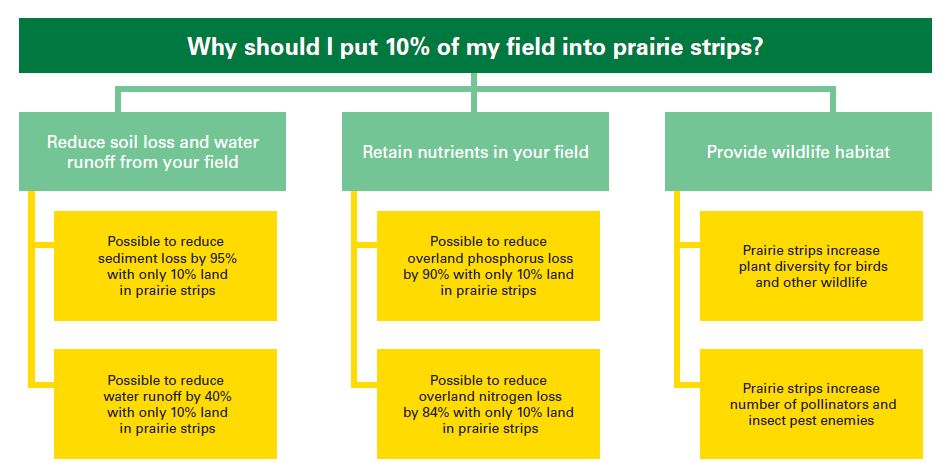
STRIPS stands for Science-based Trials of Rowcrops Integrated with Prairie Strips. The STRIPS project is composed of a team of scientists, educators, farmers, and extension specialists working on the prairie strips farmland conservation practice. Our research shows that prairie strips are an affordable option for farmers and farm landowners seeking to garner multiple benefits. By converting just 10% of a crop field to diverse, native perennials farmers and farmland owners can reduce the amount of soil leaving their fields by 90% and the amount of nitrogen leaving their fields through surface runoff by up to 85%. Prairie strips also provide potential habitat for wildlife, including pollinators and other beneficial insects.
Roeslein Alternative Energy, Smithfield Hog Production, and the Environmental Defense Fund brought together conservationists, food producers, scientists, educators, farmers, policy makers, and other interested members of the community to discuss the future of responsible land management on and around the Missouri Grand River Basin. Additionally, this conference was centered around providing market-based solutions that significantly improve water quality, soil erosion, nutrient losses, carbon sequestration, and soil health.
United by a sincere interest in working together to produce food responsibly, while also providing energy in a sustainable way to meet the growing demands of global community, speakers at the Grand River conference presented studies and research on different land management and prairie restoration options. Attendees were asked to brainstorm new ways to bring these goals to life in the short term and long term.
Several initiatives have taken shape since this conference on May 17th 2018. If you or your organization would like to be involved, learn more, have an idea you want to discuss or a project with a similar mission, please email us at [email protected].
The more we communicate our ideas and projects, the more we can help each other grow those projects. We would encourage you to read Rudi Roeslein’s follow up letter from the event. Thank you for participating and more importantly thank you for caring enough to do more.
Presentations
Video Presentations
Speakers & Biographies
Noel Aloysius
Noel Aloysius is an Assistant Professor at the Department of Bioengineering and the School of Natural Resources at the University of Missouri. He completed his PhD at Yale University, MS at the University of North Dakota and a BS in Civil Engineering at the University of Peradeniya, Sri Lanka. His research seeks to uncover how key drivers and mechanisms, both natural and anthropogenic, affect water and nutrient flow pathways and predict their behavior under environmental change.
His current research projects include estimating conservation measures needed to reduce nitrogen and phosphorus losses from non-point sources in the Mississippi River Basin.
Erik Anderson
Mr. Anderson is an Associate at Environmental Incentives out of Denver, CO. Erik works with program managers and diverse stakeholder groups to design, test, and adapt new and existing conservation programs to achieve measurable conservation outcomes. Erik supports the full lifecycle of program design and implementation, from initial concept to operations, and specializes in performance-driven approaches. Erik also facilitates interdisciplinary teams to develop data collection and analysis protocols that translate data into insight.
Sarah Carlson
Sarah Carlson joined Practical Farmers of Iowa staff in the fall of 2007 and is currently the Strategic Initiatives Director. She helps transfer agronomic research about cover crops and small grains through supply chain projects, articles, blogs and presentation materials while working to improve the support for cover crop and small grains research. She also serves as an agronomist on the staff transferring ideas for solutions to integrated crop and livestock concerns from farmers’ stories, results from on-farm research projects and her own knowledge as a trained agronomist. In the spring of 2008 Sarah completed her Masters Program co-majoring in Sustainable Agriculture and Crop Production/Physiology in Iowa State’s Agronomy Department.
James Cole
James Cole is The Nature Conservancy in Missouri’s Director of Conservation Programs. He has worked professionally in natural resource conservation for the past 18 years, and brings a diverse set of skills and experiences to the field, including a background in engineering and—more recently—work in the Great Lakes focused on restoring migratory bird habitat and engaging stakeholders in a shared whole-system conservation blueprint. In his current role, James helps coordinate the work of TNC’s conservation staff across the state, a team that is engaged in such diverse yet interconnected priorities as sustainable agriculture practices, climate change mitigation, and biodiversity protection.
Steve Herrington
Dr. Steve Herrington is the Director of Freshwater Conservation for The Nature Conservancy in Missouri. An aquatic ecologist with over twenty years’ experience in fish and stream ecology, Steve completed his Bachelor’s and Master’s degrees at the University of Illinois at Urbana/Champaign and doctoral degree at Auburn University in Alabama. Steve joined The Nature Conservancy in 2004 and currently directs all freshwater conservation actions in Missouri, as well as leads and collaborates on several large‐scale freshwater initiatives across the U.S., including conservation planning, dam removal and stream restoration, and protection of priority freshwater habitats.
Jacob Jungers
Mr. Jungers is an Assistant Professor at University of Minnesota. His research objective is to improve and develop new cropping systems that provide high-value agricultural products, mitigate environmental pollution, and reduce greenhouse gas emissions. His research focuses on improving nutrient use efficiency of crops and cropping systems to increase farmer profitability and agricultural sustainability. He relies on the basic principles of ecology, field and laboratory experimentation, statistical analysis, and simulation modeling to contribute information to scientists, farmers, and policy makers. He co-authored Aspects of Applied Biology: Biomass and Energy Crops.
Clarence Lehman
Dr. Lehman is a Professor and General Advisor to the Dean at the University of Minnesota. His research interests include theoretical ecology and computation in biology; biodiversity, bioenergy, and ecosystem functioning; long-term database storage; automated methods for education; ethics, science, and society. He is interested in learning to manage the earth’s combined physical-biological-social dynamics for long-term habitability by humans and wildlife. He co-authored Carbon-Negative Biofuels from Low-Input High-Diversity Grassland Biomass and Aspects of Applied Biology: Biomass and Energy Crops.
Lisa Schulte-Moore
Dr. Lisa Schulte Moore is a professor in the Department of Natural Resource Ecology and Management at Iowa State University. She conducts research and teaches in the areas of agriculture, ecology, forestry and human-landscape interactions. Her current research addresses the strategic integration of perennials into agricultural landscapes to meet societal goals for clean water, healthy soils, abundant wildlife and inspiring recreational opportunities. Dr. Schulte Moore is co-founder and co-leader of the Science-based Trials of Rowcrops Integrated with Prairie Strips (STRIPS) project, which pioneered the prairie strips conservation practice. She is also lead developer of People in Ecosystems/ Watershed Integration (PEWI), a simple web-based educational game designed to help people understand human impacts on the environment and improve the management of natural resources.
John Murphy
Originally from the Eastern Shore of Maryland, John eventually moved to central Ohio where he earned a B.A. in Biology from Cedarville College. It was also there that he began work for the Ohio Division of Wildlife, in public land management. From Ohio, John moved to Northern Missouri, where he earned a M.S. in Biology from Truman State University. John worked for the Missouri Department of Conservation in a diverse array of jobs prior to being hired as a Private Land Conservationist (PLC) in 2000. Although not simultaneously, through the span of John’s work as a PLC, he had responsibilities in Worth, Gentry, Harrison, Mercer, Putnam, Sullivan, Schuyler, and Adair Counties. His passion in those counties was fire ecology and the restoration of natural communities, especially prairie and savannas.
Since March of 2017 John has been a part of the RAE team, continuing to work on solutions to positively affect natural resources. He and his wife, Sharon, reside just outside of Kirksville, Missouri with their five children.
Michael Rainwater
Since the fall of 2011 has performed the position of General Manger of Smithfield Hog Production – Missouri, LLC (Formerly Premium Standard Farms, LLC). SHP – Missouri a farrow to finish operation that has over 1,000 employees, contains over 50 company owned sow farms (115,000 sows), over 1million company owned grow-finish spaces, and approximately 225,000 contract grow-finish space. The operations also include, boar stud facilities, internal multiplication of replacement animals, company owned feed milling facilities, company owned trucking fleet for all internal and external movements of animals, trucking fleet for all internal feed, nutrient management to support the operations on 44,000 acres of company owned land.
His body of work includes 25 years of diverse experience in Senior Management which including subsidiaries of Fortune Global 500 Companies and development of a dairy production operation that became the largest in United States, with 18,500 cows in the states of Georgia, Texas, and California. Proven history of improving profits, quality, customer satisfaction, and productivity. Demonstrated success in solving complex legal and social issues, building efficient teams, managing multiple projects and functions, and cultivating positive relationships and strategic alliances. Highly developed communications, negotiations, organizational, and interpersonal skills
Rudi Roeslein
Mr. Roeslein is a passionate about wildlife and conservation. He is a Missouri landowner dedicated to prairie restoration, science and technology. He owns three farms that are living laboratories dedicated to the pursuit of best practices for land stewardship and conservation. His efforts at Roeslein Farms are intended to demonstrate how native prairie, America’s original landscape, can deliver sustainable incomes for landowners while guaranteeing the sustainability of the environment. He is the founder of both Roeslein & Associates and Roeslein Alternative Energy (RAE). Mr. Roeslein was named 2016 Missouri Conservationist of the Year.
David Wolfe
David Wolfe (B.S. and M.E. Agricultural Engineering, University of Florida and M.S. Ecology, University of Georgia) is Director, Conservation Strategy with Environmental Defense Fund. Mr. Wolfe began his conservation career as a field ecologist with The Nature Conservancy in 1992. In 2000 he began working as a scientist with EDF to implement incentive-based programs for conservation of endangered species on private lands. This work involved the development and implementation of safe harbor and Farm Bill conservation programs to benefit endangered species, including the golden-cheeked warbler, black-capped vireo and ocelot. Mr. Wolfe is currently taking a leadership role in development of the Monarch Butterfly Habitat Exchange. He drafted a proposal to the Smithfield Foundation that led to the funding of the 1,000-acre Missouri prairie restoration project, which is a collaboration amongst Smithfield Foods, RAE, Missouri Prairie Foundation and several other partners.
Roeslein Alternative Energy uses a proprietary system of technologies to capture gases emitted from animal waste through the natural process of anaerobic digestion.
Anaerobic digestion consist of a series of biological processes that break down biodegradable material, which in the case of RAE, is livestock manure. This process occurs in the absence of oxygen.


The biogas created is mostly methane (CH4) and carbon dioxide (CO2), with very small amounts of water vapor and other gases. The carbon dioxide and other gases are removed as they pass through our complex gas purification systems. Leaving only the methane, which is the primary component of natural gas. Thus, RAE is creating renewable natural gas (RNG).
How RNG is used depends on its quality. At RAE, our gas has received the lowest carbon intensity score ever awarded by the California Air Resources Board (CARB), making our gas highly sought after as a clean transportation fuel. The remaining solids can be used as natural fertilizer and the water for irrigation.

Additional benefits of capturing these naturally emitted gases are:
- A significant reduction of harmful greenhouse gases emitted into our atmosphere
- Cleaner air with a nearly complete elimination of odor for surrounding residents
- Keeping rainfall out of the lagoons so it does not have to be cleaned using carbon sourced electricity before being land applied