DEAR CLIENTS, FRIENDS, AND COLLEAGUES:
I am sending a letter to the people with whom I have worked over the past several years to let you know some exciting personal news. My wife, Debbie, and I have been asked by our church to oversee its mission, humanitarian, and ecclesiastical work in the Adriatic North Mission (which consists of the countries of Slovenia, Croatia, Bosnia & Herzegovina, Montenegro, and Serbia) for the next three years. After much prayer and discussion, we have decided to accept this calling. I will be returning to Saalfeld Griggs the summer of 2029.
This means that I will focus my remaining time on: (1) completing the estate plans and updates that I have already started prior to our departure for the Mission in June; and (2) making sure that any clients who may have estate planning needs during my sabbatical are provided for.
If you are receiving this letter, I am grateful for the trust that you have given me in the past. I express with sincerity my deep appreciation and respect for you, my clients, friends, and colleagues. I hope that you will trust me once again as I embark on this mission and as I recommend my partners and the dedicated Estate Planning Team here at Saalfeld Griggs PC.
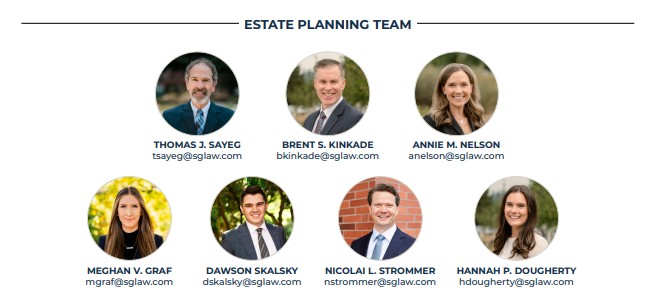
Many of you have worked with Meghan Graf, an exceptional estate planning attorney, who will be responsible for handling and triaging much of the work during my sabbatical. Meghan will work and coordinate with my partner, Brent Kinkade, and with Annie Nelson—two attorneys with more than 45 combined years of estate planning experience.
In addition, we have three additional estate planning attorneys, Nicolai Strommer, Dawson Skalsky, and Hannah Doughtery, as well as several paralegals and numerous dedicated staff members, who are eager to assist. I am very proud of this deep and highly skilled Estate Planning Team.
Frankly, this fresh news of putting a pause on my practice for three years seems a bit surreal. While I often recommend updating your estate plan every four to five years, I recognize estate planning needs will arise for some of you during my absence. Again, these six other estate planning attorneys are available and eager to help. I have every confidence that you will be well-served should such needs arise during my sabbatical.
If you have questions about your file, needed legal work, or how this transition may impact you, please don’t hesitate to reach out to me or any member of our Estate Planning Team. The contact information for each is provided below, as is our website if you would like to meet them virtually.
I am excited and anxious about embarking on this new adventure. For those whom I do not have an opportunity to see or talk with before I go, I look forward to meeting again upon my return. Thank you.
Very sincerely,
Jeff G. Moore
The post Sabbatical News for Jeff Moore appeared first on Saalfeld Griggs PC Law.
]]>The post Saalfeld Griggs PC Attorney Hunter B. Emerick Honored with De Muniz Award by Marion County Bar Association appeared first on Saalfeld Griggs PC Law.
]]>The Paul J. De Muniz Professionalism Award recognizes a member of the Marion County Bar Association who best exemplifies the pursuit of the practice of law as a profession, demonstrating a spirit of public service and the highest possible level of competence, integrity and ethical conduct, and who serves as a role model for other attorneys. The award is in honor of former Chief Justice Paul J. De Muniz and the recipients are selected by the Marion County Bar Association Board of Directors.
Hunter Emerick is a respected member of the Marion County legal community and practices in Business & Commercial Litigation, Estate & Trust Litigation, Creditor’s Rights & Bankruptcy, and Real Property Litigation. Known for his thoughtful advocacy and steady leadership, Emerick is committed to delivering practical, strategic solutions while maintaining the highest ethical standards.
The Hon. Norm Hill recognized Hunter as “an exceptional advocate” and “one of the premier business litigators in the Willamette Valley.”
Erich Paetsch shareholder at Saalfeld Griggs and colleague, added:
“Hunter is the kind of lawyer who knows that the law isn’t just a tool—it’s a trust. In a profession where shortcuts can be tempting and pressure can be unrelenting; Hunter chooses the long road. The right road. Every single time.”
This recognition reflects both Emerick’s individual achievements and Saalfeld Griggs PC’s longstanding commitment to excellence, leadership, and service in Oregon’s legal profession.
We’re proud to celebrate this well-deserved recognition.

The post Saalfeld Griggs PC Attorney Hunter B. Emerick Honored with De Muniz Award by Marion County Bar Association appeared first on Saalfeld Griggs PC Law.
]]>The post Saalfeld Griggs Recognized in the 16th Edition of Best Law Firms® appeared first on Saalfeld Griggs PC Law.
]]>We are pleased to share that Saalfeld Griggs PC has been recognized in the 16th edition of Best Law Firms® an honor that highlights our firm’s ongoing commitment to excellence, client service, and depth of legal expertise.
Among the firm’s distinctions, the Employee Benefits & Executive Compensation Practice Group has been rated “First Tier” by U.S. News & World Report – Best Lawyers Law Firms®. This recognition reflects the group’s reputation for providing comprehensive, innovative, and compliant solutions in a highly complex area of law.
The Employee Benefits & Executive Compensation Group serves a diverse range of clients, including private employers of all sizes, publicly held companies, tax-exempt organizations, governmental entities, and financial institutions. The group advises on qualified retirement plans, executive compensation, health and welfare benefit plans, and regulatory compliance, helping clients navigate this ever-evolving legal landscape with clarity and confidence.
The Best Law Firms® rankings celebrate firms that have consistently demonstrated excellence in legal practice and client satisfaction. Each recognized firm is evaluated through client feedback, peer recommendations, leadership interviews, and the breadth of their practice areas. The result is a trusted guide for businesses and individuals seeking top-tier legal counsel across the United States.
Additional details about the 16th edition of Best Law Firms® can be found at bestlawfirms.com.
Congratulations to our attorneys and staff on this remarkable achievement and continued dedication to delivering exceptional client service.

The post Saalfeld Griggs Recognized in the 16th Edition of Best Law Firms® appeared first on Saalfeld Griggs PC Law.
]]>The post IRS Announces 2026 Dollar Limits Applicable to 401(k) Plans appeared first on Saalfeld Griggs PC Law.
]]>2025 2026
Eligible Compensation: $350,000 $360,000
DC Annual Additions: $70,000 $72,000
401(k) Deferral Limit: $23,500 $24,500
Catch-Up Limit (50+): $7,500 $8,000
“Super Catch-Up” Limit (60-63): $11,250 $11,250 (no change)
“High Earners” for Roth Catch-Up: $145,000 $150,000
HCE Compensation Definition: $160,000 $160,000 (no change)
Social Security Taxable Wage Base: $176,100 $184,500
The post IRS Announces 2026 Dollar Limits Applicable to 401(k) Plans appeared first on Saalfeld Griggs PC Law.
]]>The post What to know, and what to do about ICE Business Raids and I-9 Audits By David Briggs appeared first on Saalfeld Griggs PC Law.
]]>While the Trump Administration has been persistent in enforcing its immigration policies, it has increased its focus on companies that employ workers without legal status. The crop production, food processing, and construction industries are particularly subject to enforcement with undocumented immigrants making up an estimated 15-20 percent, or more, of workers within them, according to Goldman Sachs. White House border czar Tom Homan recently told reporters that “you’re going to see more work site enforcement than you’ve ever seen in the history of this nation,” and that “worksite enforcement operations are going to massively expand.” By federal agents raiding four workplaces in the garment district of Los Angeles and the Administration’s expressed distaste in sanctuary cities and states, Oregon seems to be one of the focal points for ICE enforcement. This article provides guidance for how businesses can prepare, navigate, and comply with ICE’s enforcement procedures.
ICE generally has two enforcement procedures for businesses. They commonly conduct either an I-9 Form Audit or a “raid”. I-9 Audits and Raids can expose employers to significant civil and criminal liability, especially if violations are found during or as a result of the raid. Knowing the scope of your liability, your rights and obligations as an employer, the rights of your employees, and what you should do to navigate ICE investigations are key for navigating the current landscape of immigration law.
Civil and Criminal Liability for Violations
Key areas of potential liability include
Employing unauthorized workers: It is unlawful to knowingly hire or continue to employ individuals who are not authorized to work in the United States. Penalties for first-time violations can range from nearly $700 to over $5,000 per unauthorized employee, while repeat violations can exceed $27,000 per employee in penalties (adjusted annually).
Failure to properly complete, retain, or produce I-9 forms: Employers who fail to maintain accurate Form I-9s or fail to produce them during an audit or investigation may face paperwork violations with fines up to $3,000 per unauthorized worker, depending on the error and the employer’s compliance history.
Pattern or practice violations: Employers found to have engaged in a pattern or practice of knowingly hiring unauthorized workers may face criminal penalties, including fines and up to six months of imprisonment per offense.
Obstruction or noncompliance during the raid: Interfering with ICE agents, providing false information, destroying documents, or denying access to areas authorized by a valid warrant may result in obstruction of justice charges or additional fines.
Retaliation or discrimination: Employers who retaliate against employees for asserting their rights, or who discriminate based on national origin or perceived immigration status, may be subject to enforcement actions by the Department of Justice’s Civil Rights Division, under the Immigrant and Employee Rights Section (IER).
Civil lawsuits or labor claims: Raids can lead to secondary liability, such as wage and hour claims or wrongful termination lawsuits, especially if employers panic and terminate workers without proper legal basis.
The I-9 Form Audit
An I-9 Form Audit is an administrative review conducted by Immigration and Customs Enforcement (ICE) to assess employer compliance with federal employment eligibility verification laws under the Immigration Reform and Control Act (IRCA). It centers on whether employers are verifying employee identity and work authorization properly through Form I-9
How it may be presented: ICE initiates an audit through a Notice of Inspection (NOI), typically delivered in person, via certified mail, or by commercial courier. ICE does not require a warrant or subpoena to serve an NOI. This is not a criminal enforcement action but an administrative procedure.
How to prepare:
· Maintain a centralized, well-organized I-9 file, stored separately from general personnel files.
· Conduct an internal audit using a qualified immigration attorney or HR professional to identify errors (e.g., missing signatures, outdated forms, incorrect document combinations).
· Correct errors in good faith where legally permitted, using proper amendment procedures. Do not backdate or alter original entries.
After the audit, ICE may issue the following:
· Notice of Inspection Results (compliance achieved);
· Notice of Technical or Procedural Failures;
· Notice of Suspect Documents (employees who appear unauthorized);
· Notice of Discrepancies;
· Warning Notice (violations noted but no fine);
· Notice of Intent to Fine (NIF).
How to Comply: Employers have three business days to produce all I-9 forms and supporting documents (e.g., copies of IDs and work authorization documents if kept). You may request an extension, but it is discretionary and should be requested promptly. Failure to respond in time may result in serious penalties.
When Faced with an ICE Raid
Generally: ICE may arrive without notice and with or without a warrant. They may be conducting:
· Worksite enforcement actions
· Criminal investigations
· Immigration status arrests
Rights of Your Employees: Regardless of immigration status, employees all have the following rights
· The right to remain silent
· The right to decline an interview by ICE agents
· The right to refuse to provide identity documents
· The right to refuse disclosure of one’s country of nationality or citizenship
· The right to request legal representation
First Steps if Approached by ICE: Train employees who are likely to be the first to encounter agents in the event of an ICE visit to
· Ask for identification to record the names and badge numbers of the agents.
· Immediately contact counsel, send a copy of the warrant to counsel if you can, and ask the agents to have counsel present
· Request to see the warrant and be able to identify the validity, type, and scope.
· Document the raid
Determining a Warrant’s Validity, Type and Scope:
Valid judicial Warrant: Must be signed by a judge and say “U.S. District Court” or “[X] State Court” at the top.
Valid Admin. Warrant: Issued by ICE (e.g., Form I-200 or I-205), not a court, and does not permit entry into non-public areas without consent. This will likely say “Department of Homeland Security” at the top.
ICE Authority if you are Presented with a Valid Warrant:
Valid Judicial Warrant: ICE may access and search areas described in the warrant.
Valid Admin. Warrant: Does not allow ICE to enter private areas without consent. Do not volunteer information or escort agents to specific individuals.
Seizure of company property is permitted only if authorized in the warrant. If seizure is authorized, you should:
· Request copies before seizure.
· Ask for imaging of devices instead of removal.
· Explain operational impacts to ICE and request alternatives.
· What you and your employees should do:
· Comply only within the scope of the warrant.
· Do not expand or consent to actions beyond its scope.
· Document all activity and notify legal counsel.
In the Absence of a Valid Warrant:
ICE authority:
· Public areas: Agents may enter freely.
· Private areas: You may deny entry without a judicial warrant. Do not consent unless advised by counsel.
· Seizure of property: Prohibited without a valid warrant or your consent. Do not consent.
· Communication with employees: Remember the rights of employees, as listed above, including the rights to: (1) remain silent; (2) decline an interview; (3) refuse to provide documentation; (4) refuse to disclose nationality or citizenship status; (5) an attorney.
Best practices for employers and employees:
· Politely decline entry into private areas and decline seizure requests.
· Request a judicial warrant for private areas.
· Politely decline entry or seizure requests in the absence of one.
· Contact legal counsel immediately.
Raid Preparation and Employee Training:
· Step 1: Retain qualified immigration counsel to make ensure you are prepared for an audit, raid, or other ICE interaction.
· Step 2: Post clear signage, or draft a clear internal policy, designating public vs. private spaces. This clear to ICE agents which areas they may enter when they do not have a judicial warrant.
· Step 3: Designate a company representative to handle questions and serve as primary contact person with ICE agents during and after the raid.
· Step 4: Train employees who are likely to be the first to encounter agents in the event of an ICE visit (e.g., front desk, host, etc.) to:
o Ask for identification to record the names and badge numbers of the agents.
o Immediately contact counsel, send a copy of the warrant to counsel if you can, and ask the agents to have counsel present
o Request to see the warrant and be able to identify the validity, types, and scope.
o Document the raid
· Step 5: Train all employees to stay calm, not run, and know their rights
Do’s and Don’ts While a Raid is in Progress:
Best practices include
· Documenting everything you can – designated representatives should record by video or note (preferably video):
o Names, badge numbers, and agencies of agents
o Areas accessed
o Documents or property seized
o Whether agents exceeded warrant authority
· Cooperating with agents who are acting within a valid warrant’s limits.
· If agents act beyond the scope of the warrant, inform them that you do not consent to this, but do not physically interfere.
· In the event of documents being taken, ask officers if copies of any documents can be made before they are taken.
· In the event of computers or electronic devices being taken, request that officers image the devices rather than seizing them.
· If the seizure of any items will interfere with business operations, ask the agents to image or copy the items instead.
Employers should generally refrain from the following:
· Do not share employee information without the employee’s consent or unless legally required by law.
· Do not consent to searches beyond the scope of the warrant without approval of legal counsel.
· Do not destroy documents
· Do not encourage/facilitate hiding of documents or employees
· Do not retaliate against employees who were subject to ICE investigation.
· Do not lie/provide false information.
· Do not interfere with any attempts of agents to speak with employees, but remember that you are not obligated to assist in their search for certain employees.
Additional Requests to Make to ICE During/After a Raid
· A full inventory of seized items (ask ICE for a receipt).
· Which, if any, employees taken into custody.
· A copy of the warrant and supporting documentation.
· Any notes from agents identifying alleged violations or noncompliance.
Post-Raid Next Steps:
· Conduct an internal review with counsel.
· Identify potential liability or exposure.
· Develop a compliance improvement plan.
· Reassure employees and provide legal support contacts.
Summary
Both I-9 audits and ICE raids carry serious legal and operational risks. Employers must:
· Maintain compliant records
· Know the limits of ICE’s authority
· Train staff appropriately
· Document and respond to every encounter in coordination with legal counsel
Proactive preparation is the best defense. Employers who are subject to ICE’s enforcement of immigration laws and wait until ICE arrives are often too late to avoid liability for themselves and their employees.
The post What to know, and what to do about ICE Business Raids and I-9 Audits By David Briggs appeared first on Saalfeld Griggs PC Law.
]]>The post FinCEN Proposes Delaying Effective Date of its New Investment Advisor Rule appeared first on Saalfeld Griggs PC Law.
]]>On September 22, 2025, FinCEN published a proposed rulemaking that would delay the effective date of the IA AML Rule by two years, to January 1, 2028. The proposed rulemaking principally cites the opportunity to continue to review and tailor the IA AML Rule to best serve the goals of the Rule and the businesses that it will regulate. The advisers that are covered by this rule greatly vary in size, complexity, and risk profile, and FinCEN has recognized that more time is needed to effectively and efficiently implement the Rule.
The proposed rulemaking also recognizes that the delay would save covered investment advisers the costs required to ensure compliance with the Rule, at least for another two years. FinCEN further recognized that those costs may be higher than when the IA AML Rule was promulgated. As a result, the delay will have notable economic savings for covered advisers.
The delay does bring about certain risks, however. Namely, during the period would-be covered advisers are not required to comply with the Rule there is an inherent increase in the risk of economic harms that may otherwise be prevented by the Rule. Even considering this risk, FinCEN asserts that a delay in the Rule is the proper course of action.
The post FinCEN Proposes Delaying Effective Date of its New Investment Advisor Rule appeared first on Saalfeld Griggs PC Law.
]]>The post Oregon’s SB 426: A New Era of Wage Accountability in Construction appeared first on Saalfeld Griggs PC Law.
]]>- What has Changed?
Senate Bill 426 creates strict joint and several liability for “unrepresented employees” (those not covered by a collective bargaining agreement) for unpaid wages and fringe benefit contributions. Under this new law, both the project owner and the direct contractor are now jointly and severally liable for unpaid wages and fringe benefits to unrepresented employees of any subcontractor, regardless of their tier in the contracting chain. This means a worker can seek payment from the owner and the direct contractor, even if that party paid the subcontractor in full for the employee’s work.
- Who is Covered? How Does it Work?
Unrepresented employees, their authorized representatives, or the Attorney General can bring a civil action against the owner, direct contractor, or subcontractor to recover unpaid wages, interest, penalty wages, damages, attorney fees, and costs.
Before a civil action can be initiated, a claimant must send notice via certified mail to the owner and direct contractor, describing the alleged wage violation. The recipients then have 21 days to correct the violation. If not cured, the employee can sue for damages.
- Who is Excluded?
Not all construction projects or workers are subject to SB 426:
- Unionized Employees: The law specifically applies to “unrepresented employees,” meaning workers covered by a collective bargaining agreement that includes a binding mechanism for recovering unpaid wages are generally excluded.
- Owner’s Principal Residence: Projects involving construction, reconstruction, alteration, maintenance, moving, or demolition of the owner’s principal residence are exempt.
- Small-Scale Residential/Commercial Projects: Projects involving five or fewer residential or commercial units on a single tract of land are also excluded.
- Public Agencies and Financial Institutions: Owners who are public agencies are generally excluded from the “owner” definition for the purpose of this liability. In addition, financial institutions that acquire ownership through foreclosure are exempt, so long as the financial institution does not take over the project.
- What does it mean for Contractors and Owners?
For project owners and contractors, SB 426 significantly increases their exposure and responsibility. Owners and direct contractors could find themselves paying twice for the same labor – once to the direct contractor or subcontractor and then again to a subcontractor’s unpaid workers. While the law allows for owners and directors contractors to seek reimbursement from the responsible subcontractor, there is no guarantee of recovery. To mitigate risk, owners and contractors should be aware of the following considerations:
- Enhanced Due Diligence: Rigorously vet all contractors and exercise greater scrutiny in selecting contractors, including subcontractors at lower tiers, to assess their financial stability and history of wage compliance. This may involve requesting detailed financial records and conducting thorough background checks.
- Implement Robust Payroll Auditing: Subcontractors are now required, upon request from the owner or direct contractor, to provide certified payroll records, relevant worker information, and an affidavit detailing any prior involvement in wage violation proceedings within the last five years. Establish systems to regularly request and review certified payroll records to ensure employees are being paid correctly and on time. This moves beyond simply confirming work completion to verifying actual wage and benefit payments. But note that this is not a shield. Even if a subcontractor falsifies or withholds payroll records, owners and direct contractors can still be liable.
- Update Contracts: Revise all subcontracts to reflect the new legal landscape, including provisions for mandatory payroll submissions, affidavits regarding past wage violations, and the right to withhold payments in case of non-compliance or direct payment of wages. Also note that SB 426 explicitly invalidates any contractual agreement that attempts to waive or release an owner or direct contractor from this liability or to indemnify them for unpaid wages and fringe benefit contributions.
- Proactive Risk Management: Consider requiring payment bonds from subcontractors to mitigate the financial risk of having to pay a subcontractor’s employees.
- Increased Administrative Burden: Expect more paperwork and administrative overhead related to tracking and verifying subcontractor payrolls.
- Withholding Payments: Owners and direct contractors are permitted to withhold payments to a subcontractor if the subcontractor fails to provide the requested payroll records, or to the extent the owner or direct contractor has paid wages owed by the subcontractor to their employees.
- What’s Next?
While SB 426 provides a framework, it’s unclear how the industry will adapt to this change, and some aspect may require clarification from court interpretation, regulatory guidance, or further legislative action:
- Scope of “Fringe Benefit Contributions”: While the law broadly defines these, specific examples beyond those listed (e.g., profit-sharing, retirement, medical insurance, severance, holiday/vacation/sick leave) may need further clarity.
- Practicality of Payroll Auditing: The effectiveness and feasibility of owners and direct contractors consistently auditing subcontractor payrolls across multiple tiers, particularly for smaller projects or less sophisticated subcontractors, remain to be seen.
- Enforcement Mechanisms and Resources: While the law provides a private right of action, the extent to which the Attorney General or other state agencies will actively enforce these provisions is yet to be fully understood.
- Impact on Project Costs and Bidding: It’s unclear how the increased liability and administrative burden will translate into overall project costs and bidding practices within the Oregon construction industry. Opponents of the bill have voiced concerns about potential cost increases and stifled competition.
Oregon’s SB 426 represents a significant legislative effort to protect construction workers from wage theft. While its intent is clear, the full practical implications for owners and contractors will unfold as the law takes effect in 2026 and as the industry adapts to these new, stringent accountability measures. Proactive preparation and revised contractual agreements will be crucial for navigating this evolving landscape.
The post Oregon’s SB 426: A New Era of Wage Accountability in Construction appeared first on Saalfeld Griggs PC Law.
]]>The Federal Tax Cuts and Jobs Act of 2017 (TCJA) was a sweeping tax reform package. A key feature of that legislation was that many of its provisions, especially those affecting individual taxpayers, were temporary. These tax provisions are currently scheduled to “sunset,” meaning that they will expire, effective January 1, 2026, and the tax laws will revert to their pre-TCJA state unless Congress steps in with new legislation. For example, the federal estate tax exemption under TCJA which is currently $13.99 million per person (indexed for inflation), would revert to approximately $6.8 million per person, and continue to be indexed for inflation.
However, the Trump Administration and the Republican Congress generally favor extending most of the current TCJA provisions and are considering making them permanent. There have also been bills in both the House and the Senate to repeal certain parts of the TCJA, including a repeal of the estate tax entirely. But these are merely preliminary discussions at this point. In summary, although the current federal estate tax exemption of $13.99 million is slated to sunset to approximately $6.8 million starting January 1, 2026, it is anticipated that the current exemption will at least be extended, with the possibility of permanency.
On May 20, 2025, Washington State enacted Bill ESSB 5813, which takes effect immediately. This means that for individuals dying on or after July 1, 2025, the applicable Washington estate tax exemption has increased from $2.193 million to $3 million, with annual adjustments based on the Consumer Price Index for the Seattle metropolitan area. ESSB 5813 also increased the current 10-20% tax brackets to a 10-35% tax bracket. Individuals who die owning more than $9 million can expect to hit the highest tax backet of 35%. However, Washington maintains the qualifying family-owned business interests (QFOBI) deduction enacted on January 1, 2014.
Several bills have also been introduced in the Oregon legislature that aim to modify the state estate tax. Among the proposed bills: HB 2058 proposes that for individuals who pass away on or after January 1, 2026, the current Oregon estate tax exemption of $1 million would be increased to $13.99 million; HB 2301 proposes raising the Oregon estate tax exemption to $7 million and replacing the current 10-16% tax brackets with a flat 7% tax; HB 3844 proposes that the Oregon estate tax exemption merely be adjusted and indexed for inflation; and HB 3934 proposes “portability” for the Oregon estate tax, more easily allowing a surviving spouse to use the exemption of a deceased spouse. It’s important to note, however, that the legislative process is ongoing, and the outcome of these bills is still uncertain. The legislature seems to be paying attention to a recent study showing that Oregon’s high estate tax is influencing migration to and from the state; enough so that the state may be losing more money in income, property, and other taxes than it is gaining from the estate tax.
Our office will continue to monitor these legal developments and provide additional details as they unfold. Thank you.


The information in this letter is not intended to provide legal advice. For professional consultation, please contact the Saalfeld Griggs Estate Planning team.
Salem Office: 503.399.1070. Bend Office: 541.693.1070.
This publication is prepared by the law firm of Saalfeld Griggs PC as an information source. For further information on the matters addressed in this letter or to request inclusion on the mailing list, please contact Miranda Hugie in our office. The contents of this publication should not be construed as legal advice. Readers should not act upon information presented in this publication without individual professional counseling. Receipt of this publication does not constitute or create an attorney-client relationship. The material in this publication may not be reproduced without the written permission of Saalfeld Griggs PC.
The post Important 2025 Estate Tax Updates appeared first on Saalfeld Griggs PC Law.
]]>Join ACE’s RAISE THE ROOF event on Friday, May 16. This event gives you the opportunity to support Salem-Keizer High School students attending CTEC’s Residential Construction program. These students are learning all aspects of the construction trade, while building a home in our community.
Learn more about sponsoring and attending the event here: ACE Raise the Roof.


© 2025 Saalfeld Griggs PC
The post 2025 ACE Raise the Roof Event: Support Local CTEC Students appeared first on Saalfeld Griggs PC Law.
]]>By Margaret Gander-Vo and Emily Rich, Real Estate and Land Use practice group.
On January 7, 2025, the Oregon Department of Forestry (ODF) posted the Statewide Wildfire Hazard Map to the Oregon Explorer website. The Wildfire Hazard Map designates properties as being in a low, moderate, or high wildfire hazard zone as well as identifying whether a property is located within the Wildland Urban Interface (WUI). Properties designated as both being in the high hazard zone and within the boundaries of the WUI may be subject to new regulations regarding defensible space requirements and additional building code standards. Property owners wishing to appeal one or both designations were required to file the appeal form provided by ODF by March 10, 2025. Unless legislative relief is provided during the current session, these appeal hearings will be scheduled for those owners who correctly filed an appeal. These hearings will be an opportunity for owners to present evidence as to why the contested designation is incorrect. A property owner who is an agency, corporation, partnership, limited liability company, trust, government body, or unincorporated association is required to be represented by an attorney at these hearings. A property owner who is an individual may hire an attorney to represent them at the hearing, but it is not required.
In a press release dated February 17, 2025, Governor Kotek announced that ODF would continue to accept appeals until the deadline stated above, but that ODF would not refer appeals to the Office of Administrative Hearings (OAH) until after the current legislative session has been concluded. The legislative session is required to end by June 29, 2025. There is at least one bill currently pending, SB 678, which if passed would repeal the Wildfire Hazard Map. However, if there is not a legislative fix, then OAH will begin contacting property owners to schedule their hearings. If you have received notice regarding a property you own which is identified in the Wildfire Hazard Map and would like to discuss your options, please reach out to our team at (503) 399-1070 or visit www.sglaw.com.
The information in this article is not intended to provide legal advice. For professional consultation, please contact Saalfeld Griggs PC at (503) 399-1070 or visit www.sglaw.com. © 2025 Saalfeld Griggs PC


Margaret Gander-Vo
[email protected]
As a Real Estate and Land Use attorney, Margaret represents individuals and entities in a wide variety of real property transactions, including acquisitions, sales, and leases of land and buildings. She also works with developers and individuals on various types of land use applications, ranging from vacations and variances to comprehensive plan amendments and zone change applications. Margaret regularly represents clients before regulatory agencies, at hearings, and on appeal.
Emily is an associate attorney in Saalfeld Grigg’s Real Estate and Land Use practice group. She assists clients with a wide variety of real estate and land use matters including acquisitions, sales, leases, easements, conditional use permits, land divisions, and property line adjustments. Emily is passionate about helping clients achieve their real estate and land use goals.
Margaret Gander-Vo is a partner and Emily Rich is an associate in the Real Estate & Land Use practice group.
The post Process Begins for Appealing a Property’s Designation on Oregon’s Statewide Wildfire Hazard Map appeared first on Saalfeld Griggs PC Law.
]]>