The post Tales From the Tavern Q&A with John of Fox and Boar Games – and Druskara, and Public Access! first appeared on Shadomain - All About Games.
]]>Today we talk with John from Fox and Boar games. You can check out their work here:
https://www.youtube.com/@foxandboargames
Bluesky @foxandboargames
Instagram @foxandboargames
Facebook @foxandboargames
Patreon.com/foxandboargames
HI John, thanks for talking with us. Your company, Fox and Boar Games, publishes a wide variety of fantasy games and products. How did you decide to become a game creator?
I spent most of my youth (in the 80’s) playing and running Dungeons and Dragons, Star Frontiers, Call of Cthulhu, etc… I almost exclusively wrote my own content. I even made a lot of my own custom systems for games like AD+D.
I kept this up really through out most of my life with some breaks for graduate school, starting an academic career, etc… When I got my current teaching position one of my tasks was to work with the game dev program to create a “game art” degree.

In doing that I spent a lot of time researching the contemporary game industry (both video and tabletop games.) That was about the time Critical Role, et all exploded.
Interim I had begun working with Golden Dragon Studios – a former colleague and friend on a project that would become BlightRealms (which we currently have a quickstart booklet for). I took that momentum and began writing my own world and system (Tales of the Harrowed Land). Post Covid I decided to go all in. I took a sabbatical for game development research purposes, and then needed an identity to bring it to life. Thus Fox and Boar Games was born! It was my life long dream to write and publish my own RPG content. And I’m grateful and thrilled to do it every day even as a part time job.
Many of your games would be described as dark fantasy games in the sword and sorcery genre. Who are some of your influences in this genre?
I think we can point to the usual suspects. First and foremost Lovecraft, Frank Belknap Long, Michael Moorcock, Fritz Leiber and of course the great fantasy films of the 80s like Conan the Barbarian, Hawk the Slayer, Beastmaster and Sword and the Sorcerer. I began reading Howard later but also drew from a lot of horror like Stephen King and Clive Barker’s early works. History, Greek mythology and Tolkien also equally factor into my influences. Plus I’ve long delved into the classic occultism like Arthur Waite, Crowley, Francis Barret and some of the medieval mysticism I’ve been able to dig up. This all influenced the early D+D writers and definitely fed into the darker, heavier tone I favor.
Your ShadowWest game uses the Shadowdark system. What drew you to Shadowdark? Could you describe ShadowWest for our readers?
After a game at Philadelphia Area Gaming Expo 2 (2025) – I said to the group – imagine a game like Boothill with these rules and weirdness. The idea was a hit with the table and when I mentioned it on ShadowDark venues people really liked the idea. So…
I was previously running a long term old west Call of Cthulhu game; that was a major impetus. But I really got into the versatility and speed of play of ShadowDark.
ShadowWest has the tension and grit of ShadowDark. There is a supernatural darkness called The Bleak that occurs once a month or so (randomly) that plunges the land into an eldritch night. Strange creatures become more prominent.
During the first Bleak people with magic powers appeared, from traditional “Mystics” (wizards) to those who can harness the Bleak (Skycallers – think of them as Warlocks whose patron is the Bleak). Additionally during the Bleak a magic ore – Oranyx hits the ground in meteor falls. It is very valuable, and very powerful. It enhances magic and can be sourced to power strange devices. But… it can drive those who use it insane. It is a major economic and industrial force in ShadowWest. And the quest for Oranyx – and unlocking its power – is an ongoing theme in the game world.
It has all the tropes of the wild west. Rules for gunfights, stagecoaches, etc… and it is a bit pulp and actiony. But it also has enough creep and darkness to be a ‘dark fantasy/horror’ game. There are the dangers of the dark of ShadowWest.
The “monsters’ are incarnations of our own western folklore. Giant maniacal Jackalopes, dragons that grew out of natural reptiles, ghosts, undead riders and the like haunt the landscape.
It features art by Lissanne Lake – an established fantasy and western artist. ShadowWest, like all of our products, is all human created. No AI.
How long have you been playing TTRPGs? What was the first one you played?
I believe it would be 1983 – at about 12 years old that I found my first game group. And I had been voraciously reading D+D for a couple of years before that. It was of course Advanced Dungeons and Dragons. But I discovered Call of Cthulhu, Gamma World and Top Secret not too long after that.
Your Journeys Deck is a card deck that helps GMs build settings and stories. It works in many fantasy TTRPGs, correct? Could you give us a few details?
It is a story path deck. It’s not only a bunch of inspiration draws but has an internal system that suggests additional card draws. For example a location may prompt you to draw a creature and an encounter. The encounter may prompt another location or an NPC. The creature may prompt a treasure or a new encounter. And the paths can keep spanning out and building on each other. We’ve seen people use it on the fly to create a sidequest, layout an adventure in advance, and even solo play!
One of the main features is more all-original art by Lissanne Lake – in the old school fantasy style.
The deck is generic in the sense we don’t assign hard stats to anything. That is up to the GM and you can use it with any fantasy game. Eventually we’d like to have similar decks for additional environments (We have Ancient Woods (forest) and Underground (dungeon) for now. And perhaps even add things like cyberpunk decks and horror game decks.
Your TrashSexy game looks like a fun, different game. Could you describe a bit about it? Is it an all ages game?
A real departure for me. This is a quick play, rules light RPG where YOU play a ROWDY RACCOON! It is our best seller.
The character types are irreverent and you have your city raccoons, redneck raccoons, sewer dwellers, etc… You are smarter than your average raccoon and can use items (often badly), wear bling and communicate with each other and other animals. But you need to keep your nature secret from the humans (which usually lasts about 3 minutes in any game session).
The original form is a hybrid between a standard RPG and a game like munchkin that has cards that create locations and prompt encounters.You don’t need a GM and it is collaborative. But it can also be played like a traditional RPG. The characters collect trash in their antics which are worth points. And they spend these for advancement.
Despite the name I kept it PG-13 for family play. It can be as nasty or nice as the group wants it to be. Though I have – due to demand – been considering a supplement that makes it even raunchier.
You’ve taught game design, what’s that been like?
It is very interesting. Most of my students want to be video game designers. I teach conceptual art (as my academic background is in visual arts), world building and content design. It is great that students have the opportunity to study this in a formal environment whereas for most of us it was a hobby that we stumbled into. The challenge is keeping up with the changing landscape of game design field. I find it really rewarding when a student wants to specialize in tabletop design.
What other hobbies interest you?
My whole other life is playing historic instruments such as the medieval (German mostly) bagpipes and the hurdy gurdy. I’ve played in both traditional ensembles and with folk metal projects. I’m a live music junkie and get to as many concerts as I can.
Researching Forteana, strange mysteries and similar weirdness (which often bleeds into my game design).
I also like homebrewing beer and mead and am a foodie and enjoy craft coffee and spirits.
I’ve been get outside and away from these screens as much as possible.
Those things all consume the very little free time that I have.
What else haven’t we asked you that you’d like our readers to know about?
One of the things I am often asked is how to get started doing this (game design and publication). My answer is to just begin producing material and playing it through as much as possible. And not just with your friends and regular gaming group. Get it out in front of people as much as possible and get as much feedback, especially from established designers, as you can.
I also want to genuinely thank you and everyone who has supported these efforts so far.
Thanks, John! If you’d like to do a Q&A here, please send an email to [email protected]. We’d love to hear enyone’s opinion form new players to grizzled veterans.
New Crowdfunding – Druskara
We did a Q&A with Xane and Bunni a0from Dungeon Damsel a couple of weeks ago, and their new Backerkit campaign for their Shadowdark setting: Druskara is live now!
Jason Cordova’s The Gauntlet game company has launched their Kickstarter campaign for Public Access, a really strange and fun TTRPG using the “Carved From Brindlewood” system.
Wizards of the Coast asks YOU, “What’s up, y’all?”
Wizards of the Coast folks appeared on several streaming shows recently to let people know their plans for 2026. Now they’re asking your opinion on the current state of Dungeons & Dragons. Just fill out the form here.
The post Tales From the Tavern Q&A with John of Fox and Boar Games – and Druskara, and Public Access! first appeared on Shadomain - All About Games.
]]>The post Tales From the Tavern Q&A with Sohrab Rezvan of Flat Mountain Publishing, Tunnels and Trolls, and DnD 5.5 first appeared on Shadomain - All About Games.
]]>Today we talk with Sohrab Rezvanof Flat Mountain Publishing. You can find his work here:
YouTube, Instagram: @FlatMountainPublishing
Website: https://www.flatmountainpublishing.com
Hi, Sohrab, thanks for talking with us. You’ve written children’s books, and now a Dungeons & Dragons campaign for younger players. What came first in your life: writing fiction or role-playing games? When did you start playing RPGs? Did you always write stories?
I started playing Advanced Dungeons & Dragons 2nd Edition when I was in elementary school. I’ve always been a fan of science fiction, fantasy, and comics. As a kid, I dreamed of making comics, but that dream faded as I got older and began working toward becoming a computer scientist.
When I started writing in 2021, I initially focused on children’s books, often using my kids as inspiration. My shift to writing TTRPG content started about three years ago.

What’s your most recent project?
Wilds of Amaranth Part I: Save the Dog Kingdom is the first campaign set in the Wilds of Amaranth setting. A mysterious druid raised within the pacifist Dog Kingdom asks the heroes to help locate her lost companion. What they discover, however, is a deeper and more dangerous conspiracy that threatens not only the Dog Kingdom, but all the peace-loving kingdoms of the land. Will the heroes uncover the truth in time to stop the threat, or will the Dog Kingdom become the first to fall under this dark new menace?
This volume contains 13 adventures for beginning characters, along with a gallery of maps and puzzles to challenge players. The adventures were designed and playtested to be fun and engaging for kids ages 7 and up. They include a mix of exploration, puzzle-solving, and creature encounters to keep players immersed, regardless of their primary interest.
Samples and links are available here: https://www.flatmountainpublishing.com/our-books/wilds-of-amaranth-part-i-save-the-dog-kingdom/
You run your own publishing company. When did you start Flat Mountain Publishing and what’s the most difficult part of publishing books?
The most difficult part of publishing books is everything that happens after writing them. Finding and working with illustrators, formatting the books, marketing, social media—there’s a lot that goes into finishing and promoting a book. These tasks don’t come naturally to me.
I formed Flat Mountain Publishing as soon as I decided to take my writing seriously. Running it as a company helps me properly track the expenses and income related to the business.
You’ve been a vendor at game conventions. What’s the biggest difference between game conventions and book or toy conventions? Do you prefer one over the other?
I’ve been attending comic book conventions, toy shows, and gaming conventions since I was a kid—hundreds of shows over the years. I really love conventions. As a collector, I was a vendor at dozens of comic conventions and toy shows long before I started writing.
When selling my RPG books, my best shows have been a gaming convention and a general pop-culture convention. There’s a lot of overlap between people who love TTRPGs and those who love comics. I tailor what I bring based on the type of show I’m attending.
Are your children’s books connected by a shared world? Do you have a favorite book you’ve written?
No, each of my children’s books is set in a different world. Each one is written so it could become part of a series if sales are strong enough.
I’m sentimentally fond of my first series, The Adventures of Princess and Goose, which I based on my kids and my two silly dogs. But my most recent children’s book, How Did the Hippopotamus Get There?, received the most positive reviews, and the artwork matched the writing very well.
Do you play video games, and do you have a favorite?
I don’t currently play video games. Growing up, I played the NES and a little SNES. My favorite games were always RPGs like Dragon Warrior, Final Fantasy, and Chrono Trigger.
In high school and college, I enjoyed playing Age of Empires II, and I still occasionally watch matches on YouTube. My favorite games of all time were on the PC—Ultima VII Parts I and II (The Black Gate and Serpent Isle).
What’s something that’s happened during your writing career that our readers might be surprised by?
This can be a very challenging career. I’ve had disastrous shows where I didn’t sell a single book, and author events where only a couple of people stopped by.
If you could collaborate with any person on a project, who would you choose?
I don’t really have a wish list of specific people, but there are projects I would love to work on someday—X-Men, Star Wars, and The Phantom would all be dream jobs for me.
What other hobbies or interests do you have?
I collect comics and read about 300 each year, sometimes fewer depending on how many novels I read that year. I also collect comics-adjacent items like trading cards and toys.
I play the trading card game OverPower, and I watch a lot of soccer. I’m an avid supporter of Arsenal Football Club.
What haven’t we asked you that you’d like our readers to know?
My next project is an Arsenal Football Club-themed D&D fan adventure. The project will launch on Kickstarter later this summer.
You can learn more about it here:https://www.kickstarter.com/projects/flatmountain/crimson-marksmen-rise-of-spurwing-the-cruel
Thanks, Sohrab ! If you’d like to do a Q&A here, please send an email to [email protected]. We’d love to hear enyone’s opinion form new players to grizzled veterans.
Tunnels & Trolls Rides Again
Tunnels & Trolls was one of the earliest TTRPGs, and Rebellion Unplugged is Kickstarting an updated version soon. Check it out here.
I never played Tunnels & Trolls back in the day, but I know many people did, so I’m curious what the reaction will be. Truth: I don’t know the company Rebellion Unplugged. They’ve successfully Kickstarted 4 other projects over the past 5 years.
Dungeons & Dragons 5.5e, That’s the Name!
The team at DnDbeyond has announced that they are officially accepting the abbreviation 5.5e as the tag for the 2024 edition of Dungeons & Dragons. Check out the announcement in the changelog from March 2, 2026.
The Wizards of the Coast D&D team has become more interactive with the community in 2026, with the DnDbeyond team on a number of streaming shows and the recent State of the Game show at Nerd Immersion.
What do you think? Do you have a topic for an article, review, interview, or gaming news item you’d like us to cover? Let us know in the comments, or at [email protected]
The post Tales From the Tavern Q&A with Sohrab Rezvan of Flat Mountain Publishing, Tunnels and Trolls, and DnD 5.5 first appeared on Shadomain - All About Games.
]]>The post Tales From the Tavern Q&A with Dungeon Damsel first appeared on Shadomain - All About Games.
]]>Today we talk with Xane and Bunni from Dungeon Damsel.
You can find their work at
http://youtube.com/@TheDungeonDamsel
https://www.facebook.com/TheDungeonDamsel
Hi, thanks for talking to us!. Let’s start with Dungeon Damsel. What do you do and how did it start?
Xane: We make TTRPG supplements and rules expansions specifically for Shadowdark. I’ll let Bunni tell you where the name Dungeon Damsel came from, but the idea to make it into a company came after I created a Shadowdark class for our long-running campaign and Bunni said, “Wow. That’s really good. We should make a book!”
Bunni: Dungeon Damsel started because I was a woman who loved playing D&D and wanted a name that felt… like me. I originally used it for a miniature business years ago, then placed it on a shelf where it stayed untouched and dusty until I met Xane. We discovered a whole new world of creative possibilities together because we are two halves of a perfect circle. I’m the artist and he’s the writer, and when our love for Shadowdark took hold, we wanted our friends to step away from 5E and feel that same excitement. So Dungeon Damsel came back off the shelf and into the candlelight, and that’s how our Shadowdark supplements and its rebirth began as a publishing company!
You’ve got a new project coming up, Druskara. Can you tell us about that?
Xane: It’s that long-running campaign I just mentioned. Before Shadowdark released, I had been running it in Basic Fantasy. I love the OSR style. Rules light and deadly. And I also had the opportunity to run three groups of players all adventuring in the same world. So their actions inadvertently (or intentionally) affected each other. And I wanted cities that were just as fantastical as dungeons. Mind-blowing worlds. Druskara is THAT world. Something I’d been creating for 4 years with 3 groups playing in it simultaneously. It features scary forbidden magic, powerful world-changing artifacts, and Game-of-Thrones-like factions all vying for power and control over those artifacts. It’s also built on an evolution system that keeps the world changing and shifting on its own, whether the players involve themselves or not. It’s a massive undertaking at over 1000 pages, but it’s mostly written – just not all entered into the format nor full of art yet!
Bunni: What he said!

Druskara is designed for Shadowdark. How did that decision get made and what’s your favorite part about Shadowdark?
Xane: As I mentioned, I love the simplicity of OSR. I need to flow when I’m GMing, and stopping and looking up rules because I can’t remember how it works breaks the flow! I also love that old art style. I was a child in the late 70s and early 80s, so I definitely have nostalgia. There are many aspects of Shadowdark that I love. Other than the simplicity, it’s gotta be the easy character creation and inventory slots. Encumbrance and weight calculations are gone! HOORAY!
Bunni: My favorite part of Shadowdark is that you really have to roleplay your way through it. You can’t just min-max or cheese your way to safety. You’re not invincible, and it’s honestly the deadliest game I’ve ever played in the best way. The stakes feel real. I especially love the spellcasting system. You cast until you fail, and if you roll a 1, you trigger a calamity. It’s hard to pick one favorite thing because the system works so well as a whole. Everything vibes together in a way that’s quite honestly perfect.
How did you get your start in gaming? Were you first an artist, writer, or gamer?
Xane: I’ve made games since childhood. I played TTRPGs (red box set) and made my own video games in my younger years. It was my grandfather who taught me how to program a computer – nobody’s grandfather even knew what a computer WAS in the late 70s, early 80s! My life has been dedicated to games professionally since then. For 22 years I was a producer and executive producer in the video game industry. I worked on Baldur’s Gate: Dark Alliance and Hunter: The Reckoning among many other games – but those feel the most relevant here.
Bunni: I didn’t grow up around TTRPGs. I first played around 2012 with friends in Washington State using Pathfinder, Basic Fantasy, AD&D, but it wasn’t until I moved to where I live now and found a group I play with every Wednesday that it truly became part of my life. That’s when I really started investing in tabletop gaming and exploring beyond my comfort zone. It’s been about four years of consistent play, and I’ve completely fallen in love with it!
What’s your favorite thing about roleplaying games, compared to video games, writing or other creative pursuits?
Xane: The pure creativity by all members of the group. The players and the GM have to be at the top of their creative game! It’s a team effort, and I love teamwork. That’s my favorite part about life in general. Teamwork! Writing is cool too, but only when I think about my audience. Picturing how they will respond is an incredibly important aspect to joyful writing.
Bunni: For me, in the beginning, it was the escape. I was in a really difficult place in my life, and stepping into my characters and collaborative stories gave me somewhere else to exist for a while. It wasn’t just for entertainment, it was also a relief. Over time though, it became more than that. What I love about roleplaying games compared to other creative pursuits is that they’re alive. You’re not creating alone. The story shifts because of everyone at the table, and that shared imagination creates something none of us could have made alone. Now I play for the love and joy of the game, and create to share it.
What’s your favorite non-TTRPG (board game, video game, card game), and why?
Xane: Atari 2600 Adventure is my favorite video game of all time. The first open world game, the first game with an easter egg. My second runner-up is any good party game. I actually really like party games because it requires teamwork. Everyone is laughing and screaming! It’s the best.
Bunni: I second the party games. Xane made up this VERY entertaining game that I love playing during the holidays. We pretty much laugh until we cry every time. Oh… and Dragon Age Inquisition will always stand out to me. Solas was one of the deepest characters ever created for an RPG videogame, and probably the most heart-breaking romance.
If roleplaying games never existed, what do you think you’d be doing as a creator? What would you be making?
Xane: I’d probably have ended up back in video games. I definitely burned myself out of that realm since I was always working for someone else. That was a lot of sacrifice for a paycheck as opposed to building something that’s truly your own. However, I’d probably have gotten back into video games after a well-deserved break. That break consisted of selling all of my possessions and living the Van Life for a few years. It’s actually how I met Bunni!
Bunni: I’d probably still be doing commissioned artwork and focusing on illustration. That’s what I was doing before TTRPGs became such a big part of my life. Maybe even write a book, as the stories I wrote to escape reality were top-notch. But roleplaying games connected me to Xane and gave us a shared creative purpose. Without them, I’d still be making art on my own, instead of building something together. I much prefer their existence, thank you very much!
What’s your favorite style of music? Favorite artist?
Xane: Many genres. I was into metal as a kid. Now I actually like instrumental music the best because I can write and concentrate on complex things. If I’m listening to lyrics, I end up listening to the lyrics instead of what I’m supposed to be focused on. Electronic music offers the best instrumental in my opinion, and new music is always being released so it stays fresh.
Bunni: I’ve always been drawn to the beauty and emotion of strings, especially cello and violin. Apocalyptica was a big favorite of mine growing up, and I love music that blends orchestral elements with electronic beats. I’m pretty open across genres though. If the mood, lyrics, or rhythm resonate with me, I’ll listen to anything. Xane and I overlap a lot in taste, and I definitely have a strong pull toward rock and metal.
What other hobbies or interests do you have outside of gaming?
Xane: Gardening! I love permaculture – a self-sustaining growth of plants and trees. I’m not all that good at it, but I love learning it.
Bunni: Cats, rescuing cats–did I mention kitties? Along with traveling, sunbathing and singing karaoke in VRChat. I also work out regularly… or used to before I fractured my foot, and design enamel pins, which has become one of my favorite creative outlets. I’m even starting to explore mimic plushies…
Do any of your projects take inspiration from other media, such as a movie, book, etc?
Xane: I read the Shannara books as a kid, so that’s always present. Game of Thrones. Comic books for sure. I was a big Spider-Man fan. The marvel movies, despite their flaws, brought back that childhood love for comics. I love the power dynamics. How do you take this character’s talent and create interplay with another character’s talent?! I set up my adventures so players have to use each other’s skills in creative ways to succeed.
Bunni: My personal projects just come from my dark little mind of doom, and my brain is a treasure trove of random thoughts. I’m sure I’m influenced by the media around me like anyone is, but there isn’t one specific book. Artist, show or movie I can point to.
What haven’t we asked you that you’d like our readers to know?
Xane: With the success of Unnatural Selection, and our belief in our upcoming products, we’ve moved from just a couple of nerds into full-fledged publishing! We have another project that we’ve been working on for about a year that we’ll be announcing soon as well. So the future of Dungeon Damsel Publishing is looking bright!
Bunni: Star Wars or Star Trek? And I mean the OG! Both. They are both exceptional. Though my fondness for TNG, Voyager and DS9 maybe makes me more of a trekkie. It’s Q’s fault.
Thanks Xane and Bunni! You can follow their Backerkit here.
The post Tales From the Tavern Q&A with Dungeon Damsel first appeared on Shadomain - All About Games.
]]>The post TotalCon Review, Traveller 5e and TTRPG Book Club first appeared on Shadomain - All About Games.
]]>This past weekend I attended one day of TotalCon (aka Total CONfusion), a 4 day gaming convention held annually at the Best Western Royal Plaza in Marlborough, MA. TotalCon is a smaller regional convention but is the largest game convention in New England. I walked the vendor floor, visited with folks and ran a one-shot TTRPG in the afternoon.
Happy Anniversary, TotalCon!
2026 was the 40th anniversary of Total CONfusion, which began in 1987 at the Yankee Drummer in Auburn, MA, and moved to other local Universities and hotels as it steadily grew. Apart from the many games scheduled, TotalCon has a contest for all attendees that’s a combination of trivia game and scavenger hunt. It’s supported by a dedicated Facebook group and is managed through a Tabletop.Events system.
Tim Cask
The convention also honored Tim Kask with memorial posters at check in and tribute toasts.Tim Kask passed away at the end of 2025. Mr Kask was the first employee of TSR hobbies and a past special guest at Total CONfusion.
Games, Games and More Games
TotalCon is a small convention measured by the total number of attendees and the size of the venue but it’s still a very impressive convention in the number of gamers playing at all times. Many players come and stay at the hotel and play games all four days year after year.
Please allow some speculation as I don’t have accurate figures, but I would guess that there are more games played here than at the PAGE (Philadelphia Area Game Expo) that I attended in January, even though Page has twice the number of attendees.
The games played include board games and card games in addition to the many role playing games. There are game tournaments scheduled as well as independent sessions.
TotalCon Conclusion
This is my third year at TotalCon and I’m planning on being back next year. There’s a few advantages to a small local game convention. If you’re intimidated by large crowds or just feel mentally spent in a large convention space, smaller events might be better. There’s still a lot of games of all kinds going on constantly, and since most attendees are local, the people you meet are more likely to be those you might meet at a local game store or even interested in your in person game.
Crowdfunding – Traveller 5e
Shortly after I first encountered Dungeons & Dragons (AD&D first edition) I noticed other RPGs at the few nearby hobby stores. One of the first I picked up was The Traveller Book, the 1982 collected hardcover of one of the first science fiction roleplaying games. Those rules are famous for their perceived shortcomings, but the game itself is legendary in the history of TTRPGs.

In March 2026 the Traveller 5e campaign comes to Backerkit. This game will wrap the setting of Traveller in the familiar rules of the 5e system. Follow it to get information when it launches.
RPG news – DnD Beyond’s Development Roadmap
Wizards of the Coast recently announced its roadmap for future development. The biggest news is that the platform will be completely rebuilt. These sorts of efforts might trigger hopefulness and scepticism, but time will tell how this turns out.
Upcoming – TTRPG Book Club
This Wednesday (February 25th 8:30pm EST) we’re premiering a new show on Wes Allen’s DM Tales YouTube channel: TTRPG Book Club. A few of our friends will read and discuss a new Role-Playing game. This month we tackle Darrington Press’s Daggerheart. Tune in or catch the recorded show later, and let us know what you think in the comments!
What do you think? Do you have a topic for an article, review, interview, or gaming news item you’d like us to cover? Let us know in the comments, or at [email protected]
The post TotalCon Review, Traveller 5e and TTRPG Book Club first appeared on Shadomain - All About Games.
]]>The post Campaign Diary: Each Scene has Two Points of View first appeared on Shadomain - All About Games.
]]>In the Numenera campaign I’m running we had an interesting encounter that underscores how players and game masters can view a scene completely differently. That can give us some insight into planning TTRPGs.
The Scenario
The characters were heading through the wilderness on their mechanical wagon when they came across a large deep pit. They investigated and found a thin, frail man trapped at the bottom of an 80’ pit. They began rescuing the man with lengths of rope which they tied to their wagon, when a loud crashing sound came from the far side of the wagon. The wagon was struck by a grotesque 15’ tall humanoid, who immediately attacked the group. The characters fought and found the giant was a powerful foe.

Turning Point of the Battle
One of the characters drove the wagon at the giant, hitting him and knocking him into the pit. The giant lay at the bottom of the pit, alive but injured. Meanwhile the other characters had rescued the frail man. The characters looked down to find that the giant was asleep on the floor of the pit.
GM’s View
What the players did not know yet was that the pit had the magical effect of putting anyone in it to sleep for a random amount of time, and on waking the affected creature would take psychic damage from the horrific dreams they were subjected to.
I assumed that the battle was over at this point. The characters had accomplished their goal of getting past the pit, and rescuing a poor soul on the way, while a villain lay wounded and sleeping at the bottom of a deep pit. The characters would be able to go on with their mission with little fear.
Players’ View
The players feared leaving the enemy giant behind them, even if it was injured and sleeping. One character prepared to fire their heavy crossbow when another character grabbed their javelin and dove into the pit, hoping to land on the giant, critically stabbing him.
The jumping character landed at the bottom of the pit without damage thanks to a hover ability and immediately fell asleep beside the giant. Fortunately the jumping character was tied to a rope, the other end held by a strong character. The other character managed to drag the sleeping character up to safety. As soon as the sleeping character was clear of the pit he woke, disturbed by the dreams but alive. The giant slept a few more rounds, giving enough time for the characters to kill it with ranged weapons. The characters moved on with their mission.
Conclusion
Every scene looks different to players than it does to the GM. As the scene unfolded I thought it was clear that the safest move would be to continue on, leaving the sleeping giant trapped. The players had no way of knowing about the sleeping effect of the pit. The man they rescued had damaged memory that left him unaffected by the dreams which would torture anyone else, and the characters hadn’t had enough time to get that explanation from the man.
In the case described above the players and I saw the situation differently, but it wasn’t a critical misunderstanding and it made the encounter more interesting. But there’s a lesson we can draw from scenes like this. GMs should not assume that the players will assess any situation as the GM understands it. This idea is what leads to valuable advice such as Justin Alexander’s Three Clue Rule.
What do you think? Have you ever had a situation like this as a player or GM?
The post Campaign Diary: Each Scene has Two Points of View first appeared on Shadomain - All About Games.
]]>The post BACKERKIT-PALOOZA! Blades ‘68 and More first appeared on Shadomain - All About Games.
]]>Evil Hat has just launched a crowdfunding campaign on Backerkit for a new supplement for the Blades in the Dark TTRPG called Blades ‘68. Today we’re looking at the campaign and the 40 page free preview. And last week a bunch more cool TTRPGs went live on Backerkit, so we’re talking about those as well!
Blades in the Dark
From the description by Evil Hat:
Blades in the Dark is a tabletop role-playing game by John Harper about a crew of daring scoundrels seeking their fortunes on the haunted streets of an industrial-fantasy city.
The original game is well regarded, it is an offshoot of Powered by the Apocalypse, but with many of its own innovations. The characters are thieves, ne’er do wells and the like whose adventures are centered around heists. The setting is the city of Doskvol, where evil ghosts surround and threaten the sunless city. The setting is similar to a steampunk world.
Blades ‘68 uses the core mechanics of Blades in the Dark, but will include changes to the Gameplay Cycle.
The Blades ‘68 supplement moves the setting ahead 100 years to a time period roughly equivalent to Earth in 1968. The supplement adds new playbooks, new crews and new heists.
Blades ‘68 Playbooks
- Hull: The result of an experimental procedure meant to “cure” hardened criminals, you are now a hardened criminal mind in an android body.
- Swinger: The life of the party who meets conflict with charm and quick thinking.
Blades ‘68 Crews
Hit Squad: This crew is composed of contract killers and skilled assassins.
Blades ‘68 Doskvol
The names will be familiar, but the setting is updated for the times. That includes updated and new factions for the characters to deal with. The world of Doskvol was so dense that it could support a long campaign, and the additions from 2025’s Blades in the Dark: Deep Cuts gave even more places for fun. The updated setting of Blades ‘68 wasn’t necessary to expand the setting, but it looks like it will be great for a group looking for a shift in tone.
You’ll have to judge if your group is right for playing this, to avoid your game devolving into a session of Austin Powers.
Orshin Incident

The Orshin Incident is a sci-fi “dungeon crawl” with horror, survival and lots of tense moments. It’s created by Wes of DMtales and Dave of Grimwood Games. And just to be even cooler, it’s written for Inde card RPG, EZd6 and Ironbound, with stretch goals that can add conversions for the Cypher System and Darkspace!
Food & Evil

Food & Evil is a game by Goosepoop Games where you play a demon… running a food truck. Goosepoop is know for weirdly great games, and this one looks to be right in line with their other games. As of the writing of this article the campaign has added 4 more adventures through stretch goals!
Mystery Snacks
Mystery Snacks is a new game from TTRPGkids, known as stars in the field of family friendly games. Mystery Snacks includes 3 mysteries in a system-agnostic format. As of this writing, they’ve met stretch goals adding 2 more mysteries, and it looks like they’ll meet other stretch goals before long.
Overview
It’s a great time for Indie TTRPGs! These games add fun to many genres, and they’re written by companies we’re happy to support. Check them out!
The post BACKERKIT-PALOOZA! Blades ‘68 and More first appeared on Shadomain - All About Games.
]]>The post 1983: D&D Everywhere All at Once first appeared on Shadomain - All About Games.
]]>For the past few decades if you heard a friend was running D&D you could be pretty certain what they meant. Wizards of the Coast (and TSR before that) has published a single version of the D&D rules at a time (although 3e and 3.5e would have been available in stores simultaneously, as would 4e and the 4e essentials line). But let’s look back, dear readers, at a very different time: 1983
Advanced Dungeons & Dragons
The AD&D game (often referred to now as first edition) began with the publication of the Monster Manual in 1977, the first rulebook released as a hardcover. The Players Handbook was published in 1978 and the Dungeon Masters Guide in 1979 to complete the core rulebook set.
In 1983 this was the dominant version of D&D and was arguably the most popular version at this time.
BECMI Dungeons & Dragons
BECMI D&D is a modern abbreviation for the line of D&D games known as Basic, Expert, Companion, Master and Immortals, published beginning in 1983 by TSR. Note that this was the third time TSR published a game called “Basic” and the second time they had a game called “Expert”.
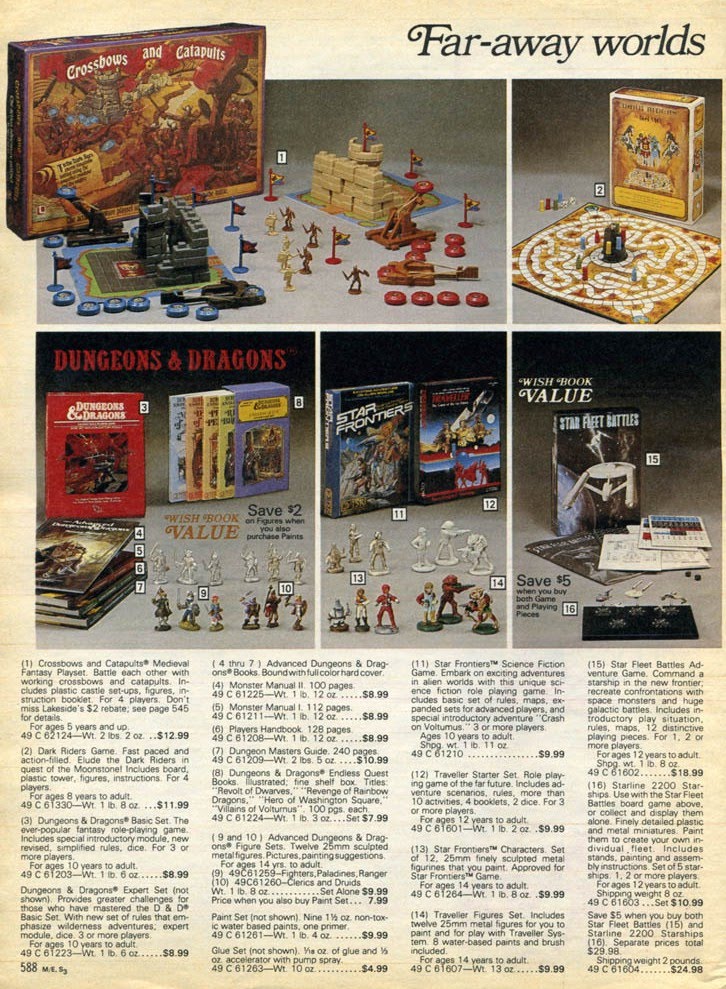
This version was released in 1983 so it would have been brand new to the shelves and garnering a lot of interest. Frank Mentzner (lead editor and writer for this version) said that this version was created in part due to a deal with the Sears catalog. That explains (sort of) why TSR released new Basic and Expert Rules only two years after the release of the previous Basic and Expert books.
B/X Dungeons & Dragons
The Basic D&D book written by Tom Moldvay and the Expert set written by Dave “Zeb” Cook and Stephen Marsh were released in 1981. These books were an attempt to be an easier point of entry to D&D, compared to AD&D which was often viewed as very complex. The Players Handbook was a 121 page hardcover and the Dungeon Masters Guide was 236 pages, where the 1981 Basic book was a 64 page staple bound paperback.
In 1983 and for several years afterwards these books would have been available at toy and hobby stores, even though the BECMI books were also available. This would have created confusion to players new to the game, but at least they had options, and all of them were bringing money to TSR.
But Wait – There’s More!
In the 1983 Sears catalog (aka the “Wish Book”) you would only see the BECMI and the AD&D books. But at game, toy and hobby stores you would have a good chance of finding the B/X versions too. But maybe even more, because in 1983 stores often kept books on the shelf until they sold.
The original D&D game (often referred to now as OD&D or 0D&D [with a zero]) was released in a series of 7 (or 8, depending on if you include “Swords & Spells”) staple bound digest size books beginning in 1974. By 1983 TSR had long since stopped publishing the original booklets, but if you were lucky you could still find some of these booklets in game stores.
The original D&D books were not well organized and could be difficult to interpret, particularly for players new to the game trying to play by reading the books. Professor Eric J. Holmes wrote a more organized book (it’s said he volunteered to do this to help new players) published in 1977 as the first Basic Dungeons & Dragons. This was a 46 page staple bound paperback book and was sold in a box set. The book did more than reorganize the rules – it modified some rules. By 1983 TSR had stopped publishing the 1977 Basic D&D set but as with the OD&D books, this was still available in some game and hobby shops.
Conclusion
In 1983, walking into a game, toy or hobby store, you could see anywhere from 2-5 different versions of Dungeons & Dragons, and more than one might be labelled “Basic D&D”. Confusing? Or was it a good strategy for a growing company like TSR? Popular opinion about the fall of D&D in the late 90s often blames the problems on having too many options, which fractured the fanbase into multiple smaller sections.
D&D continued to grow through the 1980s, despite business problems at TSR, so the strategy wasn’t an utter failure, perhaps because of the velocity of the roleplaying game craze. But it’s hard to imagine finding many different editions of Dungeons & Dragons sharing shelves in a game store today.
Bibliography
Thanks to
the YouTube channel daddyrolleda1
and the podcast WhenWe Were Wizards
What do you think? Let us know!
The post 1983: D&D Everywhere All at Once first appeared on Shadomain - All About Games.
]]>The post Philadelphia Area Gaming Expo Review first appeared on Shadomain - All About Games.
]]>The 3rd Philadelphia Area Gaming Convention (aka PAGE) took place in Oaks, PA (about 45 minutes Northwest of Philadelphia) from January 15th through January 18th. The 2026 PAGE was expanded greatly from the previous year, and had nearly 3000 attendees. Special Guests included Frank Mentzner, Jeff Dee, Anna B. Meyer, Matt Forbeck, and Stan!. It snowed Saturday and Sunday, but that’s probably expected at a convention in Pennsylvania in January.
General Thoughts
The organizers at PAGE were kind enough to give me a media/press pass, and interviews will follow. I volunteered to help my friend Dave Ward at his booth for Grimwood Games and I also ran a game at the Monte Cook Games booth.
Traffic in the vendor halls was very light on Thursday – probably expected, especially since previous PAGEs were only 3 day conventions – but picked up considerably by late Friday. Games ran constantly from 8am to midnight every day and were very popular. Unlike PAXunplugged, PAGE caters to TTRPGs specifically, with little presence of board games and collectible card games. That said, the PAGE board game lending library was really impressive with many tables for open play.
My Experience
I had a great time meeting with many other vendors and seeing many games that were new to me. At the Monte Cook Games booth (the largest vendor by far) I ran a game of Gunslinger Knights (a Cypher System game about Arthurian-style knights riding motorcycles and wielding shotguns) for a full table who enjoyed the game.
After the close of the vendor hall I played Kobolds Ate My Baby from 9th Level Games. This was my favorite game. Another night I got to play Riverbank, the new cozy game from Kobold Press, with the game’s creator, Kij Johnson, as GM.
Highlights
The highlights of the con for me were getting to meet and talk to people from the gaming community that I had only interacted with online, and in many cases never talked to at all. I got to listen to and ask many questions of TSR veteran Frank Mentzner at an AMA session, get a lot of great advice from Justin Alexander, and hear a great panel with many authors about worldbuilding.
Conclusion
I’ve never been to a game convention like this. I’ve been to small local cons where it’s just area people getting together to play games. I’ve been to large conventions where everyone in the business attends but there’s so many people you won’t get to talk or even find people.
PAGE is unique because only a few thousand people attend, but there are so many notable guests you can meet and talk to some of your heroes. Registration for 2027 is open.
The post Philadelphia Area Gaming Expo Review first appeared on Shadomain - All About Games.
]]>The post What To Prepare And What To Improvise Before a TTRPG Session first appeared on Shadomain - All About Games.
]]>As a GM of weekly games, I spend an hour or two prepping for the next game session. I don’t usually use published adventures, so I’m usually creating the plot threads and locations. I look back at our group notes from the previous session and create some encounters based on my guesses of what the characters are likely to do. If the characters are in the middle of a long dungeon delve your work is pretty clear: check the map and make sure you’ve set up interesting encounters. But is filling out a map all you need to do? Let’s look at that. I’ll use my own prep from a recent week as an example.
Whatever a GM doesn’t prepare for, if it comes up in the game, will require improvisation. Improvisation skills of GMs vary a lot. The trick is to prepare enough so that you’re comfortable with what you’ll need to improvise.

Maps and Monsters
The modern Dungeons & Dragons rules made famous the idea of dividing the game into three parts; Combat, Exploration and Social Encounters. Of course “combat” could be better identified as conflict, since the characters might avoid a fight with their choices.
Prepping for a conflict is usually choosing the creature(s), and finding representative figures, artwork or avatars. To define the conflict the GM also needs to know what the creature wants. If it’s a “wandering monster”, perhaps it only wants to continue on its way. It might be hungry, or have a specific mission. If I know a creature’s motivation I can improvise how it will react to the characters’ actions. If you’re less comfortable with improvisation you might want to script at least some dialogue for likely situations.
In my prep for this week, the characters have been exploring in a dungeon, and they are about to confront the final conflict where they will need to solve a puzzle and perhaps fight enemies. The map of the area is in place and the contents of each area are already established, so this part was done.
Back to Town
Once the characters complete their quest in the dungeon, they’ll return to the town above. They’ve achieved their goal so they’ll meet with the quest giver. They’ve also uncovered another clue about a long standing mystery, so they’ll likely investigate that. There are also a couple of plot threads they might follow that would lead to other exploration. That means another location map and fleshing out encounters for exploration and conflicts.
I have the location maps and lists of encounters for a couple of plot threads they might follow. But are maps enough? Before they head off to either location, they’ll meet with the quest giver and talk to others that are involved in the mystery they uncovered. These I’d prefer to rpepare for.
Social Encounters
I’ve already established the motivations of their quest giver. Since the characters will likely be returning victorious (although a note or two about healing and death might help just in case), I’ve set up the quest giver’s reaction including rewards they give and perhaps other quests they might suggest.
If the characters decide to explore the mystery that they found a new clue for that will involve social encounters with NPCs who haven’t appeared in the game yet. I can decide now where they’ll encounter the NPC. They might be in their lair as the characters expect, but it might be more exciting if they find the NPC in a surprising location. That might mean running into them in the street, or maybe they meet the NPC while they are talking to an ally, which could reveal more information about this NPC.
For the NPC I’ll create their description (and way of speaking if I’m “doing voices”) and their motivation. Knowing what the NPC wants is important to determine how difficult things like persuasion will be. It also will determine how the characters are first received by the NPC. That’s the minimum I need, but in this case I’ll want to heighten the action rather than just a discussion. During the discussion, I’ll plan a nearby attack, or something dramatic like a lightning strike. If the NPC is afraid of another faction, then I might have a spy from that faction break into the NPC’s lair while the characters are talking to the NPC.
Conclusion
In my GM prep I try to have maps and art ready as well as stat blocks and descriptions of tricks and traps. It’s just as important for me to prepare for social encounters. Any NPCs that are likely to appear, I’ll make sure I know their names, descriptions and their motivation. I can improvise the rest. These encounters are important, so if I see that there are no social encounters imminent I’ll prepare some. This is especially important if your characters or players value social encounters over the other pillars.
For my players I know they appreciate call backs to earlier sessions of the campaign. If your campaign is longer, you can do this by reviewing your notes and instead of making the wagon drive a new random NPC, they’re a beggar the characters encountered months ago. For many players this makes the world seem more real.
What do you think? Do you have any tips for GM preparation? Let us know!
You made it to the end, thanks! You can thank us by buying us a Ko-fi at ko-fi.com/shadomain
The post What To Prepare And What To Improvise Before a TTRPG Session first appeared on Shadomain - All About Games.
]]>The post PAGE Preview – The Philadelphia Area Game Expo first appeared on Shadomain - All About Games.
]]>This week PAGE gaming convention happens in Pensylvania from January 15-18, 2026. As of the writing of this article, badges are still available at www.phillygamingexpo.com

PAGE is in its third year, and although it’s still a small game con, it’s grown immensely. The list of special guests is huge and impressive, including Ed Stark, Frank Mentzer, Jeff Dee, Kelsey Dionne, Prof. Dungeon Master, Matt Forbeck, Mike Shea, Darlene, and tons more.
I’ll be there working at the Grimwood Games booth and helping out at the Monte Cook Games booth. Come on by if you want to talk TTRPGs, or if you want a signed copy of our mystery game, Hint. See you there!
The post PAGE Preview – The Philadelphia Area Game Expo first appeared on Shadomain - All About Games.
]]>