The post On the Home Stretch for European Grants – Centre for Systems Solutions Shares Expertise from the FOODMISSION Project appeared first on Centre for Systems Solutions.
]]>The event focused on the final calls of the #HorizonEurope programme (2021–2027) and the upcoming 2026–2027 calls, which mark the close of the current funding period and set the direction for preparations for the next Framework Programme.
Over two intensive days, participants had the opportunity to learn about the latest open and upcoming calls, key priorities of the European Commission, and practical guidance for preparing competitive project proposals. Special attention was given to artificial intelligence and new technologies – from EU policies to real applications in research and innovation projects. The programme included plenary sessions with European Commission representatives, expert panels, discussions on European partnerships, business funding instruments, and extensive networking opportunities.
Centre for Systems Solutions was represented by Michalina Kułakowska, who participated as a panelist on the second day in the “Health, Agriculture, Environment” session. This was an excellent opportunity to share our expertise gained through the #FOODMISSION project – an EU Horizon Europe initiative focused on transforming food systems toward more sustainable and inclusive models. Within FOODMISSION, Centre for Systems Solutions contributes to the co-creation of interactive educational content, monitors participatory processes, and engages citizens in hands-on research activities. Highlighting this experience during the session demonstrated how citizen engagement and practical project implementation can inform policy and innovation.
Participation in the event allowed us to showcase our experience in research and innovation projects, strengthen our presence among Horizon Europe stakeholders – including representatives from the European Commission, public administration, academia, business, and NGOs – and represented an important step in preparing for upcoming calls and further developing international project collaboration.
The post On the Home Stretch for European Grants – Centre for Systems Solutions Shares Expertise from the FOODMISSION Project appeared first on Centre for Systems Solutions.
]]>The post T-Labs Workshop: Food Swap + Design and Co-Creating the Foodmission Platform appeared first on Centre for Systems Solutions.
]]>The workshop aimed to explore the nutrition app landscape and gather in-depth user insights to support the further development of Foodmission—a platform designed to promote conscious food choices through gamification and data-driven solutions. Participants shared their experiences with shopping, diet, and health-related apps and then tested and reviewed the Nutri concept, highlighting both its strengths and potential risks.
The session welcomed a diverse group of participants, including representatives of NGOs and public administration, parents, students, consumers, designers, and health and fitness enthusiasts. This variety of perspectives contributed to a lively, thoughtful, and highly substantive discussion.
A key element of the workshop was the food swap and shared meal, featuring seasonal and locally sourced products. This informal setting encouraged open conversation and relationship-building among participants.
The insights gathered underscore the importance of designing digital solutions that are inclusive, balanced, and sensitive to users’ everyday realities. All feedback will be incorporated into the next stages of Foodmission’s development.
The post T-Labs Workshop: Food Swap + Design and Co-Creating the Foodmission Platform appeared first on Centre for Systems Solutions.
]]>The post FOODMISSION partners join forces in Münster for a more sustainable food future appeared first on Centre for Systems Solutions.
]]>During the three days, we shared progress, exchanged ideas, and planned the next steps in building an interactive platform that will inspire people to take part in shaping the future of food.
The Centre for Systems Solutions plays a key role in the project — leading activities related to community engagement, participatory methodology design, and co-creating interactive educational content within the Transformation Labs.Learn more about the project  https://foodmission.eu
The post FOODMISSION partners join forces in Münster for a more sustainable food future appeared first on Centre for Systems Solutions.
]]>The post OCTOPUS Project Launch Meeting in Budapest appeared first on Centre for Systems Solutions.
]]>The meeting also offered a chance to strengthen team cohesion within the female-led consortium. Alongside the project discussions, partners shared experiences, exchanged ideas, and built strong connections, laying a solid foundation for the months ahead.
OCTOPUS aims to modernize secondary education by providing teachers and students with inclusive, engaging, and holistic tools to prepare for final school exams. The project will deliver an e-book with pedagogical guidance, a gamified digital learning platform, and pilot trainings in Turkey, Poland, and Hungary.
The post OCTOPUS Project Launch Meeting in Budapest appeared first on Centre for Systems Solutions.
]]>The post CRS Team Supports Regional Adaptation Strategy Development for Małopolska Region: Upcoming Working Group Meetings on Key Sectors appeared first on Centre for Systems Solutions.
]]>the following areas:
- 24 July, 10:00 – 11:30 am
TOPIC: Agriculture, forestry, biodiversity - 25 July, 10:00 – 11:30 am
TOPIC: Water management (including industrial land, undeveloped land,
residential development) - 28 July, 9:00 – 10:30 am
TOPIC: Public services, public health, tourism - 29 July, 10:00 – 11:30 am
TOPIC: Energy, industry, transport
The post CRS Team Supports Regional Adaptation Strategy Development for Małopolska Region: Upcoming Working Group Meetings on Key Sectors appeared first on Centre for Systems Solutions.
]]>The post PARATUS at the Security Research Event 2025 in Warsaw – advancing security through innovation appeared first on Centre for Systems Solutions.
]]>The central theme of the 2025 edition was “Boosting security through EU‑based innovation” – exploring how EU‑funded research and technological solutions can enhance Europe’s resilience, preparedness, and strategic autonomy in the face of emerging threats, ranging from cybercrime to climate‑related disasters and hybrid attacks. The two‑day programme featured five thematic panels, an implementation dialogue led by Commissioner for Home Affairs Magnus Brunner, and the Security Innovation Award ceremony recognising the most promising EU‑supported innovations.
A key part of the conference was the exhibition, which showcased over 50 ongoing security research projects. Among them was our PARATUS project, funded under Horizon Europe, which is developing an open online platform to support dynamic, multi‑sectoral risk assessment. The platform integrates forensic analyses of past disasters, satellite data and AI‑driven modelling tools. Together with partners from 11 countries, PARATUS is addressing four case study areas (the Alps, Romania, Istanbul and the Caribbean), co‑designing future hazard scenarios with local stakeholders and applying serious games and social simulations to support preparedness planning.
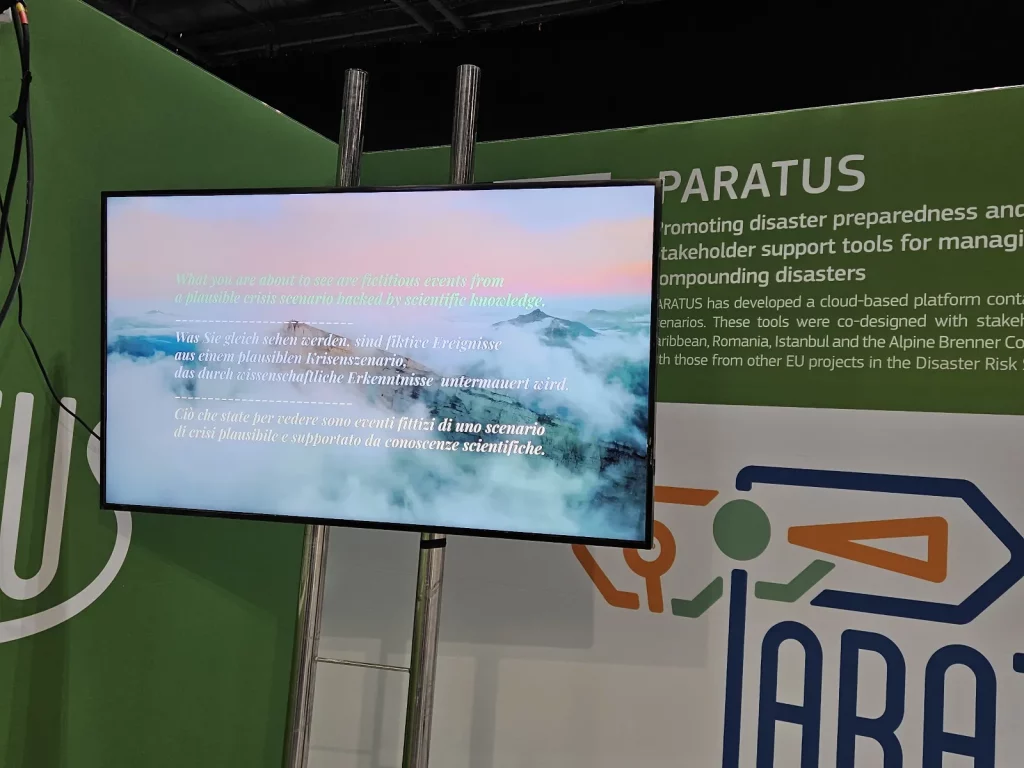
The PARATUS booth attracted considerable interest from visitors across the civil security community. Attendees explored the project’s systemic risk assessment approach, work on cascading hazards, and participatory co‑creation methods. In addition, our team’s representative, Michalina Kułakowska introduced the guest to new simulations, being developed as part of the project: Highwater Pantano, Bucur Simulaiton and Saltum Montem. Our participation in SRE offered an excellent opportunity to share knowledge, exchange ideas, and build connections with other EU security research projects and initiatives. It also marked an important step towards future collaboration and the transfer of project results into the broader European research and innovation ecosystem.
On behalf of the entire PARATUS team, we would like to thank the organisers and attendees for the opportunity to present our work!
The post PARATUS at the Security Research Event 2025 in Warsaw – advancing security through innovation appeared first on Centre for Systems Solutions.
]]>The post What Will We Eat in 2030? Two Days of Foodmission Workshops Behind Us! appeared first on Centre for Systems Solutions.
]]>Over two inspiring and fast-paced days, participants — including food bank representatives, educators, social organizations, catering professionals, and mindful consumers — collaborated to explore how we can build a more sustainable food system.
 What is Foodmission?
Foodmission is an international initiative aiming to create a digital platform rooted in citizen science. Its mission is to empower Europeans to make informed food choices, reduce food waste, and support a fair and healthy food system.
The project supports the EU’s Farm to Fork Strategy and the European Green Deal.
What makes Foodmission unique is its bottom-up approach: it’s being co-created by those who know food systems best — from activists and educators to producers, researchers, local officials, and end users. That’s where the T-Labs come in.
 Day 1: What Needs to Happen for a Sustainable Food System?
The first day focused on the backcasting method – planning “backwards from the future.” Participants created a shared vision of what a sustainable food system could look like in 2030, and then analyzed, and then mapped out the steps needed to make it a reality.
Concrete ideas emerged: social education, legislative changes, support for local initiatives, and improved cross-sector cooperation.
Key takeaway? Real change takes collective action — and the time to act is now.

 Day 2: Who Will Use the Foodmission Platform?
The second day focused on personas — fictional profiles of potential platform users. Participants created detailed character sketches, such as a sustainability-minded shopper or a parent looking for easy solutions, and asked:
- What do these users need?
- What might encourage or discourage them while using the platform?
- What platform features would they find helpful?
- How should we communicate with them?
The discussion brought forward practical ideas for platform design, content, and user engagement — all aimed at making Foodmission accessible, intuitive, and impactful.

 What’s Next?
We wrapped up with a reflection and feedback session — and the response was overwhelmingly positive. The level of insight, collaboration, and energy demonstrated how powerful diverse perspectives can be when united by a common goal.
The outcomes of both days will directly inform the ongoing development of the Foodmission platform.
Thank you to everyone who joined us. Stay tuned for future workshops and updates!
 Learn more: https://crs.org.pl/foodmission
  Contact us: [email protected]
The post What Will We Eat in 2030? Two Days of Foodmission Workshops Behind Us! appeared first on Centre for Systems Solutions.
]]>The post The Second Foodmission T-Lab Workshop Is Behind Us! appeared first on Centre for Systems Solutions.
]]>On May 6, 2025, we held the second interactive workshop as part of the Foodmission project, led by the Centre for Systems Solutions in collaboration with partners from across Europe. The aim of the project is to create an interactive platform that empowers people to make informed, healthy, and sustainable food choices – using data generated by citizens themselves.
What did we focus on during the session?
- Identifying key stakeholders in the food system and analyzing their influence and engagement.
- Exploring the potential of citizen science to support systemic transformation.
- Developing a framework for ethical and privacy-conscious data sharing and collaboration.
What did we discover?
Stakeholder Mapping
Participants mapped out a wide range of food system actors – from producers and public institutions to NGOs and consumers.
Key insights:
- Commercial actors and public institutions hold significant influence.
- Citizens and grassroots initiatives are underrepresented.
- There’s a strong need for better communication and integration of bottom-up perspectives.
The Influence–Interest Matrix
We then placed stakeholders into an influence–interest matrix, identifying four key groups:
- Strong allies (e.g., eco-conscious organizations with both high influence and strong engagement) – key partners for driving change.
- Influential but disengaged (e.g., media, major retail chains) – should be approached through value-driven messaging and strategic partnerships.
- Engaged but less influential (e.g., consumers, neighborhood groups) – need access to information and support to amplify their impact.
- Low-interest, low-influence stakeholders – should be monitored for future opportunities to engage.
 If you have feedback or additional thoughts about the stakeholder mapping or matrix exercises, feel free to get in touch:
[email protected]
Citizen Science as a Tool for Democratizing Knowledge
The second half of the workshop focused on citizen science as a powerful way to support the transition to more sustainable food systems – by empowering people to become active contributors and agents of change.
We introduced:
- The benefits of co-creating open, publicly accessible data sources,
- The FAIR principles (Findable, Accessible, Interoperable, Reusable),
- Essential data ethics and privacy considerations, including GDPR compliance.
Participants highlighted that:
- Trust and transparency are key to encouraging participation in citizen data initiatives.
- Clear and accessible information about the purpose and use of data is crucial.
Thank you to everyone who joined us for your thoughtful input and active participation.
#FOODMISSION #SustainableDiets #FoodSystemChange #CitizenScience #GamifiedEngagement #JoinTheMission
The post The Second Foodmission T-Lab Workshop Is Behind Us! appeared first on Centre for Systems Solutions.
]]>The opening activities of the T-Labs brought together an inspiring and diverse group of participants.
The post T-labs Meetings Take Off in Poland appeared first on Centre for Systems Solutions.
]]>The opening activities of the T-Labs brought together an inspiring and diverse group of participants: school and preschool canteen managers, municipal food project coordinators, university staff, NGO reps, and engaged food-conscious citizens. Across two online sessions in early April, we laid the groundwork for reimagining local food systems — together.
Here’s what happened:
We asked big questions.
What does sustainability really mean to each of us? How can we — as individuals, institutions, and communities — influence the food system?
We explored real expectations.
Participants shared their hopes for the project:
- Establishing a local food council
- Encouraging citizens of Wrocław to get involved in food-related initiatives
- Better understanding of the role we all play as food consumers
- Sharing knowledge and connecting across sectors
We started building a community.
Despite being online, the space was alive with energy and motivation. The sessions created room for mutual learning, honest exchange, and reflection — and set the tone for what’s next.
And what’s next is even more exciting!
We’re now inviting YOU to join our upcoming online and face-to-face workshops. Whether you’re working in food, passionate about sustainability, or just curious about
Expect interactive tools, gamification elements, idea-sharing, and plenty of inspiration.
Save your spot for the next meeting?: [https://docs.google.com/forms/d/1extfJphYhulAH7xpLv-5NwLtTbT6vfihphbFcbQ-SuI/edit]
Let’s co-create a smarter, healthier, and more sustainable food future — together.
#FOODMISSION #SustainableDiets #FoodSystemChange #CitizenScience #GamifiedEngagement #JoinTheMission
The post T-labs Meetings Take Off in Poland appeared first on Centre for Systems Solutions.
]]>The post FOODMISSION project has started appeared first on Centre for Systems Solutions.
]]>“Despite numerous initiatives and information campaigns, current food consumption patterns remain unsustainable from both health and environmental points of view. Citizens need to be empowered to make informed, healthy, and sustainable food choices and reduce food waste. Our goal is to give citizens an opportunity to see the tangible effects of their actions on the food system.” – announced Prof. Mæhle.
The FOODMISSIN project has set a goal of engaging citizens in a variety of activities, including those of a gamification nature. In the project, a virtual platform will be created, which combines educational content with tasks designed to motivate project participants to think critically and take action to minimize food waste and shop responsibly. Project participants will be assigned to “Transformation Labs” located in partner countries, where they will work together to implement the platform and other key project outcomes.
The FOODMISSION inaugural meeting gathered representatives from 8 European countries. Partners include four universities, two SMEs, one national consumer association, a representative from the retail sector, a social science and policy implementation organization, and an interest group of agribusiness and food companies.
The project will last 3 years and 6 months.
The post FOODMISSION project has started appeared first on Centre for Systems Solutions.
]]>