T7 Solution https://t7solution.com/ Tech That Cares Sat, 31 Jan 2026 12:32:04 +0000 en-US hourly 1 https://wordpress.org/?v=6.9.4 https://t7solution.com/wp-content/uploads/2025/07/cropped-favicon-32x32.png T7 Solution https://t7solution.com/ 32 32 241628854 WhatsApp Text Formatter Chrome Extension – Format WhatsApp Messages Easily https://t7solution.com/whatsapp-text-formatter-chrome-extension-format-whatsapp-messages-easily/ https://t7solution.com/whatsapp-text-formatter-chrome-extension-format-whatsapp-messages-easily/#respond Sat, 31 Jan 2026 08:34:47 +0000 https://t7solution.com/?p=5557 WhatsApp Text Formatter Chrome Extension makes it easy to format messages on WhatsApp Web using bold, italic, strikethrough, and monospace text. Designed […]

The post WhatsApp Text Formatter Chrome Extension – Format WhatsApp Messages Easily appeared first on T7 Solution.

]]>

WhatsApp Text Formatter Chrome Extension makes it easy to format messages on WhatsApp Web using bold, italic, strikethrough, and monospace text. Designed for professionals and businesses, this Chrome extension helps you send clearer, more attractive, and more impactful WhatsApp messages in seconds.

This extension allows you to format WhatsApp messages instantly with bold, italic, strikethrough, monospace, and stylish text — all with just a few clicks.

👉 Install Now:
https://chromewebstore.google.com/detail/whatsapp-text-formatter/kojiadifmpfeikldbgbhgoecbncpdjgf

What Is WhatsApp Text Formatter Chrome Extension?

WhatsApp Text Formatter is a lightweight and user-friendly Chrome extension designed to enhance your WhatsApp Web experience. It helps you convert normal text into professionally formatted messages without remembering complex shortcuts or symbols.

Whether you are:

  • A business owner

  • Digital marketer

  • Sales professional

  • Customer support executive

  • Or a regular WhatsApp user

This extension makes your communication clear, attractive, and impactful.

Key Features of WhatsApp Text Formatter

Bold Text – Highlight important words
Italic Text – Add emphasis naturally
Strikethrough Text – Show edits or offers
Monospace Text – Perfect for code & data
Stylish Formatting – Make messages stand out
One-Click Copy – Paste directly into WhatsApp
Works with WhatsApp Web
Fast, Lightweight & Secure

No login. No data tracking. Just pure productivity.

Why Use WhatsApp Text Formatter?

Typing special characters like *, _, or ~ every time is frustrating and error-prone.

Our Chrome extension:

  • Saves time
  • Reduces mistakes
  • Improves message clarity
  • Makes chats more professional
  • Boosts response rates for businesses

If you communicate daily on WhatsApp, this tool is a must-have.

How to Use WhatsApp Text Formatter Extension?

Using the extension is super simple 👇

  1. Install the extension from Chrome Web Store

  2. Open WhatsApp Web

  3. Type your message in the formatter box
  4. Select formatting (Bold / Italic / etc.)

  5. Copy & paste formatted text into WhatsApp

That’s it! ✨

Who Should Use This Extension?

  • Business Owners
  • Sales & Marketing Teams
  • Customer Support Agents
  • Freelancers
  • Digital Agencies
  • WhatsApp Power Users

Anyone who wants clean, readable, and professional messages.

Benefits for Businesses

  • Better customer communication
  • Clear offers & announcements

  • Professional brand impression
  • Higher engagement & replies
  • Saves manual formatting effort

Perfect for WhatsApp marketing, CRM conversations, and support chats.

Is WhatsApp Text Formatter Free?

Yes! 🎉

The extension is 100% free to use with no hidden charges.

Download Chrome Extension

👉 Install from Chrome Web Store: https://chromewebstore.google.com/detail/whatsapp-text-formatter/kojiadifmpfeikldbgbhgoecbncpdjgf

Start formatting your WhatsApp messages smarter and faster today.

Final Thoughts

Clear communication builds trust.

Formatted messages create impact.

With WhatsApp Text Formatter Chrome Extension, you can upgrade your WhatsApp conversations effortlessly — whether for business or personal use.

Install it once, and you’ll never go back to plain text again.

About the Developer

This is developed by T7 Solution, a software development company known for creating practical, easy-to-use tools that improve daily business communication and productivity.

The post WhatsApp Text Formatter Chrome Extension – Format WhatsApp Messages Easily appeared first on T7 Solution.

]]>
https://t7solution.com/whatsapp-text-formatter-chrome-extension-format-whatsapp-messages-easily/feed/ 0 5557
Java Architecture Reloaded: From SOLID to Spring Boot Superpowers https://t7solution.com/java-architecture-reloaded-from-solid-to-spring-boot-superpowers/ https://t7solution.com/java-architecture-reloaded-from-solid-to-spring-boot-superpowers/#respond Sat, 28 Jun 2025 17:49:09 +0000 https://t7solution.com/?p=3808 A deep-dive into modern Java architecture: SOLID principles, Clean Architecture, design patterns, Spring Boot best practices, and Java 17+ features.

The post Java Architecture Reloaded: From SOLID to Spring Boot Superpowers appeared first on T7 Solution.

]]>

Introduction: Not Your Grandma’s Java

Java isn’t just about public static void main anymore. It’s the backbone of enterprise systems, cloud-native apps, high-performance APIs, and modern microservices. With powerful paradigms like Clean ArchitectureSOLID principlesSpring Boot best practices, and Java 17+ features, Java today is leaner, cleaner, and meaner.
In this blog, we’ll explore:

  • The essence of SOLID in Java
  • Clean Architecture applied to enterprise systems
  • Java Design Patterns for scale
  • Spring Boot Best Practices
  • Cool new features in Java 17 and beyond

All in a fun, engaging tone made for Java developersenterprise architectsbackend engineers, and curious tech geeks who love clean, scalable backend systems.

The SOLID Foundation in Java

Let’s decode the SOLID principles and how they make your Java code awesome:

S — Single Responsibility Principle (SRP)

“A class should have only one reason to change.”

📌 Example:

class InvoicePrinter {
    public void print(Invoice invoice) {
        // Handles only printing logic
    }
}

class InvoiceRepository {
    public void save(Invoice invoice) {
        // Handles only DB persistence
    }
}

SRP helps keep business logic, UI, and persistence cleanly separated.

O — Open/Closed Principle (OCP)

“Software entities should be open for extension but closed for modification.”

📌 Strategy Pattern:

interface PaymentStrategy {
void pay(double amount);
}

class CreditCardPayment implements PaymentStrategy {
public void pay(double amount) {
// Pay using credit card
}
}

class PaymentService {
public void executePayment(PaymentStrategy strategy, double amount) {
strategy.pay(amount);
}
}

Add new payment types without changing PaymentService.

L — Liskov Substitution Principle (LSP)

“Derived classes must be substitutable for their base classes.”

📌 Avoid violating contracts:

class Bird {
    void fly() {}
}

class Ostrich extends Bird {
    // Uh oh — Ostriches can’t fly!
    @Override
    void fly() {
        throw new UnsupportedOperationException("Ostrich can't fly!");
    }
}

LSP reminds us: extend carefully, or you break the app.

I — Interface Segregation Principle (ISP)

“Clients should not be forced to depend on interfaces they do not use.”

📌 Don’t use fat interfaces:

interface Worker {
    void code();
    void cook();
}

// Better split:
interface Developer {
    void code();
}

interface Chef {
    void cook();
}

Smaller interfaces = fewer surprises.

D — Dependency Inversion Principle (DIP)

“Depend on abstractions, not concretions.”

📌 With Spring Boot:

@Service
class OrderService {
    private final PaymentGateway paymentGateway;

    @Autowired
    public OrderService(PaymentGateway paymentGateway) {
        this.paymentGateway = paymentGateway;
    }
}

interface PaymentGateway {
    void processPayment();
}

Use interfaces and Spring’s dependency injection.

Clean Architecture in Java — Onion Style!

Layered like an Onion

  1. Entities: Plain old Java objects (POJOs) — business rules
  2. Use Cases: Application logic (services)
  3. Interface Adapters: Controllers, REST, UI mappers
  4. Frameworks & Drivers: Spring Boot, DBs, APIs

Folder Structure:

src/
├── domain/ # Core business logic
│ ├── model/
│ └── service/
├── application/ # Use case orchestration
├── adapter/ # Controllers, REST
├── infrastructure/ # DB, external services
└── config/ # Spring Boot setup

“It’s like a well-built sandwich: layers, but no soggy bread.”

Design Patterns for Scale

Factory Pattern

Creates objects without specifying exact class.

class NotificationFactory {
public Notification create(String type) {
if (type.equals("email")) return new EmailNotification();
return new SMSNotification();
}
}

Singleton Pattern

One instance globally.

public class ConfigManager {
private static ConfigManager instance;
private ConfigManager() {}

public static synchronized ConfigManager getInstance() {
if (instance == null) instance = new ConfigManager();
return instance;
}
}

Builder Pattern

Create complex objects in steps.

User user = new User.Builder()
.name("Vaibhav")
.email("[email protected]")
.build();

Adapter Pattern

Bridges incompatible interfaces.

class LegacyPrinter {
void printOld(String data) {}
}

class PrinterAdapter implements Printer {
private final LegacyPrinter legacy;
void print(String data) {
legacy.printOld(data);
}
}

Modern Java 17+ Features You Should Be Using

Sealed Classes

Restrict inheritance:

public sealed class Shape permits Circle, Square {}

Pattern Matching (instanceof)

if (obj instanceof String s) {
System.out.println(s.toUpperCase());
}

Switch Expressions

String message = switch (status) {
case OK -> "All good!";
case ERROR -> "Something went wrong.";
default -> "Unknown";
};

Records

Data-holding classes made simple:

public record User(String name, String email) {}

Spring Boot Best Practices

  1. Use @ConfigurationProperties for clean config
  2. DTOs + Validation with @Valid and @NotNull
  3. Avoid business logic in controllers
  4. Use Profiles for dev/stage/prod
  5. Graceful Exception Handling with @ControllerAdvice
  6. Use OpenAPI/Swagger for client collaboration
  7. Enable Actuator + Micrometer for observability
  8. Database versioning with Flyway or Liquibase
  9. Keep Beans small and focused — back to SRP!

“Spring Boot isn’t magic — it’s well-structured convention.”

Fun Analogy: Java System = Airport

Java Element Airport Role
Entity (POJO) Passenger Info
Use Case Security + Check-in
Controller Ground Staff
Service Flight Operations
Repository Luggage Dept
Spring Boot Airport Terminal
Clean Architecture Airport Layout

“You don’t let pilots handle baggage — you don’t let your controller do business logic.”

Internal References

Conclusion

Today’s Java is powerful, modular, and expressive. By following SOLID principles, clean architecture, and leveraging Spring Boot + modern Java features, you can build:

  • Highly maintainable systems
  • Truly scalable services
  • Cleaner code that teams can rally behind

“From messy monoliths to microservice masterpieces — Java’s got your back.”

Need help architecting your Java backend? Connect with T7 Solution — Your system’s upgrade starts here!

The post Java Architecture Reloaded: From SOLID to Spring Boot Superpowers appeared first on T7 Solution.

]]>
https://t7solution.com/java-architecture-reloaded-from-solid-to-spring-boot-superpowers/feed/ 0 3808
Scalable ERP Architecture: Designing for Future Business Growth https://t7solution.com/scalable-erp-architecture-designing-for-future-business-growth/ https://t7solution.com/scalable-erp-architecture-designing-for-future-business-growth/#respond Tue, 10 Jun 2025 06:59:26 +0000 https://t7solution.com/?p=3664 In today’s dynamic business environment, growth is not just an aspiration but a necessity. However, as businesses expand, their operational complexities multiply. […]

The post Scalable ERP Architecture: Designing for Future Business Growth appeared first on T7 Solution.

]]>

In today’s dynamic business environment, growth is not just an aspiration but a necessity. However, as businesses expand, their operational complexities multiply. A common casualty of this rapid growth is the Enterprise Resource Planning (ERP) system, which can quickly become a bottleneck if not designed for scale. This article delves into the critical aspects of designing a scalable ERP architecture, ensuring your system can evolve alongside your business, supporting increased users, data volumes, and transactional loads without compromising performance or agility. We’ll explore the principles, technologies, and design considerations that underpin a future-proof ERP.

Why is Scalable ERP Architecture Crucial for Growing Businesses?

For any growing business, a scalable ERP architecture is not a luxury but a fundamental requirement. As your company expands, several factors will test the limits of your ERP system:

  • Increased User Load: More employees across different departments will need access to the ERP, performing various tasks simultaneously.
  • Growing Data Volume: Sales orders, customer data, inventory records, financial transactions – all these data points will surge, demanding robust storage and processing capabilities.
  • Higher Transaction Throughput: The number of transactions processed per second (e.g., order processing, inventory updates) will increase significantly.
  • New Business Processes and Functionalities: Expansion often means new product lines, market entries, or regulatory requirements, necessitating new modules or functionalities within the ERP.

A non-scalable ERP system crumbles under this pressure, leading to:

  • Performance Bottlenecks: Slow response times, system crashes, and reduced productivity.
  • Increased Maintenance Costs: Constant firefighting, patching, and expensive hardware upgrades become the norm.
  • Inability to Adapt: Difficulty in integrating new technologies or business models, stifling innovation.
  • Competitive Disadvantage: Slow decision-making due to inaccessible or outdated information.

Conversely, a well-designed scalable ERP architecture offers significant benefits:

  • Agility: Quickly adapt to changing market demands and business opportunities.
  • Cost-Efficiency: Optimize resource utilization, often through cloud services, paying only for what you use.
  • Improved Performance: Maintain optimal system responsiveness even during peak loads.
  • Future-Proofing: Build a system that can accommodate future growth and technological advancements.
  • Enhanced Decision Making: Reliable access to real-time data empowers better strategic choices.

Key Principles of Designing a Scalable ERP Architecture

Building a scalable ERP architecture involves adhering to several core design principles. These principles guide the development process to ensure the system can handle growth efficiently.

1. Modularity and Decoupling in ERP Systems

Breaking down the monolithic ERP into smaller, independent, and self-contained modules (e.g., Finance, Supply Chain Management (SCM), Customer Relationship Management (CRM), Human Resources) is paramount.

Benefits

  • Independent Scaling: Scale specific modules based on their individual demand (e.g., scale the SCM module during peak season without over-provisioning the HR module).
  • Targeted Development & Deployment: Teams can work on different modules concurrently, and updates to one module don’t necessitate a full system redeployment.
  • Fault Isolation: An issue in one module is less likely to bring down the entire ERP system.
  • Technology Diversity: Different modules can potentially use the most suitable technology stack for their specific function.
  • Microservices Architecture: This is an advanced form of modularity where the ERP is composed of fine-grained, independently deployable services. This approach offers maximum flexibility and scalability but also introduces complexity in management and orchestration.

2. Statelessness for Scalable ERP Performance

Application tiers within the ERP should be designed to be stateless wherever possible. This means that each request from a client to a server contains all the information needed for the server to fulfill the request, without relying on any stored session state on the server itself.

Benefits

  • Horizontal Scaling: Easily add or remove server instances without worrying about session data loss or replication.
  • Improved Resilience: If an instance fails, requests can be seamlessly routed to other healthy instances.
  • Simplified Load Balancing: Load balancers can distribute requests to any available server.

3. Asynchronous Communication in ERP Architecture

Instead of direct, synchronous calls between modules or services (where one service waits for another to respond), implement asynchronous communication patterns using message queues (e.g., Apache Kafka, RabbitMQ, AWS SQS).

Benefits

  • Decoupling: Services don’t need to know about each other directly; they just publish messages to or consume messages from a queue.
  • Improved Responsiveness: The calling service can respond quickly to the user without waiting for downstream processes to complete.
  • Load Leveling: Queues can absorb spikes in requests, preventing system overloads. For example, during a flash sale, orders can be queued and processed steadily by the backend systems.
  • Enhanced Reliability: If a consuming service is temporarily down, messages remain in the queue and can be processed once the service recovers.

4. Database Scalability for ERP Systems

The database is often the most challenging component to scale in an ERP system. Strategies include:

  • Read Replicas: Offload read-heavy queries to one or more read replicas, reducing the load on the primary write database.
  • Sharding/Partitioning: Distribute data across multiple database servers (shards) based on a shard key (e.g., customer ID, region). This allows for horizontal scaling of both reads and writes.
  • NoSQL Databases: For certain types of data or workloads (e.g., product catalogs, user session data, audit logs), NoSQL databases (like MongoDB, Cassandra) can offer better scalability and flexibility than traditional relational databases.
  • Efficient Data Modeling: A well-designed schema, proper indexing, and optimized queries are crucial regardless of the database technology used.
  • Connection Pooling: Efficiently manage database connections to prevent exhaustion under high load.

5. Elasticity and Auto-scaling in ERP Architecture

Leverage cloud infrastructure capabilities to automatically scale resources (compute, storage, database capacity) up or down based on real-time demand.

Benefits

  • Cost Optimization: Pay only for the resources consumed.
  • Performance Maintenance: Ensure sufficient resources are available during peak loads.
  • Operational Efficiency: Reduce manual intervention for capacity management.

Core Technologies Enabling Scalable ERP Architecture

Achieving a truly scalable ERP architecture requires leveraging modern technologies and components designed for distributed and high-demand environments.

Cloud Infrastructure for Scalable ERP (IaaS, PaaS, SaaS)

Cloud platforms (AWS, Azure, Google Cloud Platform) provide the foundational elasticity and managed services crucial for scalability.

  • IaaS (Infrastructure as a Service): Offers raw computing, storage, and networking resources that can be scaled on demand.
  • PaaS (Platform as a Service): Provides managed services like databases (e.g., Amazon RDS, Azure SQL Database), message queues, and application runtimes, reducing operational overhead.
  • SaaS (Software as a Service) ERP: Many vendors now offer their ERP solutions as SaaS, where scalability is largely managed by the provider. However, understanding the underlying architecture is still important for integration and customization.

Scalable ERP with Docker & Kubernetes

  • Docker: Packages applications and their dependencies into lightweight, portable containers. This ensures consistency across development, testing, and production environments.
  • Kubernetes: An open-source platform for automating the deployment, scaling, and management of containerized applications. Kubernetes can automatically scale ERP modules/microservices based on CPU usage or custom metrics.
  • Benefits: Efficient resource utilization, rapid deployment, automated scaling and self-healing, and simplified management of complex distributed systems.

API-Driven Scalable ERP Design

Design the ERP with an “API-first” approach. All functionalities and data should be accessible through well-defined, secure, and versioned APIs (Application Programming Interfaces).

Benefits

  • Facilitates Modularity: Modules communicate via APIs.
  • Easier Integration: Seamlessly connect the ERP with other enterprise systems (e.g., third-party logistics, e-commerce platforms, BI tools).
  • Supports Headless ERP: Allows for custom front-ends or mobile applications to interact with the ERP backend.
  • Enables an Ecosystem: Partners or even customers can build value-added services on top of your ERP data/functionality (with proper permissions).

Scalable ERP Database Solutions

Beyond the strategies mentioned earlier (read replicas, sharding):

  • NewSQL Databases: Combine the ACID guarantees of relational databases with the horizontal scalability of NoSQL systems (e.g., CockroachDB, Google Cloud Spanner).
  • Database Caching: Implement caching layers (e.g., Redis, Memcached) to store frequently accessed data in memory, reducing database load and improving response times.

Load Balancers for ERP System Scalability

Essential for distributing incoming network traffic across multiple servers (application servers, database replicas).

  • Benefits: Prevents any single server from becoming a bottleneck, improves availability (by routing traffic away from failed servers), and allows for seamless scaling by adding more servers to the pool.

Design Considerations for Scalable ERP Architecture

Beyond core principles and technologies, several practical design considerations are vital for a scalable ERP architecture.

Performance Testing in Scalable ERP Systems

  • Continuous Load Testing: Regularly simulate realistic user loads and transaction volumes to identify performance bottlenecks before they impact production. Test different scaling configurations.
  • Comprehensive Monitoring: Implement robust monitoring and alerting for key metrics:
  • System-level: CPU, memory, disk I/O, network traffic.
  • Application-level: Response times, error rates, transaction throughput per module.
  • Database-level: Query performance, connection counts, replication lag.
  • Queue-level: Message queue depth, processing times.
  • APM (Application Performance Management) Tools: Utilize tools like Dynatrace, New Relic, or Datadog for deep insights into application performance and distributed tracing.

Data Archiving Strategies for ERP Scalability

As data volumes grow, performance can degrade.

  • Data Tiering: Move less frequently accessed data to slower, cheaper storage.
  • Archiving: Regularly archive historical data that is no longer needed for daily operations but must be retained for compliance or occasional analysis.
  • Data Purging: Establish policies for purging obsolete data.
  • Database Maintenance: Regular tasks like index rebuilding and statistics updates are crucial.

Integration Strategies for Scalable ERP Architecture

ERPs rarely live in isolation. Scalable integration is key.

  • Standardized Integration Patterns: Use patterns like API gateways, message brokers, or an Enterprise Service Bus (ESB) for consistent and manageable integrations.
  • Scalable Integration Platforms (iPaaS): Cloud-based integration platforms can handle varying loads and simplify the connection between the ERP and other cloud or on-premise applications.
  • Consider Data Synchronization Frequency: Not all data needs real-time synchronization. Batch or near-real-time updates can be more efficient for some integrations.

Security at Scale in ERP Systems

Security measures must scale alongside the system.

  • Centralized Identity and Access Management (IAM): Ensure robust authentication and authorization that can handle a growing number of users and roles.
  • Scalable Network Security: Firewalls, intrusion detection/prevention systems (IDS/IPS) that can handle increased traffic.
  • Data Encryption: Ensure data is encrypted at rest and in transit, with scalable key management solutions.
  • Automated Security Audits and Compliance: Implement tools and processes for continuous security monitoring and compliance checks.

Future Trends in Scalable ERP Architecture

The landscape of ERP is continuously evolving, with new trends further enhancing scalability:

  • AI and ML for Predictive Scaling: AI algorithms can analyze historical usage patterns and predict future demand, proactively scaling resources before bottlenecks occur. ML can also optimize ERP workflows.
  • Serverless Architectures (FaaS – Function as a Service): For specific, event-driven tasks within an ERP (e.g., processing an incoming order notification), serverless functions can provide extreme scalability and cost-efficiency, as you only pay for the execution time.
  • Composable ERP: The move towards building ERP systems from best-of-breed, independent Packaged Business Capabilities (PBCs). These are self-contained software components representing specific business functions, which can be assembled and reassembled to create highly flexible and scalable ERP solutions.

Edge Computing for ERP: For global businesses, processing certain ERP transactions closer to the user (at the “edge”) can reduce latency and improve performance for specific regional operations.

Designing a scalable ERP architecture is an ongoing journey, not a one-time project. It requires a strategic approach that embraces modularity, leverages cloud capabilities, and prioritizes robust data management and integration. By focusing on the principles and technologies discussed, businesses can build or evolve their ERP systems to not only meet current demands but also to confidently support future growth and innovation. An investment in a scalable ERP is an investment in your company’s agility, efficiency, and long-term success.

Is your current ERP system ready for your business’s future?

Contact T7 Solution today to discuss how we can help you design, implement, or modernize your ERP system for optimal scalability, performance, and resilience.

The post Scalable ERP Architecture: Designing for Future Business Growth appeared first on T7 Solution.

]]>
https://t7solution.com/scalable-erp-architecture-designing-for-future-business-growth/feed/ 0 3664
How Generative AI in eCommerce is Transforming the Future https://t7solution.com/how-generative-ai-in-ecommerce-is-transforming-the-future/ https://t7solution.com/how-generative-ai-in-ecommerce-is-transforming-the-future/#respond Sun, 01 Jun 2025 01:55:35 +0000 https://t7solution.com/?p=3623 The eCommerce landscape is undergoing a revolutionary shift, driven by the capabilities of Generative AI in eCommerce. From automating content creation to […]

The post How Generative AI in eCommerce is Transforming the Future appeared first on T7 Solution.

]]>
The eCommerce landscape is undergoing a revolutionary shift, driven by the capabilities of Generative AI in eCommerce. From automating content creation to personalizing the shopping experience, generative AI is not just supporting eCommerce—it’s redefining it.

Whether you run a startup or a global brand, integrating generative AI is now a crucial step to staying competitive and delivering exceptional customer experiences.

What is Generative AI?

What is Generative AI?

Generative AI refers to advanced algorithms that can create new content such as text, images, and videos by learning from existing data. Unlike traditional AI, which focuses on analysis and classification, generative AI creates original content, making it a powerful tool for creative and customer-driven industries like eCommerce.

The Role of Generative AI in eCommerce

1. Personalized Customer Experience

Generative AI enables dynamic content generation tailored to individual customers. Examples include:

  • AI-generated product descriptions based on user behavior.
  • Personalized email marketing content.
  • Tailored website layout and visuals for different demographics.

Example: Shopify merchants are now using AI tools to auto-generate product descriptions and social media posts.

2. AI-Powered Product Design

Generative AI can help brands create multiple product prototypes in less time.

  • AI-generated fashion sketches
  • Custom design recommendations
  • Dynamic A/B testing of product visuals

Example: Brands like Nike and Adidas use AI to co-create custom shoe designs with consumers.

3. Visual Search & Product Discovery

AI models can generate images and enhance visual search by:

  • Creating new product photos from text input.
  • Enhancing low-quality images automatically.
  • Enabling visual product searches using uploaded photos.

4. Conversational AI & Virtual Assistants

Generative AI improves chatbot interactions using natural, human-like responses.

  • Real-time product recommendations
  • Handling FAQs with higher accuracy
  • Multilingual support for global consumers

Example: H&M uses AI chatbots to recommend clothing items based on user queries.

5. Content Generation at Scale

Creating compelling content consistently is tough, but Generative AI makes it easier:

  • Blog posts
  • SEO-friendly product descriptions
  • Social media captions

6. AI-Driven Product Innovation

Brands like ZARA are using generative AI to create new fashion lines and predict trends, significantly reducing time-to-market for new collections and ensuring customer alignment.

Customized eCommerce Solutions

Benefits of Generative AI in eCommerce
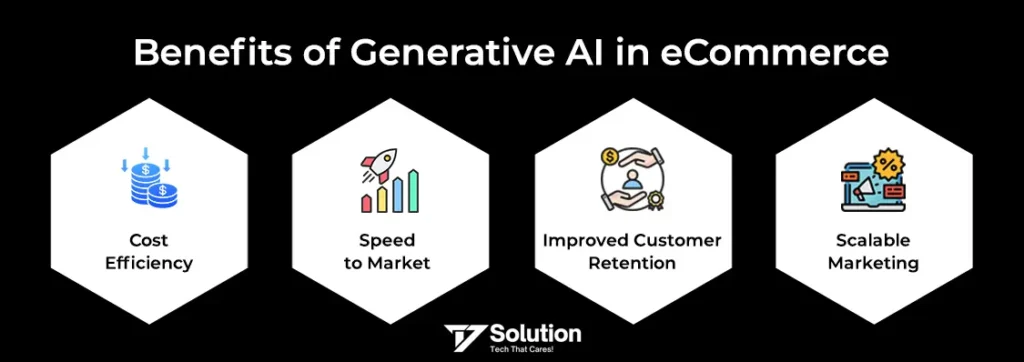
Benefits of Generative AI in eCommerce
  • Cost Efficiency: Reduces reliance on human input for repetitive tasks.
  • Speed to Market: Faster product iteration cycles.
  • Improved Customer Retention: Personalized engagement boosts loyalty.
  • Scalable Marketing: Enables dynamic campaigns across platforms.

Challenges to Consider

While the advantages are immense, Generative AI comes with challenges:

  • Data Privacy: User data must be handled ethically.
  • Accuracy: AI-generated content may contain errors.
  • Overreliance: Too much automation can remove the human touch.

Future Trends to Watch

  • AI-generated 3D product models
  • Virtual try-ons and avatars
  • Blockchain integration for AI-authenticated transactions
  • Real-time AI influencers and brand ambassadors

Final Thoughts

Generative AI in eCommerce is more than a trend—it’s a long-term enabler of digital transformation. Businesses that adopt and adapt early will gain a competitive edge in personalization, efficiency, and customer satisfaction.

Call to Action

Ready to integrate Generative AI into your eCommerce strategy?

Let our team help you build future-ready, AI-enhanced shopping experiences. Contact Us Now.

Stay updated with the latest in AI-driven eCommerce by subscribing to our newsletter!

The post How Generative AI in eCommerce is Transforming the Future appeared first on T7 Solution.

]]>
https://t7solution.com/how-generative-ai-in-ecommerce-is-transforming-the-future/feed/ 0 3623
Mobile Banking App Guide: Build a Secure and Scalable App https://t7solution.com/secure-scalable-mobile-banking-app/ https://t7solution.com/secure-scalable-mobile-banking-app/#respond Thu, 15 May 2025 07:18:03 +0000 https://t7solution.com/?p=3330 In a world where smartphones are our wallets, calculators, and financial advisors, a mobile banking app has become a critical touchpoint between […]

The post Mobile Banking App Guide: Build a Secure and Scalable App appeared first on T7 Solution.

]]>

In a world where smartphones are our wallets, calculators, and financial advisors, a mobile banking app has become a critical touchpoint between financial institutions and their customers.

This blog by T7 Solution is a comprehensive guide for banks, fintech startups, and financial service providers looking to build mobile banking apps that are resilient, compliant, and future-ready.

1: Define Core Features of a Mobile Banking App

Before any code is written, define the app’s functional scope. The best mobile banking apps offer essential financial operations while maintaining simplicity.

Must-Have Features:

  • User Registration & Login (email/phone + password, biometric login)
  • Account Management (balances, transactions, account details)
  • Fund Transfers (NEFT, RTGS, IMPS, UPI)
  • Card Management (freeze, set limits, request replacements)
  • Bill Payments & Recharge
  • Push Notifications
  • Live Chat or Chatbot Support
  • Expense Tracking & Budgeting

2: Build Your Mobile Banking App with Security at the Core

Security Strategies for Mobile Banking Apps:

  • End-to-End Encryption (AES-256, TLS 1.3)
  • Multi-Factor Authentication (MFA)
  • Biometric Authentication
  • API Security (OAuth 2.0, IP whitelisting)
  • Device Fingerprinting
  • Fraud Detection Engine
  • Security Logging & Alerts

Compliance You Can’t Ignore:

  • PCI-DSS
  • GDPR/CCPA
  • RBI/SEBI Guidelines
  • ISO/IEC 27001

3: Architect for Performance and Scalability

  • Microservices Architecture
  • Containerization (Docker + Kubernetes)
  • Cloud Infrastructure (AWS, Azure, GCP)
  • Load Balancers
  • CDN Integration

4: Select the Right Technology Stack

ComponentTechnologies
FrontendFlutter / React Native / Swift / Kotlin
BackendNode.js / Django / Spring Boot
DatabasePostgreSQL / MongoDB / Redis
CloudAWS / Azure / Google Cloud
SecurityOAuth 2.0 / JWT / SSL / Vault
CI/CDGitHub Actions / Jenkins / GitLab CI

5: Enable Real-Time Monitoring & Analytics

  • Performance Monitoring (New Relic, Datadog)
  • Crash Reporting (Crashlytics, Sentry)
  • Behavioral Analytics (Mixpanel, Amplitude)
  • Fraud Detection

6: Stay Compliant from Day One

  • Data Localization (RBI norms)
  • Audit Trails
  • Customer Consent
  • Secure Onboarding (KYC)

7: Focus on a Seamless User Experience (UX)

  • Simple Onboarding
  • Clean Layout
  • Accessibility Support
  • Dark Mode
  • Interactive Tutorials

8: Test, Optimize, Repeat

  • Unit Testing
  • Integration Testing
  • Load Testing
  • Security Testing
  • User Acceptance Testing (UAT)

9: Plan for Continuous Improvement

  • Weekly analytics monitoring
  • Monthly/quarterly updates
  • Immediate patching
  • User surveys & feedback

Conclusion: Think Long-Term. Build a Future-Ready Mobile Banking App

Building a secure and scalable mobile banking app is a strategic initiative. T7 Solution delivers fintech applications that are:

  • Built with security as the foundation 🔐
  • Engineered to scale under pressure 📈
  • Developed to meet global compliance standards 🌍
  • Crafted to deliver delightful user experiences 🎯

🚀 Let’s Build Your Mobile Banking App Together

Have an idea or need to modernize your legacy banking system?

📞 Contact T7 Solution to schedule a free consultation today!

The post Mobile Banking App Guide: Build a Secure and Scalable App appeared first on T7 Solution.

]]>
https://t7solution.com/secure-scalable-mobile-banking-app/feed/ 0 3330
Enterprise Software: Why It’s Essential for Large Businesses https://t7solution.com/enterprise-software-for-large-businesses/ https://t7solution.com/enterprise-software-for-large-businesses/#respond Thu, 15 May 2025 04:12:12 +0000 https://t7solution.com/?p=3239 Enterprise software is the foundation of digital transformation in large businesses. In today’s fast-paced world, companies can’t afford to operate with outdated […]

The post Enterprise Software: Why It’s Essential for Large Businesses appeared first on T7 Solution.

]]>

Enterprise software is the foundation of digital transformation in large businesses. In today’s fast-paced world, companies can’t afford to operate with outdated systems or disconnected processes. Scalable and integrated software helps streamline operations, drive insights, and boost efficiency.

Understanding Enterprise Software: More Than Just Business Tools

Comprehensive, scalable, and integrated applications designed to support the core functions of a business — from accounting and human resources to customer relationships and supply chain management.

Unlike personal apps, enterprise software for large businesses focuses on automation, collaboration, and real-time decision-making across departments and locations.

Common Types of Enterprise Software

  • ERP (Enterprise Resource Planning): Integrates finance, HR, inventory, and operations.
  • CRM (Customer Relationship Management): Manages sales, service, and marketing.
  • SCM (Supply Chain Management): Coordinates logistics, procurement, and warehousing.
  • BI (Business Intelligence): Delivers dashboards, reports, and data insights.
  • HCM (Human Capital Management): Automates payroll, onboarding, and compliance.

Why Is Enterprise Software Critical for Large Businesses?

Centralized Operations Across All Departments

Ensures company-wide consistency and communication. No more disconnected apps!

Real-Time Data for Smart Decisions

Leaders can make decisions using data—not guesswork—with the help of dashboards and KPIs.

Efficiency Through Automation

Time-consuming manual tasks like invoice entry or scheduling can be fully automated with tools like Zapier and ERP integrations.

Security & Regulatory Compliance

Built-in security features help companies comply with GDPR, SOX, and other regulations.

Superior Customer Experience

With a robust CRM, businesses can offer seamless, personalized, and consistent customer interactions across channels.

Scalability That Matches Business Growth

Enterprise software can scale effortlessly as your business grows—no need for complete overhauls.

Real-World Impact of Enterprise Software

Imagine a manufacturing firm struggling with late shipments and inventory mismatches. After implementing an ERP solution:

  • Inventory updates happen in real-time
  • Finance and procurement teams work in sync
  • Delivery timelines improve
  • Operating costs drop by 15%

This is the true impact of the right enterprise solution.

How T7 Solution Helps You Succeed

At T7 Solution, we don’t just provide off-the-shelf tools — we deliver fully customized enterprise software solutions tailored to your business model and industry goals.

We specialize in:

  • ERP & CRM implementation and integration
  • Custom automation & reporting tools
  • Secure cloud hosting
  • Scalable architectures for growth
  • Ongoing support and optimization

Ready to Future-Proof Your Business?

Let enterprise software take the complexity out of your operations and transform your business into a data-driven, streamlined powerhouse.

👉 Contact T7 Solution today for a free consultation!

📧 Email: [email protected]
🌐 Website: https://t7solution.com/contact-us

The post Enterprise Software: Why It’s Essential for Large Businesses appeared first on T7 Solution.

]]>
https://t7solution.com/enterprise-software-for-large-businesses/feed/ 0 3239