The post DAFs Are No Longer a Nice-to-Have. They’re a Proven Growth Engine. appeared first on TIFIN.
]]>All of that is true. But it’s incomplete.
What’s increasingly clear is this: when implemented thoughtfully, DAFs are not just a planning feature. They are a durable growth driver for wealth firms.
At Give, this has been a core belief from day one. Philanthropy, when designed around advisors and embedded into the wealth experience, can unlock growth across advisors, assets, and client relationships.
Now we have proof.
From Legacy Program to Scalable Growth: AssetMark’s DAF Evolution
In mid-2024, AssetMark made a deliberate decision to evolve its donor-advised fund program to better meet the needs of advisors and clients. While the program had a solid foundation, advisor engagement and growth had remained relatively steady over time. AssetMark saw an opportunity not just to modernize the underlying technology, but to reimagine how charitable giving could more directly support advisor-led growth.
AssetMark partnered with Give in June 2024 to transition its DAF program to a fully digital, advisor-centric experience. The platform is designed to integrate seamlessly into advisors’ existing workflows and planning conversations.
Just as importantly, the program made tax-efficient charitable giving simple and turnkey for advisors. Contributions could be aligned with high-income years, liquidity events, and appreciated assets, without introducing operational complexity or separate workflows. That clarity lowered the barrier to entry for advisors and made the DAF an easy extension of existing planning conversations rather than a standalone specialty offering.
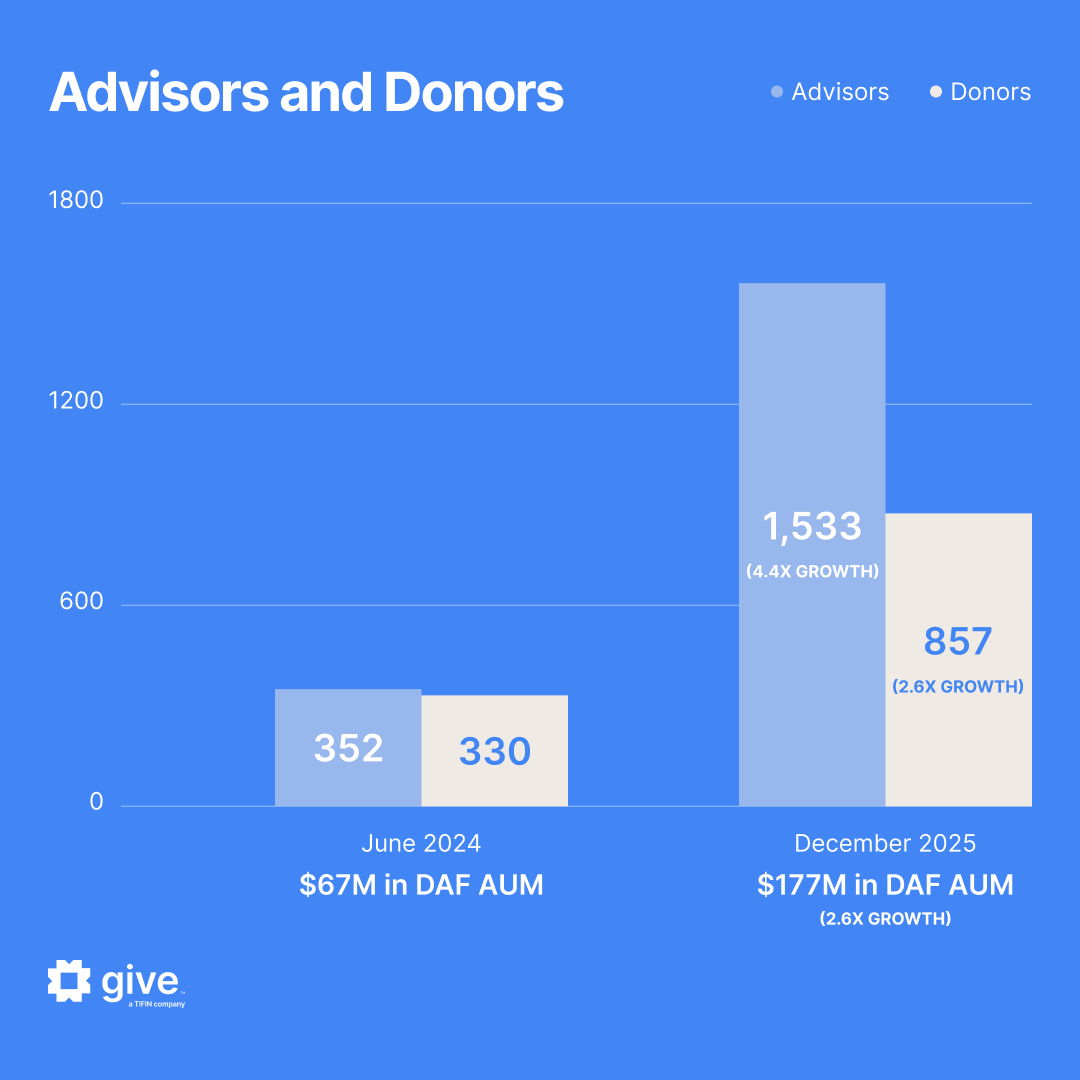

This is what happens when philanthropy is easy to adopt, easy to use, and deeply aligned with how advisors actually work.
Why Modern DAFs Drive Growth
The AssetMark experience reinforces something we see consistently across firms: DAF growth is not accidental. It’s structural.
When done right, modern DAF platforms unlock growth in three critical ways.
- Advisor engagement scales first
Advisors don’t adopt philanthropy tools because they’re told to. They adopt them because they help them deepen client relationships, create differentiated conversations, and deliver real planning value. A seamless, advisor-led DAF experience removes friction and invites participation. - Assets stay closer to the advisor
Traditional charitable workflows often push assets away from the advisor ecosystem. Modern DAFs do the opposite. They keep charitable assets visible, invested, and connected to broader planning strategies, including tax management and multi-generational engagement. When tax-efficient giving is built directly into the advisor workflow, whether to offset capital gains, manage high-income years, or plan around liquidity events, advisors can proactively surface opportunities rather than react to year-end tax pressure. - Client relationships expand beyond transactions
Philanthropy creates continuity. It introduces family members. It opens values-based conversations. It turns episodic planning into an ongoing relationship. Growth follows trust, and trust compounds when advisors help clients give with intention.
Technology Is the Enabler, Not the Strategy
It’s tempting to look at AssetMark’s results and credit technology alone. That misses the point.
Technology is the enabler. Strategy is the driver.
AssetMark didn’t grow its DAF program simply by upgrading software. It grew by embracing a belief that philanthropy belongs at the center of the advisory experience, not on the sidelines.
As David McNatt, Head of Wealth Solutions at AssetMark, put it:
“Modernizing our DAF experience wasn’t about adding a feature. It was about creating an experience advisors would actually use. The shift unlocked advisor adoption, improved client engagement, and ultimately drove meaningful growth.”
That alignment between belief, experience, and execution is what turns DAFs into a growth engine rather than a static offering.
The Bigger Signal for the Industry
The broader context matters. Donor-advised funds continue to grow rapidly across the industry, fueled by tax complexity, generational wealth transfer, and evolving client expectations. But growth in the category alone doesn’t guarantee growth for firms.
What AssetMark demonstrates is that intentional design matters. Firms that treat DAFs as a checkbox will see limited impact. Firms that treat philanthropy as a strategic lever for advisor-led growth will see measurable results.
This is the shift we believe the industry is now ready to make.
DAFs are no longer just about giving. They’re about growth.
And the data is starting to prove it.
TIFIN Give does not offer legal or tax advice. Please consult the appropriate professional regarding your individual circumstance.
Mutual Funds and Exchange Traded Funds (ETF’s) are sold by prospectus. Please consider the investment objectives, risks, charges, and expenses carefully before investing. The prospectus, which contains this and other information about the investment company, can be obtained from the Fund Company or your financial professional. Be sure to read the prospectus carefully before deciding whether to invest. An investment in the Fund involves risk, including possible loss of principal.
A donor‑advised fund is a charitable giving account held at a sponsoring organization (e.g., Fidelity Charitable, Schwab Charitable, a community foundation). When you contribute to a DAF, your contribution becomes an irrevocable charitable gift and the assets legally belong to the sponsoring nonprofit.
The post DAFs Are No Longer a Nice-to-Have. They’re a Proven Growth Engine. appeared first on TIFIN.
]]>The post TIFIN Give to Power Donor-Advised Fund Experience for Confluence Financial Partners appeared first on TIFIN.
]]>BOULDER, CO – February 26, 2026 – TIFIN Give today announced a new partnership with Confluence Financial Partners, a client-centric wealth management firm recognized for its strong community commitment and personalized approach to financial planning. Serving more than 4,500 families across five offices and overseeing approximately $7 billion in assets (as of February 19, 2026), Confluence will integrate TIFIN Give’s donor-advised fund (DAF) offering to deliver a modern, advisor-led philanthropy platform for its clients and their families.
Confluence Financial Partners has built its reputation on helping clients maximize their lives and legacies through personalized planning, strategic investing, and a deep commitment to the communities they serve. By integrating TIFIN Give’s digital DAF platform into its offering, the firm is extending that commitment and making charitable planning a seamless, strategic part of its broader wealth management approach.
“At Give, we believe philanthropy should be fully integrated into the wealth experience and not treated as a standalone product,” said Paul Lussow, CEO of TIFIN Give. “Confluence shares that philosophy. Their deep community roots and family-first mindset make them an ideal partner, and we are proud to support their advisors with a platform that strengthens both impact and relationships.”
A Differentiated, Family-Centered Giving Platform
Through TIFIN Give’s technology, Confluence advisors can offer a fully digital donor-advised fund solution that supports tax-efficient contributions of cash and complex assets, provides advisor-managed investment flexibility, engages multiple generations of families, and simplifies reporting and administration.
Family engagement capabilities were a key factor in Confluence’s decision. The platform enables families to define shared missions, involve heirs in giving decisions, and build philanthropic legacies that extend across generations within a secure and intuitive digital environment.
“Our clients care deeply about their families and the communities they serve,” said Gregory Weimer, CFP®, CPA, President at Confluence Financial Partners. “We wanted a donor-advised fund solution that reflects those values and makes giving thoughtful, strategic, and engaging for the entire family. TIFIN Give allows us to elevate philanthropy within our planning conversations while delivering a truly differentiated offering.”
Donor-advised funds are the fastest-growing charitable vehicle in the United States, now representing more than $250 billion in assets and continuing to gain momentum. As wealth management evolves toward more holistic planning, firms increasingly recognize that philanthropy is not just a client benefit, but a meaningful driver of relationship depth, multi-generational engagement, and long-term growth.
About TIFIN Give
Give, a TIFIN company, is a donor-advised fund (DAF) platform that enables wealth firms to grow assets and strengthen relationships through modern philanthropy. By engaging the next generation, offering unmatched investment flexibility, and integrating tax-efficient strategies, TIFIN Give turns charitable giving into a strategic lever for client retention, acquisition, and expansion.
The TIFIN Group LLC (TIFIN) is a platform of products and companies that apply AI for financial services, with a focus on wealth management, asset management and insurance. TIFIN’s companies include Magnifi, TIFIN @Work, TIFIN Sage, TIFIN AG, TIFIN AMP, TIFIN Wealth, Helix, Give and TIFIN AXIS. TIFIN is backed by leading investors including J.P. Morgan, Morningstar, Hamilton Lane, Franklin Templeton and SEI, among others.
About Confluence Financial Partners
Confluence Financial Partners is a wealth management firm dedicated to helping clients achieve their financial goals through personalized strategies and guidance. With a commitment to integrity, innovation, and long-term relationships, Confluence helps to empower individuals and families to make confident decisions about their financial future. For more information, visit www.confluencefinancial.com.
Media Contact
Samantha Davison
[email protected]
TIFIN Give does not offer legal or tax advice. Please consult the appropriate professional regarding your individual circumstance.
Mutual Funds and Exchange Traded Funds (ETF’s) are sold by prospectus. Please consider the investment objectives, risks, charges, and expenses carefully before investing. The prospectus, which contains this and other information about the investment company, can be obtained from the Fund Company or your financial professional. Be sure to read the prospectus carefully before deciding whether to invest. An investment in the Fund involves risk, including possible loss of principal.
A donor‑advised fund is a charitable giving account held at a sponsoring organization (e.g., Fidelity Charitable, Schwab Charitable, a community foundation). When you contribute to a DAF, your contribution becomes an irrevocable charitable gift and the assets legally belong to the sponsoring nonprofit.
Confluence works with a variety of donor-advised fund sponsors to support clients’ charitable planning goals, including TIFIN Give. Confluence does not receive compensation from TIFIN Give for referrals. TIFIN Give is an independent organization and is not affiliated with Confluence. Confluence Wealth Services, Inc. d/b/a Confluence Financial Partners is an SEC-registered investment adviser. Registration of an investment adviser does not imply any level of skill or training. Please refer to our Form ADV Part 2A and Form CRS for further information regarding our investment services and their corresponding risks. Additional information about Confluence Wealth Services, Inc. is available on the Investment Adviser Public Disclosure (IAPD) website at: www.adviserinfo.sec.gov.
The post TIFIN Give to Power Donor-Advised Fund Experience for Confluence Financial Partners appeared first on TIFIN.
]]>The post TIFIN named to The Agentic List 2026 appeared first on TIFIN.
]]>The post Bridging the Final Mile in Philanthropy appeared first on TIFIN.
]]>Yet one persistent challenge remains. The final mile of charitable giving, the moment funds actually arrive at a nonprofit, has not kept pace with the rest of the donor experience. While donors and advisors can determine giving strategies with speed and precision, grant payments themselves often move through outdated, fragmented systems that slow delivery and add administrative burden.
This friction is not simply an inconvenience. Research from the World Bank shows that inefficient last-mile payment systems reduce trust, delay outcomes, and limit the effectiveness of funds intended for impact. While much of this research focuses on development and social programs, the same principles apply to philanthropy. When charitable dollars stall in process, the effectiveness of giving is diminished at exactly the moment it is meant to do the most good.²
The Last-Mile Opportunity in Modern Giving
In financial services, last-mile payments refer to the final transfer of funds to the end recipient. Across industries, expectations around this step have changed dramatically. Research from McKinsey shows that individuals and institutions increasingly expect payments to be fast, transparent, and digitally native, regardless of context.³ Philanthropy is no exception.
Within the DAF ecosystem, grant payments often involve multiple stakeholders, including donor platforms, sponsoring organizations, intermediaries, and nonprofits. Each handoff introduces friction, delay, and risk. When the final step is slow or opaque, donor confidence erodes and nonprofit operations are strained.
Innovating Grant Payments Together: TIFIN Give and Chariot
The partnership between TIFIN Give and Chariot is designed to address this challenge by modernizing how charitable dollars move from donor intent to nonprofit impact.
TIFIN Give provides a modern, advisor-led donor-advised fund platform that integrates charitable giving into broader wealth and tax strategies. Chariot complements this approach with a payments infrastructure purpose-built for philanthropy, enabling electronic, data-rich grant disbursements directly to nonprofits.
Together, the platforms reduce friction at the most critical point in the giving journey. Donors gain confidence that grants are delivered quickly and securely. Once approved, payments are instantly sent to nonprofits’ Chariot accounts, with real-time status updates visible in TIFIN Give. The underlying financial infrastructure ensures accounts are thoroughly vetted and continuously monitored for compliance. Advisors and DAF providers benefit from reduced operational complexity, while nonprofits receive funds faster, with greater transparency and fewer administrative hurdles.
Why This Moment Matters
Several trends make this work especially timely. DAFs continue to grow as a preferred giving vehicle. As people grow accustomed to seamless, thoughtful digital experiences across every aspect of their financial lives, they now expect the same in charitable giving. At the same time, nonprofits are under pressure to do more with less, making fast, efficient payment flows more critical than ever.
Above all, trust remains the foundation of philanthropy. Clear, reliable grant payments reinforce confidence across the ecosystem, strengthening long-term engagement between donors, advisors, and the organizations they support.
A Shared Vision for the Future of Giving
The TIFIN Give and Chariot partnership reflects a shared belief. Technology should simplify giving, not complicate it.
By modernizing last-mile grant payments, we can ensure that generosity moves with the same speed, clarity, and intention that defines today’s best financial experiences. The future of philanthropy will not be defined solely by how much is given, but by how effectively that generosity reaches the causes it is meant to serve.
The post Bridging the Final Mile in Philanthropy appeared first on TIFIN.
]]>The post From Access to Action: Why Growth in Wealth Management Is an Intelligence Problem appeared first on TIFIN.
]]>- Access to data.
- Access to tools.
- Access to products.
- Access to clients.
And yet, organic growth remains stubbornly difficult.
Advisors often feel overwhelmed rather than empowered. Leadership teams struggle to produce consistent, repeatable results. Firms continue to ask the same question: why hasn’t all of this investment translated into growth? The answer isn’t a lack of effort or ambition. It’s a lack of intelligence.
More Data Has Not Led to Better Decisions
Most wealth enterprises already believe they have what they need. CRM platforms, data warehouses, client segmentation models, dashboards, reports, and marketing automation tools are firmly in place.
But more data has not produced more clarity. In many cases, it has made decision-making harder.
Advisors are asked to interpret dozens of signals across disconnected systems, each offering only a partial view of the client. Leadership teams rely on backward-looking metrics that explain what happened but offer little guidance on what to do next. Marketing generates engagement data that rarely translates into consistent advisor action.
The result is predictable. Everyone is busy, but not always focused on the right opportunities. Data alone does not create momentum. Without context and prioritization, it creates noise.
Growth requires something different: intelligence that helps firms decide where to act.
The Hidden Cost of Unfocused Advisor Effort
Advisors don’t struggle because they aren’t working hard. They struggle because they are forced to make too many decisions without enough guidance.
On any given day, an advisor may be balancing client reviews, prospect outreach, cross-sell and expansion opportunities, referrals from a bank or branch network, marketing-driven leads, and internal product priorities. Without clear prioritization, effort gets spread thin. High-potential opportunities look the same as low-probability ones, and advisors default to what feels familiar instead of what is most impactful.
Over time, this lack of focus creates real costs: missed wallet-share opportunities, slower conversion rates, advisor frustration and burnout, and uneven client experiences across the enterprise. The issue isn’t motivation. It’s direction.
Why Dashboards Are Not Enough
Many firms attempt to solve this problem by building better dashboards—aggregating data into centralized views and expecting insights to emerge.
But dashboards still require interpretation. They show what happened, not what to do next, and they place the burden of prioritization back on advisors and managers who are already stretched thin.
True growth doesn’t come from visibility alone. It comes from decision support—intelligence that connects signals across the enterprise and translates them into clear, prioritized actions. This is the shift wealth management must make: moving from reporting performance to guiding behavior.
Growth Is an Intelligence Problem, Not an Access Problem
At its core, organic growth in wealth management depends on consistently answering three questions:
- Which clients and prospects represent the best opportunities right now?
- Which advisor is best positioned to engage them successfully?
- What is the most relevant action to take in this moment?
Answering those questions across thousands of advisors and millions of client relationships requires more than enrichment tools or point solutions. It requires an enterprise intelligence layer that unifies data across banking, wealth, CRM, and engagement systems; applies supervised AI to identify patterns tied to real outcomes; learns from advisor behavior and client response; and scales decision-making across the organization.
This is where intelligence replaces guesswork.
From Dashboards to Direction
When firms move from access to intelligence, the experience changes meaningfully. Advisors receive prioritized guidance instead of static lists. Leadership gains forward-looking insight rather than purely historical reporting. Marketing, sales, and advice teams align around the same signals and definitions of opportunity.
As a result, growth becomes more consistent and more scalable. Instead of asking advisors to do more, firms help them focus on what matters most. Instead of flooding teams with information, they provide clarity. Instead of hoping the right connections happen, they engineer them intentionally.
The Enterprise Advantage
This shift is especially critical at the enterprise level. Individual advisors cannot unify data across banking, lending, wealth, and marketing systems on their own. They cannot build models that learn from firm-wide outcomes or scale best practices across thousands of peers.
Enterprise intelligence changes that. It allows firms to convert deposit relationships into wealth opportunities, expand wallet share with existing clients, improve advisor confidence and effectiveness, and deliver more consistent client outcomes across channels…not by replacing advisors, but by amplifying their impact.
The Future of Growth Is Focus
Wealth management doesn’t have an access problem, it has a focus problem.
The firms that win won’t be the ones with the most data or the most tools. They’ll be the ones that turn intelligence into action at scale. Growth isn’t about doing more. It’s about knowing where to act next, and having the systems in place to make that decision consistently.
That is the real intelligence challenge.
The post From Access to Action: Why Growth in Wealth Management Is an Intelligence Problem appeared first on TIFIN.
]]>The post TIFIN Give Partners with SEI to Deliver White-Labeled Donor- Advised Fund Solutions to Bank and Trust Clients appeared first on TIFIN.
]]>BOULDER, CO – January 29, 2026 – TIFIN Give, the modern donor-advised fund platform designed for wealth organizations to drive growth through philanthropy, today announced a new partnership with SEI® to deliver a white-labeled donor-advised fund (DAF) solution to SEI’s bank and affiliated wealth clients. This collaboration expands on SEI’s 2024 strategic investment in TIFIN to advance innovation and growth across the industry.
Through the partnership, TIFIN Give serves as a solution provider for SEI, powering a digital, branded charitable giving experience that banks and trust organizations offer directly to their clients. Purpose-built for banks and trust operating models, TIFIN Give combines a branded donor experience with end-to-end administration and investment flexibility in a single platform. The solution enables SEI’s network of bank, affiliated wealth, and independent trust companies to launch proprietary charitable funds under their own brand with streamlined onboarding, grantmaking, and reporting workflows built for day-to-day operations.
Many bank and trust organizations have seen charitable assets migrate outside their ecosystem to large national providers due to the absence of a modern, in-house DAF offering. This partnership addresses that gap by giving banks a turnkey solution that allows them to retain assets, deepen client relationships, and engage the next generation through philanthropy.
“Charitable giving has become a core component of holistic wealth planning, yet too many banks and trust organizations have been forced to outsource it or lose it altogether,” said Greg Murray, Chief Revenue Officer of TIFIN Give. “Together with SEI, we are enabling banks to offer a modern, white-labeled DAF experience that keeps charitable assets within their ecosystem while strengthening client and next-generation relationships.”
“Banks and trust organizations are increasingly turning to modern technology to deliver a more differentiated and holistic wealth experience,” said Allie Carey, Global Head of Strategy for SEI’s Private Banking and Wealth Management business. “At SEI, we are committed to helping our clients stay competitive and accelerating their growth. Through the TIFIN Give platform, we are expanding our capabilities to support bank and trust clients with a seamless, white-labeled donor-advised fund experience that integrates charitable giving into their broader wealth and trust strategies.”
The TIFIN Give platform provides a fully digital, intuitive experience that simplifies administration for bank teams while delivering transparency, ease of use, and flexibility for donors. The solution supports branded donor-advised funds, streamlined grantmaking, and integrated workflows designed to reduce operational friction and improve the overall client experience.
For SEI’s bank and trust clients, the offering represents an opportunity to transform philanthropy into a strategic growth lever that supports asset retention, enhances client loyalty, and positions charitable planning as a long-term revenue and relationship driver.
About TIFIN Give
Give, a TIFIN company, is a donor-advised fund (DAF) platform that enables wealth firms to grow assets and strengthen relationships through modern philanthropy. By engaging the next generation, offering unmatched investment flexibility, and integrating tax-efficient strategies, TIFIN Give turns charitable giving into a strategic lever for client retention, acquisition, and expansion.
The TIFIN Group LLC (TIFIN) is a platform of products and companies that apply AI for financial services, with a focus on wealth management, asset management and insurance. TIFIN’s companies include Magnifi, TIFIN @Work, TIFIN Sage, TIFIN AG, TIFIN AMP, TIFIN Wealth, Helix, Give and TIFIN AXIS. TIFIN is backed by leading investors including J.P. Morgan, Morningstar, Hamilton Lane, Franklin Templeton and SEI, among others.
About SEI®
SEI (NASDAQ:SEIC) is a leading global provider of financial technology, operations, and asset management services within the financial services industry. SEI tailors its solutions and services to help clients more effectively deploy their capital—whether that’s money, time, or talent—so they can better serve their clients and achieve their growth objectives. As of Dec. 31, 2025, SEI manages, advises, or administers approximately $1.9 trillion in assets. For more information, visit seic.com.
Media Contacts
Tanya Bhasin
TIFIN
[email protected]
408-332-1750
Alicia Rudd
SEI®
[email protected]
610-676-3887
The post TIFIN Give Partners with SEI to Deliver White-Labeled Donor- Advised Fund Solutions to Bank and Trust Clients appeared first on TIFIN.
]]>The post Building AI Pilots That Actually Drive Growth appeared first on TIFIN.
]]>The reality is there is no magic formula for organic growth. What works for one firm, channel, or advisor population may not work for another. Sustainable growth comes from testing, learning, refining, and then building a repeatable process around what works. In that sense, pilots aren’t just a step toward growth, they are the growth process.
After supporting many firms through AI pilots tied to organic growth use cases, a few consistent patterns have emerged. While flexibility is essential, thoughtful cohort design can dramatically improve both pilot outcomes and long-term adoption.
One principle stands above the rest: your pilot participants will eventually become your champions. Their experience—positive or negative—will shape how the broader advisor population perceives the technology. Selecting the right cohort is not just about testing functionality; it’s about building credibility and momentum.
Below are several considerations wealth leaders may find useful when designing AI pilot groups. While informed by organic growth use cases, these principles are broadly applicable across most AI pilots.
Advisor Tenure
Advisor tenure plays a meaningful role in how AI is adopted and where it delivers the most value.
- Less-tenured advisors are often highly focused on growth. They may be prospecting actively, building habits, and looking for leverage. AI tools that help prioritize leads, surface opportunities, or reduce manual work often align well with this stage.
- More seasoned advisors typically manage larger, more complex books. While they may prospect less, they often benefit from AI in wallet-share expansion, client prioritization, and identifying underpenetrated relationships.
Neither profile is inherently better. The key is aligning the pilot use case to where advisors are in their careers.
Book Size
Book size introduces a different dynamic from tenure alone.
Advisors with smaller books often have deep familiarity with their households and frequent touchpoints. While growth remains important, incremental technology may feel less immediately necessary.
Advisors with larger books, on the other hand, often struggle with prioritization. Time is constrained, engagement is uneven, and growth opportunities can be difficult to surface systematically. For these advisors, AI can provide meaningful leverage by identifying where attention is likely to produce the greatest impact.
For many firms, larger books create clearer early value signals in growth-oriented pilots.
Ideal Book Demographics
Beyond overall book size, the composition of an advisor’s book can materially influence the effectiveness of an AI pilot.
The most obvious dimension is client size. While many advisors aspire to move upmarket, in practice most serve a mix of clients. As a result, mass affluent relationships—often viewed as transitional—can represent an outsized growth opportunity when supported by the right tools.
AI-driven growth use cases tend to perform especially well in mass affluent and HNW segments:
- The addressable market is larger
- There is more structured and external data available
- Growth opportunities are more repeatable and scalable
UHNW clients remain critically important, but they are fewer in number, often intentionally diversify across firms, and tend to have less publicly available data. AI can still add value—but expectations and success metrics should be calibrated accordingly.
Client size, however, is only one part of the equation. Increasingly, the most effective growth pilots also consider how an advisor’s book aligns with emerging opportunities across the wealth ecosystem.
Examples include:
- Generational wealth transfer opportunities, where assets are likely to move or be reallocated over time
- NextGen relationships, where advisors have access to heirs or beneficiaries but limited engagement today
- Gen X and Millennial households, which often represent future growth potential rather than current wallet share
- Women-led households, where transitions, life events, or changing decision dynamics can create meaningful engagement opportunities
Advisors whose books naturally skew toward these segments often see greater lift from AI, as these opportunities benefit from prioritization, timely outreach, and proactive engagement.
Another important—and often overlooked—dimension is the mix of brokerage versus advisory assets within the book. Advisors with a meaningful brokerage business frequently have clear opportunities to transition assets to advisory relationships. AI can help identify which households are most likely candidates for deeper advice, enabling more focused and relevant conversations.
Taken together, understanding book demographics helps firms move beyond a one-size-fits-all pilot. When AI use cases are aligned to the actual growth opportunity embedded in an advisor’s book, pilots are more likely to generate tangible results—and clearer paths to ROI.
Advisors Acquiring or Inheriting New Books
One cohort that consistently sees strong impact includes advisors who are acquiring or inheriting books of business.
These advisors face immediate complexity:
- Hundreds of unfamiliar households
- Limited historical context
- Pressure to retain and grow relationships quickly
AI can help them make sense of the book, prioritize outreach, and scale value creation faster. We’ve seen advisors use AI to accelerate growth and stabilize acquired business in ways that would be difficult to achieve manually.
Openness to New Technology
Every advisor population includes individuals who naturally gravitate toward new tools.
These advisors tend to:
- Enjoy experimentation
- Adapt workflows more readily
- Look for ways to make technology useful in their own practice
They are often ideal early pilot participants—not because they represent the entire advisor base, but because they help firms understand what could work at scale. Their experiences help surface best practices that can later be operationalized for broader adoption.
Willingness to Provide Feedback
The most effective pilots are collaborative.
Advisors who actively participate and provide thoughtful feedback are invaluable. They help answer practical questions:
- What fits naturally into workflows?
- Where does friction appear?
- What insights feel actionable versus theoretical?
This feedback loop not only improves the technology—it also helps firms design rollout strategies that resonate with a broader population.
Growth Mindset vs. Maintenance Mindset
One of the most important—and often underestimated—factors in pilot success is mindset.
Some advisors are in a growth phase, actively seeking to acquire new assets, expand relationships, or increase wallet share. Others are in a maintenance phase, focused on servicing an established book efficiently and preserving what they’ve built.
Neither mindset is right or wrong. But AI tools designed to drive organic growth tend to resonate more quickly with advisors who are explicitly focused on growth outcomes. These advisors are more willing to experiment, adjust behaviors, and invest time upfront in exchange for longer-term results.
For wealth leaders, it can be helpful to ask not just who could benefit, but who is currently motivated to grow.
Manager or Branch Support
Advisor enthusiasm alone is rarely enough to sustain a pilot.
Pilots are more successful when advisors have visible support from managers or branch leadership. This doesn’t require heavy oversight—rather, it means:
- Reinforcing the purpose of the pilot
- Creating space to experiment
- Framing participation as learning, not evaluation
When managers understand the intent of the pilot and communicate its importance, advisors are more likely to remain engaged through early friction and integrate new tools into their routines.
Alignment between firm leadership, field leadership, and advisors creates the conditions for pilots to translate into lasting change.
Clear Personal Success Metrics
The most effective pilot participants tend to have a clear answer to one question:
“What does success look like for me?”
That definition may vary:
- More productive prospecting
- Identifying expansion opportunities they would have otherwise missed
- Prioritizing time across a large or complex book
- Gaining confidence when inheriting new relationships
Advisors who can articulate personal success criteria tend to use AI more intentionally and provide more actionable feedback. Encouraging this clarity at the outset can materially improve pilot outcomes and learning velocity.
Pilots as the Foundation for Scale
Ultimately, the goal of an AI pilot isn’t to prove that technology works, it’s to learn. When firms treat pilots as flexible learning environments and select cohorts with intention, they set themselves up not just for adoption, but for durable, repeatable growth.
The firms that get the most out of AI aren’t the ones that rush to scale first. They’re the ones that design pilots thoughtfully, learn quickly, and empower their early participants to become the storytellers who drive adoption across the organization.
The post Building AI Pilots That Actually Drive Growth appeared first on TIFIN.
]]>The post The Hidden Obstacles to AI Success in Wealth Management appeared first on TIFIN.
]]>For leaders entering 2026, the message is clear: the next wave of advantage will come from execution, where AI is embedded into real workflows and measured by real impact.
Access the full issue here.
The post The Hidden Obstacles to AI Success in Wealth Management appeared first on TIFIN.
]]>The post Growth Solved Differently appeared first on TIFIN.
]]>Asset managers focus on expanding distribution, more coverage, more meetings, more access. Wealth firms focus on serving clients, more personalization, more products, more solutions. Both sides invest heavily in data, tools, and analytics. And yet, organic growth remains elusive for many firms.
The problem isn’t effort. It’s alignment.
The Misalignment Across the Value Chain
At the heart of the challenge is a structural disconnect: asset managers and wealth enterprises make growth decisions using different signals, different time horizons, and different definitions of opportunity.
Distribution teams often prioritize:
- Relationship strength
- Historical production
- Meeting activity
Wealth enterprises prioritize:
- Client suitability and readiness
- Advisor confidence
- Long-term relationship outcomes
Each view is rational in isolation, but incomplete on its own.
According to Cerulli Associates, advisors continue to cite “time constraints” and “uncertainty around client relevance” as key barriers to engaging with new products, particularly in complex areas like alternatives and insurance. Meanwhile, asset managers report that a significant percentage of wholesaler activity fails to translate into meaningful allocation outcomes.
The result is friction: high activity, low conversion and missed opportunity on both sides.
The Difference Between Data Sharing and Opportunity Intelligence
As firms attempt to close this gap, conversations often turn quickly to data sharing. That’s where momentum tends to stall.
Regulatory complexity, privacy concerns, and competitive boundaries make broad data exchange impractical and in many cases, inappropriate.
But alignment doesn’t require sharing raw data. It requires shared intelligence about opportunity.
A shared intelligence layer focuses on:
- Signals, not sources
- Probability, not promotion
- Timing, not targeting lists
Instead of asking “What data can we exchange?” The better question is: “Do we agree on what constitutes a real opportunity and when it exists?”
McKinsey has noted that leading wealth and asset management firms are shifting away from static segmentation toward dynamic opportunity models that integrate behavior, engagement, and contextual indicators without exposing underlying client-level data.
This shift allows each party to operate within its own governance framework while still aligning around where focus is most likely to matter.
Why This Matters More as the Industry Evolves
This misalignment becomes even more consequential as the industry changes.
- The expansion of access to private markets increases complexity, not simplicity
- Advisors face higher expectations around suitability and education
- Distribution teams must scale insight without scaling risk
In this environment, growth driven by volume, more products, more meetings, more outreach becomes less effective.
A shared intelligence layer helps reframe growth as:
- Precision instead of pressure
- Readiness instead of reach
- Confidence instead of content
Deloitte research highlights that firms aligning distribution strategy with advisor and client readiness, not just sales coverage are significantly more likely to see sustained organic growth and improved advisor trust.
Better Outcomes for Advisors and End Investors
When wealth firms and asset managers operate from a shared understanding of opportunity, advisors benefit first.
They gain:
- Clearer prioritization
- Better context for conversations
- Reduced noise in already crowded workflows
That clarity ultimately benefits investors as well, by ensuring that solutions are introduced when they are appropriate, timely, and aligned with real needs.
This isn’t about accelerating sales cycles. It’s about improving decision quality across the ecosystem.
Solving Growth Differently
The next phase of growth in wealth management won’t be unlocked by more access or more data alone.
It will come from alignment, across firms, functions, and the value chain around what opportunity truly looks like.
Not shared databases. Shared intelligence.
That’s how growth gets solved differently.
The post Growth Solved Differently appeared first on TIFIN.
]]>The post DAFs, Alternatives, and the Next Frontier of Advisor-Led Growth appeared first on TIFIN.
]]>Scale, distribution infrastructure, and mature product ecosystems all help explain why advisors devote so much attention to alternatives.
But while alternatives continue to expand, another trend is accelerating under the surface, one that could have an equal, if not greater, impact on advisor-led growth:
The rapid rise of modern donor-advised funds (DAFs).
According to the National Philanthropic Trust’s 2024 DAF Report, DAFs now hold over $228 billion in charitable assets, after more than a decade of sustained double-digit annual growth. Many in the industry expect this trajectory to continue, with DAF assets widely projected to surpass $1 trillion within the next decade, driven by demographic shifts, tax planning needs, and a generational preference for values-driven wealth strategies.
And yet, while alternatives dominate conferences and research agendas, DAFs are still under-discussed relative to their strategic potential.
But this isn’t a story of competition. It’s a story of convergence.
Where These Trends Meet
Alternatives and DAFs operate at different scales and serve different purposes, but they reinforce one another in ways that matter deeply to advisors.
Alternatives bring diversification, yield, and portfolio sophistication. DAFs bring tax strategy, multi-generational engagement, and deeper client relationships.
Put together, they allow advisors to deliver performance-driven portfolio construction, and purpose-driven wealth planning without forcing clients to prioritize one over the other.
This is where the modern DAF changes the narrative. Today’s DAFs are not static charitable buckets. They can hold advisor-managed portfolios, integrate alternatives, and serve as part of a holistic tax strategy that keeps assets guided by the advisor rather than flowing to external providers.
It’s no longer about choosing between growth stories. It’s about recognizing that the two are mutually reinforcing.
The Best of Both Worlds
Advisors increasingly see the advantages of aligning alternatives with charitable planning:
- Alternatives inside a DAF allow clients to invest in line with their long-term purpose.
- Tax-efficient charitable contributions create more capacity for strategic allocation.
- Multi-generational philanthropy keeps family members connected to both the advisor and the investment philosophy.
Alternatives strengthen what’s in the portfolio. DAFs strengthen the relationship that surrounds it. Together, they create a more durable advisory connection, one that can withstand market cycles, generational transitions, and shifting client expectations.
The Bottom Line
Alternatives have earned their industry spotlight. They’re large, growing, and backed by significant distribution resources. DAFs, meanwhile, are one of the fastest-rising and most client-aligned planning tools available.
But the advisors who win the next phase of growth won’t be choosing between the two. They’ll be combining them. Integrating alternatives into modern DAF strategies. Leveraging tax efficiency and values-based planning to deepen relationships, and creating a portfolio and philanthropy model that puts them at the center of a client’s financial and family legacy.
The future isn’t either/or. It’s both.
The post DAFs, Alternatives, and the Next Frontier of Advisor-Led Growth appeared first on TIFIN.
]]>