The post 2025 draws to a close appeared first on TOOOL UK.
]]>A few more notable locks have fallen. After 3 years, “Pugh’s Patent Pickproof Padlock” was defeated. The RKL-10 had it’s first public pick. The Protec 2 remains picked. There’s not much that is left unopened!
Here’s to a great 2026.
The post 2025 draws to a close appeared first on TOOOL UK.
]]>The post BlackHat EU, 11th & 12th December, at the ExCel London appeared first on TOOOL UK.
]]>Business Hall, at the back, in the “Bricks and Picks” section!
Wednesday, 11 December | 10:00 AM – 6:00 PM
Thursday, 12 December | 10:00 AM – 4:00 PM
The post BlackHat EU, 11th & 12th December, at the ExCel London appeared first on TOOOL UK.
]]>The post It’s the end of 2023! What’s next? appeared first on TOOOL UK.
]]>Well, things have been fairly quiet since the great plague of 2020, but we now feel that the time has come to start building something great, and do justice to the TOOOL UK name, but in a way that is beneficial. So, starting in the New Year, we are going to be offering a low cost paid membership option. This will be only £20 per year and this will include a few benefits, namely;
a (honestly, probably infrequent) newsletter,
being able to order items from Keyprint and hopefully other suppliers,
access to a members only area in the Discord, plus some flair,
no need to donate at the monthly FizzPOP meet-up!
The benefits offered from the membership may be expanded upon in the future, but we will let you know well in advance, and of course we will make sure any and all membership perks will be beneficial to all.
So, if you wish to sign up to become a member, please simply email and/or paypal us [email protected], and begin enjoying your perks straight away!
For now, we would like to wish you a Happy New Year, and hope you have a great 2024!
From all of us here, at TOOOL UK.
The post It’s the end of 2023! What’s next? appeared first on TOOOL UK.
]]>The post Mick Friend appeared first on TOOOL UK.
]]>
Mick had been battling cancer for several years, and unfortunately he had a bad reaction to his latest round of chemotherapy.
After leaving school, he started an electrical engineering apprenticeship, but found it dull, so in 1968 he joined the London Fire Brigade, and spent 26 years, mostly in West London, as a Sub Officer and then as a fire investigator. After medical retirement, he trained as a locksmith, almost entirely self taught. He joined the MLA, passed the exams, and eventually rose to both head examiner and chairman, at different times, as well as a lead trainer, and was also the first chairman of Sold Secure.
He started writing “The Encyclopaedia for Locksmiths” in 1998, publishing it in 2004, marking “the first time since 1958 an English writer had produced a book for the UK security market.”

He ran LockExpo, the only annual, and for certain the most dog friendly, locksmith exhibition in the UK, for 13 years.
A gruff & often grumpy persona, Mick had a true heart of gold. He will be missed.
The post Mick Friend appeared first on TOOOL UK.
]]>The post Making your own tools – part 5 appeared first on TOOOL UK.
]]>As described in there, you can use a blank to make a tensioner, rather than needing a CNC machine – after all, it already fits! Even better, many locks come with a key that works! If it came with 2 or more, result!!
Below, I am using a blank key, if I recall correctly, but a cut key would be exactly the same process, with a little less metal to remove.
This is a pipe key, so there’s a hole in the tip, and we are making a Hobbs pick, effectively.
Once the flag is cut back to the shaft of the key, leaving just our tensioner part, we need to go deeper. We still need to cut away metal so that the picking wire can get access. So, do just that – keep filing.

Once you are at this stage, you might find you go all the way through the top edge of the blank. Don’t worry, you are trying to make room for the picking wire, and this is as far as you can go without attacking the lock with tools. The tensioner will still have plenty of strength. Try to angle the filing cuts so that you do limit the material taken away though. You want it removed where it matters most, which is just at the entrance to the keyhole, and a little in front, and then all the way back to the tension part you left in place from the flag. Try to take into account where the wire will be relative to where the tensioner will stop. I like to try and leave a smooth flat surface for the wire to move easily on.
You can bend the shaft to 70 to 90 degrees cold in a vice.

A commercial tool on the left (Stainless Steel) and two I made myself (from keys that clearly weren’t!) – a Hobbs style from a short pipe key with welded on handle extension, and one from a longer pin key that doesn’t need any extension. Rightmost is a double ended, single bend, picking wire. You’ll notice I went all the way through the wall of the pipe key, and it makes no difference as there’s still plenty of metal on the far side to provide the required rigidity.
Refer back to Part 3 for the wire bending. You’ll likely only need a basic single bend, as shown on the right, for a key and lock like this, as the drill pin precludes the existence of a curtain, mostly.
Post your wins on the Discord!
The post Making your own tools – part 5 appeared first on TOOOL UK.
]]>The post Electromagnetic Field And BriLockCon 2022 appeared first on TOOOL UK.
]]>We owe a debt of gratitude to Jan-Willem for coming all the way over from the Netherlands in order to lend his impressive skills and knowledge (And providing a lift down to BriLockCon) – It is always a pleasure. I don’t imagine we will tire of Stroopwafels anytime soon…
We were also graced by Andy Pugh, who brought a challenge lock he has designed and machined himself – And which no-one successfully opened, despite the promise of a gallon of beer (or equivalent beverage of choice) for the person who could successfully open it! I imagine something more about that will be written in the near future…
Finally, we wish to thank everyone who volunteered their time over the weekend to share their knowledge and teach new people how to pick their very first locks – many hands make light work, and it was certainly easier going than the previous EMF Camp as a result!
We hope the next EMF Camp will be even bigger and better, and we look forward to seeing many more of you in future.
Coincidentally, BriLockCon – A conference for locksport enthusiasts based in Bristol – also took place over the same weekend. Organised by some lovely individuals over at the UKLS forum, the event included lock-themed treats, a variety of competitions, and excellent company.
Of particular note was the “chain of pain” which consisted of 10 padlocks secured to a piece of chain which required the challenger to pick each of them in series. Naturally, the earliest padlocks were the easiest, and the further along you got, the harder the padlocks got to pick.
We’re all looking forward to seeing how this grows in the future!
The post Electromagnetic Field And BriLockCon 2022 appeared first on TOOOL UK.
]]>The post Rick’s Picking Journey – From Injury to Youtube (Part 2) appeared first on TOOOL UK.
]]>
My Picking Journey – From Injury to YouTube (Part 2)
Welcome to, or welcome back for part 2 of my journey from picking hobbyist with severe backpain obstacles, to enthusiast, to locksport video blogger. If you haven’t read part 1, it’s not necessary to understand this chapter. However, I recommend reading part 1 to understand why some things have taken time to happen along my journey.
In part 1, I left off with advice about making adjustments for comfort, whilst remembering to take rests where required. Along my journey, about 3 months in, I discovered the belt ranking system and was compelled to use it for focusing on what locks I wanted to pick next.
But, for advancing in belts, this required video evidence. I may come across as a very confident person, but when it comes to videos it’s completely different. Knowing people will watch them, trying to make sure I don’t make daft mistakes? This is difficult for me. I can talk to people all day, and have no issue, but when I’m talking to a camera my brain just blanks. It’s easy to talk about what I’m doing at that time, or describing pins, because it’s focused. But “outros”? Well, that becomes a bit of a problem.
This idea ended up getting shelved for a while, between my back issues (which I hadn’t figured out at this point), stopping picking sessions, confidence in myself recording, and just generally not wanting to put time and effort into recording/editing/uploading, I didn’t think about the idea for a while. After a couple more months I discovered the Toool.uk discord server. Shortly after I started joining in weekly group calls with my camera on to show what I was picking if anyone wanted to discuss the lock with me.
I also began getting more involved with the community in various forms, from an online forum (which was the first community I joined) to Facebook groups and discord servers. I found myself becoming more involved with trying to help people if I knew how to help them. Or if I knew a video that would help, I would direct them towards that so they could overcome that particular obstacle. Becoming involved with communities opened up another avenue to me; Challenge locks.
As I started picking more and more challenge locks, whilst coming across more difficult stock locks that would progress my belt ranking, I began to think about videos again. I became more confident in myself. I had found ways to allow myself to pick more, building on my skills. However (because of my other responsibilities and priorities) I still wasn’t happy about the time-consuming aspect of editing, waiting on uploads, or the real-life factors that may blow a take and need to be restarted.
I was getting further and further involved with the communities, making friends who I was in contact with via PM’s just to see how each other were doing, or doing silent videos to help with an explanation I was giving to someone who needed help. Finally, I realised that I was doing everything except for talking on the video, and I wanted to keep helping people even more, whilst creating talking points to extend my hobby even further.
Before discussing my idea in a public forum, I toyed with the varying concepts and aspects from name ideas to upload frequency. I eventually persuaded myself to take the plunge and create my Pickin’ Rick account when I was asked for tips about picking my favourite type of lock; American Lock AL1100’s.
My setup is fairly simple, yet does exactly what I need it too. I continued to use my table setup with the 2 boxes. For the recording, I ordered myself a tripod stand with a built-in ring light, whilst using the iPhone 11 I already owned.
Initially I directly uploaded to YouTube from my iPhone, until I created a video that required more complex video editing than the standard iPhone provides. After researching various video editing software and seeking advice from a well-established YouTube locksporter, I settled on Adobe Premiere 15.0 Pro. Here is a picture of how my setup usually looks. I used the same phone to take the picture as I use for video, so it is obviously missing from the bracket fixed to the ring light.
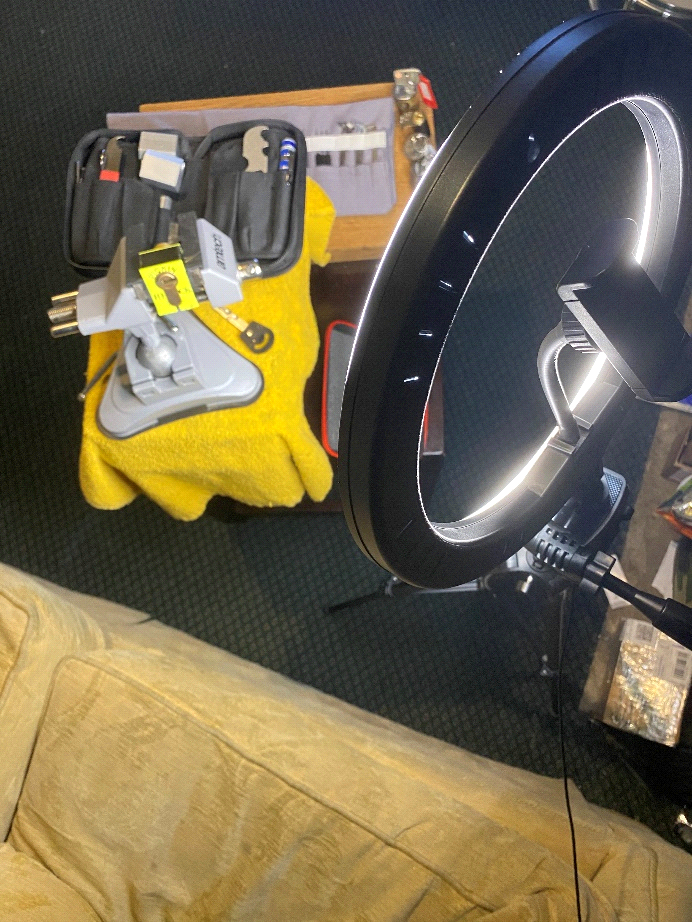
I found I myself enjoying recording the videos more and more. From picking my stock locks to picking challenge locks. And I was really enjoying the discussions I was having with other community members. There was only 1 more thing I had not done… streaming. This would be the real test for me. Being a chef by trade, you can imagine my vocabulary can be… Colourful, to say the least. However, having children I have learned to turn off certain words. So, after many talks with a fellow community member (PickedItMate) I was finally persuaded to log onto Twitch and set up my Pickin’ Rick account.
I currently have 65 subscribers on YouTube, and 10 Followers on Twitch. I never once thought about trying to hit big time numbers. If I only reach 70 subscribers, I will be happy. My videos have helped people, but more importantly, I’ve had more interactions with new people. I started locksport for a new hobby. And when I discovered the community, with so many awesome people who are always willing to trade locks, ideas or knowledge, I knew I wanted to do my bit to help fellow pickers along their journey.
So, that’s my story so far.
I had to make some considerations to make picking easier. I had to grow as a person to fully realise the enjoyment to be gained from our hobby – not just the picking – communication and the friendships that became available to me. And the journey has been worth it in so many ways.
If you are considering doing videos, streaming, or even just wondering about joining groups, I implore you to make the leap. I have not looked back on my decisions to join communities, record videos or stream. My enjoyment of locksport continues to grow exponentially.
You will feel stressed with difficult locks, I know I do. But there are people out there willing to help…. It may even be me you happen across.
Most importantly, enjoy your hobby. Enjoy it however is best for you. You may need to change or adapt some of your methods, but all that matters is that the changes work for you. We all do this hobby because we enjoy it immensely. When the hobby unlocks doors to friendships, that is the biggest positive of all.
I hope my posts were enjoyable and helpful. I hope to see you all in the future where we can trade tips and ideas.
Thanks for reading and – in doing so – joining me on my journey.
Have a great weekend. And or course… happy pickin’!
Pickin’ Rick
The post Rick’s Picking Journey – From Injury to Youtube (Part 2) appeared first on TOOOL UK.
]]>The post Rick’s Picking Journey – From Injury to Youtube (Part 1) appeared first on TOOOL UK.
]]>
My Picking Journey – From Injury to YouTube (Part 1)
Allow me to introduce myself, so it’s not just a random person jabbering on. My name is Rick, discord knows me as Rickest Rick, other places (including YouTube) I’m known as Pickin’ Rick. I bought my first proper pick set (Sparrows “Wizwazzle” kit) in September 2020, and have been steadily building up my kit and lock collection ever since.
I started out with just a few padlocks, and a cutaway euro cylinder that I was picking in hand, but very quickly bought a cheap vice so my hands were free for tensioning and picking. However, it was also around this time my back went from (almost) no issues to quickly and steadily aching more and more, following on with starting to cause pains in my leg depending on how I moved. Due to the lockdown at that time, I wasn’t able to get an MRI to diagnose my problem – Herniated discs which caused pressure on the sciatic nerve, which I found out the following March.
As you can imagine, this made sitting straight up, or leaning over, for prolonged periods of time quite challenging and sometimes completely unmanageable. I was forced to find a workaround to continue a hobby I was quickly loving more and more. Whilst I had been building up my kit, I acquired plastic locking containers of various shapes and sizes which formed a big part of my solution.
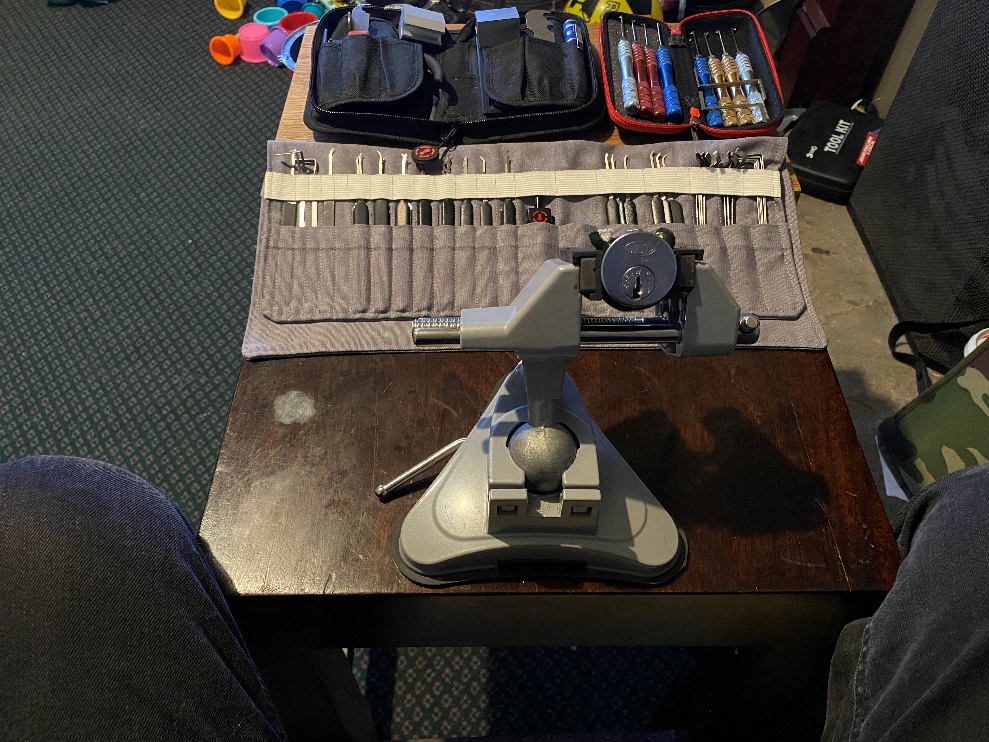
Here is how my original set up looked. Granted it isn’t the most ergonomic or even comfortable to the healthiest back, but I don’t have space for a kitchen table or a desk, so I made the best out of what I had. I could stay on the sofa or chair, and lean over to the lock, or I could place a cushion on the floor if I needed the lock closer to eye level. As you can imagine, this started hurting more and more, so I made a massive (and very well needed) change.
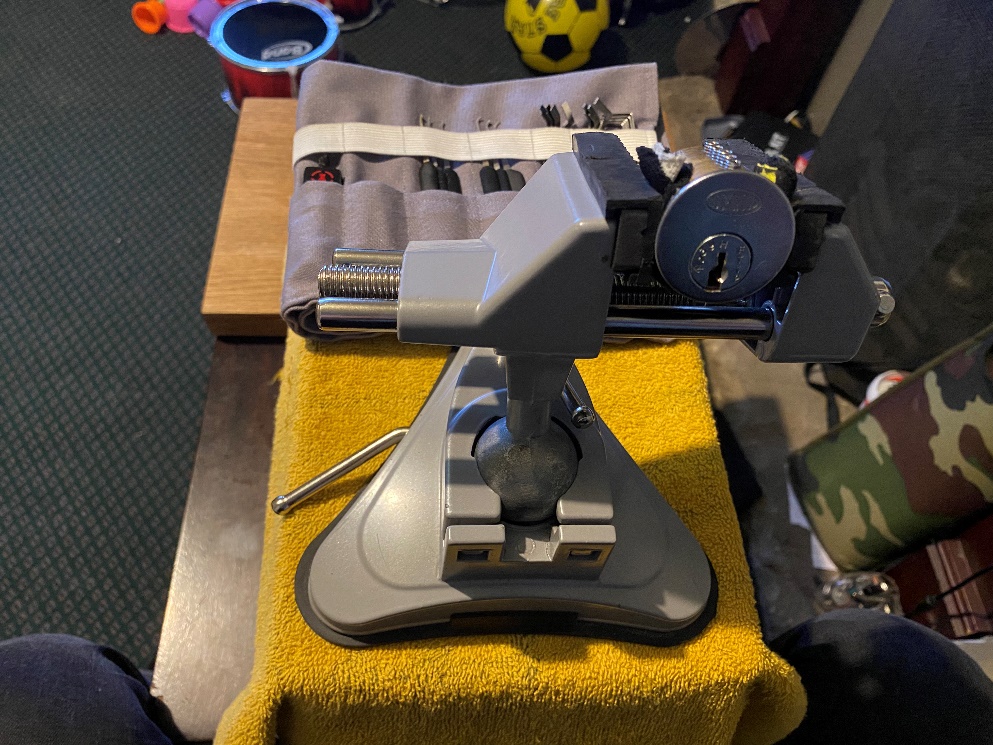
Here is how my table setup looks nowadays. Using a couple of my storage boxes, I raised the vice up much higher, so I wouldn’t have to lean over anymore, and can see what I’m doing a lot easier too. This also translated to when gutting locks too – I didn’t need to lift the lock up to see pins better, so if a pin tries to escape there’s a much better chance that the pin will be trapped by the towel. I was able to spend more time picking locks again, but this still didn’t help me when I was having a particularly painful day. Inspiration strikes again.
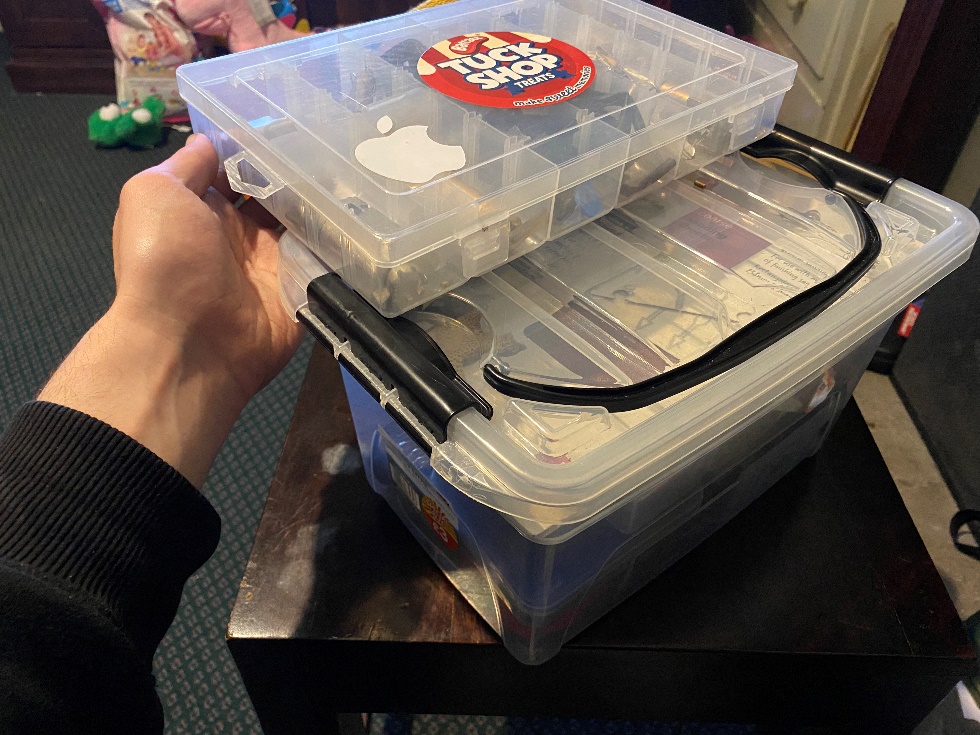
These are the 2 boxes I have underneath the towel. The bottom box is a box for lesser used tools, empty cases from picking tools, and a secure housing for my pin box. It is not feather light, but it light enough that I don’t struggle to lift it or hold it for a prolonged period of time. It has locking handles too, so if I happen to drop it from a sudden physical reaction to a pain flare up, everything inside stays safe and secure.
The box on the top contains various keys, empty euro and rim cylinders, and heat shrink for pick handles. This box also has a little bit of weight inside it, but not enough to cause, or contribute to, a problem. This box also has an added bonus. Did you happen to notice how the lid of the bottom box is recessed, with further trenches recessed into it?
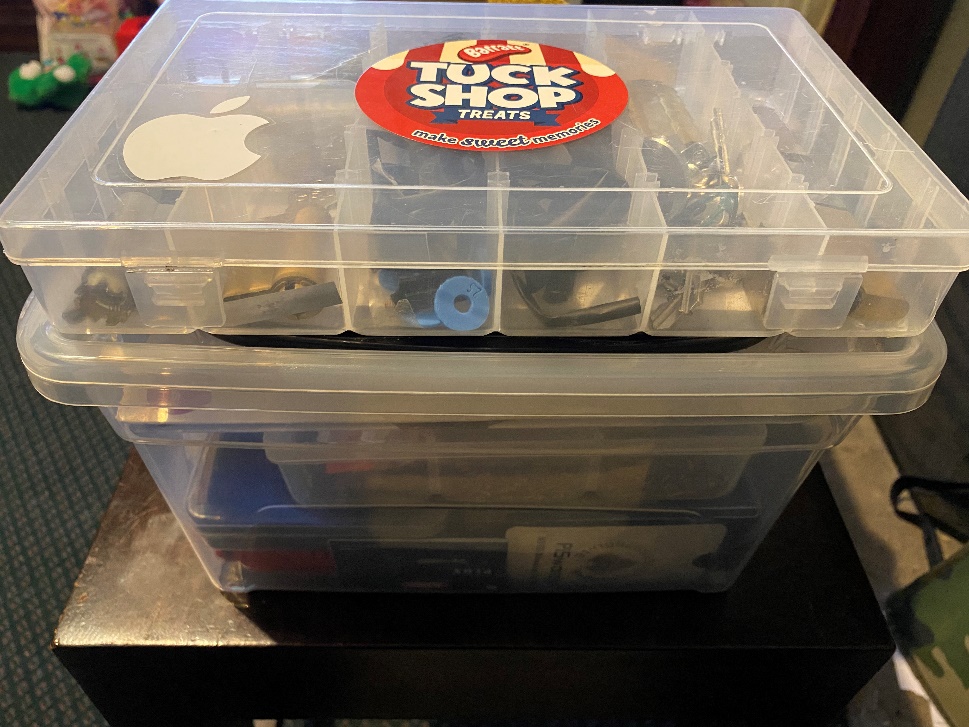
Well, the top box is only very slightly bigger than the size of the recess, so I can seat the top box on the lid, giving me a flat top to work upon, preventing the vice from being unstable, and allowing me to change the position and orientation of the vice. The towel over the top adds grip, whilst making retrieving pins & springs much easier.
Thanks to the footprint size of the bottom box, and the almost ideal weight of the boxes combined, I realised I was able to place the boxes either directly onto my thighs or on top of a small cushion, and the weight would help keep the boxes upright so I can focus on my picking.
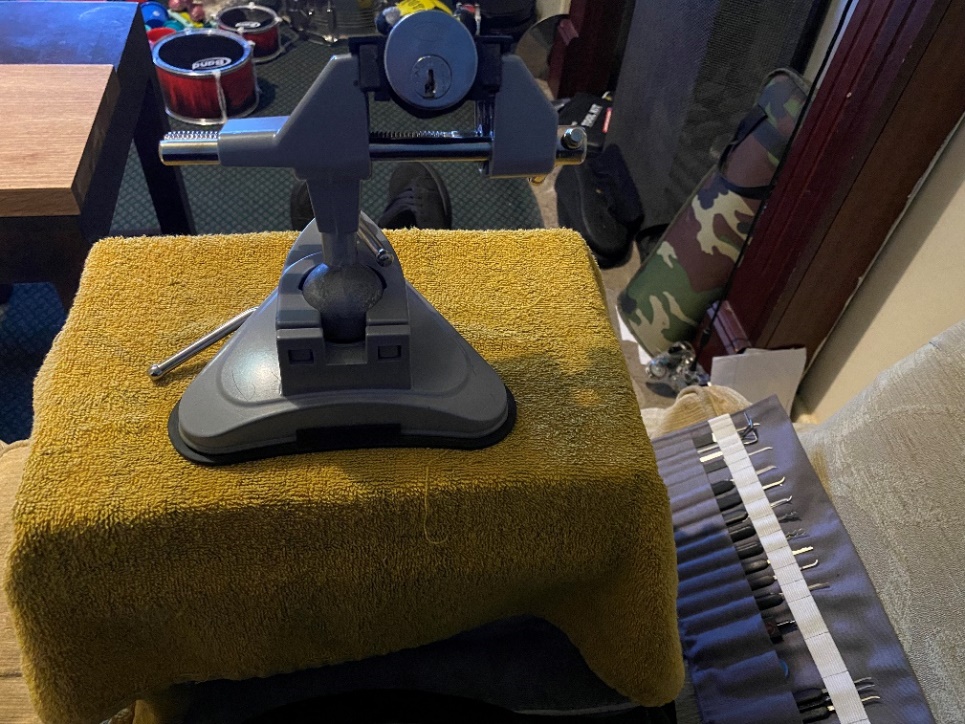
So, this meant on my worst days, I could actually keep picking, whilst sitting back in a much more comfortable position. If I need the vice slightly higher, I could add another cushion underneath or find something additional to place under the vice, and if I needed the vice lower, I could remove the top box, but I would just have to be mindful of the position of my vice when I move it around. The bonus of being on the sofa meant I could still keep my pick wrap within reach if I required a different pick, as well.
Of course, there are days when none of these options help, and I just have to admit defeat and take a day off, but with these 2 boxes I have been able to keep myself picking much more than I would have been otherwise. I also made a removable shelf I could use across the bath when I needed to soak for a while to try and alleviate nerve irritation, but sadly it had to be repurposed and I don’t have any pictures of it.
But, my biggest piece of advice to help myself, more than altering setup or adjusting seating positions, is “Know when to rest.” We all wish to get better, and push ourselves to pick harder locks, but being in pain (especially back and/or sciatic pain) will not only make the journey less enjoyable and more frustrating, but your brain will struggle to stay focused and either miss vital feedback or cause you to start picking rougher and making many more mistakes.
I shall end my post here for now, but there will be a part 2 in the coming days about how I came to setting up my YouTube channel, and how the solutions discussed helped me be able to record videos much easier than I would have without them. I hope that if you, or another picker you know, has back problems, you press your doctor to get results as to the cause (as they can be varied in severity) and I also hope my solutions help you being able to pick for longer before stopping is required.
Thank you for reading my ramblings, and I hope to see you in the second part 
The post Rick’s Picking Journey – From Injury to Youtube (Part 1) appeared first on TOOOL UK.
]]>The post The Belt Ranking System appeared first on TOOOL UK.
]]>I’ll dig into some of the misconceptions around the ranking system, and talk about some of it’s limitations.
Why create a ranking system?
This is the first question we should ask. There are a variety of answers, too. Firstly, having a ranking system facilitates comparison. It can facilitate ranking locks, or pickers, or potentially both. Being able to compare locks helps us make choices about which locks we want to use, and being able to compare lockpickers helps build on the “sport” aspect of “locksport”. But it’s important to be very clear about the aims of our particular ranking system, and it’s limitations.
Ranking Locks
When it comes to ranking locks, there are a few issues. First of all, no two locks are the same. This is why some people can pop open a given lock of a certain make and model very quickly, but struggle with others of that same make and model. The binding order is determined by the inaccuracies in manufacture, and this is basically impossible to meaningfully account for. There are also factors like bitting, which can affect which rakes – if any – are effective, or which pick profiles might be best suited to picking the lock. A further complication is that some methods may be effective against a given lock, and others not. This is why sometimes one lockpicker at a table struggles with a lock another picker can trivially open. Furthermore, locks change over time as they wear and as they are picked, so a lock that was previously easy to open, can become a totally different beast later on.
so here is the first problem: We can’t strictly rank locks by make and model. Instead, we can only rank individual, particular locks.
One possible approach would be to have a wide variety of lockpickers attempt to pick a controlled selection of locks over an extended period, and then compare how the locks held up.
The issue with this, however, is that this is basically useless. Unless you then wanted to purchase and install one of those locks (which would have been doubtless subjected to countless hours of abuse), this would offer basically no benefit to anyone.
The alternative is to accept a loss of accuracy in your lock ranking system, in order to give approximate rankings for lock models. This obviously has much more utility, and is also the fundamental idea behind the subreddit’s beltranking system. Locks are given relative rankings, as decided by a volunteer team of experienced lockpickers, with feedback from their community.
Ranking lockpickers
Ranking lockpickers also presents challenges, in large part due to the aforementioned factors that make it hard to rank locks in the first place. Again, the key here is to take cumulative times across a wide selection of locks (instead of a wide selection of pickers, this time), and then rank the lockpickers according to that.
There is also one more factor that I haven’t already mentioned – the locks must be unknown.
That is to say, when we attempt to rank lockpickers, we don’t want to rank them based on the time it takes them to pick a lock they are already familiar with. The best way to explain this that I can think of is that comparing lockpickers on the basis of times that they achieve for picking a known lock (like videos on Youtube, where we might be witnessing take 1000, and not take 1.) would be like watching a contest between two people solving Rubix cubes from known positions. I’m sure there is a lot of beauty in seeing a well-choreographed performance, but I think there is a general consensus in the community that higher skill is shown by opening unknown locks, and that contests should focus on that.
Indeed, this is exactly how various contests between lockpickers work, from the Dutch Open which takes place at LockCon, to the German championships, to basically any other locksport contest. In fact, I can’t think of a single lockpicking ranking system that doesn’t work on that basis.
Only the toool.nl Suitcase Contest – to the best of my knowledge – works differently. Competitors are able to pick the same locks over and over again, getting familiar with the lock, and doing their best to improve their times. Unfortunately, it is only open to members of toool.nl.
The Subreddit Belt Ranking System
This brings me back around to the belt ranking system. Now that we understand some of the issues with ranking locks and lockpickers, hopefully what I say about the subreddit belt ranking system will be clearer.
Of course, it’s important to mention the intention behind the belt ranking system. It’s mainly designed to encourage people to improve their lockpicking skills. Of course, this doesn’t stop people from using it to judge which lock would be best for their front door, nor as a shopping list for the collectors among us. But I’d argue it does its job very well. I’ve benefitted from it myself, and I’ve seen countless others benefit from it too. It’s also indubitably the best resource I’ve seen for helping answer the question “Which lock should I try to pick next?”.
That said, it’s important to understand the limitations of the ranking system:
Firstly, the lockpicking subreddit’s belt ranking system doesn’t rank lockpickers. It fundamentally only ranks locks.
Secondly, It can’t distinguish between those lockpickers who were only able to defeat known locks, and those who are sufficiently skilled to defeat locks of a given difficulty without prior knowledge of the lock.
Thirdly, it puts almost 0 value on being able to open locks quickly – Although, since a volunteer needs to watch the video to verify it, it’s considered polite for the video to not exceed a few hours.
Fourthly, for a lock ranking system, it only generally considers non-destructive methods – specifically picking. The heavy emphasis on single pin picking as the method of opening also puts lower value on raking methods, which was one of the reasons I wrote my article in defence of raking.
And finally, the belt ranking system breaks down at the top end of the spectrum. I’d argue that the least well categorized locks are those at black belt level. There’s a real mix of locks there, from those that are just difficult to single pin pick but require no special tooling, to those that have not yet been publicly picked at all.
There are some other interesting effects, however, which I’ve only been able to notice thanks to conversations I’ve had with Holly Poer;
1. Most obviously, it’s resulted in a massive amount more lockpicking videos. The emphasis on gutting the locks also means that a massive wealth of knowledge on the internals of these locks is now publicly accessible.
2. Interestingly, it’s also given rise to very detailed methods for specific models of lock being openly discussed and actively developed. Medeco is probably the most prominent example that springs to mind for me, given the amount of details on specific pick shapes, direction of tension, and attacking the sidebar and then the pins, or vice versa.
3. The majority of people engaging with the belt ranking system seem to be motivated by social value. By this, I mean recognition from their peers for their accomplishments (instead of by, for example, money. This is certainly the case for some locksmiths who specialise in opening a small handful of particular locks quickly and efficiently, and keeping their methods secret from others is important to their business model)
These are details I hadn’t given any consideration previously, and I’m indebted to Holly for her astute observations (And corrections to the article too!).
Conclusion
Wrapping this up, I’d like to recommend that anyone who hasn’t done so takes a look at the belt ranking list on the subreddit. It really is a fantastic resource for finding challenging new locks, interesting lock mechanisms from around the world, and compiling wish lists of locks.
Just remember that it’s a compromise, and the system has limitations. Especially when it comes to making comparisons between lockpickers!
The post The Belt Ranking System appeared first on TOOOL UK.
]]>The post Locksport without tools appeared first on TOOOL UK.
]]>Please note: You are responsible for checking the law in your own jurisdiction!
However, there are also countries and jurisdictions where that doesn’t apply. Notable examples include Japan, Poland and Hungary. In those jurisdictions, just owning lockpicking tools is against the law.
So, if you live in one of those jurisdictions, do you need to give up on your dreams of picking locks?
The Loophole
The good news is, there’s a loophole. Basically all of these laws ban possession of lockpicking-specific tools. That means that if you can explore locksport without needing specific lockpicking tools, then you can still enjoy the rush of opening a lock without the key!
Specifically, I’m talking about combination locks.
Most combination locks can be manipulated without any special tools. You still need to develop a feel, and of course not all combination locks are the same, either. I recommend starting out with simple, cheap combination padlocks, which use multiple wheels. You should be able to grab one of these from a hardware shop, locksmith’s or online.
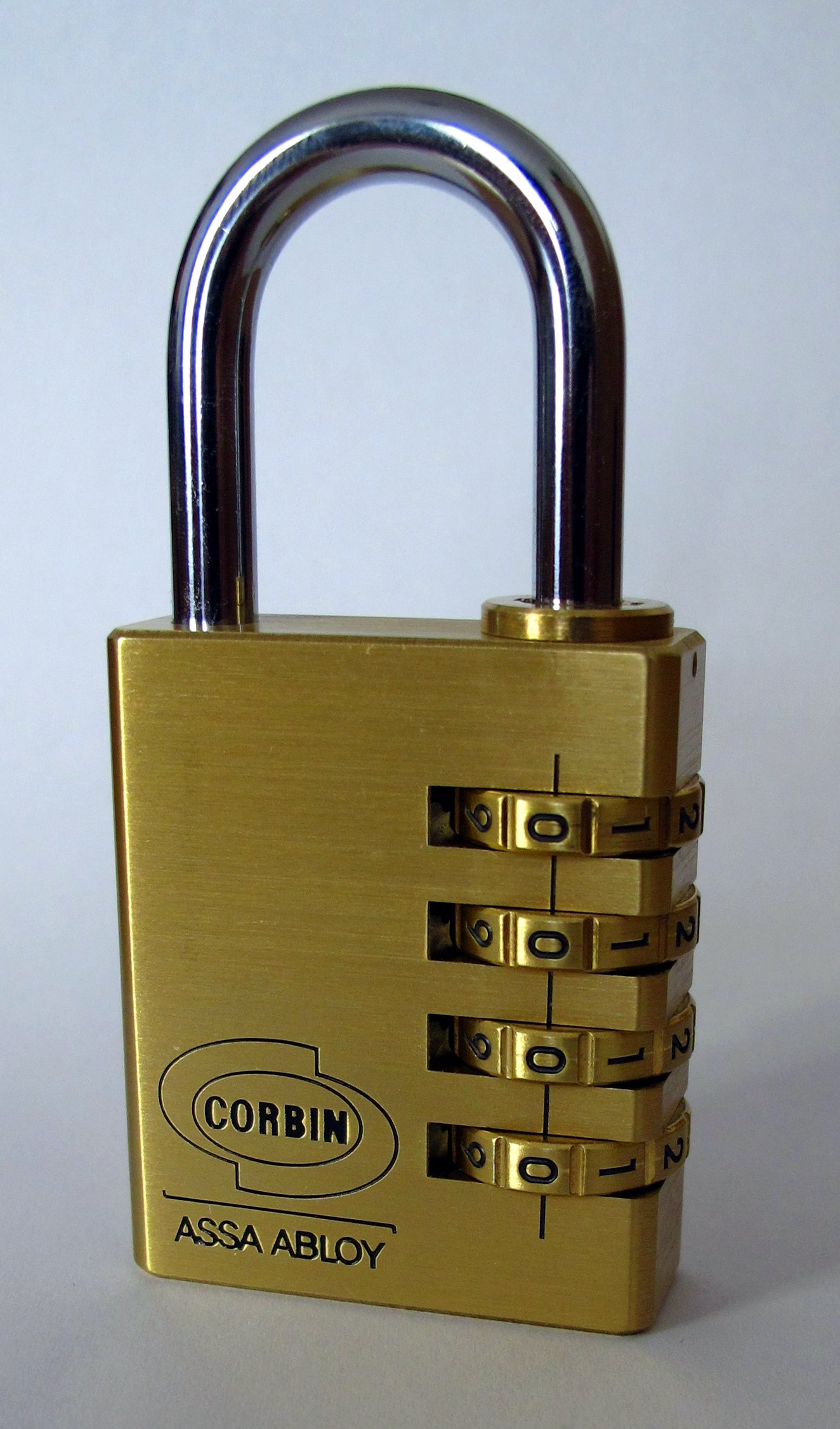
Youtube, as ever, remains a great source of knowledge for tutorials on combination padlock manipulation. I’m a particular fan of Potti314‘s videos, which cover a wide variety of combination padlocks in good detail.
For those concerned that they might hit a ceiling rapidly when approaching combination padlocks, there’s always combination safe locks. Again, no special tools are required to manipulate them, although spreadsheets, or graph paper are pretty much a necessity.
As with most things in locksport, you can start out on the relatively easy end of things, with an S&G 6700 series combination dial safe lock, or other Group 2 lock, and go from there.
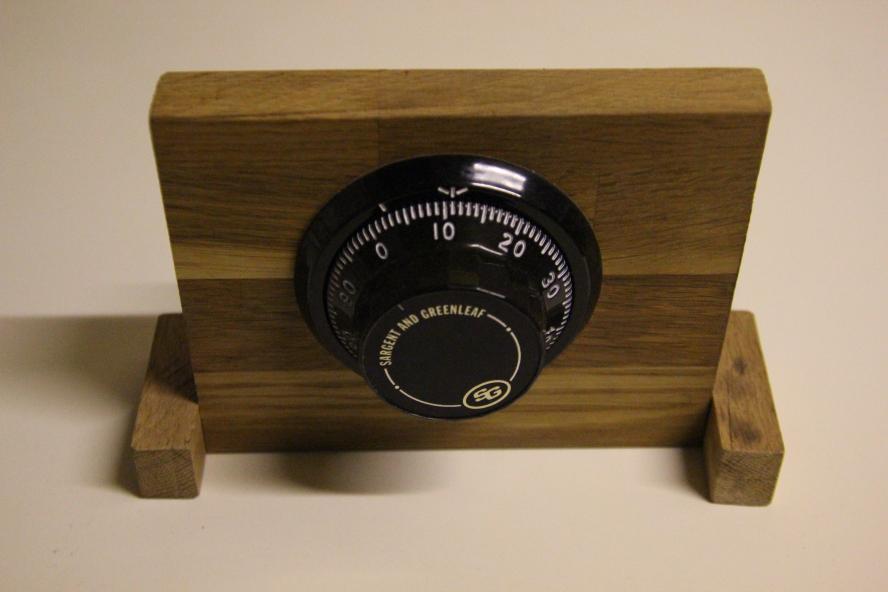
Hopefully this helps some of those who can’t access lockpicks, but still want to explore the wonderful world of locksport. Please remember to double-check laws around lockpicking in your jurisdiction. And for those who don’t have any issues accessing lockpicks, but who may have neglected combination locks as an area of locksport to explore, I hope this article inspires you to give it a shot!
The post Locksport without tools appeared first on TOOOL UK.
]]>