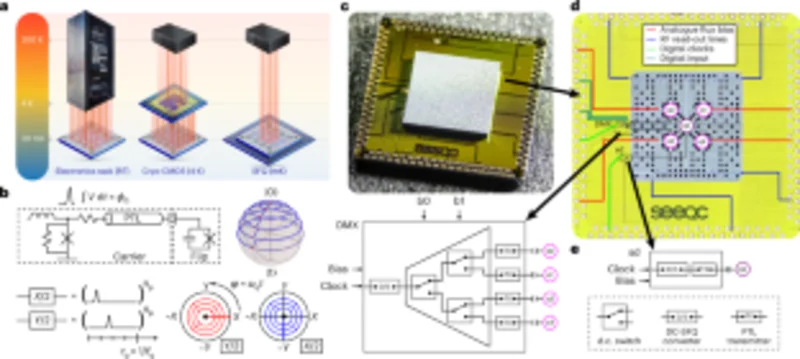
Insider Brief
- SEEQC reported in Nature Electronics the first demonstration of a full-stack superconducting quantum computing system with integrated digital control logic operating alongside qubits at millikelvin temperatures, addressing a key barrier to scalable architectures.
- The system integrates superconducting digital electronics with a five-qubit processor using Single Flux Quantum pulses, achieving high gate fidelities above 99.5%, ultra-low power dissipation, and no measurable degradation in qubit performance.
- By moving control electronics into the cryogenic environment and enabling multiplexed signal routing, the approach reduces wiring complexity, thermal load, and system overhead, offering a pathway toward chip-based, data-center-scale quantum computers.
PRESS RELEASE — SEEQC today announced a significant breakthrough in the development of scalable, chip-based quantum computers, with results published in a peer-reviewed study in Nature Electronics. The publication reports the first demonstration of a full-stack quantum computing system with digital superconducting logic for qubit control operating reliably at millikelvin temperatures in the same cryogenic environment as quantum bits (qubits).
The study details experimental results from a novel “active” quantum processor developed by SEEQC that integrates superconducting digital control circuits directly with a quantum chip. By demonstrating that digital logic can function alongside qubits at millikelvin temperatures, the work addresses a central systems-level challenge in scaling superconducting quantum computing architectures.
“Quantum computing progress has largely focused on improving individual qubits,” said Dr. Shu-Jen Han, Chief Technology Officer of SEEQC and corresponding author of the study. “Our results show that digital qubit control logic can operate at millikelvin temperatures alongside the qubits themselves. By integrating superconducting digital control with the quantum processor, we establish a path toward quantum systems engineered and scaled more like modern integrated circuits.”
From Room-Sized Machines to Quantum Computers on a Chip
Today’s superconducting quantum computers rely on room-temperature electronics connected to ultra-cold qubits through thousands of individual control lines. As systems scale, this architecture drives increases in wiring density, thermal load, engineering complexity, physical footprint, and energy consumption.
In contrast, SEEQC’s architecture integrates superconducting digital qubit control electronics directly with the quantum chip at cryogenic temperatures, through chip-to-chip bonding. Using digital multiplexing, multiple qubits can be controlled through shared pathways, significantly reducing the need for a one-control-line-per-qubit approach and mitigating the linear wiring growth that has constrained prior system designs.
Because superconducting quantum processors must operate near absolute zero, conventional room-temperature control systems introduce heat and complexity that fundamentally limit scale. By moving digital control into the cryogenic environment, SEEQC’s approach reduces interconnect density, lowers thermal load and simplifies system integration — key requirements for transitioning quantum computing from laboratory prototypes to data-center-class systems.
Peer-Reviewed Validation of a Scalable Architecture
The peer-reviewed results published in Nature Electronics experimentally validate a fully integrated quantum processor. This milestone supports SEEQC’s long-standing strategy of building quantum computers as chip-based systems, integrating quantum and classical functionality within the same cryogenic platform.
By demonstrating that digital superconducting logic can coexist and operate reliably with qubits in the milliKelvin regime, SEEQC provides experimental evidence for an architecture designed to enable scalable, energy-efficient quantum computing infrastructure.
The advance marks a foundational step toward quantum computers engineered with the manufacturability, integration density, and system discipline that defined the evolution of classical semiconductor computing.
How the System Works – and What the Study Demonstrates
In the Nature Electronics study, SEEQC researchers built and tested a five-qubit superconducting quantum processor integrated with a separate control chip containing digital superconducting logic. The two chips were stacked into a single module and operated inside a dilution refrigerator at 10 millikelvin.
Rather than generating control signals at room temperature and transmitting them down individual wires, the system generated control signals locally using Single Flux Quantum (SFQ) digital pulses, an ultra-low-power superconducting technology suited to cryogenic operation. The researchers performed standard quantum benchmarking experiments to evaluate gate fidelity, signal crosstalk, power dissipation, and thermal impact, demonstrating that digital qubit control electronics can operate in the same cryogenic environment without degrading qubit performance.
According to the research paper, the system demonstrates:
- Qubit charge control by SFQ digital pulses at millikelvin temperatures
- Multi-qubit operation with integrated digital demultiplexing
- Single-qubit gate fidelities exceeding 99.5%, with peak results above 99.9%
- No detectable quasiparticle poisoning that can degrade qubit coherence
- Ultra-low power dissipation, measured in nanowatts per qubit
- Reduced wiring and thermal load compared with conventional room-temperature and cryo-CMOS control systems
“This publication validates digital charge control at millikelvin temperatures, which is a foundational step,” added Shu-Jen Han, PhD. “Our next milestones include integrating digital flux control and digital qubit readout directly on die, enabling a more fully integrated and scalable quantum system architecture.”
Implications for Scalable Quantum Computing
While many recent advances in quantum computing focus on improving individual qubit performance, this study addresses the broader system architecture required for large-scale machines. Superconducting qubits require operation at millikelvin temperatures and scaling them to hundreds or thousands of qubits has been limited by the complexity of routing control signals from room temperature into cryogenic environments.
By demonstrating that digital control electronics can function at millikelvin temperatures and multiplex signals locally, the work establishes a practical architectural pathway toward larger, more integrated quantum processors. Reducing wiring density, thermal load, and system overhead is critical for building quantum computers that move beyond laboratory prototypes toward manufacturable, repeatable platforms.
Citation
Jordan, C., Bernhardt, J., Rahamim, J. et al. A quantum computer controlled by superconducting digital electronics at millikelvin temperature. Nat Electron (2026). https://doi.org/10.1038/s41928-026-01576-6
About the Publication
The study, titled “A Quantum Computer Controlled by Superconducting Digital Electronics at Millikelvin Temperature,” appears in Nature Electronics and reports experimental results from a five-qubit quantum processor integrated with digital superconducting control electronics.

Insider Brief
- Alice & Bob has achieved a 9.25x speedup in quantum error correction decoding using GPU-accelerated simulation through NVIDIA CUDA-Q, reducing runtime from 18 hours 2 minutes on CPU to 1 hour 57 minutes on GPU for simulated syndrome data of its Elevator Codes architecture.
- The GPU-accelerated approach maintained identical logical error performance to CPU-based decoding implementations, demonstrating no performance degradation while significantly accelerating the decoding process for the company’s concatenation-based error correction scheme tailored to biased noise qubits.
- The collaboration builds on Alice & Bob’s June 2025 integration of NVIDIA CUDA-Q into Dynamiqs, its QPU simulation library, with the companies continuing to explore GPU and AI applications for scalable quantum system development.
PRESS RELEASE — Alice & Bob announces accelerated quantum error correction decoding through GPU-accelerated simulation using the NVIDIA CUDA-Q platform, marking a step toward scalable fault-tolerant quantum computing.
Through GPU-accelerated simulation Alice & Bob achieved a runtime time of 1 hour 57 minutes for the decoding of simulated syndrome data of its Elevator Codes, a new error correction architecture developed by the company that uses a concatenation-based scheme specifically tailored to biased noise qubits. The result represents a x9.25 speed-up compared to CPU-based decoding implementations, which required 18 hours 2 minutes for the same workflow. The GPU-accelerated approach maintains identical logical error performance, demonstrating that there is no performance degradation despite the greatly accelerated decoding.
Quantum error correction depends on fast classical processing to interpret measurement outcomes in real time. As quantum processors scale, evaluating error correction performance under realistic conditions becomes increasingly computationally demanding. By leveraging GPU-accelerated simulation through CUDA-Q, Alice & Bob has demonstrated reduced decoding times within large-scale simulation workflows, enabling more efficient study of fault-tolerant architectures.
The collaboration builds on the existing relationship between Alice & Bob and NVIDIA. In June 2025, the companies announced integration of NVIDIA CUDA-Q into Dynamiqs, Alice & Bob’s QPU simulation library, enabling GPU-accelerated quantum simulations.
The two companies will continue to work together to explore how the use of GPUs and AI can advance scalable quantum system development.
Juliette Peyronnet, US General Manager, Alice & Bob, says: “Fault tolerance is a system-level challenge that requires strong classical infrastructure alongside quantum hardware. By working with partners like NVIDIA, we are accelerating the large-scale simulations needed to design and refine scalable quantum architectures.”
Tim Costa, Vice President and General Manager for Quantum, NVIDIA, says: “Scalable quantum computing will depend on seamless integration between quantum hardware and accelerated computing. Alice & Bob’s use of CUDA-Q has allowed them to simulate, validate, and iterate on fault-tolerant architectures more efficiently, bringing them close to useful quantum applications.”
Sam Stanwyck, Group Product Manager, Quantum Computing, NVIDIA presented the use case at NVIDIA GTC, Monday March 16 in a session titled Integrating AI and Quantum Computing to Accelerate the Future of Supercomputing, more information can be found here.

Insider Brief
- A study in Physical Review X reports quantum control protocols that can suppress or invert a system’s “arrow of time,” enabling processes that appear to run backward and offering new approaches to energy extraction and quantum state preparation.
- The researchers use measurement-driven feedback and engineered control Hamiltonians to cancel or overcompensate for measurement disturbances, producing stochastic trajectories consistent with reversed or altered time flow.
- The work demonstrates a measurement-based “quantum engine” that extracts energy from quantum observations and outlines future experimental validation in platforms such as superconducting qubits.
- Photo by Donald Wu on Unsplash
In new research published in Physical Review X, scientists have designed quantum control protocols that generate processes more consistent with time flowing backward than forward. The protocols — techniques to control quantum systems — modify a quantum system’s “arrow of time,” the concept of time as moving in one forward direction. The work opens up possibilities for energy extraction from quantum systems and for quantum state preparation.
A quantum system, such as a collection of qubits, is governed by the laws of quantum mechanics. The team’s control protocols can prevent the emergence of the arrow of time in a quantum system or even invert its direction — that is, cause quantum time to appear to flow in reverse. As an application of their research, the team leveraged their control protocols to design a measurement engine that extracts energy from quantum measurements performed on the system.
“Unlike phenomena we observe around us, at the microscopic level most fundamental laws of physics see forward and backward movement in time as physically possible,” said Los Alamos National Laboratory physicist Luis Pedro García-Pintos. “In other words, those laws of physics are symmetrical under time reversal; the equations work just as well if you reverse time. For quantum systems, which operate at that microscopic level, the tools we’ve constructed can manipulate the perceived arrow of time, leading to surprising, novel ways to control quantum systems.”
Time-reversed trajectories
Unlike classical physics, where measurements have little influence on the phenomenon being observed, in quantum physics, measurements stochastically change the system’s state, inducing an arrow of time. The research team used measurements and feedback to engineer time-reversed stochastic trajectories, making quantum systems behave in a way perceived as going backward in time.
The team designed a control Hamiltonian — a sequence of fields and pulses — that could emulate the effects of measurements. Using that Hamiltonian in a feedback process, the team could cancel, amplify or overcompensate for measurement disturbances, generating new trajectories consistent with stretched, blurred or even inverted arrows of time.
In the 19th-century thought experiment known as “Maxwell’s demon,” manipulating the direction of hot and cold particles decreases entropy in a system, seemingly violating the second law of thermodynamics, which posits that entropy should increase or stay constant as the natural order. (Later physics has shown that the second law is not violated when all sources of thermodynamic costs are accounted for.) The Laboratory team’s quantum “demon” exploits knowledge of a quantum system’s state and measurement outcomes to drive similarly anomalous processes, reversing the natural order — the arrow of time — in a quantum system.
Quantum feedback control for superconducting qubits
The tools developed by the team can modify the flow of energy in and out of the system. Such a capability is useful to power a continuous measurement engine that can extract energy from the monitoring process. The quantum measurements, therefore, are exploited as a thermodynamic resource from which energy can be drawn; for instance, to drive another process or store in a quantum battery.
Next steps in the research will include experimentally demonstrating the use of Hamiltonian measurement processes for quantum feedback control; for example, in superconducting qubits, a platform that allows for rapid feedback and high detection efficiencies and in which quantum versions of Maxwell’s demon have been implemented. In follow-up work, the new techniques are used to design quantum state preparation protocols.
Paper: “Reshaping the Quantum Arrow of Time” Physical Review X. DOI: 10.1103/l18s-9vmh
Funding: This work is supported by the U.S. Department of Energy, Office of Science, Advanced Scientific Computing Research program, the Beyond Moore’s Law project of the Advanced Simulation and Computing Program at Los Alamos, and the National Science Foundation.

Insider Brief
- BTQ Technologies has released Bitcoin Quantum testnet v0.3.0 featuring the first working implementation of Bitcoin Improvement Proposal 360, a quantum-resistant Pay-to-Merkle-Root output type that was merged into Bitcoin’s official proposal repository earlier this year.
- The implementation includes full P2MR consensus with SegWit version 2 outputs, five Dilithium post-quantum signature opcodes enabled in tapscript context, and end-to-end CLI wallet tooling for creating and spending quantum-resistant transactions.
- Bitcoin Quantum testnet has attracted over 50 miners, mined more than 100,000 blocks, and assembled an open-source contributor community of over 100 cryptographers and developers, with BTQ planning to operate a mining pool expected to accumulate approximately 100,000 BTQ tokens in its first twelve months.
PRESS RELEASE — BTQ Technologies Corp. (“BTQ” or the “Company”) (Nasdaq: BTQ) (CBOE CA: BTQ) (FSE: NG3), a global quantum technology company focused on securing mission-critical networks, today announced that Bitcoin Quantum testnet v0.3.0 includes the first working implementation of Bitcoin Improvement Proposal (“BIP”) 360, the quantum-resistant Pay-to-Merkle-Root (“P2MR”) output type that was merged into Bitcoin’s official Bitcoin Improvement Proposal repository earlier this year.
While BIP 360 remains a draft proposal within the broader Bitcoin ecosystem, BTQ has already built, tested, and activated the upgrade on the Bitcoin Quantum testnet, providing developers, miners, and researchers with a live environment to evaluate how quantum-resistant Bitcoin transactions function in practice. With this release, BTQ has moved BIP 360 from concept into usable, testable infrastructure.
“BIP 360 represents the Bitcoin community’s most significant step toward quantum resistance and we’ve turned it from a proposal into running code,” said Olivier Roussy Newton, CEO and Chairman of BTQ Technologies. “Bitcoin Quantum exists to prove that quantum-safe solutions work in practice, not just on paper. By shipping a full BIP 360 implementation on testnet, we’re giving the entire industry a live environment to validate these critical protections before the quantum threat arrives.”
Why BIP 360 Matters
BIP 360 addresses one of the most important long-term security questions facing Bitcoin.
Taproot, activated on Bitcoin in 2021, is foundational to Bitcoin’s scaling and programmability roadmap. It underpins advanced functionality used by innovations such as Lightning, BitVM, and Ark, and is widely regarded as critical infrastructure for Bitcoin’s future evolution. However, Taproot’s design includes a key-path spend mechanism that can expose public keys on-chain. In a future with sufficiently powerful quantum computers, exposed public keys could become vulnerable to attack via Shor’s algorithm.
BIP 360 addresses that risk by introducing Pay-to-Merkle-Root, a new output type that commits directly to the script tree’s Merkle root without relying on an internal key or tweak. This preserves Taproot’s scripting capabilities while eliminating the key-path spend that creates quantum vulnerability.
In practical terms, BIP 360 offers a path to preserving the functionality that powers Bitcoin’s next generation of applications while reducing one of its most important long-term cryptographic risks.
From Proposal to Working Infrastructure
Although BIP 360 has now entered Bitcoin’s formal proposal process, implementation across the broader ecosystem has not yet advanced. BTQ has gone ahead and implemented the upgrade in Bitcoin Quantum testnet v0.3.0, making it available today as a functioning environment for real-world experimentation and validation.
Bitcoin Quantum’s BIP 360 implementation includes:
- Full P2MR consensus: SegWit version 2 outputs with bc1z address encoding (bech32m), Merkle root commitment verification, and control block validation
- All five Dilithium post-quantum signature opcodes enabled in P2MR tapscript context, providing real quantum-resistant signature verification inside the script tree
- End-to-end CLI wallet tooling: Complete wallet RPC support enables users to create, fund, sign, and spend P2MR transactions on testnet today.
- Live, testable infrastructure: The release includes functional validation across address creation, funding, transaction construction, signing, mempool acceptance, broadcast, and confirmation.
- Network activation: BIP 360 functionality has been activated across Bitcoin Quantum’s testing environments.
This release moves BIP 360 beyond a technical proposal and into a practical environment where the broader ecosystem can observe how a quantum-resistant Bitcoin transaction model operates.
Additional Testnet v0.3.0 Enhancements
Beyond BIP 360, Bitcoin Quantum testnet v0.3.0 includes several improvements designed to support continued testing and development of post-quantum Bitcoin infrastructure.
These include:
- Optimized block cadence with one-minute target block spacing to support faster iteration and testing,
- Refined emission schedule with a 5 BTQ block subsidy and 2,100,000-block halving interval to maintain Bitcoin-like monetary behavior,
- Dilithium signature hardening through improved sigop counting and tapscript security fixes, and
- SegWit discount restored, which is especially important for post-quantum signature schemes, because these signatures are substantially larger than traditional Bitcoin signatures.
Together, these enhancements are intended to make Bitcoin Quantum a more practical and scalable environment for testing quantum-resistant blockchain infrastructure.
Full release notes: https://github.com/btq-ag/btq-core/releases/tag/v0.3.0-testnet
Demonstrating Real Progress on Testnet
Bitcoin Quantum continues to show measurable progress as a live testing ground for quantum-safe Bitcoin infrastructure. To date:
- More than 50 miners have joined the network, demonstrating operators’ willingness to run post-quantum Bitcoin infrastructure today.
- More than 100,000 blocks have been mined, and
- The project has now advanced into its fourth testnet iteration, with each release incorporating lessons learned from prior versions.
The network has also attracted an active open-source contributor community of more than 100 cryptographers, developers, and miners working to validate and improve the protocol.
This traction reinforces BTQ’s broader strategy of building practical infrastructure that allows quantum-safe blockchain systems to be tested before migration becomes mandatory.
Regulatory Urgency Is Increasing
The release of testnet v0.3.0 comes as governments and critical infrastructure stakeholders accelerate planning around post-quantum migration.
U.S. federal agencies face an April 2026 deadline to submit post-quantum cryptography transition plans under NSM-10. In Europe, the European Union has set a target for critical infrastructure quantum-resistance by 2030. In Canada, new federal procurement requirements aligned with post-quantum cryptography take effect in April 2026.
These developments reflect a broader shift: post-quantum cryptography is no longer a distant research topic. It is increasingly becoming an operational and policy priority across public-sector and mission-critical systems.
Bitcoin Core Progress Remains Limited
Despite BIP 360’s inclusion in Bitcoin’s official proposal repository, broader implementation across the Bitcoin ecosystem remains limited. A May 2025 analysis from Chaincode Labs noted that Bitcoin post-quantum initiatives remained at an early and exploratory stage. More broadly, Bitcoin’s conservative governance culture has historically made major protocol upgrades slow to move from concept to adoption. SegWit took approximately 8.5 years from conception to adoption, while Taproot took approximately 7.5 years.
Against that backdrop, Bitcoin Quantum is intended to help close the gap between proposal and practice by providing a fully functional implementation that developers, researchers, and operators can evaluate, test, and iterate on today, without waiting for broader ecosystem consensus.
A Live Environment for the Industry
Bitcoin’s governance and development model is intentionally conservative, which can make security upgrades slow to move from proposal to adoption. BTQ’s view is that the industry cannot afford to wait until a crisis point to begin understanding how quantum-safe Bitcoin infrastructure might work in practice.
Bitcoin Quantum helps address that gap by providing a fully functioning environment where developers, researchers, and infrastructure operators can test and evaluate quantum-resistant transaction models now.
Looking Ahead
“The industry can’t afford to treat quantum resistance as a theoretical exercise,” concluded Roussy Newton. “BIP 360 was a landmark proposal and we’ve turned it into a landmark implementation. Every developer, researcher, and institution that wants to understand how quantum-safe Bitcoin actually works now has a live network to test against.”
Capturing Value Across the Quantum Transition
BTQ believes the transition to quantum-safe infrastructure will create opportunities across both blockchain networks and enterprise security environments. In addition to advancing the technical development of Bitcoin Quantum, the Company is building infrastructure intended to support multiple potential commercialization pathways as post-quantum adoption accelerates.
BTQ expects to operate a Bitcoin Quantum mining pool, which is designed to generate mining-related revenues while enabling the Company to accumulate and hold Bitcoin Quantum tokens as a strategic treasury asset. BTQ believes this early positioning may allow it to participate directly in the growth of a quantum-safe proof-of-work network as adoption develops.
Through its mining pool model, which is expected to apply a 3% fee on block rewards, the Company projects accumulation of approximately 100,000 BTQ tokens during the first twelve months of network operation, excluding any tokens mined directly by the Company. These holdings are expected to be retained on the Company’s balance sheet, with potential uses to be evaluated as the network matures.
Beyond network participation, BTQ sees longer-term opportunities to monetize the infrastructure required for post-quantum migration. As quantum-resistant transactions and cryptographic standards become increasingly important for high-value digital assets and mission-critical systems, BTQ believes its platform could support future offerings spanning security-as-a-service models, premium settlement infrastructure, and quantum certification services.
BTQ’s strategy is designed to capture value across both enterprise and permissionless markets. On the enterprise side, the Company’s broader Quantum Secure Systems and Networks (QSSN) platform is intended to support managed offerings with the compliance, integration, and service requirements expected by regulated institutions. In parallel, decentralized products such as Bitcoin Quantum provide open infrastructure for developers, miners, and network participants building in public blockchain environments.
This dual approach positions BTQ to pursue commercialization opportunities tied both to institutional adoption of quantum-safe systems and to the organic growth of open blockchain networks.

Insider Brief
- Crane Harbor shareholders approved the proposed business combination with Xanadu Quantum Technologies, clearing a key step toward the company going public.
- The combined company is expected to begin trading on Nasdaq and the Toronto Stock Exchange under the ticker “XNDU” following a planned March 26, 2026 closing.
- The transaction is expected to provide approximately $302 million in gross proceeds, with additional potential funding under a separate Canadian government investment still under negotiation.
PRESS RELEASE — Crane Harbor Acquisition Corp. (“Crane Harbor”) (Nasdaq: CHAC) today announced that its shareholders approved all proposals necessary to complete the previously announced business combination with Xanadu Quantum Technologies Inc. (“Xanadu”), a leading photonic quantum computing company, at Crane Harbor’s extraordinary general meeting of shareholders. The approval represents an important milestone toward completing the transaction and advancing Xanadu’s scalable photonic quantum technology platform.
The closing of the business combination is expected to occur on March 26, 2026. Following the closing, the combined company will operate under the name Xanadu Quantum Technologies Limited (the “Company”), with its shares anticipated to begin trading on the Nasdaq Stock Market (“Nasdaq”) and the Toronto Stock Exchange (“TSX”) under the ticker symbol “XNDU” on March 27, 2026, subject to the satisfaction of customary closing conditions and stock exchange approval.
The transaction is expected to deliver gross proceeds of approximately US$302 million to the Company, consisting of funds held in Crane Harbor’s trust account and proceeds from a fully committed PIPE financing. These proceeds are separate from and incremental to the previously announced negotiations with the Government of Canada and the Government of Ontario for an up to CAD$390 million investment under Project OPTIMISM. The proposed support remains subject to the completion of due diligence and the execution of final agreements.
Xanadu is a leader in photonic quantum computing, pioneering a light-based approach to develop scalable, modular, and networked quantum computers that compute at room temperature. The company attracts world-class talent, led by Founder and Chief Executive Officer, Christian Weedbrook, a member of Canada’s Quantum Advisory Council who has advanced quantum technologies through groundbreaking research and leadership for over 15 years. Xanadu is committed to building quantum computers that are useful and available to people and institutions everywhere.
“We’re excited to help Xanadu continue pursuing its mission of widely accessible, fault tolerant quantum computing,” said Bill Fradin, Chief Executive Officer of Crane Harbor. “We look forward to completing the transaction and providing Xanadu with a strong capital base and public-market platform to support its commercial roadmap and further strengthen its leadership in photonic quantum computing.”
“The anticipated close of the transaction marks a major milestone for our team and partners,” said Christian Weedbrook, Founder and Chief Executive Officer of Xanadu. “As the first publicly traded photonic quantum computing company, we believe Xanadu is entering this next chapter from a position of technological leadership and with a clear focus on providing practical quantum solutions to customers worldwide.”

Insider Brief
- Horizon Quantum completed a SPAC merger with dMY Squared Technology Group, securing about $120 million and listing on Nasdaq under the ticker “HQ” to expand its quantum software business.
- The company is focused on building hardware-agnostic software infrastructure, including its Triple Alpha development environment, to enable developers to run applications across different quantum computing platforms.
- Executives said the funding will support R&D and system development as advances in quantum hardware and error correction push the industry toward broader practical use.
PRESS RELEASE — Horizon Quantum Computing Pte. Ltd. (“Horizon Quantum”), a pioneer of software infrastructure for quantum applications, today announced that it has completed its previously announced business combination (the “Business Combination”) with dMY Squared Technology Group, Inc. (“dMY”) (OTC: “DMYY”, “DMYYU” and “DMYYW”), a publicly traded special purpose acquisition company. The Business Combination was approved by dMY’s shareholders at dMY’s special meeting held on March 17, 2026. On March 20, 2026, the combined company’s Class A ordinary shares and warrants will begin trading on Nasdaq under the ticker symbols “HQ” and “HQWWW,” respectively.
Horizon Quantum is building software infrastructure that empowers developers to use quantum computing to solve the world’s toughest computational problems. The closing of the Business Combination provides Horizon Quantum with gross proceeds of approximately $120 million, before transaction expenses, which the company plans to use to accelerate its investments in research and development, strengthen its hardware testbed, and further advance its integrated development environment Triple Alpha.
“Recent rapid progress in advancing quantum computing hardware and breakthroughs in error correction mean that the field is reaching an inflection point. With today’s closing and our Nasdaq listing, Horizon Quantum is positioned to deliver the software infrastructure that will power this next phase of computing and help enable broad quantum advantage across tough computational problems,” said Dr Joe Fitzsimons, Founder and CEO of Horizon Quantum. “While there is still much work needed before quantum computers reach their full potential, with more than 20 years in quantum computing research, I have never been more excited about the prospects and future of the technology.”
Harry You, Chairman and CEO of dMY, said, “Over the tenure of my career, I have witnessed many technology companies triumph, and I have found that the ones who are most successful in building long-term shareholder value have been those that build software infrastructure and operating systems. Horizon Quantum is compelling because the company is approaching the quantum industry with hardware-agnostic software infrastructure that stands to benefit regardless of which way the market share ultimately falls across the competing quantum modalities, including the cloud.”

Insider Brief:
- Australia is transitioning quantum from long-term research into an industrial capability, supported by sustained public investment, a growing workforce, and an expanding ecosystem of companies and institutions.
- National coordination across commercialization, supply chains, and global engagement will determine whether Australia converts its research strength into a competitive quantum industry.
- Companies across sensing, communications, and computing are already advancing real-world applications, demonstrating a shift from laboratory breakthroughs to deployable systems.
- Government strategy, capital investment, and international partnerships are aligning to position quantum as part of Australia’s trade and industrial policy, with collaboration seen as essential to capturing long-term value.
For 25 years, Australia has built one of the world’s deepest reservoirs of quantum talent. The stakes are rising as quantum moves beyond the lab. Increasingly quantum is emerging as an export industry, a sovereign capability platform, and a source of measurable productivity gains across defense, energy, mining, healthcare, finance, and more. This structural shift reflects over USD$1.6 billion in sustained public investment that has positioned Australia with the world’s fifth largest quantum workforce, over 40 companies operating across sensing, communications, and computing, and 26 research institutions with specialized capability.
What determines Australia’s value uptake over the next decade, however, will be the degree of national coordination around commercialization, supply chains, and global engagement according to Petra Andrén, CEO of Quantum Australia: “Australia has led in quantum research for decades,” Andrén says. “The task now is to convert that depth into sovereign capability and a globally competitive industry. That requires deliberate coordination between researchers, startups, industry, investors, and government.”
Quantum Australia was established as the national centre for quantum growth to support delivery of the National Quantum Strategy. Its role is not symbolic. It convenes policymakers, end users, investors, and technologists around defined industrial objectives. That coordination will be visible in Adelaide on 29 to 30 April at the Quantum Australia Conference 2026.
The conference brings together a diverse mix of voices, including end users from financial services, life sciences, resources, energy, and transport, alongside startups, quantum and adjacent technology companies, government and policy leaders, defence stakeholders, and academic experts. It is structured around capability, procurement, and capital mobilisation and how alignment across these factors will determine whether capability scales domestically, or diffuses offshore.
From Laboratory Breakthroughs to Industrial Systems
Encouragingly, the industrial transition is already visible across multiple domains on home shores. In Adelaide, QuantX Labs has developed TEMPO, the next-generation of optical atomic clocks, providing an order of magnitude performance improvement compared to current GNSS clocks. These optical atomic clocks were tested alongside AUKUS partners in Washington D.C. in 2025. Precision timing underpins radar performance, satellite synchronisation, and telecommunications integrity. And SENTIO, an extremely sensitivequantum sensor for subterranean surveillance perfect for detection of covert operations and undersea surveillance.
Q-CTRL is a global leader in AI-powered quantum infrastructure software, accelerating progress toward quantum advantage on leading platforms, such as IBM Quantum. Q‑CTRL is also delivering to the global market a complete quantum-assured navigation system, field validated to outperform the best GPS-alternatives, in partnership with AUKUS governments and industry leaders, including Airbus and Lockheed Martin.

In Sydney, DeteQt is commercialising diamond on chip magnetometers capable of operating in GPS denied environments, with applications spanning navigation, mineral exploration, and medical imaging. A broad range of opportunities exist for “magnetic intelligence” with high-sensitivity, chip-scale quantum sensors.
At the computing frontier, both Diraq and Silicon Quantum Computing are advancing silicon-based quantum processors, building upon trillions of dollars in research and development from the semiconductor industry. Founded in Sydney, Diraq is a global contender in the race to deliver utility scale quantum computing. The company is developing utility-scale quantum computers using silicon technology compatible with existing semiconductor manufacturing, enabling the potential to scale to millions of qubits on a single chip. Diraq’s quantum computers are designed to be scalable, powerful, and readily deployable, for example, in conventional data centres.
Meanwhile, Silicon Quantum Computing (SQC) is advancing commercial scale silicon quantum processors using its proprietary PAQMan manufacturing process. The company can design, produce and test new quantum chips in under a week, demonstrating the speed and precision needed to scale quantum hardware.
Integration with established manufacturing pathways reflects an understanding that scalability will determine global competitiveness, and we are already seeing this understanding from the Australian government.
In February 2026, Diraq secured a USD$14 million equity investment from the National Reconstruction Fund Corporation – an investment that signals quantum has shifted from research priority to industrial policy. The capital will support Diraq’s goal of delivering a system capable of genuine quantum advantage by 2029.
Emergence Quantum, on the other hand, reflects ecosystem maturation. Founded by former leaders of Microsoft’s quantum hardware program, it addresses control systems and integration bottlenecks across platforms because, as sectors scale, enabling layers will become as critical as core hardware.

And, finally, university commercialisation is also entering a more deliberate phase. The University of Queensland and its commercialisation arm UniQuest recently launched Cortisonic following a collaboration with Lockheed Martin. Cortisonic is developing Sonic Processing Units, a new class of AI processors that leverage acoustic waves for computation to achieve ultra-low-power edge inference.
Lockheed Martin’s sustained involvement demonstrates both the global credibility of Australian research and the export potential of university originated intellectual property when commercialisation pathways are structured with industrial partners from inception.
Collectively, these examples illustrate a sector transitioning from discovery to deployment. They also demonstrate breadth, with capability being cultivated across sensing, communications, and computing rather than concentrating on a single technological pathway.
Coordination as National Advantage
The National Quantum Strategy, released in 2023, formalised the ambition to position Australia as a global quantum leader by 2030. It aligned research funding, industry development and regulatory settings, reinforced by capital mechanisms including USD$700 million allocated to critical technologies through the National Reconstruction Fund. Yet strategy alone does not create industry. Structured collaboration does.
Andrén describes Quantum Australia’s operating model as a community of practice, bringing together end user industries, technology developers, investors, and policymakers around defined challenges: “When defense, mining, energy, and finance engage with quantum companies early, adoption pathways accelerate,” she says. “That shortens the distance between scientific achievement and economic impact.”
Without coordination, Andrén says, research excellence can fragment and talent can drift offshore, resulting in value then accruing in other nations.
Industrial capture requires alignment between capital, procurement, and commercialization according to Malcolm Roberts, Director – Technology at the Australian Trade and Investment Commission, who believes quantum now sits squarely within Australia’s trade and investment strategy: “Quantum combines frontier science with tangible commercial pathways,” Malcolm says. “Our role is to connect Australia’s most credible quantum companies with global customers and integrators, positioning them for real commercial uptake in international markets.”
Austrade’s presence in the United States, United Kingdom, and Asia Pacific markets provides structured access to defence primes, advanced manufacturers and institutional capital. In a sector shaped increasingly by geopolitical sensitivity, trusted intermediaries strengthen confidence.
This global connectivity is already yielding results through companies like Q-CTRL, whose software enables users to run utility-scale algorithms across diverse platforms, empowering enterprises, developers, and researchers to get the most out of quantum hardware. At the same time, its quantum education platform is helping organizations prepare the workforce and close the skills gap as quantum technology adoption scales.
An Industrial Nation in Formation
Quantum remains inherently international with its cross-border applications, mobile talent, and supply chains that span jurisdictions. Strategic competition, however, is intensifying as governments seek sovereign capability and competitive advantage in technologies underpinning defense systems, communications infrastructure, and advanced manufacturing.
Australia’s response has been characterised by continuity, according to Andrén. “Long-term research investment built credibility. Policy settings are aligning capital, procurement, and trade to convert that credibility into durable industry,” she said.
“Whether this alignment sustains momentum will depend on disciplined collaboration across institutions that have historically operated independently. So for policymakers, technologists, and industry leaders, participation is not peripheral. It is formative.”
The Quantum Australia Conference offers a concentrated view of this type of coordinated ecosystem operating across research, industry, and policy and will take place in Adelaide, South Australia on 29-30 April 2026. Book your tickets now.
For all inquiries about how the Australian Trade and Investment Commission can assist with connections to this ecosystem, please contact [email protected]

Insider Brief
- The Post-Quantum Financial Infrastructure Framework submitted to the U.S. Securities and Exchange Commission’s Crypto Assets Task Force cites QuSecure’s four-month banking deployment with Banco Sabadell and Accenture as the sole “Real-World Implementation Precedent” for successful post-quantum cryptography migration.
- The framework, detailed in Sections Two and Seven, highlights that the QuProtect deployment demonstrated PQC implementation feasibility within existing infrastructure, network-layer encryption enabling quantum-safe standards without complete system overhaul, and crypto-agility approaches proving viable for complex banking environments.
- The PQFIF emphasizes migration urgency for the financial sector, referencing a Europol report suggesting quantum threats could materialize as early as 2028, and states that cryptographically relevant quantum computers pose existential threats to trillions of dollars in assets.
PRESS RELEASE — QuSecure, Inc., the market leader in post-quantum cybersecurity and cryptographic agility, today announced that the Post-Quantum Financial Infrastructure Framework (PQFIF) submitted to the U.S. Securities and Exchange Commission’s Crypto Assets Task Force specifically cites QuSecure’s, Banco Sabadell’s, and Accenture’s four-month banking deployment as a real-world precedent for successful crypto-agile post-quantum cryptography (PQC) migration and quantum-safe cryptography. The PQFIF states the implementation demonstrates that “migration to post-quantum cryptography is both technically feasible and operationally practical for major financial institutions, providing a benchmark for industry-wide adoption strategies.”
Detailed in Sections Two and Seven of the proposed Post-Quantum Financial Infrastructure Framework, the QuSecure, Banco Sabadell, and Accenture deployment was chosen as the sole “Real-World Implementation Precedent”. The case study highlighted the realized benefits of the QuSecure QuProtect deployment, including that QuProtect’s “PQC implementation proved feasible within existing infrastructure frameworks, [its] network-layer encryption solutions enabled quantum-safe standards without complete system overhaul, [and its] crypto-agility approaches demonstrated practical viability for complex banking environments.”
Implemented in a live banking environment, the Banco Sabadell engagement demonstrates that quantum-safe migration can begin today without disruptive infrastructure replacement or multi-year system overhauls. The deployment shifts the industry conversation from long-term planning to immediate execution.
“The SEC framework goes beyond theory to real-world execution,” said Rebecca Krauthamer, Co-founder and CEO of QuSecure. “The PQFIF represents groundbreaking guidance that both recognizes the immediacy of the threat and gives financial sector practitioners a clear set of actions to take to move beyond strategy and crypto inventory before the clock runs out. I expect other highly regulated sectors – pharma, healthcare, and energy – to adopt the path laid out in the PQFIF as they formalize their own migration guidance. QuSecure is proud to continue our pioneering legacy, giving security leaders peer precedent and board-ready examples that quantum-safe progress can start now, pragmatically, in phases, and without operational disruption, alongside innovative and security-first organizations like Banco Sabadell and Accenture.”
The submitted Framework emphasizes the urgency of migration for the financial sector, highlighting the compression of timelines, and pointing to a Europol report that suggests the quantum threat could be realized as early as 2028.
According to the PQFIF, “The U.S. digital asset ecosystem, built upon current cryptographic standards, faces an existential threat from the rapid advancement of quantum computing. A cryptographically relevant quantum computer (CRQC) could break the fundamental security that protects trillions of dollars in assets leading to systemic risk, catastrophic investor losses, and a complete erosion of market confidence. The framework provides a structured methodology for assessing vulnerabilities, planning a risk-based migration, and implementing NIST-standardized cryptographic solutions without disrupting market operations. Action today is needed to secure investor assets and ensure the long-term integrity of U.S. capital markets in the quantum era.”
QuProtect’s production-ready remediation capabilities allow institutions to inventory, prioritize, and mitigate quantum risk while maintaining operational continuity. The engagement further underscores Accenture’s ability to guide complex, regulated institutions from post-quantum strategy to executed deployment, moving beyond advisory frameworks into executed deployment.

Insider Brief
- TUMCREATE is leading the secure hardware platform research thrust within the QUASAR-CREATE programme, a three-and-a-half-year initiative bringing together Nanyang Technological University, Fraunhofer@NTU, Technical University of Munich, and National University of Singapore to develop quantum-safe security technologies.
- The research focuses on developing the world’s first fully open-source post-quantum cryptography-secure 64-bit RISC-V processor implementation, integrating hardware-level protection and quantum-resistant cryptography with plans to fabricate the chip using GlobalFoundries’ 180-nanometer process technology in Singapore.
- The secure hardware platform integrates post-quantum cryptographic accelerators, secure operating systems, and trusted execution environments to defend against side-channel and physical attacks, with validation through practical use cases including FIDO2 authentication tokens and future compatibility with quantum key distribution technologies.
PRESS RELEASE — As quantum technologies continue to advance, the resilience and trustworthiness of digital systems have emerged as critical priorities for Singapore’s future infrastructure. Addressing these challenges, TUMCREATE – the research arm of the Technical University of Munich (TUM) funded by the National Research Foundation, Singapore (NRF) – is playing a key role in QUASAR-CREATE (Quantum Security and Resilience for Emerging Technologies), a three-and-a-half-year research programme.
The QUASAR-CREATE research programme brings together an international consortium comprising Nanyang Technological University, Singapore (NTU Singapore), Fraunhofer@NTU (FSR@NTU), TUMCREATE, the Technical University of Munich (TUM), and the National University of Singapore (NUS). The programme aims to develop new methods and technologies that strengthen the security and resilience of emerging digital systems in the face of future quantum-enabled threats.
Under the recently launched Research, Innovation and Enterprise 2030 (RIE2030) plan, Singapore is strengthening its capabilities in semiconductor and quantum-enabled technologies. The security of complex chips and electronic systems becomes a foundational design consideration,” said Professor Ulf Schlichtmann, CEO at TUMCREATE and Principal Investigator of the QUASAR-CREATE project. “QUASAR-CREATE contributes to this effort by advancing research on how security and resilience can be embedded at the hardware and system-design level. By bringing together complementary expertise from Singapore and Germany, the programme supports the development of secure, trustworthy chip technologies that are essential for the future.
Building Resilient Digital Foundations for the Quantum Era
QUASAR focuses on moving beyond conventional cybersecurity approaches by embedding resilience directly into the design of next-generation technologies. By integrating quantum-safe security mechanisms early in the development of digital systems, the programme seeks to ensure that critical infrastructures remain robust, trustworthy, and adaptable amid increasing uncertainty.
The research programme is organised into three coordinated thrusts, forming a complete security pipeline. Within this framework, TUMCREATE leads Thrust 1: Secure Hardware Platform, spearheading research into an open-source, verifiable, and quantum-safe hardware foundation for post quantum security.
TUMCREATE Leads Secure Hardware Platform Research
Together with NTU’s School of Electrical and Electronic Engineering (EEE), Thrust 1 focuses on the development of an open and verifiable, quantum-safe RISC-V processor platform, envisioned as a foundational building block for future secure systems. The research is positioned to deliver the world’s first fully open-source post-quantum cryptography (PQC)-secure 64-bit RISC-V
processor implementation, integrating hardware-level protection and quantum-resistant cryptography from the ground up.
Professor Georg Sigl, Principal Investigator at TUM for QUASAR-CREATE, emphasises: “Post-quantum security in resource constraint devices cannot be achieved by software alone. If we want digital systems to remain trustworthy in the era of quantum computing, security must be anchored directly in the hardware architecture. With QUASAR-CREATE, we are integrating quantum-resistant cryptography into a RISC-V processor with the final target to build a fully open-source chip design using open-source technology. The project plans to fabricate the chip using GlobalFoundaries’ 180-nanometre process technology at its manufacturing facilities in Singapore. This approach allows us to build a transparent and verifiable foundation for resilient digital infrastructures of the future.”
By embedding security directly into hardware architecture, the work addresses long-term trust, transparency, and resilience challenges that cannot be adequately mitigated through software solutions alone.
The research integrates both hardware and software-level protection mechanisms to defend against side-channel and physical attacks – threats that are expected to intensify as quantum and other advanced computing technologies mature. Key components include post-quantum cryptographic accelerators, secure operating systems, and trusted execution environments, ensuring protection across the entire computing stack.
To demonstrate real-world applicability, the platform will be validated through practical use cases such as FIDO2 authentication token, with future extensions exploring compatibility with quantum key distribution (QKD) technologies.
Strengthening Singapore’s Quantum Security Research Ecosystem
QUASAR-CREATE exemplifies Singapore’s commitment to advancing cutting-edge, internationally collaborative research with real-world impact. The programme brings together complementary expertise from NTU, NUS, TUM and the Fraunhofer-Gesellschaft, including contributions from the Fraunhofer Institute of Applied and Integrated Security (AISEC), the Fraunhofer Institute for Electronic Nanosystems (ENAS), and Fraunhofer Singapore as an institutional partner.
“As quantum technologies move closer to real-world deployment, ensuring trust and security will be essential for their adoption,” said Principal Investigator, NTU Professor Gwee Bah Hwee, School of EEE. He adds, “QUASAR-CREATE allows us to bring together expertise across institutions to address these challenges proactively, supporting Singapore’s efforts to harness emerging technologies in a secure and sustainable way.”
Through its leadership of the secure hardware thrust, TUMCREATE strengthens research collaboration with NTU in microelectronics – in close partnership with NTU’s School of Electrical and Electronic Engineering (EEE) – extending existing educational ties into joint, application-driven research. The programme also opens pathways for engagement with the QUASAR professorship at NTU, funded
by the Dieter Schwarz Foundation, reinforcing long-term capability building across research, education, and innovation.
By anchoring advanced quantum security research within Singapore’s research ecosystem, TUMCREATE contributes to the translation of frontier science into deployable, future-ready solutions that support trusted digital infrastructures in the quantum era.
Insider Brief
- enQase will showcase enhancements to its quantum security platform at RSA Conference 2026, with booth demonstrations at Booth #6483 in the North Expo and multiple industry discussions on quantum-safe cryptographic strategies.
- Rajesh Patil, Interim CEO and CTO of enQase, will participate in an on-site interview with Shira Rubinoff on Wednesday, March 25, 2026 at 11:30 AM and is featured on the March 16, 2026 episode of the Security You Should Know Podcast.
- The platform demonstrations will focus on cryptographic visibility, crypto-agility implementation, quantum-safe capability integration, and alignment with NIST standards for CISOs, security architects, and enterprise risk leaders.
PRESS RELEASE — enQase, a pioneer in quantum security and crypto-agility, announced a series of activities surrounding RSA Conference 2026 that highlight the company’s growing leadership in the emerging quantum-safe security market.
The company will showcase enhancements to the enQase quantum security platform while participating in several industry conversations on the future of cryptographic protection in the quantum era.
Rajesh Patil Featured in Industry Discussions at RSA Conference
Rajesh Patil, Interim CEO and CTO of enQase, will participate in multiple discussions and media engagements associated with RSA Conference 2026.
Ahead of the conference, Patil met with security leader and top RSA influencer Shira Rubinoff to discuss the implications of quantum computing on encryption and the growing urgency of quantum-safe cryptographic strategies. The discussion builds on enQase thought leadership exploring how quantum attacks may impact traditional encryption models and the need for physics-based security approaches.
During RSA Conference, Rubinoff will also conduct an on-site interview and booth walkthrough with Patil at the enQase booth in the North Expo. The interview is scheduled for Wednesday, March 25, 2026 at 11:30 AM at Booth #6483.
These conversations focus on how organizations can transition from awareness of quantum risk to practical implementation of quantum-safe security solutions.
enQase Quantum Security Platform Demonstrations
Throughout RSA Conference 2026, enQase will demonstrate enhancements to its full-stack quantum-safe security platform.
The enQase platform integrates proven cryptography, physics-based quantum hardware, and a flexible software integration layer designed to help enterprises adopt quantum-safe security with minimal disruption to existing infrastructure.
Live demonstrations at the booth will highlight how organizations can:
- Gain visibility into cryptographic usage across systems and infrastructure
- Implement crypto agility across enterprise environments
- Integrate quantum-safe capabilities while maintaining operational continuity
- Align security strategies with emerging NIST standards, regulatory expectations, and internal policies, implementing powerful governance
The demonstrations are designed for CISOs, security architects, and enterprise risk leaders preparing for the long-term impact of quantum computing on data protection.
Security You Should Know Podcast Feature
In advance of RSA Conference, Patil is also featured on the Security You Should Know Podcast, where he joins several CISOs to discuss the evolving cryptographic risk landscape and practical approaches to quantum-safe security.
The March 16, 2026 episode and transcript will explore the intersection of enterprise security strategy, cryptographic risk management, and emerging quantum technologies.
The discussion highlights how organizations can begin preparing for the quantum era while balancing operational realities and regulatory obligations.
Engaging the Industry on Quantum Risk
As quantum computing advances, organizations across financial services, defense, telecommunications, and critical infrastructure sectors are evaluating strategies to protect long-lived data and maintain cryptographic resilience.
Through industry engagement, thought leadership, and technology innovation, enQase continues to help organizations understand and address the transition toward quantum-safe security.
Visitors attending RSA Conference 2026 are invited to meet the enQase team and experience platform demonstrations at Booth #6483 in the North Expo.