For the Valley Advocate
Growing up in western Massachusetts, local musician and “artivist” Indë Francis, who performs mononymously as Indë, lacked role models who could help them understand their identities. Now, with their new album, they’re honoring elements of their life story and their path to becoming the Black queer role model they wished they’d had.
Indë’s new album, “Role Model,” will be released with a launch concert at Bombyx Center for Arts & Equity in Florence on Saturday, March 21 at 7 p.m.
“There were no queer Black people in my community, and there were hardly any Black people,” they said. “It was just my dad, who himself is an immigrant, so I didn’t have anyone to learn about African American culture from. It was really isolating, and I had to go through a lot of cultural and identity strife to find myself.”
In a high school English class, for example, Indë referred to a piece of text written in African American Vernacular English (AAVE) as “grammatically incorrect,” to which their teacher replied that AAVE uses its own grammatical structure, distinct from that of standard English.
]]>For the Valley Advocate
The roots music festival Back Porch Festival will return for its 12th year from Friday, March 27, to Sunday, March 29, with more than 60 performers at 12 venues throughout downtown Northampton. Two of those venues — Haze and the Flex Space at 33 Hawley — are new this year.
“I think it’s very exciting that Haze is getting ushered into the town and being included with all these other incredible venues,” said Haze co-owner Jon Pedigo, adding that co-owner Anja Wood, who oversaw the venue’s partnership with Back Porch, represents Northampton very well. “We plan to be part of Northampton for a long time and part of the live music scene.”
Headliners for this year’s festival will take over the Academy of Music starting Friday at 8 p.m. with BERTHA: Grateful Drag with special guest Magnolia Masquerade. Saturday’s 7 p.m. slot features Peter Rowan and the Sam Grisman Project playing the music of Old & In The Way alongside guests Big Richard and Trey Hensley. The festivities wrap up Sunday at 7 p.m. with I’m With Her with special guest Olive Klug. As of this writing, the Sunday headline show is already sold out.
“We’re going to play two full sets of Grateful Dead music at the highest level we know how to, and while serving the best looks that we can possibly serve for you, Northampton,” said Melody Walker, co-founder of BERTHA: Grateful Drag. “It’s going to be a blast.”
Andrew Curran, better known as his drag persona Magnolia Masquerade, said he was particularly excited to join BERTHA and connect with performers who take a different approach to the craft.
“And for all of this to be a part of Back Porch Fest is even more exciting as it will get more eyes on the art of drag which can dip into so many other performance types,” he said in a statement. “I feel honored that they reached out to me, and I’m looking forward to adding my brand of local drag to their touring set here!”
True to its name, BERTHA: Grateful Drag is a Grateful Dead tribute act where every musician performs in drag. According to their website, the band’s origin story involves time travel, cloning, LSD and Jerry Garcia’s severed finger — a combination that supposedly birthed “musical mutants” who each had “the chops of their father, but a physical form yet unseen in the jam band world — that of a woman.”
Their actual origin story, however, is more serious. In 2023, Walker and her friend Caitlyn Doyle wanted to protest the Tennessee Adult Entertainment Act, which targeted “adult cabaret” performances — a catchall phrase primarily referring to drag shows — in front of minors or in public spaces.
“As musicians — longtime touring musicians, songwriters, artists — we felt that that was an affront to all art and live entertainment,” Walker said, “not to mention the fact that the law was written so vaguely as to catch any gender-nonconforming musicians, performers, anybody on a stage that they think isn’t dressed the way that they’re supposed to be dressed.”
Walker and Doyle organized a one-time benefit concert for LGBT nonprofits, performing Grateful Dead songs while dressed in drag. They were joined by what Walker described as a “dream team” of musicians who were “good enough to play this music, interested enough in this music and down to get in drag, which is a pretty great cross-section of people, it turns out.”
They livestreamed the show, and it took off, thanks to queer members of the Grateful dead fanbase, the Deadhead community.
“A lot of people like to ask, ‘How did you think to make the Grateful Dead scene queer?’ And my answer is always, ‘How did you think there weren’t already queer people in this scene, enjoying the scene, participating in the music, playing the music?’ Just like in every other genre out there,” Walker said.
Beyond the live sets, Sunday’s schedule features a movie screening of “You Got Gold: A Celebration of John Prine,” a concert film about a tribute show honoring the late singer-songwriter, at 11 a.m. at the Academy of Music. Earlier that morning, The Iron Horse will host a live broadcast of the Back Porch radio show at 9 a.m., with guest artists to be announced. While the radio broadcast is free to the public, the film screening requires a Ramble Pass for entry.
In addition to the headlining acts and the regional and national performers, Back Porch Festival will also feature about two dozen local bands and artists, including Lefever, Los Trio Gigantico, Myrtle Street Klezmer, Winterpills, Gold Dust, Cloudbelly, Samirah Evans and Her Handsome Devils, and The Unlucky Shots.

Christa Joy (pictured above, center), bandleader of Christa Joy & The Honeybees, said that with the band’s upcoming Back Porch show, audiences “can expect a reflection of all the hard work we’ve been putting into this music for the last few years. They can expect a really joyful, lively set [with] all original music.” / CONTRIBUTED
With the band’s upcoming Back Porch show, Joy said, audiences “can expect a reflection of all the hard work we’ve been putting into this music for the last few years. They can expect a really joyful, lively set [with] all original music.”
Songwriting, she added, is “just like any other profession. You have to keep at it and keep at it to improve and get better, and it’s nice to be at the point where I’ve been writing for a long time, so I get to write music that is better than any music I’ve ever written. When I write with the band in mind, it changes the way you write, and I’m excited for audiences to feel that synchronicity of players who play together regularly and are supporting a songwriter who’s hard at work. That’s kind of a cool thing. I’m really lucky.”
Admission to Back Porch Fest is $85 for a Ramble Pass, which works similarly to the buttons at First Night Northampton: for one price, guests can come and go as they please throughout the downtown venues (not including the Academy of Music headline shows). Kids under 10 are free. Ticket prices to the headline shows vary and are available at aomtheatre.com.
For more information, including a full lineup and schedule, and to purchase tickets and Ramble Passes, visit backporchfest.com.
]]>For the Valley Advocate
Singer-songwriter Cass McCombs has gotten his fair share of critical acclaim. The Fader, a New York-based music and culture publication, called him “one of the greatest lyricists of our time.” BrooklynVegan, a New York City-based music blog, called him “one of the most reliable singer-songwriters of the last 20 years.” British daily newspaper, The Guardian, called him “one of indie-rock’s finest.” Soon, he’ll be bringing his musical prowess back to the Valley.
McCombs will perform at the Iron Horse in Northampton on Sunday, March 22 at 7 p.m., highlighting his latest album, “Interior Live Oak.” Described as his most personal work to date, the album draws from more than two decades of experimentation to “cut through with a direct and clarifying light.” Jennifer Castle is set to open the show.
“Interior Live Oak,” which was released last August, was “a long time in the making,” McCombs said. He wrote much of the album in New York City, but his home state of California was never far from his mind — particularly the Bay Area and Northern California. He describes the region as “the confluence of my memories, history, and also stories of friends that are there. Some are gone, some have grown up, and some live on the street.”
Much of his work is inspired by social justice and countercultural themes. In “Missionary Bell,” McCombs asks, “Where on land could you run to / Where there’s no missionary bells?” While the song follows the story of a specific friend, it also grapples with the colonial legacy of California’s missions. It can be a “heavy burden,” McCombs noted, “for almost everybody who treads where these things happened.”
This connection to place often bleeds into his visuals. The music video for “Home At Last” features Hi8 footage — shot by McCombs himself — of students tearing down fencing at the historic People’s Park in Berkeley. The lo-fi aesthetic links the current housing development conflict to decades of youth-led guerrilla activism.
“More importantly than being important to me, it’s just an element of growing up in the Bay,” McCombs said. “It’s inherent, if you’re from there, particularly in the time that I grew up there — you don’t even think about it until you leave, and you realize that the rest of the world isn’t like that. It didn’t seem unique until I left, and then I realized what a special and volatile place it is.”
An avid reader, McCombs finds inspiration in an eclectic collection of books. His current “to-read” pile includes James Joyce’s “Finnegans Wake,” which he called “a constant problem for me for my whole life,” a re-read of “Cold Mountain,” Gnostic texts and ancient Chinese poetry.
“I have a giant pile here,” he said. “I’ve just been philandering from book to book.”
That wandering spirit extends to his music videos, which often intentionally clash with his lyrics. The video for “Asphodel” — whose name alludes to a purgatory-like space in Greek mythology purgatory — features low-resolution footage of a bird in flight. Similarly, the video for “Miss Mabee” avoids the lyrical suggestions of a dominatrix in favor of footage of water running down pavement, rows of skyscraper windows and a puddle with slushy ice, among other clips.
“Sometimes, it’s almost more interesting to me when there is a kind of a contradiction in the mix-up. If it fits too perfectly, then it doesn’t seem to work for me. I like things to be a little odd,” he said.
In the same vein, McCombs doesn’t want to give a prescriptive answer for what audiences should take away from the album.
“I don’t really want to get in the way of what people take away from [it]. That’s not really up to me,” he said. “In a way, it can be polarizing, because I think it covers a lot of ground, so I think people take whatever they take from it, as little and as much as they want, but it’s not really up to me to get in the way. My part’s been done — I wrote the songs and made them and the way that I like them to be, so how they’re interpreted, I wouldn’t want to mess with that.”
Tickets are $30 via ironhorse.org.
]]>For the Valley Advocate
Most new businesses use scissors at ribbon cuttings to celebrate opening. When that business is a heavy metal music venue and bar combo, now open in the heart of Easthampton, it’s only fitting to use a sword instead.
That is exactly what happened at The Heavy Culture Cooperative’s (THCC) opening ceremony on Jan. 3, officially marking the long-awaited launch of the member-owned underground music and arts organization.
“When we were initially talking about doing a ribbon cutting there’s always those big scissors,” said THCC Board President Tom Peake. “My thought was ‘We’re a heavy metal bar — we should use a sword.’ ”

Board members of The Heavy Culture Cooperative before the first live music event at THCC in Easthampton, Saturday, Feb. 14, 2026. DANIEL JACOBI II / Staff Photo
The underground music venue, THCC (pronounced “thick”), has officially opened at 1 Northampton St., the former location of The Massage School across from Pulaski Park.
While THCC is fundamentally a membership-based cooperative owned and operated by workers, artists and heavy metal fans, it also functions as a full-service bar. The bar is now open from 5 p.m. to midnight on Thursday through Saturday, and 2 to 9 p.m. on Sunday. Peake said that, as far as THCC knows, it is the only bar in Massachusetts that operates as a cooperative.
Shows will typically be held every weekend, with the first show scheduled for Valentine’s Day, Saturday Feb. 14 as a doubleheader with Peake playing with his band as the opener.

Attendees begin to mosh as Bellower performs during the first live music event at The Heavy Culture Cooperative in Easthampton, Saturday, Feb. 14, 2026. DANIEL JACOBI II / Staff Photo
“Heavy metal, punk and hardcore and everything have been part of the cultural fabric of western Mass. for a long time,” Peake said. “There’s definitely a lot of influential bands that have come out of here.”
THCC is the latest thread in the cultural fabric Peake refers to, which he says is alive and well in the Pioneer Valley.
Peake says the cooperative’s new location is the perfect spot, and he hopes that THCC can be a “bridge” between Cottage, Union and Main streets and the Eastworks Mills — a hope echoed by board member Tim Brault.
“Within Easthampton you’ve got the U-shaped downtown between Cottage and Main Street, and then you get to the mills,” Brault said. “It’s really bridging the gap. There’s a lot of other vibrant businesses and arts groups in Easthampton, and we slot right into a gap that’ll help make that a bit more of a continuous downtown experience.”
Constructed in 1865 and previously known as Memorial Hall, the building at 1 Northampton Street has a long history in Easthampton, having served as the former high school, an annex to the old town hall, a massage school and The Art Bar Cafe.

Olde Bard guitarist and vocalist Johnny “Johnny Ugly” Sheldon performs during the first live music event at The Heavy Culture Cooperative in Easthampton, Saturday, Feb. 14, 2026. DANIEL JACOBI II / Staff Photo
“It’s a big part of Easthampton’s history, and we’re really excited to be stewards of it and keep it in good shape,” Peake said about the building.
When brainstorming ideas for THCC, Peake said Brault floated the idea of making the venue membership-based and cooperative.
“I thought that there would be something really cool about that because it would mean that the thing we are creating is owned by the community,” Peake said.
A share of the cooperative can be bought through a one-time $150 payment, or $26 over six months, making the purchaser a member. THCC offers different types of membership classes for those employed by THCC or who contribute creatively to the organization, such as performers.
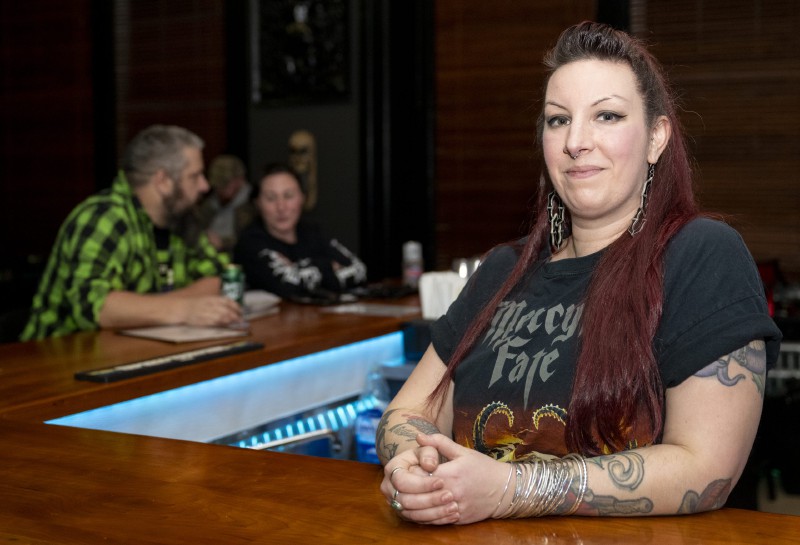
Bartender Nichole Galenski at The Heavy Culture Cooperative in Easthampton. DANIEL JACOBI II / Staff Photo
While members are entitled to a share of THCC’s profit each year, they also get a vote to elect future board members. For Peake, the ability to vote is one of the most appealing aspects of membership, effectively giving members a say in the cooperative’s future.
“Because it’s owned by its customers, the goal is not necessarily to make the maximum amount of profit for the owner,” Peake said about cooperatives. “Obviously you want to be sustainable and thrive. But they cater the actions of the business to reflect the values of what the customers want.”
Nichole Galenski, bar manager and vice president of the board, said opening THCC has been a long but rewarding process.
“Opening our doors and getting all of our permits in town was a huge obstacle, but with our teamwork and camaraderie we made it happen,” she said.

A sign at the entrance of The Heavy Culture Cooperative in Easthampton. DANIEL JACOBI II / Staff Photo
Venue longtime coming
Peake said starting around 2010 a strong, local heavy metal, punk and hardcore scene was taking shape in the area, partly due to the creation of RPM Fest in 2014. RPM Fest is a heavy metal campout festival in Montague, held every Labor Day weekend.
“I think that RPM Fest was really important for the creation of THCC,” Peake said. “A lot of people from RPM are on the THCC board.”
Galenski and Peake said THCC was a spinoff from RPM Fest in many ways. Peake said that while camping out in the woods, many people asked, “Why can’t we do this more often?”

Olde Bard bassist Gandhi Gracia performs during the first live music event at The Heavy Culture Cooperative in Easthampton, Saturday, Feb. 14, 2026. DANIEL JACOBI II / Staff Photo
To accomplish that, though, required a venue.
“There’s a lot of music venues in the area and New England that do punk, metal and hardcore stuff but it can difficult for bands of that nature to find spaces,” Galenksi said, whose partner co-founded RPM Fest.
Peake said heavy metal fans in the Valley lost their “third space” gathering areas during the COVID-19 pandemic, with many venues closing at the time. THCC formed in the wake of those closings.
“It’s important to understand that for a lot of people, these (metal) shows are their church,” Peake said. “They are coming here as the place where they see their friends or make new friends. COVID was really tough for a lot of these people.”

Bellower vocalist Tom Peake performs during the first live music event at The Heavy Culture Cooperative in Easthampton, Saturday, Feb. 14, 2026. DANIEL JACOBI II / Staff Photo
Once pandemic restrictions subsided, THCC formed in 2022. Community members in and out of City Hall gave support, but more hurdles approached in finding a location and getting necessary permits. Galenski said the group looked through at least 30 different locations.
Peake said after an auction where some 20 bidders left empty-handed for the building at 1 Northampton St., fortunately THCC member Ian Wilson was able to purchase the building and lease it to THCC. Peake said the former owners of The Massage School were very willing to work with the group.
“We repainted everything, but most of the heavy, expensive renovation was noise mitigation, which is something we always had intentions to do because we love our community and want to be good neighbors,” Peake said.
Peake said with the help of multiple sound engineers, slate walls that can close were installed over the windows in the building to reduce noise. THCC had to ensure outside noise levels were below a certain threshold.

Inside The Heavy Culture Cooperative in Easthampton. DANIEL JACOBI II / Staff Photo
While renovations were extensive, Peake said most of the work was done on a volunteer basis and the heavy metal community has a way of rallying behind each other.
That is exactly what the ribbon cutting was made to represent, according to Peake. On the newly built ramp up to the THCC entrance, multiple ribbons lined the handles for several people to cut. Peake said the ribbon cutting was the perfect symbolism of THCC’s journey.
“In the ribbon cutting, there is a symbolism that the ramp is supposed to represent our commitment to an inclusive space, each ribbon represented a hurdle and step that it took to get here and the sword represented the power of friendship and heavy metal,” Peake said.
]]>For the Valley Advocate
Sixteen years ago, Newton-born actress Amy Poehler’s character, Leslie Knope, the perpetually perky deputy director of the popular NBC mockumentary sitcom, “Parks and Recreation,” took her gal pals out for “Galentine’s Day.” Declaring Feb. 13 “the best day of the year” because it centered on “ladies celebrating ladies,” Knope invited her girlfriends — and her mom — to breakfast in Pawnee, Indiana, and showered them with gifts, including personalized 20-page essays on why each woman was outstanding.
The episode, which aired during the show’s second season, became iconic, and Amy Poehler’s character’s idea took on a life of its own. Though Galentine’s Day is an unofficial holiday, its concept has caught on and the day of “uteruses before duderuses” continues to be celebrated on the day before Valentine’s. And its gender-inclusive counterpart, Palentine’s Day, is also gaining popularity. While both could be likened to Friendsgiving in the way they redefine tradition by focusing on friendship, Galentine’s Day, at its heart, is ultimately a tribute to girl power.
When Valentine’s Day passed on Feb. 14, The Valley Advocate took note of the nontraditional ways locals celebrate the platonic loves of their lives — and honor their relationships with themselves. After all, love can’t be confined to a day or two on the winter calendar. To borrow another popular “Parks and Rec” phrase, there is always time to “Treat Yo’ Self.”
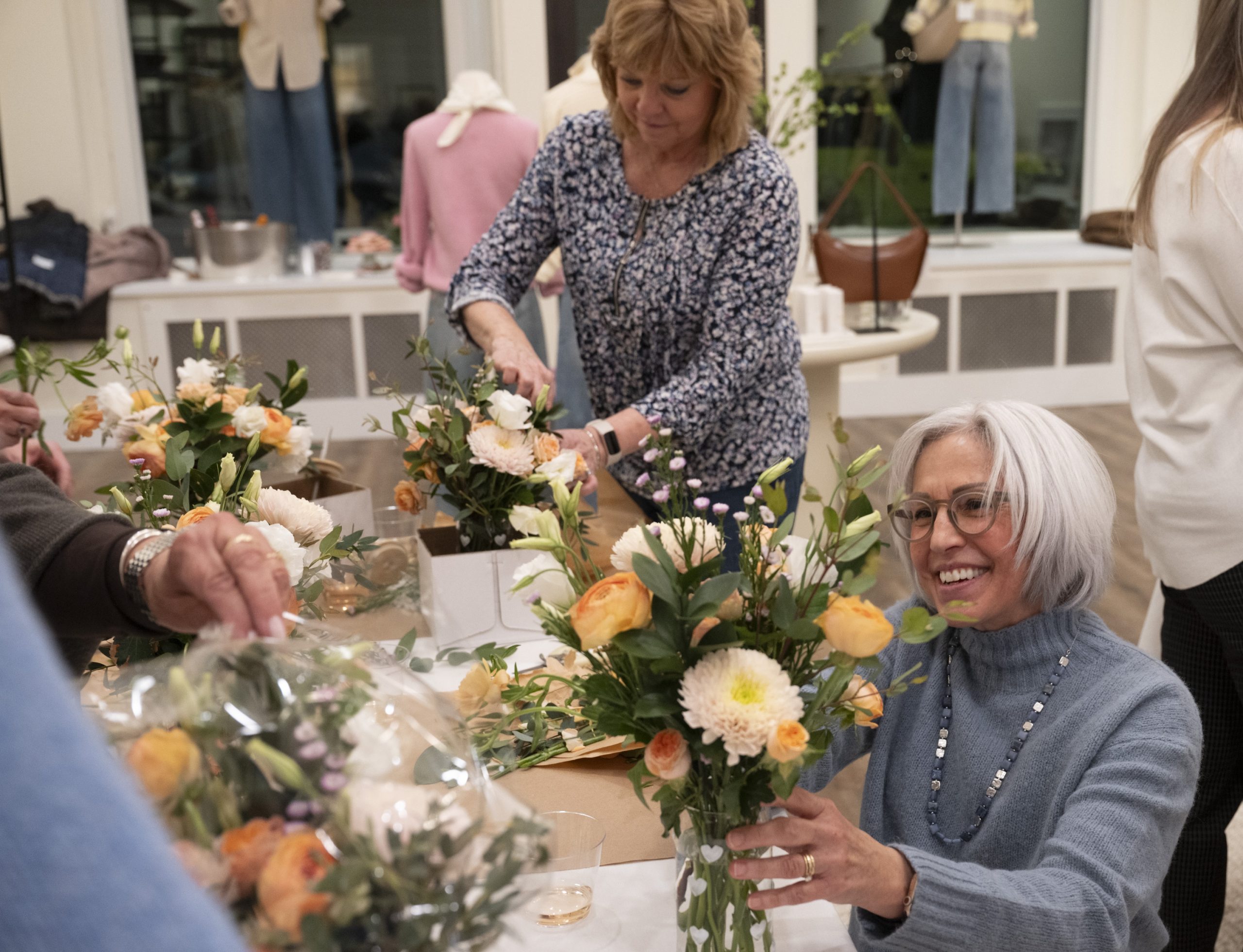
Judy Losito, and Marianne Baskin arrange bouquets at a Galentines event by Tina D’Agostino, owner of The Blooms Studio, at Harper James, owned by Kayla Diggins in Easthampton. CAROL LOLLIS / Staff Photo
In Easthampton, an ode to female friendship
On a chilly evening in early February, eight women gathered to arrange flowers for themselves. On two linen-draped tables lay heart-accented vases that doubled as reusable water bottles. Next to the vessels, open white boxes waited for easy transport in the bitter cold.
At the front of Harper James, an upscale women’s clothing store in Easthampton, the owner of Blooms Studio, Tina D’Agostino, stood before the women and unfastened a bouquet. Behind her, red, pink and white balloons hovered along the ceiling. The boutique’s owner, Kayla Diggs, watched from the front of the store, where in the window, underneath a mannequin, was a spread of chocolate-covered strawberries, sugar cookies and truffles, and fine wine nestled in a bucket of ice.
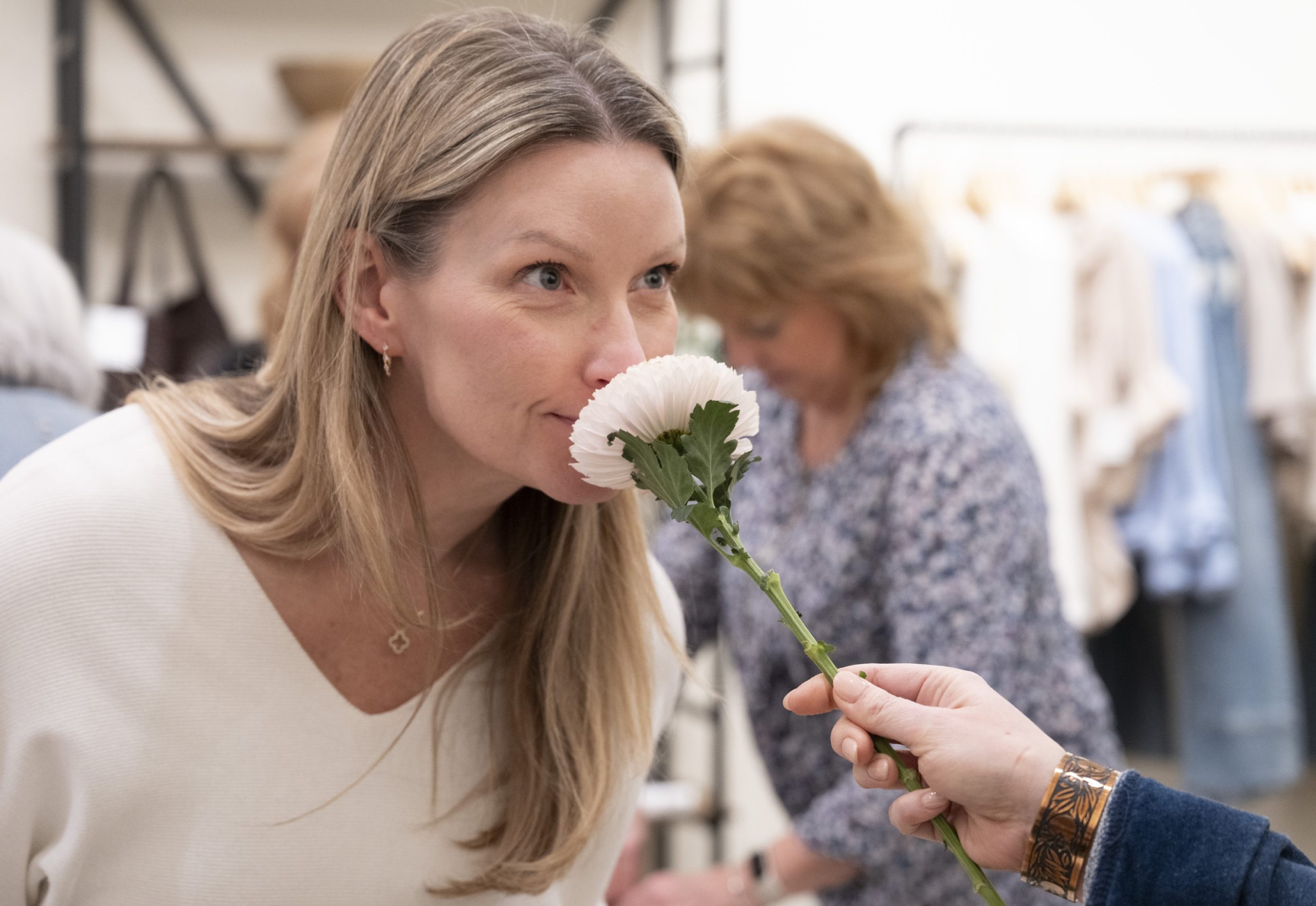
Tara Satkowski smells a flower held by one of her friends at a Galentines event run by Tina D’Agostino of The Blooms Studio at Harper James, owned by Kayla Diggins in Easthampton. CAROL LOLLIS / Staff Photo
It was Harper James’ third year offering the workshop with Blooms, which is based in Westfield. “We get together every year and catch up quick,” said Diggs. After the workshop, she holds a special sale for attendees, who may be entering the store for the first time or happily returning. “It’s nice having events that people can look forward to every year.”
‘We’ve got to celebrate our gals’
Tara Satkowski of Westfield was celebrating her birthday with her friend Julie Dimono, also of Westfield. Michelle Martone of West Springfield, an avid gardener, was showing love for D’Agostino, whose workshops she follows religiously. “She always has a tip or a trick that I take back, and it’s just a fun way to get together and meet new people,” said Martone.
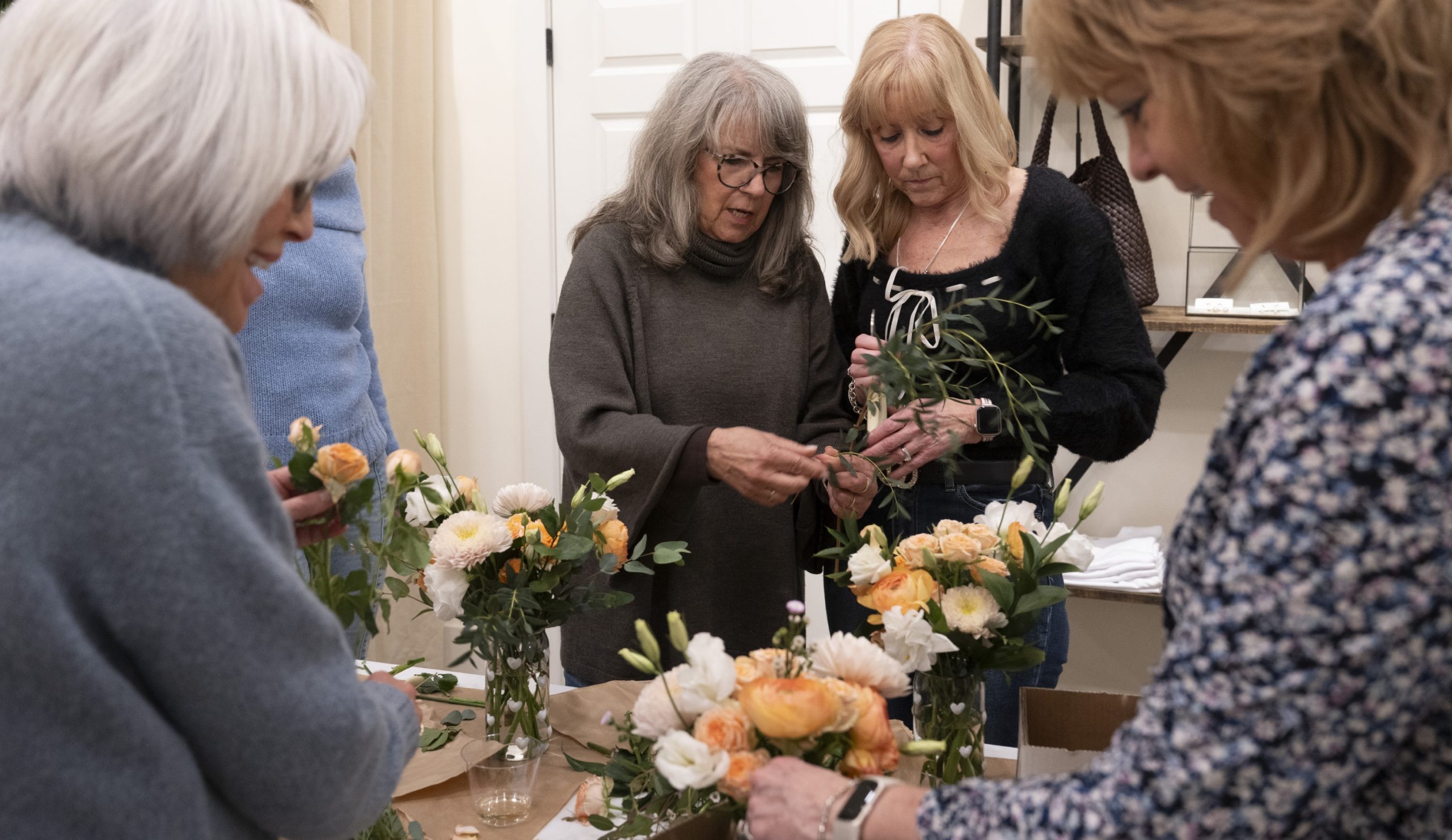
Judy Losito, Mary Magagnoli, Terry olbrych and Marianne Baskin arrange bouquets at a Galentines event by Tina D’Agostino, owner of The Blooms Studio, at Harper James, owned by Kayla Diggins in Easthampton. CAROL LOLLIS / Staff Photo
The others hailed from the 5 a.m. spin class at Fresh Cycle in Southwick.
“We are the ‘Spin Bitches,’” Judy Losito declared proudly.
Their spin instructor, Gina Noblit Giannetti, confirmed this title. Some of the women have seen each other every morning for the past 15 years, she said. Two, including Losito, joined the group within the last two years. Giannetti recalled introducing Losito to a friend at another event. “Oh, so you’re a ‘Spin B?’” the friend asked Losito, who ran home and excitedly told her husband about her edgy new identity.
The group, which also includes Mary Magagnoli, Marianne Baskin and Terry Oldbych, has also anointed each other with genial nicknames. Gianetti’s is “Julie cruise director,” after the welcoming character Julie McCoy on the 1970’s sitcom “The Love Boat.” It was her idea for the Spin B’s to attend the workshop for the past two years. “We’ve got to celebrate our gals,” she said. “Don’t get me wrong, my kids are No. 1, No. 2 is my husband, and then there’s my friends. I do love them, each and together, because at the end of the day, let’s be honest: you need them.
“So we’ll do this again and again.”
Judy Losito, Mary Magagnoli, Terry olbrych and Marianne Baskin arrange bouquets at a Galentines event by Tina D’Agostino, owner of The Blooms Studio, at Harper James, owned by Kayla Diggins in Easthampton. CAROL LOLLIS / Staff Photo
In Williamsburg, a tribute to community
About 10 miles away, the 18th annual Handmade Valentine Swap was underway. While the event was created for people in western Massachusetts to mail traditional Valentines to each other, it eschews commercialization by encouraging those of all ages to make handmade cards for strangers — or yet-to-be-met neighbors — in their larger community.
“It started at my dining room table,” explained Sienna Wildfield, founder of Hilltown Families, a community-based education network in Williamsburg that organizes the swap. “A group of us wanted to bring our kids together and show them how to foster community connections.”
Over the past 18 years, folks across the 413 have swapped more than 10,000 Valentines. “We consider them tokens of friendship and acts of kindness, and it helps to eliminate loneliness,” explained Wildfield.
A 2025 study by the Cigna Group, a global health services company, found that all generations know profound loneliness in the United States. And while Generation Z experiences the most isolation, the vitality of Baby Boomers is the most compromised by it.
A holiday that focuses on romantic love may exacerbate these conditions. A 2023 survey by BetterHelp, the world’s largest therapy platform, found that approximately 15 million American adults over age 18 say their mental health gets worse around Valentine’s Day, and more than one in four feels negativity around the holiday. The authors hypothesize that societal pressure around dating — particularly for Gen Z — can push people over the edge between discouragement and depression. They recommend self-care and finding platonic, familial or self-led sources of love and affection.
Beautiful snail mail
To participate in the Handmade Valentine Swap, people who sign up on Hilltowns’ website by Jan. 30 are placed into groups of 10 by Wildfield. Each person within a group is given a batch of randomized mailing addresses. No one knows anything else about their recipients besides their names, which is exactly the point: Here, love isn’t a transactional relationship, but an unconditional act.
Wildfield said that some people have a tradition of collecting all their mail and opening it on Valentine’s Day, or making a garland of cards that they display in their windows. She is always impressed by people’s creativity.
“Some of them are so great with the use of puns, making some of the most clever Valentines,” she said. She described one card made of brown construction paper and cut into the shape of a mason jar. Inside were four red-and-black ladybug stickers. The card was addressed “to my love bug.” Another sender melted crayons into the shape of a heart and sent the accompanying message: “For ‘crayon’ out loud, won’t you be my Valentine.”
Wildfield pointed out that the swap has helped people develop a sense of pride in the ever-expanding region they call home. “Eighteen years ago, out in the Hilltowns, we didn’t even have high-speed internet,” she said, noting the irony that technological advances have only underscored the value of material things. Now an entire community is sending its love via beautiful snail mail.
In Northampton, the value of self-love, and getting ‘warm and cozy’
Certified life coach Dana Olivo invites women like herself, who have often focused on taking care of others, to consider what they might want for themselves. Self-awareness may be the root of self-love — on Valentine’s or any other day of the year.
“My mom used to always get me a box of chocolates as a kid, but I think it can be more than that,” she said of the holiday. “I think there’s people who love to love. I can appreciate that, but at the same time, love you. Take yourself out on a date, buy yourself some flowers, pour yourself a glass of non-alcoholic wine, or alcoholic wine.”
Due to the success of the self-help industry, the Northampton resident said that there is a national yearning for self-discovery. She said that assessments qualifying someone’s love language or attachment style may be in the service of romantic relationships, but are actually driving people to better understand themselves before coupling up.
“I do think we’re conditioned to find a match, find a partner, find a mate, but I think I’m beyond that,” she continued, emphasizing the importance of accountability. “I enjoy spending time with myself. If I don’t, I can’t expect anyone else to enjoy spending time with me.”
When she was younger, “there was this mad rush to find someone to spend Valentine’s Day with,” she said. But as she matures, she hasn’t experienced that personally or professionally, among her clients. “As we come more into our own, I think we appreciate the time with ourselves and what we have to give to ourselves in ways that we may not have before.”
‘I’m a little bit in love with all my friends’
Olivo’s close friend has hosted a Galentine’s dinner for the past two years while going through a divorce — and mining the holiday’s potential to transcend romance and focus on love.
“I often think I’m a little bit in love with all of my friends,” said Olivo. “I love something about each of them that’s different and how we interact with each other feels way more intimate [than a romantic partnership with a man].”
She didn’t think cisgender men thought about being “warm and cozy” with each other in the same way that women do, noting that she and a couple friends schedule “a day of nothing” as an excuse to “be in close proximity to each other.” Only those with a “certain vibe” are invited — or welcomed back. In fact, she said that you can’t talk too much, and you can never ask what the group is doing next. The point is to relax in good company.
Reflecting on the popularity of The Golden Girls, a sitcom from the 1980s, she said that maybe the privilege of close friendship is “one of the things everybody loved about [the show] no matter where they were coming from.” Invoking the theme song of the seven-season series, she said, “‘Thank you for being a friend,’ there’s something so sweet about that.”
In Greenfield, taking care of business
At Adam & Eve in Greenfield, Valentine’s Day can be a gateway to self-love, said Jenni Skyler, the company’s sexual health and wellness “sexpert” and codirector of the Intimacy Institute in Denver, Colorado. Adam & Eve began as a mail-order business in 1971. Starting in 1999, the company expanded into 100 independently owned stores in Canada and the United States, including Greenfield.
“I think self-pleasure is a part of loving yourself, and an expression of it. It’s a lovely gift to yourself,” said Skyler. “We’re not made to have these nerve endings to do nothing with them.”
Skyler said that for those new to masturbation, her advice is to go to Adam & Eve and look around — preferably in a physical store, where, “just like you would in Nordstrom, just get a feel of what it’s like to be there. Imagine the toys in your bedroom. Imagine the toys in your hand.” She recommends building a “bedside box” and visualizing what you need to feel sexy, whether that be music, candles or a disco ball — more than one client has fantasized about the spherical light reflector.
This kind of self-attention can only benefit people who enter a relationship, she said, where “you’re going to have to be the expert on yourself.”
Meanwhile, Skyler says, “The best way to attract someone is when you’re not hunting for it … when you’re happy and comfortable with yourself.”
“It’s Valentine’s Day,” she continued. “If you’re not used to pampering yourself, this is the time to treat yo’ self.”
Melissa Karen Sances can be reached at [email protected].
]]>For the Valley Advocate
Victor E. Everwin knew he might die at the Dark Magic School reunion — and he welcomed it. Fourteen years ago, he’d entered a time loop fueled by a “Dark Pact,” and only winning the “Most Nefarious” superlative could break the cycle.
On a cold December night at a brick-lined tavern in Paradise Valley, Everwin bided his time. The only thing standing between him and eternal rest was his main opponent: a chicken. Fortunately, no lives were actually at stake. Everwin was a character portrayed by Holyoke actor and theater teacher Tom Roché during an immersive theater event at Quonk, a Northampton venue redefining performance art at 122 Main St.
Learning to play
Quonk, which is both the name of the company and the venue itself, is the brainchild of Jonathan “Jon” Pedigo, the company’s founder and owner, who also co-owns the bar and music venue Haze in Northampton.
Pedigo grew up south of Chicago, where some of his most treasured childhood memories involved playing make-believe with his friend Steven Clark, who has since passed away. The pair loved creating fantastical worlds in their basements, then showing those worlds to their families.
“It was always about bringing other people in,” Pedigo said.
In high school, Pedigo made short comedy videos through his school’s broadcasting club, but he wasn’t involved in theater and didn’t see performance as a viable career path for himself. As a student at Hampshire College, he studied software engineering. His Division III graduation project involved a series of websites that could only be accessed at the college. He said he was “obsessed with things that are unscalable, essentially” — by creating something site-specific, he was making “something special that just can’t be touched by capitalism.”
Beyond his education, Pedigo’s engagement with immersive theater at the college and through trips to New York City proved transformative. He found that active participation in these productions disrupted his rigid work routine and restored a sense of creative play. He said that this exposure opened up the possibility of a career in immersive performance.
“Immersive theater transformed me and made me realize that I do want to play,” he said.
‘Bar of Dreams’
Pedigo graduated in 2015 and moved to New York City, where he worked in an office and instructed aspiring developers at a software engineering bootcamp. In 2017, he moved back to Northampton and launched his inaugural immersive production, “Bar of Dreams,” in his own bedroom.
The show, which followed a sleeping man needing the audience’s help to wake up and open a bar, eventually traveled with Pedigo to Los Angeles in 2018.
By late 2023, a desire for community prompted his return to the Valley. In April 2024, Pedigo found an ideal fit at the former Oh My Sensuality Shop, located at 122 Main St., under the Pinocchio Pizza awning, through the door on the left.
“I walked in and thought, ‘This is amazing … it’s time to do this,’” he recalled.
After initially hosting DJ nights and movie screenings, Pedigo has since produced nine other immersive events, besides the Medieval Fantasy Tavern. While he balanced software work to fund the venue’s start, Quonk is now his full-time occupation.

Tom “Victor E. Everwin” Rochè listens to a conversation during a Dark Magic School Reunion, an immersive medieval night out by the Quonkhampton theater company, in Northampton. DANIEL JACOBI II / Staff Photo
What is ‘Quonk?’
The name Quonk is as eclectic as its origin. While Merriam-Webster defines it as a disruptive broadcasting noise, founder Jon Pedigo views it as a “mini fun quest” — a subconscious portmanteau of “quack,” “honk,” and a nickname for his favorite protein chips.
In any case, Pedigo said, “Like getting this venue, it just felt right.”
Though it utilizes theater, Pedigo explained that he sees Quonk as a company of “transformative experiences and experience design,” he said. Every show features central narratives and character backstories, but there are no rehearsals — only “playtests.”
“There’s no wrong way to play,” he said. “The world needs more play — playing more and getting together more and getting off of our screens. I like screens; I’m a software guy, I like games, but I want to see a journey from screens to being in person being really an exciting one for people.”
Building an event
To bring the college reunion at the Medieval Fantasy Tavern to life — much like any college reunion, perhaps, but with conversations about dragons and curses thrown in the mix — the Quonk team had to audition performers. Six of them, a group largely made of self-described nerds and theater people, gathered at Quonk the Monday night prior to the event to showcase their improv skills.
Pedigo was joined in person by team members Jake Gibson and Erin Fitzgerald; a few others joined via a video call. Everyone who’s part of the cast at a Quonk event is paid, but Gibson is the only member of the leadership team who is paid for his monthly work; everyone else is a volunteer.
Unlike a typical theater audition, this one had no sides to read or songs to belt — instead, the team wanted to see how well each actor could give and receive information from someone else.
In improv, this is referred to as “yes, and,” a principle that involves continuing and building onto what another performer says to you to continue the scene. If, for example, someone says, “Hey, I remember you from potions class!” the other person might reply, “Yes, and you once spilled a love potion on my hat!”
Of course, Quonk has its guardrails. “Yes-anding” everything could mean, for example, that someone could come to the Tavern and declare they were from the future, and then derail the medieval fantasy. Though it’s not a common problem, in part because the audience demographic naturally self-selects for people who want a fantasy experience and because the events are designed to keep the story’s universe intact, Pedigo said.
“Ninety-nine percent of the time, if you establish core facts very early and very clearly, people … will take them with them throughout the night and treat them as real, as long as they’re continually reinforced by every performer,” he said.
In fact, Quonk launched improv classes in February. Its eight-week Improv 101 and Improv 201 classes, taught by Pedigo and immersive performance artist Keight Leighn, will each have 12 students per class and culminate in a public show.
During auditions, actors, who performed under the premise that they hadn’t seen each other in a long time, improvised scenes ranging from a man hiding that he was a werewolf to a summoner berating another character for bringing a “low-quality goat” to the Devil’s Sacrament.
Ezra Wilde, a western Mass. resident who later joined the cast as a character named “Olly,” shared that they felt play was an opportunity to learn and develop as a person.
“I think that play is such a valuable part of the human experience and that, for some reason, our society hammers this idea into us that we’re supposed to outgrow it, and I think that that’s silly and very bad for mental health,” Wilde said.
A dark party
At the Medieval Fantasy Tavern, on the evening of Saturday, Dec. 6, the reunion crowd swelled to nearly 50. Marilena Vulpes (played by Fitzgerald), a vampiric redhead with dark lipstick and a Bela Lugosi-inspired accent, and her fiancé Dionisie “Dio” Georgescu (Fitzgerald’s real-life boyfriend, Ray Tannheimer, who is also a member of the Quonk leadership team) were poised to take the stage.
The duo announced the evening’s superlatives contest and gave instructions on how to vote using color-coded stars. To cast a ballot for the “Most Nefarious,” for example, participants placed a red star sticker on their chosen candidate’s name tag.
As the votes began to be tallied, the chicken named “AI” — a stuffed chicken in the real world, but a real one in the show’s universe — nearly swept “Most Nefarious” with eight red stars. AI was bested, however, by Rodney, who had collected 22 red stars by nefarious means. In fact, Rodney was revealed to be the school’s headmaster in disguise. He allowed the students to bargain to renegotiate their Dark Pacts, with Sammy Sacrificed (played by Pedigo) as his own lawyer — his literal “devil’s advocate.”
Once the contest had wrapped and the crowd transitioned into a dance party, Everwin walked over to the stage and sat down. He hadn’t won the award, so he was still stuck in a time loop. He’d had a good night anyway.
“I had my reasons for coming here, but this day will always hold a special place in my heart,” he said. “In a way, it is kind of like an ending, y’know? Tomorrow, I’m gonna watch the movie again, I’m gonna play the song again, but maybe what I should learn from this is, even though I have to repeat this life over and over and over again, a song on repeat still has a beginning and end, even if you have to listen to it over and over and over again.”
For more information about Quonk, visit quonkhampton.com.
]]>For the Valley Advocate
With Women’s History Month soon upon us, it makes sense to call attention to women who have changed the course of history.
Names like Carrie Chapman Catt and Alice Paul may not be instantly recognizable, but when Shaina Taub’s Broadway musical “Suffs” closed on Broadway one year ago after only 301 performances, plans immediately started being made for this show to go on tour, where its message of women’s struggle for equality might find a completely different audience.
Like “Hamilton” to which “Suffs” will undeniably be compared, musicals can be creative ways to tell history and introduce audiences to real people who were dedicated to making the country a better place for all. What is also path-breaking about this show is the commitment to an almost all-woman production team as well as an all-woman cast. The story of how the show got to Broadway could be a play in itself. Producers Hillary Clinton, Malala Yousafzai, Jill Furman, and Rachel Sussman, along with visionary director Leigh Silverman led a creative team made up of mostly women to represent women of all walks of life — and all of whom owe a debt to the foremothers who tried their best to ensure legal equality for women.
The first touring company recently performed at The Bushnell in Hartford, and it became clear on opening night, Jan. 27, that a new generation of audience members was hungry for a show that focused on real women who took risks and challenged patriarchy to inch toward equality. The energy in the theater was palpable. I talked to many audience members who had never been to see a live musical before, but they were excited to see this story, and they braved frigid temperatures for the experience.

Marya Grandy as Carrie Chapman Catt in “Suffs,” and Company.
Joan Marcus

Maya Keleher as Alice Paul in “Suffs.”
Joan Marcus
Carrie Chapman Catt, played by Marya Grandy, was of the “old guard” by trying to get men to pass voting rights to women in 1900. Successor to Susan B. Anthony, Catt took a cautious approach. Twenty years later, along came Alice Paul, with the purpose of establishing the National Woman’s Party to demand women’s suffrage and fight for the Equal Rights Amendment. Committed to non-violence, Paul and her inner circle challenged the status quo with different methods and outcomes, many of which were inherently dramatic, such as a hunger strike and exercising their right to demonstrate at the White House gates. Perhaps because of the show’s appeal to a younger demographic, the story of the suffragists who were the “Suffs” is told primarily through the eyes of the younger suffragist, Alice Paul.
On Broadway, “Suffs” won the Outer Critics’ Circle Award for Best New Musical and Shaina Taub won Tony Awards for Best Book and Best Score. The story, though not completely historically accurate, is fascinating, and the 17 women who perform the 33 songs represent a much more “typical” cross section of womanhood than the usual Broadway fare. “Suffs” is destined to be a much produced musical on regional and local stages, and the touring company at The Bushnell gave the show a high-voltage energy that excited the audience. A feeling of triumph and liberation accompanied the evening’s entertainment. “Suffs” will have a long lifespan on the stage in regional and local theaters, so if you missed it on Broadway or in Hartford, watch for it to come around again. It’s well worth the immersion into the past to understand where we are as women now, and how far we still have to go.
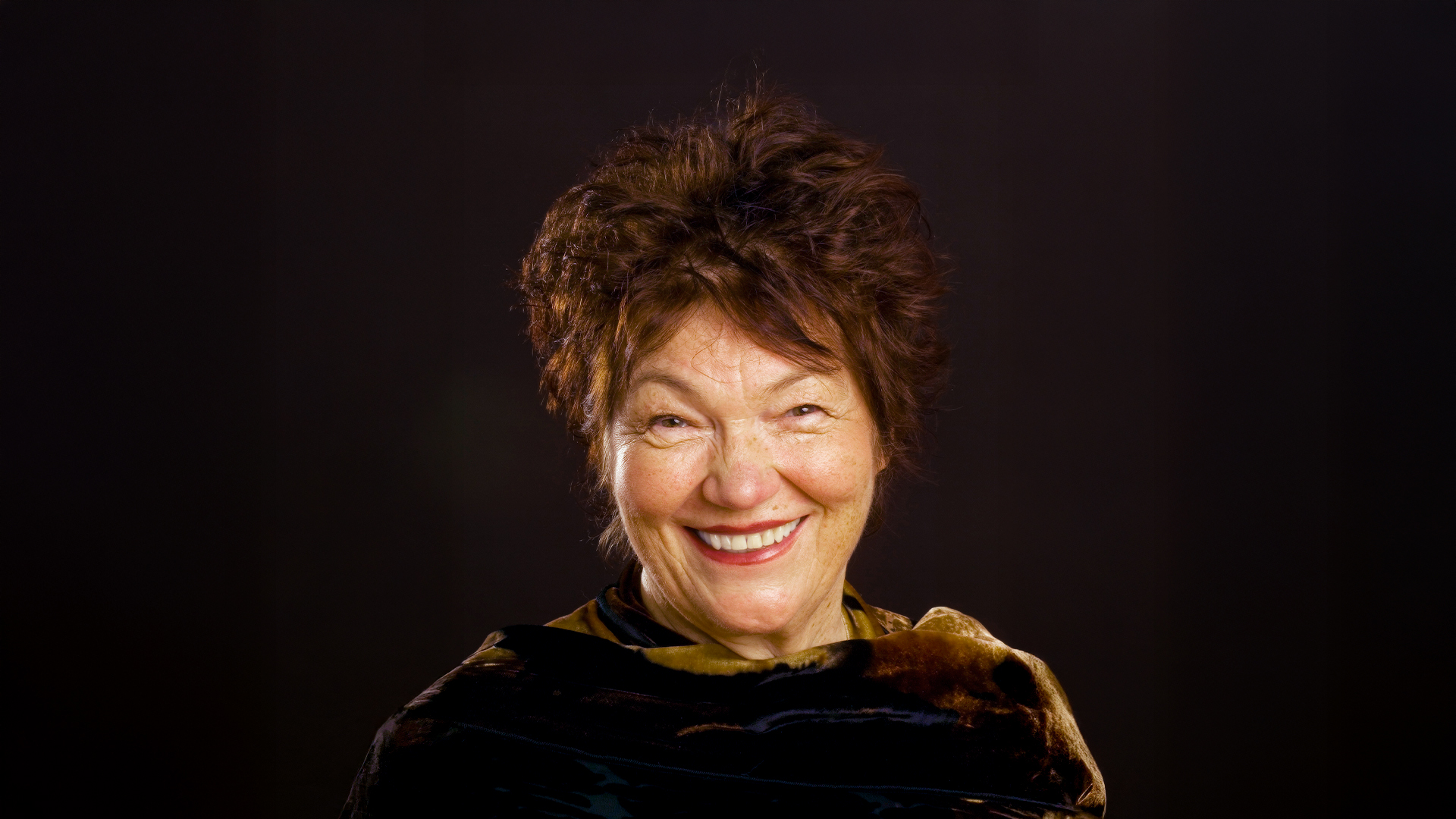
Tina Packer, actor, director, visionary theater icon, who was known for her longtime work with Shakespeare & Company in Lenox.
Shakespeare & Company
The Queen of the Berkshire Bard: The Great Tina Packer (1938-2026)
The regional theater world as well as theaters around the world are mourning the loss of Tina Packer, the visionary, driving force behind Shakespeare & Company, one of the premier performance and educational venues in the Berkshires. Tina passed away on Jan. 9, 2026, ironically, just months after the mortgage was paid on the Shakespeare & Company campus in Lenox.
Tina co-founded Shakespeare & Company in 1978 with actor, director, writer and teacher Dennis Krausnick, who later became her husband; voice and text teacher Kristin Linklater; Kevin Coleman, actor, who also serves as director of education; and a group of prominent theater artists. The first home of Shakespeare & Company was at The Mount, Edith Wharton’s home in Lenox. The company later moved to its own 30-acre campus on Kemble Street where it grew to encompass four very different types of performance spaces, indoor and outdoor, and it expanded its theatrical offerings to a host of different plays.
As artistic director until 2009, Tina coordinated the artistic, educational, and outreach activities of the company, and was its chief fundraiser and advocate. After 2009, she shifted her attention to directing and acting. Though always a stalwart presence during the peak season of the company’s work, Tina was drawn to regional and local theaters around the nation and the world.
I remember first meeting Tina when I interviewed her for a performance she was preparing for called “Mother of the Maid” about the mother of Joan of Arc. Her arresting presence, sense of humor, and full candor made that interview feel as though we had moved from interviewee/interviewer to friends. We chatted far longer than we had planned. I think I was more concerned about her spending too much time with me so close to opening night, but that never seemed to rattle Tina. She always seemed to control time while not missing a beat in talking about what she was most passionate about, which was always “putting on a great show” and “finding what you know to be a universal truth.”
Committed to telling the stories of Shakespeare’s women, Tina performed all of the female characters over her career. In 1994, she was awarded Guggenheim and Bunting Fellowships to fund the project and performances of “Women of Will” in Mexico, England, The Hague, China, and across the United States. Her influential book, “Women of Will” was published by Knopf in 2015. Her insights into character, gender relationships, power, and culture, all contributed to her vision of the lasting legacy of Shakespeare’s work.
In honor of Tina’s legacy, a celebration of life will take place on Sunday, May 31, at the Shakespeare & Company campus; please check the website for more information this spring. Shakespeare & Company has established the Tina Packer Legacy Fund and in lieu of flowers, Tina’s family asks that friends show their support by donating to the fund.
Tina Packer will be remembered by countless students and audience members for her warmth, energy, and spirit. Actors will remember her as a leader and extraordinary talent. Anyone wishing to share memories, a story or reflections about Tina are invited to email that message to: [email protected].
]]>For the Valley Advocate
There are few people that get to say they turned their passion into a living.
Sam R. Webber meticulously assembled his 1950 Harley Davidson Panhead seven years ago with parts he collected from various locations, within the confines of the first floor of his former Northampton residence.
While his interest in motorcycles began long before that, it revved a passion for Webber leading him to start his own business, Sam’s Custom, building dream bikes for clients around the country.
Webber restores vintage motorcycles for clients and builds some of his own from vintage parts. The process involves extensive restorative work and custom fabrication of certain parts — welding and forging metal into the desired piece — to turn his client’s vision into a reality.
For Webber, who now resides in Florence, the business and hobby have never really been separated since opening his own shop in one of the town’s mill buildings three years ago.
Whether it’s a larger antique motorcycle event such as the Antique Motorcycle Club of America’s annual swap meet in Oley, Pennsylvania or just meeting up with a friend, Webber seeks different parts, that when put together, create the puzzle that is an antique motorcycle.
“It takes a long time to hunt down all the parts,” Webber said at his shop. “These are all old parts, you can’t just order them and put it together. You have to travel around the country, go to antique swap meets and do all this to collect it all.”
Whether it’s something as small as a drive chain that allows the wheels to turn or as big as the forks that connect the wheels to the body, the process requires a keen eye to hunt down the pieces that would work for a particular build.
During his interview with the Gazette, Webber sat beside two bikes he was working on — a 1952 Harley and a 1960 Harley. One he had just restored for a client in Denver, and the other just came into the shop.

Sam Webber at his workshop, Wednesday, Nov. 12, 2025, in Florence. DANIEL JACOBI II / Staff Photo
For the bike that just came in, it could take up to six months to help execute the client’s vision, a collaborative process that Webber said is more of a creative process, emphasizing that he is not a mechanic.
“I’m more of a creative person, but I don’t mind executing someone else’s vision,” he said.
His favorite part of the job is the ability to control his schedule and leverage his creativity; clients sometimes know exactly what they want, while at other times he has the freedom to explore his creative liberties.
“This was just a pile of parts,” he said motioning to one of the bikes. “(You) Just start with a frame. Start with a dream.”
For a motorcycle that’s built from the ground up, Webber said it can take up to a year to construct. In his shop, there is a shelf festooned with parts waiting to be used for a build. To Webber, it’s not about putting the pieces together, it’s about finding the right ones.
“A lot of what I do would be restorative fabrication and machine work. So I’m able to take some of the worse-off discarded parts and restore them into functional state,” he said. “In this scene, it’s always best to use the original parts because the quality is so much better than a modern reproduction of the part.”
Webber’s process does not always involve starting with a client. He may begin working on a bike and then fish for buyers either locally or at different swap meets.
A lot of what Webber does involves restoration through different methods including welding and refurbishing. He custom fabricates certain parts such as a fender strut using different metals and pieces to mold new parts together. Webber has had clients come to him with different parts that need to be restored from as far as Japan and Australia.
Webber harnessed his metal-working craft, having worked for more than eight years for Salmon Studios, one of the world’s leading architectural mill workshops, in Florence.
“It taught me damn near everything I know about metal working,” Webber said about his time at Salmon Studios. “I’ve known how to use hand tools and I’m comfortable around machines. I learned woodworking before metalworking, but basically my time as an employee over there, it was like an education in metal.”
Before learning to work with metal materials, Webber studied wooden furniture design. When he first started working with metal, he said he saw the medium to have more versatility compared to more rigid wood materials.
At it’s core, Webber’s business main focus is bike restoration, but he also fabricates custom designs for a variety of projects as small as coat hangers to larger fences and business signs. For example, he has been developing custom metal coat hangers for a client in New York City who is expanding their art studio.
He likes to work with brass, aluminum and other materials for custom designs, though he typically sticks with steel when fabricating parts for motorcycles as it is more durable than the others.
Webber’s journey to get wear he is today has been a road trip of its own, having jumped between the east and west coast multiple times trying different educations. However, his ultimate goal has always been to own his own shop.
“I realized having some sort of a shop, I didn’t really know what I would do, but having a shop was always the goal,” he said.
Webber bought his first bike in high school. He favored the two-wheel automobiles for one reason.
“In high school, it was money. It was like, I don’t have any money and motorcycles have two wheels, not four … I saw a couple local guys getting onto bikes and I just thought it would be a lot cheaper to have a cool bike than a cool car,” he said.
Ultimately, Webber holds a bachelor’s degree in sculpture from the University of Massachusetts Amherst, but it took time to find the right program. He initially studied architecture at UMass, before dropping out. He then moved to Los Angeles to study automotive design and also spent time in San Francisco studying furniture design.
In San Francisco, after a lunch with one of his professors, Webber was inspired to go back to Northampton, finish his degree at UMass in sculpture rather than architecture and then started working toward that dream of owning his own shop.
While in Los Angeles, a particular motorcycle brand caught Webber’s eye — Harley Davidson. He said it’s not just about Harley Davidson, it’s about the vintage, older engines that come from 1936 to 1969 Harley’s.
“What Harley is today is not really what I identify with or think is interesting,” Webber said. “I kind of admire the history of the brand more than anything and some of the machines that came from the golden age of American motorcycles.”
Older models of motorcycles are easier to repair while more modern models require specific parts to be fixed with multiple pairs of hands, Webber said.
“The old bikes just have a much more analog feel. They’re built to be serviced and maintained by the owner,” he said.
Although he’s owned multiple motorcycles over the years, including Honda and BMW brands, for Webber, nothing beats Harley for aesthetic and drivability.

Sam Webber welds a motorcycle piece at his workshop, Wednesday, Nov. 12, 2025, in Florence. DANIEL JACOBI II / Staff Photo
He has driven his Harley cross-country multiple times, connecting with friends that he’s met through the trade. And while he puts together bikes for many people, one thing is certain: Webber’s is not for sale.
“I’ve got friends all around the country just from swap meets or road trips,” he said.
He noted that having only been in business for three years, he still has much to learn. He hopes to continue expanding into different fabrication methods, recognizing the limited supply of vintage motorcycle parts. Recently, Webber announced he will be moving locations to a larger shop in Florence to help expand his business.
“It’s an incredible feeling just being out in the middle of nowhere, hundreds of miles from anything, on a machine that you built yourself,” Webber said about riding.
For more information, visit Webber’s Instagram account: samrwebber
]]>For the Valley Advocate
Western Mass. is known for a lot of things. Colleges. Asparagus. Apples. Lesbians. Basketball. But wine? Not as of yet. Beer? For sure. With stalwarts like Berkshire Brewing Company, The Northampton Brewery and The People’s Pint, alongside well-decorated newcomers like Treehouse, western Mass. is solidly on the map when it comes to beer. But wine from the 413 is still very much up-and-coming.
As a person who prides himself on celebrating all things local, and who does his best to shop local and eat local — and who also imbibes in a fair amount of wine — I face my own shame when it comes to how little local wine I drink. But perhaps the 19,000 vines planted across 18 acres in North Hatfield will broaden my horizon.
I visited Black Birch Vineyard in North Hatfield on a blisteringly cold morning in January. It was a few days after a foot and a half of snow fell on their vine-trellised fields. With the winter sun still low on the horizon, scattering sunlight across the snow-covered vines, the drive up the long driveway to the tasting room felt magical. I met the dog, Yogi, and the cats, Pinot and Chardonnay before I met one of the Black Birch owners and vintners, Ian Modestow. The farmer-meets-mad-scientist was working on a natural process to remove tiny harmless crystals from their white wine when I arrived. While the frozen tundra of a vineyard looked beautiful on the drive in, I wondered what that much cold and snow does to the vines.

Black Birch owners and vintners, Ian Modestow and Michelle Kersbergen.
Monte Belmonte
“Vines actually acclimatize well to cold weather. But they need to acclimatize,” Ian answered. “Our vines, when they’re getting ready for the winter, they actually lose water and develop a little anti-freeze. So, the colder it gets earlier in the season, the better the vines are prepared for real cold.”
But with New England’s unpredictable weather, how cold is too cold? “If it gets below -10 we do get damage,” Ian said, “And that happened last year. We had two nights of -20.” And that cold created some major loss. “Typically we’ll pull four or five tons from our Cabernet Franc,” Ian said, “Last year in 2025 we pulled maybe 600 pounds.”
Ian’s partner in life and libation, Michelle Kersbergen, entered the chat. “The tender varietals like Chardonnay, Riesling, Pinot, Cab Franc, the cold is putting a lot of pressure on them as far as survivability,” she said. “But we do have some hybrids growing here.”
These hybridized grapes were designed for survival in cold weather, specifically for cultivation in places like the Finger Lakes in New York. Some of the names of these grapes have started to become more well known, and thus more popular to consumers, like Traminette and Marquette. Michelle said “Those are sort of our insurance policy when those tender varietals can’t handle those temperatures.”

The award-winning wines of Black Birch Vineyard in North Hatfield are created by hand in small, individually numbered batches that are available based on growing conditions.
Monte Belmonte
And Black Birch also gets creative with blending, so the 600 pounds of Cabernet Franc didn’t go to waste.
“We’ll take those grapes and do a fun estate-blend, that we’ll barrel age,” Ian said. “Or we’ll make a young fresh Nouveau wine.”
They’ve even created two specific labels for when the farming is less ideal and when the winemakers need to get creative. They call them “Grace” and “Redemption.” Those styles have become so popular their customers ask for them, even when they haven’t had as rough of a farming season.
“Our goal is to be an estate grown winery,” Michelle said, “We’ve had some great years and we’ve had some not so great years.”
One of the benefits of being a local estate-grown winery, versus being a winery from a better-known region, is they don’t have to suffer under the threat of ridiculous tariffs. And despite an overall dip in alcohol consumption across the board, Black Birch is still making it work.
“People want local wine,” Ian said, “so we’ve been fortunate not to see the impacts that larger companies in California are seeing.”
Plus, Black Birch keeps its production small. “We do on average about 4,000 cases a year,” Michelle said. “That’s not a lot. And our price point is not so extravagant that it’s unaffordable.”
Having cultivated a dedicated local clientele helps to keep Black Birch in the black.

Pinot the cat at Black Birch Vineyard.
Monte Belmonte
Wine is more than alcoholic grape juice. It’s a lifestyle. And Black Birch brings that to The Valley in spades. They have a beautiful tasting room, amidst the giant stainless-steel tanks where the wine is vinifying. They have a gallery of sorts, where the walls of the tasting room are adorned with local art. They have a book club. They have music. And, especially in the warmer weather, they have glorious outdoor concerts.
Over the past few years, they’ve teamed up with the record label and concert promoters, Signature Sounds Recordings Co., to bring some top-notch performers to a farm in North Hatfield. Artists like Rachael and Vilray, Darlingside and Heather Maloney.
“Living in The Valley here, in western Mass., is just like a focal point for such great things,” Michelle said, “And I feel like wine and our space can be a hub for that. That’s what we want it to be.”
Wine is also more than lifestyle, it’s a time capsule. Each bottle is a message … in a bottle, from a year of farming. We’ve heard what can happen if a winter is too cold. But if a summer is too hot or too dry or too wet, it will all translate into a message from the vines. Black Birch has an appropriately dusty library of all of those messages.
“You really have to ask about purchasing these bottles,” Ian said. “These are no longer for sale.”
But occasionally Black Birch hosts what’s called a “vertical,” where you taste the same grape or style of wine from, say, 2017, 2018 and 2019, to taste how the message in those grapes and in those bottles has changed from year to year. Their library goes back as far as 2010, when Black Birch left Southampton and what is now Glendale Ridge Winery and focused on creating their estate grown wines in North Hatfield.
Wine is a time capsule, and a lifestyle and alcoholic grape juice, but perhaps most importantly it is a farm product. And Ian and Michelle are farmers. They not only farm grapes, but they also have 25 acres of pasture with 40-50 sheep that they raise for meat and for wool — sheep who graze between the rows of vines and fertilize the fields with their feces.
These farmers are our neighbors. And they work really hard to make a well-crafted and delicious crop. I only buy asparagus when it’s in season from our farmers in Hadley (and yes, sometimes in Deerfield). Why don’t I make the same commitment to the farmers of wine in North Hatfield? In a time where mutual aid, community support and neighbor-helping neighbor is becoming more important than ever, maybe I should. If I’m being honest, I’ll never give up my love of wines from France or Italy or Spain. But I’m ready to fall in love with a wine from North Hatfield, Massachusetts. USA.

With the winter sun still low on the horizon, scattering sunlight across the snow-covered vines, the drive up the long driveway to the North Hatfield tasting room felt magical.
Monte Belmonte
For the Valley Advocate
Dear Yana,
I’m in a committed relationship with someone I care about deeply, and I’ve crossed a line I never thought I would — I’m having an affair. I love my partner and we have a real life together. And still, I’ve been lying to them for months. I keep telling myself I’m doing it to protect them, but the truth is I’m exhausted from the double life and the constant fear of being found out.
I want to tell them in the hopes that we can process the pain and hurt and move forward. But, I don’t know how to confess without blowing everything up. I don’t know if there’s a way to tell someone you’ve betrayed them that isn’t cruel. How do I tell my partner I’m having an affair when I still love them and don’t want things to end? How can I offer to build back trust while also giving them space to process?
Thanks,
‘Fraid to Fess
Dear Fess,
Affairs are increasingly common but rarely happen because the betrayed partner failed or fell short. Instead, they happen in moments of identity rupture on behalf of the person having the affair. Affairs are rarely about the partner who was betrayed — they’re more about the person who stepped out to have the affair — often when they are longing to feel alive, wanted, or momentarily unburdened by the very life they’ve created.
Don’t get me wrong, this isn’t an excuse. But it does help focus on what the affair is actually about: you — not your partner, your affair partner, or either relationship. I’m not saying that all affairs have nothing to do with the state of the relationship or the actions (or inactions) of the other partner/s involved but it’s far more common for affairs to be rooted in you over anything else. More importantly, this framing deeply matters when you disclose and will come in absolute handy as you and your partner attempt to move forward.
If you can’t identify what this affair was showing you about you then it will be far harder to confide in your partner about your motivation for the affair, it’ll make it harder to be specific about how you’ll change your daily actions in order to prevent an affair from happening again, and it’ll incorrectly lay more responsibility than is warranted in the lap of your partner.
If you’re only going into this disclosure because you’re secretly hoping it’ll erase-and-reset what’s been done (and what needs doing), your partner will sense that, you’ll fail to take accountability, and the point and process of disclosure will either stall out or blow up. Confession is not a repair strategy – it is an accountability act and a first step towards building a new structure where a faulty one once stood.
Unfortunately, there’s no cruelty-free way to disclose, but there is a responsible one. Having an affair is not a way to avoid pain for anyone involved so trying to do-so now is a bit of a fool’s errand. However, you can reduce damage done in the way you disclose. Don’t confess impulsively during a fight, give graphic sexual details or comparisons, frame it as something that “just happened”, or rush your partner toward forgiveness or a decision.
Instead, responsible disclosure might sound something like this: “I need to tell you something difficult because you deserve to know the truth about our relationship. I’ve been having an affair. I’m not telling you to force an outcome or ask for immediate forgiveness. I’m telling you because I want to end the affair, to take responsibility, answer your questions, and let you decide what you need next.” In this last sentence, you are importantly returning agency to them rather than asking them to manage your anxiety.
Wanting to rebuild trust is understandable but the timeline might move slower than you’d like. Trust isn’t built overnight via confession but is steadily restored through predictability, transparency, and consistently. Importantly, this is a process that takes time. A couples therapist who is light on the shame and heavy-handed on the accountability can be a helpful professional companion in this process as you work towards getting more specific about what being a trust-worthy partner means to you and your partner from here.
Yana Tallon-Hicks, LMFT is a relationship therapist, sex educator, and author living in the Pioneer Valley. You can find her work and her professional contact information on her website, yanatallonhicks.com.
]]>For the Valley Advocate
Nearly two years after reopening its doors following significant renovations, The Iron Horse Music Hall has turned its attention to improving its financial stability and recently launched a capital campaign with a members-only concert by celebrated singer-songwriter Josh Ritter.
The Feb. 11 show kicked off a new phase in the venue’s development: the “Playing It Forward” capital campaign, which has a goal of raising $800,000 by May.
“We’re looking forward to keeping the music alive,” said Executive Director Chris Freeman.
This capital campaign follows a $1.6 million renovation that the Iron Horse began in the fall of 2023, after the Parlor Room Collective purchased the venue following a pandemic closure under its previous owner, Eric Suher. The venue reopened in May 2024, and its renovations included adding a bar, bathrooms on the main floor, more accessible space, a new greenroom, and a new sound system. A capital campaign in 2023 brought in $875,000 to help pay for the renovations.
Now, the Iron Horse is looking to raise the remainder of the $1.6 million to pay off construction debt, build up reserve funds to help with repairs and emergencies, and support free programming and ticket initiatives. Freeman summarized the effort as “helping to build the whole musical ecosystem around our venues and in our community. … We feel it’s deeply important that everybody gets a chance to be at the Iron Horse.”
“It would really give us the staying power to make this comeback really durable and allow us to really invest in our community the way that we want to,” he said.
The Playing It Forward campaign is already more than halfway to its goal, with major gift donations totaling $550,000 in what Freeman calls “the quiet phase,” which launched last summer. The Iron Horse team is hoping the community will help it raise the remaining $250,000.
As helpful as those donations have been, however, the team doesn’t want the capital campaign to be built on donations alone.
“If people just give us money and they don’t come to shows, that doesn’t work,” Freeman said. “We need everybody to experience it, to love the Iron Horse, artists to want to play it, and to really feel as though we’re both doing the work and raising the money to buttress [the venue] and give us a strong foundation so that we can thrive going forward.”
Freeman said that Ritter is a great choice for the launch event in part because of his history performing in Northampton: not only has he performed at the Iron Horse, the Academy of Music, and the Calvin Theatre, but he also released his first albums on the Northampton record label Signature Sounds. He most recently performed in the area as one of the headliners of Arcadia Folk Festival in Easthampton last August.
Reached by email, Ritter said “Northampton and the Pioneer Valley are lucky to have some incredible venues for independent music. Places like these are locus-points for community. And in days like these, community is more important than anything else.”

The renovated Green Room at the Iron Horse. CAROL LOLLIS / Staff Photo
Freeman said Ritter also knows the value of local venues as someone who built up his career by playing in them.
“He really embodies what we’re trying to do,” he said. “We’re trying to be an independent venue in a secondary market. We’re not New York; we’re not Boston, but it’s this amazing underdog story that a small city like this can have such an outsized role in the music scene.”
Ritter is not the only musician to have performed at the venue before stardom; Chappell Roan, Tracy Chapman, Brandi Carlile, Wynton Marsalis and Beck have all performed there, too.
“It’s an incredibly powerful thing for a small community to have a place that has both the history and the ability to move forward in this way,” Freeman said.
The venue, which will celebrate its 47th birthday later this month, will continue to play a key role in the life of downtown, Freeman said. Since becoming a nonprofit and reopening, the Iron Horse has sold 85,000 tickets for more than 400 shows, paying out $1.5 million to artists and art educators. The music hall has also grown its membership to 1,200 people and given out an additional 600 free memberships to students and low-income individuals.
“The Iron Horse is a crucial part of downtown’s economy, downtown’s morale and the fabric of our city and our community,” Freeman said.
Once the Iron Horse hits its fundraising target this spring, Freeman said the venue will throw “a big party to say, ‘We did it, and our community came together!’”
“They know that the Iron Horse is important,” he said. “They know that this is the spark, the fire, that can really help rebuild all of downtown Northampton around it and through it.”
]]>For the Valley Advocate
Greenfield residents Mark Schwaber and Ada Langford are spinning something new on Avenue A — a record store and cafe with a focus on community building around physical media in a sober and inclusive setting.
Schwaber, 53, and Langford, 45, are planning to open Two Ghosts Vinyl Cafe at 104 Avenue A, the former home of Textür Beauty Bar. The store is expected to be open from noon to 8 p.m. Wednesday through Sunday.
Schwaber is a touring musician and veteran of the New England independent music scene. He co-owned Easthampton’s Night Owl Records from 2003 to 2008 and spent a decade at Platterpus Records in Westfield. He and Langford have worked in the field of substance use disorder and mental health as counselors, and are both in recovery from addiction themselves.
Schwaber and Langford joke that this record store and cafe is a “pre-retirement” goal with longstanding roots that Schwaber has been hoping to see come to fruition.
“I always was stuck on the fact that I didn’t really want a traditional record store again in just an old-fashioned way,” Schwaber said, “even though I love them and I have a lot of friends who own them. I wanted to offer something different.”
To start, Schwaber said there are collections of his music for sale, with around 3,000 vinyl records, 1,000 CDs and 500 cassette tapes.
Having been involved with other record stores and having been part of the larger music scene of the Valley for several decades, Schwaber said that, especially among younger people, there is a desire to connect with physical media while moving away from the age of streaming music.
“There’s this kind of revolt around [streaming], and it’s small, but now it feels like it’s garnered so much momentum,” he said. “I’ve met less people [aged] 18 to 25 in the last few years that stream stuff constantly than I have met people who want their hands on things again in some way.”
In the early 2010s, Schwaber said, there was a “shift in the paradigms” around physical media like vinyl records after the boom of the iTunes and Napster era of downloading music digitally. He enjoys seeing people become their own collectors and archivists of music, noting a level of nostalgia that comes with reinvesting in buying physical music.
Schwaber thinks some of the renewed interest in physical media comes from this nostalgia for the physical connection disrupted by the COVID-19 pandemic
“There was so much unknown,” Langford said.
“That was something you could really rely on,” Schwaber added. “It was physical and right in front of you.”
Schwaber and Langford entered their lease of the roughly 1,100-square-foot space at the start of December, and since sharing their plans on social media, both say the response from the community has been positive and generous, with specific interest from people aged 25 to 34. Schwaber noted the LGBTQ and addiction recovery communities have shown positive sentiment toward the space as well.
Langford recalled how she and her clients would talk about their desire to have a social setting for the arts without alcohol. This is the type of space she would love to offer people in the Pioneer Valley.
When asked about incorporating sobriety as one element of the store, Schwaber said he and Langford aim to be loud about their business as a sober safe space — but not loud in a literal sense as they seek to be a sensory-friendly environment while incorporating live music in the future.
“I think it’s really about being loud in the public sphere at first, to just be like, ‘Hey, listen, we are a space where you can get all the things that you’ve been able to get at traditional bar rooms, except with more retail elements, and an opportunity to not have to be around people who are under the influence of anything,’” Schwaber said. “I think that’s the thing that we need to be loudest about.”
While the drink menu is still in development, Two Ghosts plans to offer coffee, tea and “sober sips,” in Langford’s words. There will also be grab-and-go canned drinks.
Another important element to their business is the idea of creating the beverages with intentionality, focusing on a slow service where people can take their time in the store shopping, listening to music on a record player or stereo, and perusing other activities.
“We have this incredibly wonderful sounding Hi-Fi system, which will be on, but we’re also going to have stations for people to listen to records while they’re having their coffee,” Schwaber said, noting there will also be a create-your-own mixtape station.
As the two head into this new venture, they see themselves as being a community staple that collaborates with other businesses along Avenue A and beyond. Langford has spent time on some of the fixtures already, including the vinyl record racks and wall decor.
Other community members have also been generous with their time and resources to help the store get started, including Sam French of Gill CC Woodworks, who will install the wooden counter for the cafe. Schwaber and Langford have also had offers from community members looking to consign their music equipment, and the store plans to purchase records, CDs, cassettes and listening equipment.
With the support of other community members and their friends, Schwaber wants people to keep in mind that while he and Langford own the location, the store and cafe have been a group effort with a central focus on inclusion and community.
“I think that it’s important to remember that as we’re doing this, this is not about the two of us,” Schwaber said. “It’s going to be about how other people have experienced similar travails, and this will be a place for them to share that experience and to feel seen.”
A grand-opening celebration date has yet to be scheduled. To stay up to date on the future opening, visit tinyurl.com/bdfmutn8.
]]>For the Valley Advocate
Kaspar Hauser
Live at Zone Art Center, Springfield, MA 4-24-1982
A few months ago I received a CD in the mail from Georgia. I ended up putting it aside for far too long. I already had a lineup of reviews to end the year with and thought, ‘I’ll dive into that once my plate is clear.’ The moment I started listening to Kaspar Hauser’s “Live at Zone Art Center” I was immediately upset for depriving myself of this album.
I was transported back in time to early 1980s in Springfield, and wished I had experienced the music scene here in that timeframe. What can I say, I’m a sucker for a synthesizer in a rock band with that dreamy new wave, goth-ish style. Kaspar Hauser fits right in with the legendary likes of Bauhaus, Joy Division, Talking Heads, The Cure and I feel like this album will slide into my regular listening rotation.
In the fall of 1980, drummer Ted Selke started playing with bassist Tim Power and guitarist Steve Traiger and an unnamed vocalist in a cover band called The Moral Majority. They played a mixture of new wave and ‘60s-style music. When that band fell apart, they decided to go in a different direction.
“Tim, Steve and I decided to break off and try to make some original music, influenced by the post punk sounds we loved — Gang of Four, Remain in Light era Talking Heads, Discipline era King Crimson, etc.,” Selke said, “Steve worshipped Jimi Hendrix but he also loved Adrian Belew and he tried to emulate some of the wild guitar sounds that Adrian was making in King Crimson and Talking Heads. Tim and I loved funky grooves and wanted to make music that was danceable.”
They later met David Wildman who would become their vocalist and control the synthesizer for the band they called Kaspar Hauser.
“We got together and practiced over Christmas break and into early 1982 before playing our first show in March of that year, just one month before the show at ZONE was recorded,” Selke said.
The Zone Art Center gig was only the band’s sixth performance, but you wouldn’t know it from the recording. It sounds like a band that had been established for quite some time, not merely months.
“Mysteries of the Organism” kicks the album off strong and energetic and initiates an instant dancing around. I love the synth in this. They definitely succeeded in making the music danceable like they wanted.
“Bounty” is a sexy sounding tune with some spiraling guitar wails. I like how there is a soft echo after Wildman’s vocals, it adds to that new wave vibe. You can just feel the energy radiating from each member during “Personal Space.” I can picture them on stage, all in their liveliness with everyone in the audience dancing around.
“People on a Crowded Bus” is a jam! The constant repetitive bass beats connecting the song together was my favorite part. Power didn’t miss a beat and kept the rhythm sounding smooth and vibrant the whole time. The guitar solo towards the end was ethereal sounding, dancing above the repetitive bass and drum beats. Such a great song!
I like how the bass started “Decision Time” — this one definitely has that ‘80s synth rock vibe, I’m totally here for it. They end the set with another version of “Personal Space (Reprise).” It’s still energetic but it has a different vibe. I love the fact that they were like ‘yeah we’re playing this song again, but different.’
“We had a lot of songs by then, and we played two sets that night so I was able to be somewhat selective with the tracklist,” Selke remembers of the show, “That’s why there are two versions of ‘Personal Space’; I thought the first version was better but the second version shows that we didn’t feel the need to play songs the exact same way every time.”
They all continued with the band until they graduated from UMass in 1984, then all went on different journeys. Selke moved to Georgia and has been in a collection of bands down there,https://tedselke.com. Wildman now fronts a band named TELL, https://telltheband.com/. Traiger is in a Joy Division tribute band in California, https://www.ceremony81.com/ and Power plays in a band called The Risk Register based in Oxford, Oxfordshire.
You can pick up the vinyl at local record stores including Turn it Up!, Electric Eye Records and Feed Your Head. Or you can purchase the album here as well, https://www.bompstore.com/mesh-art/.

The Demographic
Verse Chorus Curse (Expanded Edition)
Originally independently released in 2011, “Verse Chorus Curse” has recently been remastered and re-released with four additional outtake tracks. Written and performed by Tom Pappalardo and Sturgis Cunningham of The Demographic who are a guitar, drum duo (turned trio) who have been gracing the western Mass. music scene since 2009.
The remastered version of opening track, “The Headliner” sends the listener off to indie rock-ville immediately. This whole album has that pristine 1990s indie rock, with a touch of moody punk feel, in the best way possible. Especially with tracks “Cost/Benefit” and “Post-Encore” — I imagine a concert lineup of Dinosaur Jr. and Pixies playing with The Demographic, perfect fit.
“This Broken Place” starts off soft and melancholic, then turns a little heavy at points with some angst. It’s lyrical poetry with each section of the song a small poem, title included, yet it all comes together, connected. “Broken bones / I’m standing very still because of / Broken bones / You can’t stop to find me here / Anyway / There is no way out of / This stupid place / There is no way out / Of this broken place.” I love this song, I listened to it multiple times in a row.
“Another Big Mistake” has an indie country vibe to this one. And I love the lyrics to this, especially where the song ends, “I screwed the pooch / I shit the bed / Shot myself in the foot / Shoulda aimed for the head / I should’ve stayed in bed instead.”
“Trends & Markets” is one of the outtake tracks. This song is such a powerful tune and I wonder why it was left off the album the first time it was released. I love the guitars in this, mixed with the contradiction of life’s “pleasures”-inspired lyrics, gives it almost an ominous western tone to it. “Therapy for mental health / merch it out and brand yourself … Trial membership ran out / tech support can hear you shout.” I love at the end of the recording you can hear someone in the studio say “I kinda like that.” Then a response with, “Me too.”
You can check out this album, along with more from The Demographic at their bandcamp page, thedemographic.bandcamp.com/.
]]>For the Valley Advocate
Trips to South America helped a pair of lifelong best friends from Northampton realize a love of learning Spanish. Now, they’re turning that passion into an app to help other people learn the language and make connections.
Reed Young and Ethan Gorman, who graduated from the University of Massachusetts Amherst in 2021, recently launched Avita, a free artificial intelligence-powered mobile app for Spanish language learning.
Following graduation, Young and Gorman moved to Boston and worked full-time jobs. About nine months ago, however, they realized they needed to get out of Massachusetts. After living in the state their entire lives, they realized they wanted a change of scenery — a new adventure. So they quit their jobs and moved to Argentina. “It was absolutely amazing,” said Young, who is also currently pursuing his master’s at UMass’ Isenberg School of Management. “But what happened about a month and a half in was, I was taking classes, in-person, in Buenos Aires and Ethan wasn’t, but we both found that there [weren’t] actually as many opportunities to practice as we had hoped. We’d always heard immersion is the way to learn, immersion is how you will gain fluency, and a month and a half in, Ethan and I still, on a day-to-day basis, weren’t practicing as much as we wanted to.” At the time, AI was beginning to gain popularity, and Gorman started dabbling with it, talking with Meta AI through WhatsApp, albeit about an unrelated project. “I was like, ‘I’m just going to have this conversation in Spanish. Why not? It’s my way of practicing Spanish,’” he said. Through his usage, he found that his conversations made him use verb tenses he didn’t use much in everyday conversation, and they also taught him new vocabulary words. “He said, ‘You know, this is really, really useful,’” Young recalled. “‘Don’t you think we could find some use cases for learning Spanish through AI?’”
Their new (temporary) home — which they chose because Gorman’s girlfriend is from Argentina and has family there — inspired the app’s name. In Buenos Aires, Gorman lived across the street from the Museo Evita, the museum honoring Eva “Evita” Peron.
One day, he needed to apply for something with an email address that had a custom domain, and he got the idea for the name “Avita” while he was sitting on his balcony. After he purchased the domain, he didn’t intend to keep it beyond the app’s first iteration, but he kept using it more and more until “the whole app got built on it,” Gorman said.
“I was like, ‘Well, we’re stuck with it! It’s here!” he laughed. “No changing it now!’”
After three months, once their visas expired, Gorman and Young came back to Northampton for a summer and worked long hours at carpentry jobs to save money. After that, they took another immersion trip — this time, to Ecuador, where they produced a beta version of the app. In the development process, they had a mantra: “We became beginners again.”
“We were like, ‘How are we going to make a Spanish app if we don’t speak perfect Spanish?’” Gorman said. “But at the same time, we’re our target audience — if it works for us, it probably works for a lot of people.”
The two returned to Massachusetts in December. The app launched publicly on Thursday, Jan. 29 at a free community language and culture exchange event, “intercambio,” at Sunset Cantina in Boston.
“The launch was a fantastic turnout!” Young said. “There was lots of joy in the restaurant, people felt comfortable practicing Spanish, and a strong sense of community emerged almost immediately around the shared connection to Spanish.”
Each lesson begins with a written explanation of the subject matter, followed by an exercise in which users must answer questions via their microphones. The first lesson for “A1 learners” on the app explains cognates. For example, words like “normal,” “personal” and “final,” which mean the same thing in English and Spanish but have different pronunciations. The user then has to translate English sentences like “It is cultural” into Spanish.
A lesson for “B1 learners” asks the user to describe, through voice dictation, “an unexpected evening in an apartment where you used to live,” using the imperfect tense, which describes past actions that were ongoing or habitual.
Compared to, for example, free language-learning platform and app Duolingo, Gorman said Avita has the advantage of providing learning opportunities that are more relevant to real-world conversational usage. However, both apps have a “streak” feature that counts how many consecutive days that a user finishes a lesson (or multiple lessons).
“From day one, we’re making you talk. There’s a microphone and you’re talking into it, where[as], with Duolingo, you’re pressing a button and it’s a fill-in-the-blank or ‘What’d you hear?’ And that’s just not how your brain’s actually going to process it when you go into the real world,” Gorman said.

Avita; Learning Spanish App created by Reed Young and Ethan Gorman, both of Northampton. CAROL LOLLIS / Staff Photo
“I think there’s this trope of people who have a 1,500-day streak on Duolingo, and they land in Spain or something, they’re like, ‘What? What’d they say? I can’t say anything.’ And there’s a reason for that,” he continued. “That’s because, okay, you could rearrange words. You could do multiple choice. You could do matching. You could do fill-in-the-blank. But [with Avita], when that moment comes, you’re pulling a full sentence out of your brain.”
The two designed their lessons in conjunction with tutors and teachers they met from Argentina. The role of app’s AI is to listen to a user’s audio responses and let them know if there were any errors. It can also generate a stack of flashcards on any theme — such as travel vocabulary or medical terminology — accompanied by relevant AI art. Users have the option to flag a message or lesson if it’s incorrect.
Naturally, Gorman and Young are aware of concerns and criticism of AI, but they aren’t dissuaded from making it a fundamental part of their app — exactly the opposite, in fact. As Young sees it, “AI is going to exist whether we use it or not,” so he and Gorman want to make sure they use it as ethically as possible.
“When I realized that we could use AI to bridge people together, there was no negative stigma in my mind,” he said. “Our whole purpose of AI, in this case, is to bring people together through conversation. You’re only learning Spanish if you want to communicate with somebody else, and if we can ease that process and help people learn Spanish, then to me, AI is being used as a tool, and I think it’s more about creating that narrative of, ‘How can we use it?’”
Still, Gorman pointed out, learning a language on an app is not a substitute for real-world immersion.
“At some point, you’re going to have to start reading Spanish books, listening to Spanish podcasts, and eventually, hopefully, go out and travel somewhere Spanish-speaking, or find someone local who speaks Spanish and have the real conversation,” he said. “I think it all comes down to the connection part, and if we’re going to use AI to get there faster and connect more people, I’m all for it.”
In fact, they see Spanish language learning as a particular necessity for the current sociopolitical climate — namely, in response to ICE raids that have shaken up immigrant communities, especially those from Spanish-speaking countries.
“Spanish isn’t a foreign thing here,” he said, “and we want to make people feel comfortable.”
Now that Avita has launched, the two are preparing for another trip: this time, they’re going to Bolivia in mid-February to continue learning Spanish and getting more ideas for their app. When they come back home, they want to host events in the Valley — including at UMass — to promote Avita and share their passion for language-learning.
“I never thought, ‘Oh, yeah, I’m one of those people who could learn seven languages,’” Young said. “I never felt that way. And I was like, ‘I don’t know how these people go out here and learn languages.’ But then to feel the process happening, I’m like, ‘Okay, I see the path. I see how it’s possible,’ and it’s so satisfying and so fun, because it happens quicker than you think.”
Avita is available on the App Store. To learn about about future Avita events and updates, visit instagram.com/Avita.app.
]]>For the Valley Advocate
The Valley has several of performance opportunities for adults, but a local festival wants to instead turn the spotlight on young performers.
The Youth Performance Festival (YPF) will return for its seventh year this week with multiple showings at 33 Hawley in Northampton.
The festival, a collaboration between the Northampton Center for the Arts and Play Incubation Collective in partnership with Holyoke Media, is a performance opportunity for young people aged 8 to 18 who create and perform original works in theater, dance, music, spoken word, animation and more. Young artists work with adult mentor artists in cohorts based on their chosen performance type.
Festival Co-Directors Kelly Silliman, who is co-director of the nonprofit Northampton Center for the Arts, and Sarah Marcus, who is co-director of the nonprofit Play Incubation Collective in Northampton, started the festival in 2019.
“When I was a kid, I was that kid who was always making up a show and putting on a dance performance, and I had a lot of adults who said yes to me, and it gave me a sense that I can do anything creatively,” Silliman said. “So in 2019, when Sarah approached me with this idea for the festival that was loosely based on a program that she had participated in in Brooklyn, it was this immediate yes.”
When Marcus was growing up, “I didn’t have people telling me to really believe in the power of my own voice, versus getting to be in a play that somebody else wrote, or be in a chorus that someone else is directing, or be in a dance performance that someone else is choreographing,” she said, “so I think that message that kids are getting — that their creative voice is important, that they are the creative engines, they have that empowerment — I think is so important. Whether or not they continue to be artists in their professional lives, they’re getting the practice of really listening to themselves and learning about the creative process.”
As part of YPF, the youth artists and mentors met over the course of seven weeks in December and January. Part of the mentorship process involves a session in which the mentors and youth artists exchange feedback. The festival encourages feedback about how a work makes an observer feel rather than encouraging comments like “you should do this” or “you should change that part.” “The point of that is that it puts the decision-making power back with the artist, and they can respond. If somebody says, ‘I felt so sad at the end of this dance, when you ended up on the floor,’ and the artist is like, ‘Wow, I didn’t want people to feel sad, I wanted them to feel restful,’ then they can make some changes,” Silliman said, “but if they’re like, ‘Yeah! I really want people to feel that sadness!’ then they know they’re on the right track. But it’s really their choice.” This year’s festival features 48 youth artists and 13 adult mentors, who were split into two groups. One group developed their works at 33 Hawley and the other at Holyoke Media. YPF continues to grow each year. In fact, this is the first year they’ve had to turn people away, and solely because of capacity, though more than half of this year’s cohort are returning performers. Sometimes, those kids will spend a few years in one cohort — theater, for example — and then switch to another — say, music. “It’s a solid mix of those two, of the kids who are like, ‘This is what I do,’ and the kids who are like, ‘I can do anything,” Silliman said, adding that the ethos of the program is “that you can do anything.” Marcus said that young performers often push boundaries, pitching creative acts the festival has never staged before. A few years ago, for example, one youth artist asked about performing stand-up comedy. “We’re like, ‘Oh, we haven’t done that before, sure,’” Marcus said, “and then other kids see that and think, ‘Oh, that’s an option now. I could try that.’” Mentor Kayara Hardnett-Barnes, a writer and multidisciplinary storyteller, said she appreciates the confidence of the young people who participate in YPF. “They came with ideas, they knew what they were doing, they were down to just do it,” Hardnett-Barnes said. As she sees it, the festival is a good way of helping young people grow artistically “before they learn to not be audacious.” “It’s really exciting to be a part of ideally preventing that, or at least helping them have the tools to maintain their artistic integrity as they get older,” she added. “It’s a program I wish I would have had access to when I was a young artist.” Dancer and choreographer Samantha Grossman said in an email, “As a mentor, I so appreciate the reminder that making art doesn’t have to be some difficult, serious or perfect experience — sometimes, it is really just as simple as putting the ideas together and seeing what happens. These kids are fearless and inspiring!” This year’s lineup features a bass clarinet piece involving “many, many sheets of paper,” according to Silliman; an original song about moving and friendship by two New York-born transplants; a solo ballet choreographed by an 8-year-old; a hand-drawn animated film about flightless birds; and an improv team that turns audience suggestions into a reality TV spoof.
Ismael Dahi, 13, and Max Schneider, 12, will be part of the improv team. For Schneider, being part of YPF is “really fun,” he said in an emailed response, and “you get to create something really amazing for the people you love.”
“Acting in front of 40 people is something that not everyone has the ability to do. You may be nervous and can’t think of the line you were supposed to hit at that exact moment,” Dahi said in an email. “But the mentor artists at YPF know how to push that barrier. You learn so much just by being in their presence, so after you leave YPF, you will always get something you may not have had before.”
One young artist, returning for her seventh year with the festival, will be showcasing an original animated piece. This artist, Silliman said, always shares information about her creative process, including how many frames are necessary and the larger story of a work.
“We love that because it sets such a good example for the other young artists that this festival is about process and about learning how to see a project through, but that projects can return and work can continue beyond the scope of the program,” Silliman said.
A parent of a youth artist recently told Marcus that she’d overheard one of the performers saying something like, “These are my people! I’ve found my people; I’ve found my creative home.”
“That, I think, is one of the biggest selling points of really being in this space, of feeling so accepted and so buoyed up by the energy of the room — of everyone being like, ‘Yes, we’re all artists, we’re here to make work together,’ — the camaraderie of that,” Marcus said. “The community aspect of it is huge to us, and we really see it as an antidote to all of the things that are hard in our world.”
“Even if you don’t know kids who are performing, it’s totally worth getting a ticket and coming out, because it’s really incredible what these young people can do,” Silliman said.
The Youth Performance Festival will take place on Saturday, Feb. 7, where Cast A will perform at 2 p.m. and Cast B will perform at 6 p.m. On Sunday, Feb. 8, Cast B will perform at 1 p.m. and Cast A will perform at 4 p.m.
Tickets, not including fees, are $5 to $15 for kids and $10 to $25 for adults, sliding scale, at nohoarts.org/youth-performance-festival.
]]>For the Valley Advocate
Michael Cohen’s friends knew him for two things: making a life in pottery and being the life of the party.
“He was very funny,” said Harriet Cohen, Michael’s ex-wife. “He could crack a joke … and he was much loved by everyone because he was a good boss. He was a wonderful father.”
Cohen, a celebrated potter and longtime Pelham resident, died on Jan. 9 at the age of 89. He founded the founder of the Asparagus Valley Potters Guild and his work is in the collections of American museums, including the Museum of Modern Art, and he authored several pottery books.
Outside of his professional accomplishments, he loved using his artistic talents for fun.
Amanda Cohen, his daughter, recalled that one year, for a friend’s Halloween party, he built a chess set where the pieces were shaped like body parts — rather than calling it “chess,” he called it “chest.” Another time, he made a teapot shaped like the pipe in René Magritte’s famous painting “The Treachery of Images” (better known by its caption, “Ceci n’est pas une pipe.”) Another time, he made a ceramic chocolate bar with a bite taken out of it.
“I asked him, ‘How did you take the bite out of it?’ And he said, ‘I just took a bite out of it.’ He bit that clay!” Amanda said. “He could do anything with clay, and he let us do it, too.”
Cohen was born in Boston in 1936. As a child at day camp, he learned how to design and make marionettes and scenery for them. As a high school student, he was part of a program for gifted art students.
Cohen graduated from the Massachusetts College of Art in 1957, where he discovered ceramics in his sophomore year. After that, Cohen wrote in an autobiographical document in 2008, “There was no turning back.”
“He set an example for so many of us on how, simply, to be a potter,” said The Marks Project, an online database of ceramics artists, in a Facebook post.
Cohen then spent a summer working as a pottery assistant at the Haystack Mountain School of Crafts in Deer Isle, Maine. After that, he enlisted in the Army for three years and photographed potteries in several European countries. When he returned, he went to Cranbrook Academy of Art in Bloomfield Hills, Michigan, for a year. In 1960, he set up a studio in his mother’s basement in Newton. In 1961, while back at Haystack, this time as a maintenance man. Cohen met his future wife, Harriet Cohen (nee Goodwin), whom he married in 1964. (The two later divorced, however.) They settled in New Hampshire before later moving to Pelham.
Gallerist Leslie Ferrin, who first met Cohen on a studio visit in the late 1970s when she was an undergraduate student at Hampshire College, said in an email, “He was a great storyteller and kept us laughing until it hurt with his biting, gallows humor as he delivered comic relief from the humbling reality of life as a self supporting artist.”
Michael and Harriet had two children, Amanda and Joshua.
“Dad was fun,” Amanda Cohen said. “Dad was a lot of fun.”
Amanda, who is now a stand-up comedian in California, called her dad “my biggest supporter” and said that he introduced her to comedy records, including those by George Carlin, Monty Python, and the Firesign Theatre. Cohen, a passionate film fan, also introduced his children to what he considered “culturally important” movies like “The Rocky Horror Picture Show,” “Blade Runner” and “Dark Star.”
Cohen loved to create novelty ceramics pieces, including a teapot shaped like the pipe in René Magritte’s famous painting “The Treachery of Images” (better known by its caption, “Ceci n’est pas une pipe.”) / COURTESY OF LESLIE FERRIN
“We would watch comedy movies, and he would explain certain joke structures to me, and he didn’t explain the joke. … I still use some of that stuff today in my writing, things that he was aware of,” she said.
His tastes were eclectic. He loved classical music, but he also brought home the first albums of the bands Devo and Gipsy Kings. He loved Akira Kurosawa movies as well as “trashy science fiction,” Amanda said — to him, they were equally valuable. He also loved movies by John Waters and even had a photo of drag queen Divine from the movie “Pink Flamingos” in their house.
He was such a fan of the arts, in fact, that he left money to the Bromery Center for the Arts (the Fine Arts Center) at the University of Massachusetts Amherst in his will.
Cohen also had a habit of creating learning experiences for his children at home, in his studio, and elsewhere. By participating in craft fairs with their father, the Cohen children learned the difference between wholesale and retail. Cohen also taught Amanda how to use power tools.
“One interesting thing about Michael is that he met challenges head-on,” Harriet Cohen said. “And if he needed a tool, if he was inventing a process and found that a certain kind of tool would be the right thing to do it, he would invent a tool! … He had a lot of different skills, and they all came into use in his work as a potter.”
Joshua eventually joined his father in the studio, and they created a line of blue tiles with stamped designs in the center. Cohen was also known for using sponge imprints in his work.
Cohen founded the Asparagus Valley Potters Guild, a group of professional potters, in 1976.
“Before that, he was even advising other potters, ‘You want to move to Massachusetts. You want to move to the Pioneer Valley. It’s a really good place for artists,’ and he knew that early on,” Amanda said.
He also helped found Studio Potter magazine, a publication written by and for professional potters.
Potter Bob Woo, who met Cohen in 1973, agreed that Cohen was “enthusiastically into everything” and “probably is the most eclectic aficionado I know. Michael was always the life of the party.”
Woo said he appreciated Cohen’s work because it was “very, very unique and individual” and had “simplicity and grace.” He appreciated Cohen’s policy and discipline. “He liked to say he didn’t leave the studio unless he did at least an hour’s worth of work on one of his one-of-a-kind pieces,” Woo said.
Overall, Woo wants people to remember Cohen as “a great craftsman and a wonderful friend.”
Amanda Cohen said that her father was always a good boss to his students and apprentices.
“He was really fair to them. He paid them well. He gave them paid vacations — all things he did not have to do because he was not a corporation,” she said. “He was not a company, but he was really, really caring to them. If there was a big snowstorm, ‘Well, it’s a paid day off. Things happen.’ And so he would keep employees for a long time.”
Garth Johnson, the Paul Phillips & Sharon Sullivan curator of ceramics at the Everson Museum of Art in Syracuse, New York, where some of Cohen’s work is part of the permanent collection, said in an email, “Michael should definitely be remembered for his own spectacular achievements, but also how he set the stage for others. Everything Michael achieved helped others come together or build something new.”
Cohen’s pottery work also has its own staying power, which Amanda appreciates.
“One of the great things about pottery is that it is all but eternal. It will last for thousands of years. I’ve been to museums where I look at pottery from China 5,000 years ago, and it’s intact. … Pottery is taking a rock and molding it to the shape you want, and he was an expert at that, so there are little eternal pieces of his work all over the world,” she said.
“There’s pottery of his all over, and it will be around for a long time, and I love knowing that,” she added. “… It’s out there, and it always will be.”
Cohen’s family will hold a celebration of life in the spring, but the date and time have not yet been determined. Cohen’s work is currently on display in “The Mad MAD World of Jonathan Adler” at the Museum of Arts and Design in New York City through Sunday, April 19. For a more in-depth chronicle of Cohen’s life, check out his 2001 oral history interview with the Smithsonian’s Archives of American Art.
]]>For the Valley Advocate
Last month, local folk singer-songwriter and multi-instrumentalist Diana Daniels performed at the Parlor Room as part of First Night Northampton, an event in which she was one of more than 100 performers playing throughout downtown. This month, she’ll be performing at the Parlor Room again — this time, as the headliner.
“I love this venue, and I love going to shows there,” she said, “and I think it’s always been a goal of mine to play there, and I think now, having moved back here, it definitely feels a lot more meaningful.” Daniels will play at the Parlor Room on Saturday, Jan. 31 at 7:30 p.m. Bones Forever (the music project of Ben Weinman) will open. Though Daniels now lives in Northampton, she originally hails from the Bay Area. As a child, her parents signed her up for piano lessons, church choir and a community choir, and then she learned other instruments through school bands. Since then, she’s learned the clarinet, bass clarinet, tenor saxophone, alto saxophone, soprano saxophone, oboe, English horn, guitar and banjo. “I think that that’s been good for the way that my brain works, and also fulfilling, because it’s fun to have little holds on a lot of different things,” Daniels said.
]]>For the Valley Advocate
Actor Kimberly Gaughan remembers taking her first step onto the stage. Technically, it was her mother’s aerobic step — it was the early ‘90s, after all — and its neon-pink-and-teal-striped surface beckoned her to rise. She was only about a foot off the ground, but it was a matter of perspective: At 5 years old, she was as tall as the platform was long; it was her custom-sized world.
“I remember standing on it and just feeling like I was commanding the space. I don’t think I could be stopped,” said Gaughan, one of the founders of Heartbeat Theater, an Easthampton-based repertoire that opens its first show on Friday, Jan. 16.
After her mother took her to the Wang Theatre in Boston to see the “Phantom of the Opera,” Gaughan declared that she was going to play Christine Daae, the Phantom’s muse. She got her actual start in her South Shore hometown of Scituate as “Orphan No. 78” in “Annie,” where she played a nameless resident in the titular character’s orphanage.
But there was a singularity to her ascent into professional acting, she said, not unlike her original, fictional foray onto the stage where she was in a company of one.
“I thought I had to be the best and have a perfect performance,” admitted Gaughan, who went on to act with the Notre Dame Shakespeare Festival as well as the now-shuttered New Repertory Theatre in Boston. “I was so rigid. Once you let go a little bit, and let the breeze flow around you and respond to the other actors who are generously on stage with you, it’s much easier.”

Anne Zager, left, playing Claire, and Kim Gaughan, right, playing Catherine, perform during a rehearsal for Heartbeat Theater’s production of “Proof” at CitySpace in Easthampton. DANIEL JACOBI II / Staff Photo
Finding community
After moving to Holyoke with her husband Daniel Curtiss, Gaughan joined the Easthampton Theater Company’s production of “On Golden Pond” in January 2025, a play about intergenerational family dynamics where she portrayed the daughter of a stubborn patriarch.
Her chemistry with actor William Spademan, who played her father, sparked an idea: What if she and Spademan acted in another play centered on a father-daughter dynamic, David Auburn’s Pulitzer-winning ”Proof”?
That June, after the show had wrapped, Gaughan and Spademan — a resident of Ashfield and the former director of Ashfield Community Theater — had dinner with Jason Rose-Langston, who directed them in “On Golden Pond.” Rose-Langston, a longtime therapist in Easthampton, had wanted to direct “Proof” since the first time he saw it. The play is about a mathematician, Robert, a genius who revolutionized his field before he turned 23 and for the next three decades struggled to discern truth from reality. Not wanting him to spend the rest of his life in an institution, his daughter Catherine, herself a burgeoning mathematician in her mid-20s when the play opens, takes care of him until his death. Then she inherits his mind and has to grapple with what that means.
“As an advocate of mental health, I think that there’s something very powerful when the public gets to see it unfiltered and presented accurately,” Rose-Langston said. “That creates a level of truth about mental illness that we unfortunately don’t get exposed to enough.”
The play centers on a mathematical proof found in one of Robert’s notebooks, and incorporates two other characters’ perspectives as they all wrestle with whether he could have been the author.
One heartbeat
After Rose-Langston agreed to direct, the three tapped two actors they’d worked with before: Shelton Windham, who would portray Hal, Robert’s former graduate student, and Anne Zager, who would act as Claire, Catherine’s sister. Then they realized that to put on a production, they needed a production company. Another actor they had worked closely with, Trish Perlman, suggested they call their new endeavor “Heartbeat Theater.”
The name speaks to what Gaughan said is the “communal experience that you have on stage, this one heartbeat,” as well as the company’s mission to “present simple productions of great plays” that pulse with intimacy and urgency.
Curtiss, Gaughan’s husband and a lifelong musician, wrote an original score for the movie. “My aim was to mirror the mission of the theatre company itself,” he said, “to create simple and tender pieces that would help set the stage for the actors.”
Rose-Langston, who is on the board of the Easthampton Theater Company, said the troupe offered their wholehearted support to Heartbeat Theater, giving them access to props and furniture. The Williston Northampton School, where both Windham and Zager work, allowed the company to use its rehearsal space.
The show will be performed at the Blue Room at CitySpace in Easthampton, an 85-seat venue where Gaughan said audience members will be up close and personal.
“In a small house, you can see all the micro-thoughts going on in an actor’s brain, in the tilt of a head, and it becomes a really voyeuristic experience in a way, a communal experience,” Gaughan said. “There’s a human connection when you can see actors processing in real time. It’s tantalizing.”
Collective excellence
After so many local theatre closures over the past decade, including that of New Century Theatre in Northampton, the Victory Theatre in Holyoke, the Pioneer Arts Center of Easthampton (PACE), and the Black Cat Theater in South Hadley, Rose-Langston is over the moon that theatre is thriving again in the Valley.
“It’s once again the art mecca that it always was,” he said.
Gaughan said that she has fallen in love with the Valley, which has exceeded her wildest expectations. “I was shocked to learn that the romance I had created in my head — that the real thing was better,” she said.
Gaughan has also become part of a company that thrives together. She said it still takes constant practice for her to make room for others. But sharing the stage has been both a relief and a revelation.
“I don’t have to do it on my own,” she realized. And then: “We can make something really brilliant together.”
Proof runs from Jan. 16-25 at CitySpace. Tickets are $23 and can be purchased at heartbeattheater.org/tickets.
Melissa Karen Sances can be reached at [email protected].
]]>For the Valley Advocate
Fifteen years ago, Gabriel “Gabe” Levey’s life took a drastic turn when he had a seizure — his first of many. But rather than letting the diagnosis silence his career as a performer, the Northampton-based clowning instructor channeled his condition into practice onstage and off — not as fuel for jokes, but as a genuine source of guidance.
Levey teaches Clown I and Clown II classes at Northampton Karate. To him, clowning is a deeply philosophical endeavor, something far deeper than circus music and juggling pins. The red nose, he said, is “the tiniest mask in the world, which reveals far more than it covers.” To Levey, clowning is a wellness practice, and an exploration of all of the beautiful and hilarious things one might want to share with the world.
Levey grew up in Northampton and was part of one of the first graduating classes at Pioneer Valley Performing Arts Charter School (PVPA). As a kid, Levey was obsessed with comedic actors like Laurel and Hardy, Buster Keaton, Peter Sellers, John Cleese, Christopher Guest, among others.
“These were the idols of, ‘How are these people so serious about making such ridiculous things so funny?” he said. He wasn’t a fan of Charlie Chaplin — “there was something a little bit more performative” about Chaplin’s comedic style — but “I really liked watching Peter Sellers and John Cleese continue to walk into every wall as if they are the most genius people in the world.”
He made his way to Shakespeare & Company in Lenox as a 17-year-old, where he joined the Young Company, an actor training program for young people, and took nine weeks of clown classes.
“It was brutal and I was not good at it,” he said. “But I could see very quickly how it applied to all of the things I wanted to do.”
Levey had a breakthrough watching Shakespeare & Company instructors in rehearsal as the comedic acting troupe The Mechanicals for a production of “A Midsummer Night’s Dream.” One of his favorite sayings about clowning is, “The clown is not an idiot. The clown is an absolute genius doing an idiotic thing,” and he saw his teachers embody that notion as they rehearsed.
He attended Boston University, which he chose because it had a study abroad program at the renowned London Academy of Music and Dramatic Arts. After he graduated with a Bachelor of Fine Arts, he moved to New York City for four years, where he took a workshop with acclaimed clowning expert and theater teacher Chris Bayes.
“One of the things that was so striking to me was that in one of those moments where I was really struggling on stage, rather than [saying], ‘Okay, not funny, get out of here,’ he leaned in and was like, ‘Do you want to try the funny way?’” Levey recalled.
To Levey, it was “a smack in the face or a wake-up call,” he said, “but there was an implicit invitation.”
Levey was impressed at Bayes’ candor and insisted on continuing to study with him. He asked if he could assistant direct Bayes’ production of “The Servant of Two Masters” at Yale Repertory Theatre, to which Bayes replied that it was usually students who did that.
“I was like, ‘Well, should I apply to the acting program?’” Levey said. “And he was like, ‘Yeah, do that.’ And so I did.”

Ky Aldrich rests on the ground during an exercise in a clown class at Northampton Karate in Florence on Saturday, Dec. 20, 2025. DANIEL JACOBI II / Staff Photo
As a student under Bayes’ teaching, “I was just enamored,” Levey said. He thought, “This is everything — this level of vulnerability, this level of play, this level of presence. To me, I felt like I was witnessing people return to their humanity, return to who they actually were.”
Yet in 2010, only 10 weeks into his program, Levey was dealt an unexpected hand: he had a grand mal seizure, which he learned was because of a brain tumor.
Since then, he’s had daily focal seizures, also called simple partial seizures. They can be invisible to others — one may entail, for example, his arm going numb — but they’re now a regular part of his life.
Rather than perceiving a limitation, these moments of vulnerability have guided Levey toward a deeper understanding of his craft.
“For the last 15 years, my body has reminded me throughout the day, every day, that control is an illusion and that the only way forward — for me anyway — is to accept every moment just as it is,” he said. “The real-time presence that is asked of me with each seizure, not knowing what’s coming next, but still leading with hope and staying open to the infinite potential of each moment, is what clown is all about.”
As a student at Yale, he said his condition made him more mindful in his performance training.
“I was in scene classes and clown classes, having seizures, having these moments of, ‘Okay, do I start worrying about this passing sensation in my body, or do I get more curious about my scene partner?’” he added. “That was quite an amazing piece of my training, [the notion of] ‘Let’s just return to the moment. Let’s return to the present,’ because nothing outside of the present moment is going to help me having a seizure, is going to help me communicate with my scene partner, is going to help me, the character, move my life forward.”
Levey graduated with a Master of Fine Arts degree in acting from Yale in 2014 and moved back to New York City. In 2018, he had brain surgery and moved back to Northampton to recover. He made the move permanent in the fall of 2019, but he still commuted to his teaching job at New York University until the start of the COVID-19 pandemic.
Now, back in Northampton, he works as a clown instructor, coach and actor.
“I think Gabe is right when he says this is about being human,” said Ethan Wattley, one of Levey’s students, in a statement. “So much of the role of the clown that has come through the class is really looking at how to listen to the audience, respond to what is working, play into that, while also balancing what is present for you and being in the moment. I sometimes call clowning, from this class, learning how to be in ‘the wow of the now.’ Gabe talks a lot in class about the idea of life being full of possibilities and wonder, and clowning is about really leaning into that. Realizing the wonder of existence itself, that this present moment exists at all and here we are in it.”
“I think of the clown, to some degree, as shocking people back into the wonder and awe of the whole experiment of life,” Wattley added.
Levey will start his next round of Clown I classes on Saturday, Jan. 10, and he’s excited to continue his practice with a new group of students.
“I love this work, and I love sharing it with people, and I have found it to be so transformational for myself as a student and as a teacher,” he said. “There’s something also completely selfish about it, because I continue to learn so much about myself and the world and humanity, and it’s a beautiful thing, and I feel like I get to be in service of the growth of others in a transformational way.”
For more information about Gabriel Levey and his classes, visit gabriellevey.com.
]]>For the Valley Advocate
If “Frankenstein” is ultimately about creation — and pulling back the curtain between marvel and manipulation — it’s only fitting that CinemaStorm’s upcoming screening of Guillermo del Toro’s movie will itself be an uncovering. While the film series typically focuses on double features at the Shea Theater Arts Center in Turners Falls, the next showing on Saturday, Jan. 3 will center on live commentary from the critically acclaimed film’s Visual Effects Supervisor Dennis Berardi.
The movie, one of hundreds of adaptations of the Gothic novel by Mary Shelley about a scientist, Victor Frankenstein, and the monster he makes, was released in 2025 and is currently streaming on Netflix. It boasts sweeping skyscapes, electric transformations and a brooding monster that yearns to know how he was made. In a bit of meta magic, Saturday’s audience will learn how his entire world was built.
The force behind the storm
Started in 2019 by Turners Falls native Robert Krzykowski, CinemaStorm focuses on the collective experience of watching “fantastic and forgotten films” in the Shea’s 330-seat theater. Krzykowski, who wrote and directed “The Man Who Killed Hitler and Then the Bigfoot” (2018), which was filmed in his hometown, notes that movies are a boundaryless art.
“There is no ceiling to the technical understanding of film,” he said. “You can recognize the exquisite skill of the filmmakers conveying a complicated idea in 10 seconds, and walk away with a better understanding of what it is to be human.”
Krzykowski said he became fascinated with movies at the age of 5, when his mother bought him an “Raiders of the Lost Ark” screenplay, illustrated with storyboards by the movie’s art director. Later, as a student at the University of Massachusetts Amherst, he created a comic “that got the attention of some people in Hollywood.” After two years at UMass, he left to pursue a career in Tinseltown.
As Krzykowski started cultivating an audience, he began to appreciate the generosity of cinemagoers — and the symbiotic relationship between viewers and creators.
“[Movies are] the one thing you sit and stare at for two hours,” he said. “So [as a filmmaker] you respect that the audience is giving you that, and you try to give it back.”
When Krzykowski is writing a screenplay, he imagines himself as an audience member, envisioning the heads in front of him, listening for gasps or laughs, and willing himself to “keep checking into that theater seat.”
“There is something about the electricity of a live audience that makes a movie come more alive,” he said.
Krzykowski is currently the writer-director of “Grendel,” which is in pre-production. Jim Henson’s Creature Shop is tackling the creature work and design. Filming is slated to start in Europe next year. Berardi, the headliner for this weekend’s event, is a producer on the highly anticipated film.
Dr. Frankenstein believes he is omnipotent as he attempts to infuse disparate parts of men’s bodies with electricity, creating one extraordinary creature. The film boasts sweeping skyscapes, electric transformations and a brooding monster that yearns to know how he was made. KEN WORONER / Netflix
Invisible man
The founder of Mr. X, a visual effects studio, Berardi has a lengthy resume and a longstanding relationship with del Toro, with whom he collaborated on “Frankenstein.” Since 2012, he has worked with the Oscar-winning director on films including “Nightmare Alley” and “The Shape of Water.”
“His job is really to do invisible work while still making the film feel gigantic,” explained Krzykowski. “I think doing a master class with Dennis is a really unique opportunity to pop the hood on a movie of this size, from conceptualizing it to post-production. It’s going to be a very revealing experience.”
Trivia and treats
Krzykowski said that he and Berardi will let the images lead the conversation as they roll the movie and discuss Berardi’s work. For this showing, attendees are encouraged to watch to watch del Toro’s “Frankenstein” on Nextflix, prior to the screening.
As he does at all CinemaStorm events, Krzykowski will ask the audience 10 trivia questions before the first act, and 10 before the second. “Frankenstein,” whose run time clocks in at two hours and 30 minutes, will be broken into its “Prelude” and “Victor’s Story,” followed by an intermission, and then the “Creature’s Tale.”
Monte Belmonte, a local radio personality and president of the Shea’s Board of Directors, will be on hand to toss candy to the lucky cinephiles who answer correctly.
“Some of the candy has a $5 bill attached, so you can actually get paid to do trivia at the show,” Krzykowski said.
The event is free, thanks to the sponsorship of Northeast Solar. Beer, wine and other concessions will be available for purchase at intermission.
“When you watch the end credits of the movie and see all those names float by, you understand it’s a lot of work,” Krzykowski said. “But having someone articulate the craft is like getting to walk into a painter’s studio. I love magic. I love magic tricks. Some people love to be wowed and not know, but sometimes the knowing makes you appreciate it all the more.”
For more information, visit sheatheater.org.
Melissa Karen Sances can be reached at [email protected].
]]>For the Valley Advocate
A century ago, when women could be arrested for smoking in public and the manufacturing and distribution of alcohol was illegal, there was an artistic and social revolution in this country. You can view a wealth of Jazz Age posters, paintings, illustrations and accouterments at Stockbridge’s Norman Rockwell Museum through April 6.
Historians mark the era as beginning in 1919 and it’s lost to the fogs of time as to when it ended.
“It depends on who you ask,” Heather Coyle said during a press reception. “F. Scott Fitzgerald said that once the money stops, 1929 is the end of the Jazz Age, but I find that there’s a continuation of a lot of the themes into the 1930s.”
The stock market crash in October of 1929 brought many things to an end including a shaky economy and the eventual collapse of some 9,000 banks.
Coyle is the curator of American Art at the Delaware Art Museum where this exhibit premiered last year. She also edited and contributed to the show’s companion catalogue “Jazz Age Illustration” (Yale University Press; 176 pgs; $50.)
The curator cast a wide net in assembling these works, many from private collections, ranging from Erte and Rockwell Kent to the illustrations of J.C. Leyendecker and celebrity artist John Held Jr. Amidst these images there’s also a video displaying the dance moves of Josephine Baker, the Nicholson Brothers and the musician Cab Calloway.
Before entering the museum you’ll see a life-size 1940 watercolor of Etta Barnett, an African American whose contralto voice brought her fame. When George Gershwin scored the original “Porgy and Bess,” he wrote the female role specifically for her. Barnett’s vocal range was so broad that in films she often dubbed the songs of White actresses.
Etta Barnett was a university instructor, then a film actress and singer. In retirement she became a civil rights activist and lived to age 102. “Etta Moten Barnett Dancing” by Jay Jackson. DELAWARE ART MUSEUM / Courtesy
“We wanted to tell a big story about American illustration at a time when it was such a big deal, “ Coyle said. “(It was) an important force in reaching America and telling a story that really shaped and reflected the culture.”
A renaissance
Etymologists note that the word “jazz” is found around 1912 in baseball slang to mean pep or energy. A short time later, newspapers are informing readers as to a new form of music with its origins among Black musicians in the South. Its epicenter was New Orleans. An original and revolutionary music form which defined freedom in every note, it became a gift to the world.
In 1922, Fitzgerald wrote a collection of best-selling short stories titled “Tales of the Jazz Age” and, as Coyle said, in giving the era a name “that cemented it.”
For the East Coast, the cynosure of this new age was in New York, where, in a three-square mile neighborhood of 175,000 African Americans, what would become known as The Harlem Renaissance was blossoming. Hundreds of thousands had left the South for the northern cities and in many communities, like Harlem, they had their own publishing presses.
“Suddenly there’s a place for Black stories to be told,” Coyle said, “and to be illustrated by Black artists.”
There are examples of those magazines in one gallery, ranging from the militant “Fire” to “Opportunity: A Journal of Negro Life,” the periodical of the National Urban League.
Among the pioneers of the Renaissance was the artist Lois Jones. Later a Howard University instructor, she was among the first to create children’s books featuring Black youth at play. There are several highly detailed, joyful renderings of her work here.
“Harlem becomes this huge entertainment district,” the curator said. “Many of the clubs there are patronized by Whites, but the entertainment is by Black artists.”
There were a half dozen clubs catering exclusively to the “class White trade.” There were hundreds of other venues as well. You could find Calloway at the Whites-only Cotton Club and nearby, Duke Ellington’s band and tap dancer extraordinaire, Bill “Bojangles” Robinson. A blowup of E. Simms Campbell’s 1932 guide to Harlem after dark suggests that at one watering hole “nothing happens before 2 a.m.”
Visiting these nightspots you’d never guess that alcohol was illegal. Feeling adventurous? If you had a seaworthy craft there were hundreds of boats up and down the coast, outside the three-mile limit, where booze also flowed.
New printing technology raised commercial artwork to a new standard in the 1920s. A 1922 cover of a Marshall Fields fashion catalogue. “Springtime” by Joseph Bolegard. DELAWARE ART MUSEUM / Courtesy
A sea change
The revolution was both in technology and sexual mores. The first national radio broadcast was in 1920, when some two million households owned radios. By the end of the decade that number quintupled and in 1930 cars now featured radios. Jazz had become transportable.
Another remarkable breakthrough was in the creation of full-color printing, freeing illustrators from a relatively crude three-color process.
Print media now sparkled with a full palette and for advertisers selling anything from soap to silverware the painted images approached middle, if not high art. National magazines, such as “The Saturday Evening Post” and “Vanity Fair” allowed advertisers to reach all 48 States. Advertising became big business and by 1925 $1.2 billion was spent domestically on the art of selling.
As Coyle explained, many ads were now running with the idea of subtle lifestyle aspiration. A delicate pastel by Neysa McMein, considered to be a self-portrait, is of a chic woman in a black, open backed, slinky dress clutching her necklace. The ad is for Wallace Silver, yet not even a spoon is to be found.
“She looks like she doesn’t give a damn about silverware,” the curator said. “But she’s going to throw a great party.”
As you look at these illustrations you find that the sharp-angled line work of Art Deco, a new art discipline transported from Europe, frequently appears. With the discovery of King Tut’s tomb in 1922, Egyptian motifs also became a craze among the era’s illustrators.
Coyle spoke about another seismic change. Women had joined the work force in great numbers during a labor shortage during WWI and remained. In 1920, after decades of struggle, they could now vote, opening new freedoms.
For young women in their teens or early 20s, there was the stereotypical “Flapper” image. With hemlines traveling further north than ever before in slinky dresses, rolled stockings and dangling necklaces, it was enough to give their parents the vapors. The shock of shocks was that they often bobbed their hair, cutting it quite short.
“It’s hard to imagine what a big thing that was,” the curator said. She explained that in researching newspaper morgues for the exhibit she found a startling headline.
“Woman Cuts Hair – Fiancé Throws Himself Off Bridge!”
“Literally,” Coyle said. “It was that big of a sea change.”
The curator pointed out her favorite painting wherein the artist, William Raine, depicts three people on a snowy mountain road. The 1925 oil, created for a story in “Woman’s Home Companion” told of a flapper and her boyfriend, their car stuck in the snow. Their clothes are inappropriate for the weather and they are to be rescued by, as the curator said “a steady, sturdy man,” a former flame. Coyle said this was a typical story arc at the time. The sophisticated, citified woman finds, like Dorothy in Oz, that there’s no place like home.
It was the multifaceted artist John Held Jr. who best satirized the wild parties and carefree sexuality of the time with his cartoonish renderings. His subjects had heads reminiscent of Ping Pong balls and easily contorted elastic bodies. You’ll find his work in the galleries including a poster outlining where to find fun in the Berkshires.
For many, however, there was no elation, but grave concern. Coyle said that, for an older generation, “there was a sense of moral collapse and jazz with its new rhythms, new improvisations and syncopations made people nervous.” The curator found that as early as 1919 a minister in Philadelphia spoke about “the dangers of this moment and how jazz is just emblematic of this moral looseness.”
Somehow America survived. However, as Fitzgerald noted, the money stopped. Wall Street lost $14 billion in value in a single day in 1929 and soon after, one out of four American workers was unemployed. The Jazz Age slowly evaporated like flat Champagne.
“Jazz Age Illustration” continues at the Rockwell through April 6. In a lower gallery the works of the late Berkshire artist Deb Koffman continue through June 8. The museum is closed Nov. 27, Dec. 25 and Jan. 1 and closed on Wednesdays during the winter months. The museum is open Monday-Friday, 10 a.m.-4 p.m., and Saturday and Sunday, 10 a.m.-5 p.m. Admission $25; Ages 18 and under, free.
]]>For the Valley Advocate
The black-and-white buddy comedy “Tallywacker” opens on Aleister, its star, a young man with brittle bone disease sitting in a wheelchair in downtown Northampton. Locals will recognize the actor as Jeremy Dubs, who is a city councilor representing Ward 4. As he waits for a ride from his bandmate, his guitar case hangs off his chair, upright.
While his halo of hair is tousled by the wind, a prim woman in pearl earrings strides past, then regards the musician with pity. She taps him on the shoulder.
“You’re just an angel,” she said. “You’re just like, God’s gift to Earth.”
“Thanks,” Aleister responded.
The woman tucks her hair behind her ear and says conspiratorially, “Can I pray with you?”
“I’m just waiting for my ride,” he said.
Giggling and kneeling down next to him, she begins to pray. “Lord, thank you for blessing this world with this wonderful gift to show us true strength and suffering. For even though he’s” — her voice fades to a whisper — “disabled, he’s still beautiful-”
“Actually, can you help me pray for something?” he interrupts.
She clasps her hands and closes her eyes.
“Dear Lord,” Aleister said. “Every time someone prays for me, I get a boner. Please help me … I mean, of course I like the fact that random strangers want to pray for me, but every time they do, it’s just boner, boner, boner.”
After the woman skitters away, his bandmate, Emmett, pulls up, and they harmonize for a moment — emitting histrionic cackles that rival a world-domination-obsessed villain like Dr. Evil’s.
Origin story
It’s a bold beginning to an edgy movie, one that grapples with how society responds to disability by ratcheting up the absurdity until the audience laughs — a release that makes room for reflection. By centering the story on Aleister, who identifies as disabled but also wants to be a rock star, “Tallywacker” incentivizes all of us to be better humans. Because when he does become mildly famous, he’s the one that ends up being kind of a dick, which he cops to while singing the aptly titled, “Aleister is a Dick.”
“Tallywacker” — which according to the Oxford English Dictionary, refers to slang word for male genitalia or “a stupid, annoying or otherwise objectionable person” — was digitally released on Nov. 18. Dubs, writer/director Brendan Boogie and actor Chris Goodwin, who plays Emmett, co-produced the film, which won the Special Jury Prize at the Independent Film Festival Boston in 2024. The trio also penned 12 original songs, some of which Dubs and Goodwin will perform in Easthampton on Saturday, Jan. 17 as part of a live band tour.
“With the first scene, you’re either with us, or against us,” said Boogie, who is Boston-bred but Los Angeles-based. “Humor is a great weapon to look at how ridiculous humans are.” As a mental health therapist, he has seen his share of well-meaning misfires. “People think there are these angels, but that’s their way of coping with something they’re uncomfortable with.”
Boogie was inspired to write “Tallywacker” after Dubs reached out on social media, daring any of his director friends to make a film starring a disabled character played by a disabled person. While Dubs had seen characters with disabilities, he noticed that often “people were feeling bad for them,” and he wanted a more nuanced portrayal.
“There’s a lot of joy in disabled people’s lives,” said Dubs, a lifelong musician who sang backup vocals for the Pixies in 2013.
When Boogie sat down with him in Northampton, Dubs was generous in sharing his lived experience of osteogenesis imperfecta (OI), also known as brittle bone disease, a connective tissue disorder characterized by a susceptibility to bone fractures. But the director was most interested in why Dubs originally wanted to be in a band. As a musician himself, Boogie admitted that as young men, “We all join to try to get laid.” When Boogie asked Dubs if he ever worried about being fetishized in the process, Dubs said honestly, “Yeah, but I decided I didn’t care.”
“That’s when the character was like — boom,” said Boogie.
Writer/director Brendan Boogie was inspired to write “Tallywacker” after Jeremy Dubs reached out on social media, daring any of his director friends to make a film starring a disabled character played by a disabled person. CONTRIBUTED
Behind the scenes
While Boogie didn’t go to film school, he said that being a therapist has been an exercise in empathy that he’s applied to his craft.
“Understanding human behavior — that’s writing,” he said. “And trying to create a safe environment for people to be vulnerable — that’s directing.”
Within the movie, he wanted to create the “voices” for two bands: Tallywacker, featuring Aleister on guitar and vocals and Emmett on drums and back-up vocals; and Carly Major (Rivera Reese), a contentious singer who fires her guitar player and asks Aleister to fill in for the rest of her tour, reducing Emmett to the status of roadie. Because Dubs and Aleister share some similarities, Dubs was tasked with writing the songs for “Tallywacker,” while Boogie channeled his inner “narcissist monster” to write for Carly Major.
“Tallywacker” was filmed in Easthampton, Northampton and Greenfield over the course of 16 days. Some of the sites included 1o Forward, a now-closed live music venue in Greenfield; Marigold Theater and Rock Valley Studios, both in Easthampton; and Anchor House of Artists, as well as lots of outdoor streets in downtown Northampton.
While Dubs and Goodwin hadn’t met before “Tallywacker,” they quickly got in sync as a band, becoming a duo before stepping on set. Their camaraderie is evident from the moment Emmett pulls up in the van and they burst into laughter.
“The chemistry was there indeed,” said Dubs. “We hung out while having band practice and I guess we fell in (platonic) love.”
Goodwin, who has toured as a musician, as well as written and directed his own films, said he prefers being part of a band or cast because he is naturally shy. Boogie knew he had a knack for comedy, though, and in the movie, Goodwin’s Emmett offers well-timed comic relief. Boogie said that he and Goodwin “had a scale of how much ‘George Costanza’ Emmett was going to be,” referring to the neurotic character from the highly-acclaimed sitcom “Seinfeld.”
After one tense scene, when Aleister and Emmett are sitting in uncomfortable silence in their van, Emmett waits a beat, and says, “Think it’d be weird if I took a shit while driving?”
When Aleister ignores him, he digs in. “Alright, new business idea. Ready? Pooper. It’s like Uber, but your driver’s pooping.”
Subverting everything
Aleister’s hubris drives the story, because being idolized — and, ideally, getting laid — is more important to him than anyone’s intentions. When Aleister begins touring with Carly Major, a photographer named Scarlett (Adwoa Duncan-Williams) wants to chronicle Aleister’s rise to the top, and in posting videos of him playing, she draws more attention to him.
Throughout the movie, Emmett worries that Aleister is being exploited, particularly after Aleister writes a haunting song called “Brittle” that speaks to his disease.
It begins:
It was after midnight
And my bones were broken
We came to a red light
Beneath the stars
We didn’t need to travel far
My screams filled the car
Dubs said that for him and his character, writing something brutally honest was new. He described his earliest memory, when he was three years old and his dad had left him alone in the middle of a large bed, assuming he wouldn’t go anywhere. He rolled off the bed and broke both of his legs. The lyrics pick up there, when Dubs is rushed to the hospital, screaming in pain while looking up at the vast universe, the stars racing by.
Emmett refuses to play the song. “It’s too obvious,” he says. This isn’t a disabled band.”
“You wrote a bunch of mopey shit when Stephanie dumped you,” Aleister fires back. “Is this a pussy band?”
“What about integrity? Tallywacker is supposed to be about integrity.”
While Scarlett keeps posting videos, she gently but firmly says she can’t “envision ever having sex” with Aleister.
“That’s fine,” he says flippantly. “I can envision it enough for both of us.” It’s the first sign that he’s perfectly capable of objectifying someone else.
Actors Chris Goodwin, left, and Jeremy Dubs, right, at a filming location from the film “Tallywacker,” Saturday, Nov. 29, 2025, in Northampton. DANIEL JACOBI II / Staff Photo
Heavy heart
Two relationships anchor the movie: the brotherly bond between Aleister and Emmett, who have played in a band together for 15 years, and the mother-and-son dynamic between Aleister and Bonnie (Laurie Mahoney), who is also his caretaker.
As Aleister’s ego grows, Emmett is a voice of reason, while his mother, who struggles with addiction, isn’t sure how to cope.
Dubs said that Bonnie is his favorite character in the movie, because she reminds him so much of his late mother. In the film, the two are bosom buddies who clash wildly. In one scene, Bonnie reluctantly “lets” Aleister play a show in a bar after pointing out that he could get trapped in a fire. When a smoker sets off the fire alarm, Bonnie bursts in while Aleister is talking with Scarlett. “Mom, no!” he yells as she begins wheeling him away.
“Fuck that!” she yells back.
He and his mother “butted heads all the time,” said Dubs.
One part that she would have struggled with, he said, is a tender but surprising scene where Scarlett photographs Aleister privately. He decides to strip down to his boxers, and as she helps him remove his pants, the camera reveals a metal rod in his leg, there to hold his bones in place after multiple fractures.
This was a surprise to everyone involved, including Boogie, whom Dubs approached just before the scene to tell him about his “medical issue.” The interaction was supposed to conclude with Dubs getting bound in Christmas lights, so the director checked in to see if he wanted to proceed. “I said, ‘Honestly, it’s up to you. But to me, if we’re going to do this, we do it.’ And in very classic Jeremy fashion, he did,” Boogie said.
To him, going all-in allowed for the movie to be about more than what meets the eye. Boogie said not only does Aleister not care if he’s exploited, he wants to experience being sexualized.
“I think the balance we wanted is that we don’t pretend the disability doesn’t exist, but it’s not every minute of every day that that’s his [identity],” Boogie said.
Bondage of self
Ultimately, the movie is about empathy. Despite Scarlett’s honesty with Aleister about not wanting to hook up with him, he publicly dedicates a love song to her on the radio and she leaves, humiliated.
While Emmett advises him to leave her alone, Aleister tries to explain. “It was supposed to be romantic,” he says.
“You know what’s romantic?” she asks. “Listening to me when I tell you what I want.”
By the end of the movie, Aleister has alienated everyone who loves him and finally has an epiphany, singing:
I was an entitled dick
A toxic masculinity dick
I didn’t show you the respect
Because I am a dick
But the epiphany isn’t just for Aleister — it’s for the audience. Dubs said that, like Aleister, he’s experienced people wanting to pray over him or speak to him like he’s a child. “I’ve never done the boner joke, but once I was out with family and there was a waitress talking to me like a little kid and I just immediately started responding back to her like a little kid,” he said. “My family knew I was playing with her. But for the most part, I do have empathy because they don’t necessarily know any better.”
“People are trying, in their mind, to do the good thing,” said Boogie.
“I’ve learned over time to be very patient,” said Dubs. “But once I moved to Northampton, I realized that if I wasn’t more vocal about my experience, I wasn’t going to be a happy person. This led to being a city councilor and speaking up for disability rights … and posting on social media.”
“Tallywacker” is available to rent/own on major digital HD internet, DVD, cable and satellite platforms, including DISH Network, Sling TV, Apple TV, YouTube Movies and Amazon.
Melissa Karen Sances can be reached at [email protected].
]]>I started dating my boyfriend Jules (they/them) in March of this year and we’ve been having a lovely time. They’ve been polyamorous for a while and we’ve agreed on a non-hierarchical relationship. It’s been quite easy, and very dreamy to build a relationship with them.
I started dating my boyfriend Emery (they/them) in May of this year, just as my relationship with Jules was taking off. Emery and I get along really well, but they are less experienced in polyamory and more prone to jealousy. Their main concern is ensuring that I’m not prioritizing Jules over them and I do my best to show that I love them both equally, without hierarchy. To Emery’s credit, we’re working together on jealousy and it’s getting better.
Things have started to get really interesting since Jules and Emery started hanging out in September, when Jules told me they have a crush on Emery. I’m thrilled about this, and I’d like it if they were dating, too. Spread the love!
However, Jules has been bringing up excellent points about how messy it could get. For example, what if me and Emery break up? Where does it leave their relationship with Jules? Or vice versa? What if Jules and I break up?
I haven’t seen too many polyamory resources out there that cover this example, where “couple privilege” doesn’t apply. Do you have any advice on how to best set up things so that we all can be dating together, while maintaining our independent relationships to each other?
— Signed, Sticky Not Stuck
Dear Sticky,
You’re right — this set-up can get sticky quickly but most polyamorous people I know aren’t too shy about deftly navigating complex relationships. In this particular situation it’s going to be important that the three of you negotiate how much involvement each person wants or is expected to have in the other person’s dyadic relationship.
Unless you’re planning on throupling up with the three of you maintaining one three-person relationship together as a central focus, you need to figure out the borders of your particular three-circle Venn Diagram comprised of four areas of relating: 1. You and Jules, 2. You and Emery, 3. Emery and Jules, and 4. The inevitable ways the three of you influence and interact with each other. Certain things are going to naturally fall into the fourth category — safer sex agreements and scheduling, for example, will impact all three of you automatically. However, certain elements of privacy are going to need to be teased apart more specifically.
How do you want to handle personal information and to who/how it’s shared? It’s my personal opinion that each dyad should have privacy within that relationship so that it can be its own independent relationship with its own ecosystem of emotional connections, sex life, and romantic expressions — especially if your goal is to maintain a non-hierarchical stance.
Regarding your shared goal of non-hierarchy, it may be useful to delineate between non-hierarchy as a stance and the ways hierarchy may play out in practical, daily life. For the uninitiated, non-hierarchal relationships shirk what’s called “couple privilege” in favor of treating all relationships equally in emotion, time, commitment, and prioritization so that all relationships in any particular network are able to develop to their own fullest extent.
Many non-monogamists can confuse non-hierarchy with automatic sameness and equality in time, feelings, and activities. Rather than view non-hierarchy as “we spend equal days together doing similar things in order to balance the books”, it can be more freeing and less conflictual for non-hierarchical dynamics to instead view their non-hierarchy as the value system of their network rather than a literal tit-for-tat calculation. You can be non-hierarchical and accept the logistical realities of any particular connection — for example, if you live together, you may spend more “non-quality,” domestic time together by sheer design.
Finally, rather than working to prevent the chips from falling at all, shore up the skills you’ll need when the chips inevitably fall where they may. Self-care, building your external support networks, and really walking the talk of allowing each relationship to flourish and flail on its own path will take you further than maintaining perfection ever will.
Yana Tallon-Hicks, LMFT is a relationship therapist, sex educator, and author living in the Pioneer Valley. You can find her work and her professional contact information on her website, yanatallonhicks.com.
For the Valley Advocate
I recently noticed an article in a magazine for high school teachers titled: “The Last Real Thing: Why Theatre Might Be the Most Important Class of the 21st Century.” The author, Zach Dulli, claimed in his Nov. 22 article that theater education (and I would argue, education in any of the performing arts) is “one of the few remaining structures where students must occupy the present moment … practicing those skills builds the neural pathways that support empathy, resilience and emotional intelligence.” I began to wonder if young people were drawn to performing because they already had the discipline and drive to fully participate, or whether those skills were learned in the process of performing.
Feeling a little like an anthropologist setting out to observe a new culture, I decided to attend two programs to learn about the world of teens in the performing arts. I attended a rehearsal for “Echoes,” the fall performance of The Hatchery Young Artist Project of the School for Contemporary Dance and Thought (SCDT), and a performance of “Briefs 2025,” a series of 10-minute plays directed and performed by Amherst Regional High School students. I came away from both experiences with deep respect for the adults who foster a dynamic world for teens to thrive in performance and who give the teens space to negotiate their own sense of self, but I also came away with extraordinary respect for the teens themselves who bravely, energetically, and very enthusiastically, step up willingly to participate in such high stress, emotionally raw experiences such as those that come with performing before audiences.

The Hatchery, fall of this year.
PETER RAPER / Contributed
The School for Contemporary Dance and Thought’s winter showcase
The SCDT will be performing their winter showcase, “Echoes,” at the Northampton Center for the Arts Workroom Theater at 33 Hawley St. in Northampton on Friday, Dec. 19 at 6 p.m. and Saturday, Dec. 20 at 2 p.m. and 7 p.m. SCDT is in its 11th year and serves teens, ages 13 to 18, from towns throughout western Mass. The school also has outreach programs in Holyoke and Springfield, a younger group of students called “The Hatchlings,” as well as a full pit band of musicians called “The Hatchery Pit Band,” that creates original music for the dancers, and a production team that collaborates with video and music.
According to Jennifer Polins, the founding director of SCDT, the philosophy of this pre-professional program is to allow participants to create choreography rooted in their own cultural identity, and develop leadership and confidence in their ability to work together. The participants often create work that is very personal and meaningful to every one of the dancers. The mentorship that teens receive in the program demonstrate the professional standards of the dance, music and visual arts fields, and teach the participants as much about humanity as they do the skills necessary to thrive in the creative arts. One of the things that makes SCDT stand apart from other classes or studios is the position Polins takes that asks: “What happens when you hand a group of teens the creative reins — and pair them with professional artists who treat them like collaborators, not students?”
I attended one of the rehearsals for the upcoming performance and was immediately impressed by the cohesiveness of the teens and the way they talked about their shared experience in the group as a “family,” or a “community.” When I asked what they liked best about participating in the program, I kept hearing the word “joy.” One young woman made the point that the experience was teaching her “how much more dance can be.” When the rehearsal began, I realized how much they were also practicing discipline, strength training, technique and that ability to listen, observe and contribute support to others.
In the upcoming performance of “Echoes,” the 25 members of The Hatchery will perform pieces by acclaimed guest choreographers Ashirah Devi Dalomba (who was an original member of The Hatchery earlier in her career), Molly Rose-Williams, Katherine Kain and Jennifer Polins, as well as pieces developed by Hatchery Performance Company members, Irina Andrews, Serena Gross, Desmond Campbell, Anika Theis, Amber Von Renesse, Veronica Przystas, Jamie Rose and Inna Selman. Members of The Hatchlings, the younger group, will join in for the Dec. 20, 2 p.m. show. The Hatchery Pit Band will also be playing original works.
You can find more about SCDT and the upcoming performances at the Center for the Arts on Dec. 19 and Dec. 20, by checking SCDT’s website, https://www.scdtnoho.com/who-we-are.html, and consider whether the young person in your life could benefit from a program like The Hatchery, The Hatchlings, or the Hatchery Pit Band. The school will be holding auditions for spring participants, and more information can be found on the website. Tickets for “Echoes” can be purchased on Eventbrite.

The Hatchery and Hatchlings in the 2025 spring program, “Wonderland.”
Amherst Regional High School’s Production of ‘Briefs 2025’
On Nov. 21 and Nov. 22, nine 10-minute plays were performed at Amherst Regional High School (ARHS). The plays featured 23 students, and were directed by eight student-directors (one 10-minute show had to be canceled because of illness in the cast). As the annual kick-off to the Theater Company season, the students featured in the plays, directing and behind the scenes, represented some first-time performers, crew and backstage personnel, and more seasoned performers.
From the moment I entered the building until I left, I observed students supporting each other, caring for each other, and celebrating their victories, their flubs (unknown to me) and enjoying the sheer experience of engaging in a group activity where the work of every individual contributed to the success of all.
I asked John Bechtold, the director of the Theater Program at ARHS, what type of student is most likely to thrive in the Theater Program. He responded, “the live, shared experience that theater offers connects students to one another at a time where sustained, meaningful, in-person connection is hard to come by. Theater is essentially a huge group project which provides the social and creative scaffolding for students to connect … that realization that you can be part of a larger whole is huge for students.” The ARHS Theater Company has a student-run leadership team that encompasses all aspects of the production, he said. “That level of agency offers students a personal level of creative ownership that is priceless,” he said.
When I asked Bechtold and Polins what they feel when they see students gaining skill and learning from experience, they shared many of the same observations.
“I love watching students discover how making something new with other people is often such joyful and connective work,” Bechtold said. “And since the work is generative, ensemble-driven and done in-person, theater becomes a tremendous forum for discovery, growth and joy in our school.”
Polins smiled when I asked the same question of her, and said, “When you’re working with original material and seeing participants figuring it out themselves and trusting each other, it’s magical.”
I came away from my foray into the world of teen performance with the feeling that “the kids are alright” and are finding, with the help of friends and teachers, how to develop the skills of respect, hard work, commitment and community that will benefit them, no matter what they do later in life.
As the new year begins, why not introduce the young person in your life, whether a teen, or even younger, to the magic of performing arts? Opportunities abound in most communities, and when you introduce someone to the “now-ness” of in-person performance, you really learn about them, and about who they might become. That’s why Theater Matters.
]]>For the Valley Advocate
For Yana Tallon-Hicks, the “V-Spot” has been the epicenter of her career. The column she began for the Valley Advocate in 2010 has since spawned a sex therapy practice, her first book and a Tedx Talk in Vienna — not to mention her beloved child.
“The column is like my ‘Six Degrees from Kevin Bacon,’” she said in a Zoom interview in November, referring to the game that links the prolific actor to every one of his peers within six steps. “It’s like six degrees from my life.”
Finding her voice
Tallon-Hicks grew up in western Mass. reading the syndicated sex column “Ask Isadora” while waiting for brunch at Jake’s in Northampton. It was a rite of passage — one that felt particularly precious because no one she knew was talking about sex, while, all around her, girls were sexualized every day.
“I was like, ‘What the hell is going on here?’” said Tallon-Hicks. “The conflict was really confusing.”
In her early 20s, inspired by “self-righteous indignation,” Tallon-Hicks started shuttling her friends to clinician-led community-based health care provider Tapestry Health for sex education.
“It was just so nice to have someone say, ‘I’m going to take you seriously, here are your options, and you have the power to make your own decisions,” she said of her experience with Tapestry Health.
As an undergraduate, Tallon-Hicks received a Reproductive Rights Activist Service Corp grant — which was a paid, 10-week internship program that placed undergraduate students at reproductive and social justice organizations — to work for Carol Queen, founder of the Center for Sex & Culture, a nonprofit that provided sex-positive education and resources (which has since closed), in San Francisco.
After earning a bachelor’s degree in queer studies and sexuality from Hampshire College in Amherst, she returned to San Francisco working as a sex educator/sales associate at female-friendly sex toy shops like Good Vibes, which she calls “the Apple Store of sex toys.” There she learned extensively about sex toys, anatomy, sexual health and human sexuality.
Upon returning to the Valley, she “cold-called” the Advocate, offering to do whatever they needed — though, ideally, she said, she wanted to write a sex advice column. To her surprise, she was hired for exactly that.
Tallon-Hicks had few examples to refer to.
“‘Ask Isadora’ was like three or four little questions with one- or two-sentence answers,” she said, noting that that model wasn’t going to work for her. “I’m so fricking verbose, I don’t know how the hell anyone did that.”
At the time, Dan Savage was making waves for his syndicated sex and relationship advice column, “Savage Love.” Where Isadora was buttoned up, Savage was confrontational. Tallon-Hicks literally grew up while writing the V-Spot, evolving from provocateur to earnest ambassador.
In the beginning, she and her editor brainstormed different column names, settling on the V-spot “as a twist on g-spot and the Valley.” And while some sex columnists at the time used pen names, Tallon-Hicks wanted to claim her own “to set a precedent for not being ashamed to talk about sex.”
After the Advocate started illustrating its columnists, she began getting recognized locally. But the advent of Instagram made her anonymity a distant memory.
“People would walk up to me at the grocery store and tell me a bunch of stuff, and I was like, ‘I just need apples,’” she said. “Or I would be talking to friends about something personal at a cafe, and someone next to me would say, ‘Don’t you write that column?’”
But the question she got most often was: Do you offer therapy?
Vibing with clients
After becoming known for her singular voice, Tallon-Hicks had “a little bit of a professional identity crisis” while in graduate school at Antioch University – New England in Keene, New Hampshire, where she earned a master’s degree in marriage and family therapy. She learned that as a therapist, she was “not supposed to be a person, that you’re really supposed to be as neutral as possible.” One professor asked her to Google herself through the lens of a potential client. Tallon-Hicks was mortified. “I wrote a column about making homemade lube in my kitchen with my roommates!” she said. “I thought, ‘Oh my god, I’m screwed: I can’t be a therapist.’”
Tallon-Hicks has now been a practicing couples and relationship therapist for eight years, and currently sees 56 people out of her office in Greenfield. Her unabashed approach to sex has turned out to be an asset that builds trust with both readers and clients.
“I’ve gotten the feedback that I write exactly the way that I talk,” she said. “I do have protected pieces that I’ve never written about, but if people have read the column, I actually feel a lot more relaxed, like they kind of know my vibe.”
That doesn’t mean that everyone automatically feels at ease with her. Reading a column and being vulnerable with a stranger are different exits on the highway to sex positivity. If a client is nervous, Tallon-Hicks gets real with them, saying: “I’m well aware you met me three minutes ago, and all social norms are telling you not to share. You should know that a butt plug is like a stapler to me, and whenever you’re ready, I’m here for it.”
Asking for it
While in graduate school in 2016, Tallon-Hicks was asked to do a Tedx Talk in Vienna, Austria, by someone who’d read the V-Spot and found her on Instagram. As part of a TEDxViennaSalon on “The Future of Intimacy” — essentially, a Ted Talk to a localized audience — she discussed sex education, consent and pornography.
In 2019, she gave birth to her son, who is now six and already asking questions about anatomy. (That’s nothing, she said — but was stumped recently when he asked about God.) Three years later, she published her first book, “Hot and Unbothered,” which she said “is like doing sex therapy with me except it only costs $18.”
She’s currently working on another book, “Redefine the Relationship,” about restructuring relationships across monogamy to polyamory.
After putting down the column for a minute, she went on a date with a “deep local” who told her, “I remember reading the V-Spot when I was waiting for brunch at Jake’s. I miss it.” She realized that she did, too.
For the second time, she asked the Advocate if she could write the column, though now they were rehiring her for a job she had already defined. She wrote her most recent V-Spot in an hour. “I was like, ‘Oh yeah, it’s just in my bones,’” she said. “A book is a long, drawn-out rigamarole, but the column feels like I’m talking to somebody. I wrote it in a coffee shop and then went to Zumba class.”
Now in her late 30s, returning to the V-Spot feels like coming full-circle: “That’s so much of my advice if you want something, you can ask for it.”
Learn more at yanatallonhicks.com, and submit your V-spot questions to the Advocate.
Melissa Karen Sances can be reached at [email protected].
For the Valley Advocate
As Turn It Up! approaches its 30th anniversary, the music store is falling into the hands of a new, but not unfamiliar, owner.
Founders Patrick Pezzati and Chandra Hancock are selling the business, which has locations in Montague, Northampton and Brattleboro, Vermont, to longtime manager Carson Arnold, whose familiarity with the shop dates back to when he was a patron at just 10 years old.
“In all honesty, this was always a dream job for me,” Arnold said in advance of taking ownership on Monday, Nov. 24. “So I’m kind of pinching myself right now a little bit as we inch closer toward it.”
From 10-year-old music buff, Arnold joined the Brattleboro location of Turn It Up! as an assistant manager in 2004. He gained 21 years of experience as a manager between the Brattleboro store and the Keene, New Hampshire, location before it closed in 2018.
The idea for Arnold to take over is not a new development, though. Arnold said the idea that he would one day own the store has been floated around since the closure of the Keene location and since the start of the pandemic. In the few years since the idea surfaced, Arnold said he’s thankful that he’s been able to “fine-tune” how the store is moving forward. Pezzati will serve as a consultant for five years to help Arnold as he transitions into this new chapter, along with the 12 other employees across the three stores.
Pezzati said Arnold taking over the store is a natural progression. With Pezzati and his wife now 62 years old, and Arnold now 40, Pezzati thinks this is an appropriate time to shift ownership to start the next phase of their lives. Pezzati said he and Hancock look forward to having more time to spend with family and to travel.
“He’s obviously been part of the fabric for 21 years, which is 70% of the time we’ve been in business,” Pezzati said of Arnold. “So it just made sense and we’re happy that it’s that worked out that way.”
The store’s first location, in Northampton, opened on Nov. 24, 1995. In reflecting on owning the business for nearly 30 years, Pezzati said he’s proud to have sustained Turn It Up! through industry changes, especially through the mid-2000s when the prevalence of digital media was growing. He owes the comeback of Turn It Up! and other physical media stores to the new interest in physical media brought on by younger generations — a customer base he hopes Arnold will continue to see.
“Without the young people, it would probably just continue to decline. Instead, we’re actually seeing sales increases and are actually doing very well,” he explained.
Pezzati is also proud of the growth of Turn It Up!, which started out with just a few boxes of CDs and VHS tapes and has now supplied around 5 million records, tapes and discs to customers across the region.
Echoing Pezzati, Arnold said he’s seen demand for more niche items like vinyl records be embraced by younger generations. In keeping up with market trends, the stores have also been selling accessories and merchandise on top of their usual sales of physical media.
When asked about how media stores have changed over the last few decades, and how Turn It Up! has been able to stay open and maintain multiple locations, Arnold said having a diversified stock of music, movies, accessories and more has helped the stores thrive.
“Just going back into the mid-2000s, we started really developing a pretty core movie collector crowd,” Arnold said. “There’s actually a lot of folks who shop in our stores just solely for movies and not music. So there’s definitely a different kind of cross-pollinating markets that we have throughout all our locations.”
Additionally, having a team of employees dedicated to the store and infusing their own creativity into the business, and not being afraid to try new things, has helped Turn It Up! maintain itself through different eras.
“It’s important to be willing to try things, and certainly be honest when things don’t always work out and kind of move on,” Arnold said.
Looking to the future, there are some goals Arnold is hoping to meet as the new owner. One of the more short-term goals is having a chance to be at the Montague location throughout the winter to see about potentially having different hours, as the Montague store is only open from noon to 5 p.m. on Saturdays and Sundays, while both the Brattleboro and Northampton locations have open hours seven days a week. Arnold also hopes to offer more in-person performances at the stores and change up some of the artistic designs at the Brattleboro location.
Another opportunity Arnold wants to explore is creating a database of the media sold in stores as part of stock management, along with keeping up with a buying policy that is less of a “pick-and-choose” policy, but rather one that embraces as much diversity as possible.
“I try to look at the goal over a long period of time, and try to do a lot of things that are more small in the beginning that add up to a bigger picture in the end,” Arnold said of his thought process on guiding the business into the future.
Turn It Up! is located at 5 Pleasant St. in Northampton, 440 Greenfield Road in Montague and 85 Main St. in Brattleboro.
For the Valley Advocate
Burial Grid
“NORD Compendium”
I’ve been following Adam Kozak’s musical career since we were both in high school. Dare I say, close to 25 years later, Kozak is still one of my favorite local musicians. His latest conquest, Burial Grid, is a solo project that mixes experimental noise, electronic layers and hints of industrial and metal music. His album, “NORD Compendium,” was released this past Halloween in time for spooky season. It is eerily powerful and stunningly beautiful sounding with all its intricacies.
“It’s an album that I’ve been wanting to make for a long time, ripe with nods to the industrial and noise music that I grew up on, and incorporating my fascination with all of the obscure ways that our bodies can malfunction,” Kozak said.
The album was to be released by an unnamed UK label, but at the last minute they dropped their commitment stating that the album cover was “too extreme.” I find that so silly because the artwork by Alex Eckman-Lawn is a remarkable piece of art that belongs on a gallery wall. Without knowing the content of the album, you immediately get that “body horror” vibe from a glimpse of the multi-layered, beautifully, grim imagery. Luckily, Kozak stood by his decision for the cover art, changed absolutely nothing and released the album himself.
With all song titles representing chapters of a medical book on rare and mostly unheard of diseases and disorders, I feel this album can also shed an educational light on the listener. I definitely had to look up every single one of these song titles while I listened and learned more than I was expecting. The “NORD” in the title also stands for National Organization for Rare Disorders (rarediseases.org). Thank you for the lesson, Mr. Kozak.
In the opening track, “Sirenomelia Sequence” the eerie-sounding electronic beats set the mood as if it’s a score to a horror film. That vibe flows throughout the entire album. (Sirenomelia, also called “mermaid syndrome,” is a congenital deformity in which the legs are fused together, giving the appearance of a mermaid’s tail.)
The inaudible vocals of “Xeroderma Pigmentosum” ring through like a fever dream in a robotic tune — the industrial influence is strong in this track. (Xeroderma Pigmentosum is a genetic disorder in which there is a decreased ability to repair DNA damage such as that caused by ultraviolet light.) The lyrics feed into that robotic manner listing off deterioration steps like overheard from an old-school walkie-talkie hidden in a room: “Then the first one falls / Like a feather in smog / Eyelash after eyelash after eyelash / Until they’re all gone / An army of welts / Marches across my face.”
The beginning of “Dejerine-Roussy” (a central neuropathic pain syndrome) has this electronic beat that is reminiscent of a child’s toy sound. Then all of a sudden the vocals emerge sounding of demon-like growls. My eyes popped wide open when I heard that and my first thought was that Regan from “The Exorcist” had appeared as a guest vocalist on the album.
For a brief moment during “Dracunculosis” (a parasitic infectious disease transmitted through contaminated drinking water) you can hear Kozak’s true voice before distorting into another one of his many vocal personalities you hear on this album. The lyrics are haunting and dark, “At night / I can feel her / Baby medinensis / Clawing her way out / Reared on me / My fears, my meat / Mother and child / Burning her way out.”
“Pseudomyxoma Peritonei” is a slow-growing cancer that causes a jelly-like substance in the abdomen. This song sounds almost like it’s being presented to you from the cancer’s perspective. The echoes bouncing off the experimental sounds cause this effect of listening to it almost like you’re under water. Definitely has a creepy vibe going on here, equipped with chills.
“Cancrum Oris” (a rapidly progressive and often fatal gangrenous infection of the mouth and face) has a metal influence in this one. It also has a darker feel to it, even though I didn’t think this album could get any darker than it already was.
Closing track “Cerebromedullospinal Disconnection” (a neurological disorder in which there is complete paralysis of all voluntary muscles except for the ones that control the movements of the eyes) is a hauntingly beautiful way to end the album. Kozak’s non-disguised vocals whispered: “Don’t let me hear / Stay with me / My body is a cop / Bury me up to my stupid scalp / Don’t let me hear / Stay with me.” Toward the end of the song it sounds like you are being sucked into a vortex with heavy vibrations, then emerging on the other side with a feeling of being at peace and calmness. Almost as if you could hear the process of the body dying, and then, nothingness.
After first listening to this album sitting at my computer writing notes, I had to listen to it again — but fully listen. This time, I laid down in the dark on my bed and closed my eyes. It was almost like a meditative state and I experienced more of a transient feeling the second time around. I definitely recommend listening to this in a similar situation to feel the full effect of this genre of music.
To check out this album and more from Burial Grid and stay up to date on any upcoming shows, go to burialgrid.com.

Eyrie House Ruins
“Eyrie House Ruins”
The debut album from local gothic folk band, Eyrie House Ruins is super catchy with darkness sprinkled throughout. Tenor guitarist and lead vocalist Rikk Desgres is the mastermind behind the band that he has been developing for about a decade.
“Over the past four or five years I’ve slowly put together the band,” Desgres said. “We’ve had a few false starts, but we finally got the current lineup about two years ago.”
Joining Desgres is Val Brown on banjo, Jay Barnes on drums, Jim Pion on bass and Kelsey Peake on fiddle. They came to a compromise of “gothic folk” when they had a hard time trying to describe what genre they fit in. “Traditional country/folk meets The Cure,” they thought. I have to agree with them, but then also add in some hints of other gothic folk bands like Murder By Death and Rasputina to the mix — that would be a good lineup for a show!
Opening track “Hate in the Name of gOD” sets the mood with deep, rich vocals with the somber, yet toe-tapping-induced instruments dancing around. I like the guitar solo midway through the song.
“Waiting Around to Die” is a cover of a sad tune by the late singer-songwriter Townes Van Zandt. I think I like this version of the song better than the original because it has more of an emotional feel to it. Another cover on the album is “Killed by Death” by English rock band Motörhead. Hearing this song the way they did it is unrecognizable, I didn’t even catch on to it until Desgres pointed it out. They made it their own, but also included some punk vibes. I love the ending with the mix of instruments morphed together in a kind of aggressive, therapeutic way.
My favorite track on the album is “The Rope Swings.” You can really hear the fiddle taking over and it’s such a treat, I don’t hear that instrument as often as I’d like. It’s also one of Degres’ favorites on the album as well.
“This song is about how in the past communities would gather to watch a hanging,” he explained. “The particular vibe of this song is also where I hope the second album is more like.”
It has this witchy sound when you know the premise behind the song and I look forward to the next album to hear more like this.
“Finnegan’s Drink” has some indie rock elements going on, which reminds me of Sonic Youth. I love how “Cyanide Bride” sounds so elegant and beautiful and the lyrics are just really, really dark. “I was oblivious, I was in love / There’s another body to be disposed of / She’s my cyanide bride / Got nowhere to hide.”
Listening to the album made me want to see them perform live and they will be playing First Night in Northampton on New Year’s Eve. Check firstnightnorthampton for timeslot and location and eyriehouseruins.bandcamp.com to listen to this album for yourself.
For the Valley Advocate
Perhaps Christmastime still has enough magic in it that small gestures toward peace can make us believe that peace is possible. And if that small gesture is drinking wine, count me in. Max Hastings in his book Catastrophe 1914: Europe Goes To War, writes:
“On Christmas Day in Galicia, Austrian troops were ordered not to fire unless provoked, and the Russians displayed the same restraint. Some of the besiegers of Przemysl deposited three Christmas trees in no man’s land with a polite accompanying note addressed to the enemy: ‘We wish you, the heroes of Przemysl, a Merry Christmas and hope that we can come to a peaceful agreement as soon as possible.’ In no man’s land, soldiers met and exchanged Austrian tobacco and schnapps for Russian bread and meat.”
Food and drink and Christmas cheer was able to, for at least a day, bring pause to the violence. Fast forward more than a century and Russia is still on the frontlines of a war. This time, not with Austria but with Ukraine. And the Ukrainians, despite their recent corruption scandals, are continuing to resist. Being so far from these fronts, it’s easy to feel helpless when it comes to how to support those people most directly impacted by war. But there is one delicious way that I can think of. I found it in a bottle at State Street Fruit Store Deli Wines & Spirits in Northampton.
Shabo is a wine region of Ukraine that has been making wine for more than 2,000 years, not so long after that first Christmas. Wes Desantis, wine buyer at State Street said to me, “We talk a lot about ‘Old World Wine,’ meaning France, Italy, Spain … When those folks talk about ‘Old World Wine,’ this is what they are talking about.”
Shabo is near the Black Sea, which brings a unique terroir to this ancient winemaking region. More recently, Swiss colonists founded a winemaking settlement there in the early part of the early 19th century. And since 2003, Shabo Winery has been bringing Ukrainian wine to the world. Shabo Winery was founded by Vaja Lukuridze. He runs it with his family. Like so many former citizens of formerly Soviet states, their relationship with Mother Russia has been somewhat tempestuous since the fall of the Iron Curtain. For example, about 10 years ago, I tried my first Moldovan wines. After relationships between Moldova and Putin soured, that nation had to find new markets. Moscow’s loss was Massachusetts’ gain. Now the company Wines of Moldova has made Moldovan wine widely available to us here in the Valley. The same is becoming true for Ukrainian wine. And Shabo Winery is the first pioneer. State Street has at least two of their wines. I’m eager to try their Brut White Sparkling wine. But I was able to try the Teltí-Kuruk Reserve Shabo Dry White.
Teltí-Kuruk is an indigenous grape in Ukraine. Well, at least 500 years old indigenous. It arrived with the Ottoman Empire and survived the plague of louse, called Phylloxera, that decimated much of European viticulture. The Turkish name Teltí-Kuruk translates to “foxtail” in English, likely because of the long and clustered way these bunches of grapes grow. The wine tasted clean and crisp with great acidity. Three things I value in any great white wine. It had notes of nectarine, but it was bone dry. And austere like a Ukrainian winter. After the wine had a little while to breathe, I noticed hints of flint or Salpeter, maybe even gunpowder. I’m not sure if it was the power of suggestion knowing how much gunpowder has been expended in Ukraine over the last decade, but flint was certainly a tasting note. And a welcome one at that. I’m not Pollyannaish enough to think that if you buy Shabo wine you are actively fighting back against Putin’s act of military aggression. But I’m sure that these farmers in the World’s breadbasket are thankful. And it’s often everyday folks, like farmers, that suffer as much from the destruction of war as those fighting on the front lines.
State Street had also been carrying a Ukrainian beverage more typical of what you might expect from that region-vodka. But our Wines of Moldova friends, who had been representing the Ukrainian vodka in Massachusetts, let the folks at State Street know that the particular brand they had previously been purchasing was no longer available. The Russians had bombed the distillery. The rampant destruction of non-military targets has been going both ways. Ukraine has also bombed several Russian distilleries over the course of the war. Despite the Russian-sounding names of many of the more popular brands of vodka available in the states, almost none of the vodka sold here is owned by Russian companies. So, if you support Ukraine, you can drink your Stolichnaya or Smirnoff guilt-free.
But if you do want to actively support farmers and distillers in Ukraine, and Shabo wine is not up your alley, State Street was able to procure another Ukrainian vodka. It’s called Ghost of Kiev Ukrainian Freedom Vodka. If you think the name is a little too on-the-nose, wait until you read the label. The poor translation on the back of the bottle reads, “In the days of great battles for the freedom of Ukraine, during the glorious victories, heroic losses with great respect to our defenders and defenders, we are with Ukraine in our hearts.” Drinking this vodka brings respect to both the defenders, as well as the defenders. I do love a good bad translation. Almost as much as I love a good wine.
And Shabo Teltí-Kuruk Reserve is just that. It’s wine from a grape that I had never even heard of, let alone tried. It’s affordable, at about $20. And it’s a small way that you can support something non-violent in the face of an interminably long war. Donald Trump famously doesn’t drink. But maybe if he did, maybe he could have added a 29th point to his 28-point peace plan for the Russia-Ukraine War-“Make a Point to Try Each Other’s Alcoholic Beverages-Thank you for your attention to this matter.” Then perhaps the peace talks would be going better. Likely, they wouldn’t be. But I still find hope in the fact that on Christmas during “The War To End All Wars,” the Russians and those they were fighting paused, even for a day, to drink and eat together as human beings. I’ll do my part to support some human beings, some farmers and winemakers from Ukraine, and I’ll go back to State Street to pick up that Shabo sparkling that I’ve yet to try. And I’ll raise a hopeful toast “Vashe zdorov’ya (to your health).” “Happy Xmas. War is Over.” At least until that bottle is empty.
]]>For the Valley Advocate
Though filmmaker Rio Contrada no longer lives in Florence, he’s got plenty of love for his hometown — and he’ll be showing it off when he brings his debut feature-length film back to the Valley next week.
Contrada will screen his film “Splinter” at the Academy of Music on Monday, Dec. 22 at 7:30 p.m.
The movie is about Rosy Looper, a motorcycle-riding school psychologist in training. While working on her her practicum, Looper discovers a second grader exhibiting concerning behaviors, leading her to investigate their cause and confront her own trauma history. Contrada said the concept for this movie derived from a past relationship with a school psychologist who cheated and gaslighted him “with her psychology textbook,” he said. “I started writing this piece at first in this very juvenile reaction of, ‘How could she do this to me, this mental health professional using her knowledge against me?’ And the further I got into the project, the more I realized that was kind of a stupid take, a little bit of a misogynistic take,” he said. Instead, “I really wanted to see it from her perspective and not act as though everything was happening to me.” Contrada reached out to his ex-girlfriend (whose name he did not disclose) to let her know he was writing a movie inspired by that experience, and she agreed to be interviewed to help flesh out the character. She also sent him resources about school psychology, including a worksheet about “the splinter analogy,” from which the movie takes its name. The idea is that when someone has a splinter, “It’s painful to take it out, and a lot of people don’t want to pull the splinter out because it hurts,” Contrada said. “But if you leave the splinter in, it can get infected and fester and become worse of a problem, and it’s very much the same way with trauma. When you have an inner trauma, [it] can very much hurt to come forward about it and speak about it openly. But if you just keep it closed off, it can manifest in other ways in your life and become more problematic.”
Creating “Splinter” also helped Contrada work through his own issues, he said.

Rosy Looper (played by Scout Teyui-Lepore) and her boyfriend Fiore (played by Aaron Ford). / COURTESY RIO CONTRADA
“One of the beauties of the writing process is that you’re able to figure things out about yourself, and it’s very meditative and therapeutic,” he said, “and I think it definitely helped me become a better person as I was making it.”
Though this is Contrada’s first feature-length movie, he’s also directed a number of short films, including one about his late father, Fred Contrada, who was a longtime reporter and columnist for the Springfield-based newspaper, The Republican. The film touched upon his father’s degenerative illness. Beyond this work, much of Contrada’s filmmaking experience came from his time as a production assistant on four seasons of the medical drama series, “Grey’s Anatomy.” Through that experience, he recruited some members of his cast, including Scout Tayui-Lepore (Rosy) and Debbie Allen (Rosy’s supervisor, Mrs. James). Contrada and his team shot the movie in the summer of 2022, and most of its budget at the time came from his own salary.
Once Allen — who has won a Golden Globe and multiple Emmy awards, and most recently, an honorary Oscar — joined the crew, other “Grey’s” crew members joined the project as well: an assistant camera operator provided Contrada with camera equipment for free, and the prop master helped Contrada pull items from the “Grey’s Anatomy” props cage, including hospital beds.
“Without that help, I wouldn’t have been able to make the movie,” he said.
Contrada also credits western Massachusetts for its contributions to the movie. The soundtrack, for example, is entirely comprised of Valley artists, including Sun Parade, Mal Devisa, And The Kids, Mibble, Prewn, Boy Harsher, Jake Klar, and Karlo Rueby. To put together the soundtrack, Contrada reached out to his high school classmate Peter McQuillan, a musician, DJ and radio producer with strong ties to the local music scene. The two went through the script together, and Contrada described the kind of song he wanted for each scene, using examples from mainstream artists as reference points. McQuillan then went through what Contrada referred to as his “mental Rolodex” of music by local artists and offered Contrada options to choose from.
“We ended up with the perfect song for every scene,” Contrada said.
One of those musicians not only inspired the name of the movie’s main character, but also became part of the cast. After seeing Northampton indie folk musician Jake Klar perform his song “Rosy” at a Halloween show, Contrada said he was “transfixed.” When he later found the song on Spotify, he listened to it “over and over and over again.” Contrada also flew Klar out to Los Angeles to perform the song in the movie, in which he plays Rosy’s ex-boyfriend Stephen.
“He didn’t have much acting experience, but he crushed it as an actor,” Contrada said.
What’s more, the aerial director of photography, Caleb Des Cognets, was also one of Contrada’s high school classmates.
“Western Mass. came in strong on this movie,” Contrada said, “and I think, really, the quality of it is a lot higher because of the contributions from people from western Mass.”
Besides helping to boost the western Mass. music community, Contrada is also hoping to give back to the area in another way: all proceeds from this screening’s ticket sales will benefit services for children and young adults at the Center for Human Development (CHD), a nonprofit organization that provides mental health care services in the Valley.
“We’re really grateful to Rio not only for his very kind donation of the proceeds from the screening to our counseling programs for kids and families, but also for his work to raise awareness of mental health challenges, and to make it easier and safer for people to come forward when they need support,” said Ben Craft, vice president of community engagement at CHD.
Contrada said that when he makes movies about social issues, he wants to make sure he’s not exploiting his subjects and that he can give back to them. When Contrada made a short film about homelessness, for example, he screened the movie at the Parlor Room in 2019 to benefit the volunteer-run nonprofit Hampshire Support Alliance, which provides services to those who are unhoused in Hampshire County.
“When we did that, it just really felt right. It felt good,” he said, “and I think it’s a good way for the community to be out supporting the arts, seeing a movie that they’re not going to see at an AMC or a Cinemark, and they also get to support the community.”
With this movie, too, “I’m excited to be able to show it to my community and the people who I grew up with and people who’ve supported me through a lot of the hard times in my life in western Mass.,” he said. “Northampton’s a community that really values the arts, and that’s a big part of who I am, so it’ll be a blessing for me to be able to show people how the community has brought me up to become an artist myself.”
Tickets to “Splinter” are $19.68, fees included, at aomtheatre.com, by phone at 413-584-9032 ext. 105, or at the Academy of Music box office. Card to Culture tickets are also available for $10. The movie is suitable for viewers 17 and up.
Editor’s note: Rio Contrada is the son of nonpaid columnist, Joan Axelrod-Contrada.
]]>For the Valley Advocate
After 18 years at the helm of the Academy of Music, executive director Debra J’Anthony has announced her retirement.
J’Anthony started in her role at the Academy of Music in March of 2008. Her previous role was executive director for the Shea Theater Arts Center in Turners Falls for 16 years. By the time she decided to leave, she said she felt she’d done everything at the Shea that she could. Now, as she prepares to retire next summer, she feels the same way.
“I have enjoyed it all, truly,” she said. “There’s truly a love for the arts in this community that is unmatched.”
The beginning of J’Anthony’s tenure at the Academy overlapped with the early stages of the Great Recession. At thetime, there wasn’t any programming because the venue was still being used as a movie theater, not a performance space, she said.
“We did not have any of the resources, the technical equipment, and the building had a lot of deferred maintenance,” she said.
Fortunately, the Academy was able to apply for funding through a federal stimulus package, the Massachusetts Cultural Facilities Fund and the Community Preservation Act. The money they received allowed them to start renovations that would come to define J’Anthony’s impact at the Academy of Music.
Since J’Anthony taking the lead at the Academy, she has been responsible for raising significant capital for and overseeing improvements to the venue, including renovating the restrooms, lobby, hall and salon area; replacing the seats; painting and stenciling the walls; painting the proscenium opening; refinishing the hardwood floors, replacing the velveteen on the opera boxes; installing a fire suppression system; updating the venue’s theatrical equipment, including a projector, LED lights, light boards and sound boards; and restoring the venue’s original main curtain from 1891.
“I think her legacy will be, she will have left that building in much better shape than it was when she started,” said Jim Olsen, president of the Northampton record label Signature Sounds.
Olsen first met J’Anthony when she was the executive director of the Shea. Signature Sounds started producing events at the Academy in 2013, and the two have worked together on events like Back Porch Festival, which has expanded from one day of headliner programming at the Academy to three.
“Her strength is, she’s a very forthright leader — accountable for everything and has done a good job attracting a lot of outside promoters,” Olsen said.
Olsen noted that the Academy of Music has an unusual situation for an arts venue: the city owns it, but it has a nonprofit board, yet it has to make a profit.
“It takes a lot of skill to balance all those things, and I think Debra’s done a really great job with it,” he said.
J’Anthony’s legacy also includes overseeing numerous additions to the organization’s programming, including the creation of the Valley Voices Story; Slam; the Regional Youth Poetry Slam; and the Season Series, which includes youth classes, youth productions, “Stitch ‘N Flix” film screenings and original shows.
One particular project that stands out in J’Anthony’s mind is the Academy’s production of “(IN)Dependent: The Heroin Project,” a play about the opioid epidemic. To accompany it, the Academy also hosted writing workshops featuring people in recovery or otherwise impacted by addiction. The venue turned their work into a chapbook, and some participants got to read their writing before specific performances of the play.
“It was extremely moving,” she said, “and it was something that touched the community.”
In 2020 and 2021, J’Anthony faced another economic downturn, this time caused by the COVID-19 pandemic. She had to lay off nine part-time employees and cut three full-time staff members’ schedules down to two hours per week. For 18 months, J’Anthony was the Academy’s only full-time staff member.
Still, she allowed artists to use the space for free during the venue’s closure to allow them to perform virtual concerts. In September 2021, the Academy was able to reopen and rehire staff, thanks to the Small Business Administration’s Shuttered Venues Operators Grant.
Talent buyer John Sanders said J’Anthony has a way of “dealing with the crises and the chaos that comes with working in this business with a laugh and a good nature.”
“I think that she’s taken this cultural, iconic building in Northampton and really set it up for success for a long time in the future,” Sanders said. “That’ll be her legacy.”
Sanders works for the production group Dan Smalls Presents, which brings 25 to 30 shows to the Academy of Music each year. When he began working with J’Anthony about 10 years ago, the Academy “wasn’t really used to doing the kinds of touring productions that we brought in, so there were some early learning experiences,” he said. At the start of her tenure, he said he wasn’t sure if the Academy could survive long-term, but since then, under J’Anthony’s leadership, the venue’s operations have improved and evolved to make shows like touring productions possible.
“Now,” he said, “it’s a gem of a place.”
The search for J’Anthony’s replacement is slated to begin in January 2026, featuring a search committee led by Andrew Crystal, president of the Academy of Music’s board of trustees in partnership with LJN Advisory.
Crystal recruited J’Anthony for her role at the Academy nearly two decades ago. When he looks for her replacement next year, he hopes to find “someone that’s going to take the Academy where it is and continue to help us grow it and discover new markets and expand our audience,” he said.
“We’re sorry to see her go,” Crystal said. “She’s put in a lot of years, but she’s done a wonderful job helping us bring the theater back to what it’s always meant to be for the community — a hub for the community and a hub for Greater Northampton.”
J’Anthony will retire in June 2026, but she’ll be around for five weeks (and, after that, as needed) to help onboard her successor. “I love the Academy,” she said. “I love the people that are here and those that support the Academy, those that perform here, so if there’s anything I can do to keep the Academy thriving and growing, I’m happy to jump in.”
When the Gazette asked J’Anthony about her retirement plans, she admitted she hadn’t had much time to consider it — she was too busy booking acts for next year and working on the transition plan for her successor. Still, she has one plan in place already: she’ll be going on a solo hike in Acadia National Park in Maine in September.
“No one will be able to get a hold of me,” she laughed, “and I’ll have a little bit of space!”
For more information about the Academy of Music, visit aomtheatre.com.
]]>For the Valley Advocate
MONTAGUE — As Turn It Up! approaches its 30th anniversary, the music store is falling into the hands of a new, but not unfamiliar, owner.
Founders Patrick Pezzati and Chandra Hancock are selling the business, which has locations in Montague, Northampton and Brattleboro, Vermont, to longtime manager Carson Arnold, whose familiarity with the shop dates back to when he was a patron at just 10 years old.
“In all honesty, this was always a dream job for me,” Arnold said in advance of taking ownership on Monday, Nov. 24. “So I’m kind of pinching myself right now a little bit as we inch closer toward it.”
From 10-year-old music buff, Arnold joined the Brattleboro location of Turn It Up! as an assistant manager in 2004. He gained 21 years of experience as a manager between the Brattleboro store and the Keene, New Hampshire, location before it closed in 2018.
The idea for Arnold to take over is not a new development, though. Arnold said the idea that he would one day own the store has been floated around since the closure of the Keene location and since the start of the pandemic. In the few years since the idea surfaced, Arnold said he’s thankful that he’s been able to “fine-tune” how the store is moving forward. Pezzati will serve as a consultant for five years to help Arnold as he transitions into this new chapter, along with the 12 other employees across the three stores.
Pezzati said Arnold taking over the store is a natural progression. With Pezzati and his wife now 62 years old, and Arnold now 40, Pezzati thinks this is an appropriate time to shift ownership to start the next phase of their lives. Pezzati said he and Hancock look forward to having more time to spend with family and to travel.
“He’s obviously been part of the fabric for 21 years, which is 70% of the time we’ve been in business,” Pezzati said of Arnold. “So it just made sense and we’re happy that it’s that worked out that way.”
The store’s first location, in Northampton, opened on Nov. 24, 1995. In reflecting on owning the business for nearly 30 years, Pezzati said he’s proud to have sustained Turn It Up! through industry changes, especially through the mid-2000s when the prevalence of digital media was growing. He owes the comeback of Turn It Up! and other physical media stores to the new interest in physical media brought on by younger generations — a customer base he hopes Arnold will continue to see.
“Without the young people, it would probably just continue to decline. Instead, we’re actually seeing sales increases and are actually doing very well,” he explained.
Pezzati is also proud of the growth of Turn It Up!, which started out with just a few boxes of CDs and VHS tapes and has now supplied around 5 million records, tapes and discs to customers across the region.
Echoing Pezzati, Arnold said he’s seen demand for more niche items like vinyl records be embraced by younger generations. In keeping up with market trends, the stores have also been selling accessories and merchandise on top of their usual sales of physical media.
When asked about how media stores have changed over the last few decades, and how Turn It Up! has been able to stay open and maintain multiple locations, Arnold said having a diversified stock of music, movies, accessories and more has helped the stores thrive.
“Just going back into the mid-2000s, we started really developing a pretty core movie collector crowd,” Arnold said. “There’s actually a lot of folks who shop in our stores just solely for movies and not music. So there’s definitely a different kind of cross-pollinating markets that we have throughout all our locations.”
Additionally, having a team of employees dedicated to the store and infusing their own creativity into the business, and not being afraid to try new things, has helped Turn It Up! maintain itself through different eras.
“It’s important to be willing to try things, and certainly be honest when things don’t always work out and kind of move on,” Arnold said.
Looking to the future, there are some goals Arnold is hoping to meet as the new owner. One of the more short-term goals is having a chance to be at the Montague location throughout the winter to see about potentially having different hours, as the Montague store is only open from noon to 5 p.m. on Saturdays and Sundays, while both the Brattleboro and Northampton locations have open hours seven days a week. Arnold also hopes to offer more in-person performances at the stores and change up some of the artistic designs at the Brattleboro location.
Another opportunity Arnold wants to explore is creating a database of the media sold in stores as part of stock management, along with keeping up with a buying policy that is less of a “pick-and-choose” policy, but rather one that embraces as much diversity as possible.
“I try to look at the goal over a long period of time, and try to do a lot of things that are more small in the beginning that add up to a bigger picture in the end,” Arnold said of his thought process on guiding the business into the future.
Turn It Up! is located at 5 Pleasant St. in Northampton, 440 Greenfield Road in Montague and 85 Main St. in Brattleboro.
]]>
For the Valley Advocate
After two years of silence, the voices of the the Amherst Area Gospel Choir will rise again. On Saturday, Dec. 13, the group will present the Black Gospel Christmas Story at the Wesley Methodist Church in Hadley. The choir, now in its 16th year, went quiet during the COVID-19 pandemic, but a longing to sing — for their ancestors, for their successors — reunited the choir known by the community for their spirituality, and their commitment to spreading love.
After two years of silence, the voices of the the Amherst Area Gospel Choir will rise again. On Saturday, Dec. 13, the group will present the Black Gospel Christmas Story at the Wesley Methodist Church in Hadley. The choir, now in its 16th year, went quiet during the COVID-19 pandemic, but a longing to sing — for their ancestors, for their successors — reunited the choir known by the community for their spirituality, and their commitment to spreading love.
Roger Wallace said that his wife is also a force to be reckoned with. “Just so you know, Jacqui is the boss of the choir,” he said. “When she says jump, the only questions I have are ‘How high?’ and ‘When can I land?’”

Roger Wallace, the husband of Jacqueline Wallace, the director of the Amherst Area Gospel Choir, during a rehearsal at the Hope Community Church for their upcoming performance Saturday, Dec. 13, at the Wesley Methodist Church in Hadley. CAROL LOLLIS / Staff Photo
Jacqui and the choir have been honored by the Massachusetts House of Representatives for their service. Last year, the choir received the 15th annual Jean Haggerty Award for Community Engagement and Social Change.
Roger, who taught math for 39 years in Amherst, met his Jacqui on Sept. 20, 1970 and asked her to “go steady” less than a month later, on Oct. 4.
He also remembers how many people attended the Amherst Area Gospel Choir’s first concert: 60. The following year, it was 200. The year after that, 280. The attendance for what became their annual Christmas concert climbed to 350 before the pandemic struck.
“We have no idea how many people are going to show up this year,” he said. “It’s an act of faith.”
Jacqui said that the choir’s mission is to “promote a gospel singing community that praises Jesus Christ and preserves and advances Black gospel music in its spiritual and artistic form.”
“We don’t go the white Christian route, that god is imperialistic,” she explained. “We look at it more like, Jesus walks with me because he was oppressed, too. We ask questions of ourselves and if anybody else wants to examine their own being, they can, too.”

Jacqueline Wallace, the director of the Amherst Area Gospel Choir, leads the members during a rehearsal at the Hope Community Church for their upcoming performance Saturday, Dec. 13, at the Wesley Methodist Church in Hadley. CAROL LOLLIS / Staff Photo
The choir doesn’t proselytize. The group’s goal is to share sacred music that has uplifted generations of African Americans with its unshakable faith in a higher power, even in humanity’s lowest moments. There are 18 members, ranging in age from 14 to 75, who hail from different countries and practice different religions.
“We have Jewish people in our choir, but they love gospel, so let’s sing,” said Roger. “We have Quakers, so let’s sing. We have Buddhists, so let’s sing. The interesting thing is, wherever we go, there are always folks who just want to hear [us sing].”
Jacqui, a practicing social worker, admits that she has turned away from her faith at times, only to be surprised by a grace she didn’t see coming.
“There are times when I’d be closing the Bible on god, then I’d be trying to mind my own business, and the sweetness of something will come and I’m almost in tears,” she said. “I puzzle with questions when I hear about the latest ridiculousness, then I just have to take a breath. I believe it’s the ancestral breath, or just spirit, some beauty in the earth.”
“I think gospel music connects and opens doors,” she continued. “My hope is that people’s hearts will be open, too.”
On Saturday, the choir will sing a selection of 11 songs at 2 p.m. at the Wesley Methodist Church in Hadley. At 5 p.m., they will perform at a service for Jacqueline Bearce, a psychologist who sang alto with the choir, at Hope Community Church in Amherst. All are welcome to attend.
Melissa Karen Sances can be reached at [email protected].
]]>
For the Valley Advocate
Socks in the Frying Pan, the high-spirited, traditional music-playing trio from County Clare, Ireland, known for combining virtuosic musicianship with humor and charm and fervor for their roots, will soon grace the Iron Horse stage.
The band, comprised of guitarist/lead vocalist Aodan Coyne, accordionist Shane Hayes and fiddler Fiachra Hayes, will perform a holiday show at the Northampton venue on Wednesday, Dec. 10. Showtime begins at 7 p.m.
“We will do our best to speak slowly so that you can understand what we’re saying,” Sean Hayes joked. “We can’t afford the big overhead projector that has subtitles.”
This isn’t the band’s first time in Northampton. As it happens, the group, which formed in 2014 in County Clare, Ireland, performed at the Iron Horse last December, too, on tour in support of their fifth album, “Waiting for Inspiration.” Every song on the album is original, which Hayes said is rare in Irish music. “Northampton is a great little town. We love going there … It’s a great town to walk around in, and the Iron Horse is an absolutely fantastic spot,” Hayes said. Beyond Northampton, the band is well acquainted with the United States. They’ve played in 48 states; the only two the group haven’t yet performed in are Hawaii and Alabama. Interestingly, one of Hayes’ standout memories of the U.S. include a food truck burger in Natick. Though he couldn’t remember the company’s name, he admitted that he thought about the burger probably more than he should. “It’s not trying to be anything; it’s just a burger. But I often think about that burger, and I just think, ‘I would love to go [back] there,’” he recalled. In a certain sense, traditional Irish music is transporting, too, Hayes said. He said he likes playing this genre because its spirited. “It’s an infectious, energetic style. It’s a really great way to be able to express yourself,” Hayes said. “You can really bring yourself into the music, and you can really get across what you’re feeling, and it’s usually just [a] very high energy, close-your-eyes-and-vibe type of thing. It’s like another world you can go into. You can close your eyes and disappear, and you go into this great world where you’re communicating with an audience.”
Hayes spoke to the Gazette by Zoom from Florence, Italy, where he lives and conducts bus tours, which he said is easier than touring “because, instead of us going to 50 places, 50 people come to see us in the one place.” The band also leads bus tours of Ireland.
When asked what made him move from Ireland to Italy, he had a simple reply: “A woman.”
In 2021, Hayes and his bandmates weren’t allowed to get visas to the U.S. It was the first summer in 10 years that the band hadn’t traveled to the U.S., but Hayes’ uncle had a place in Florence. He offered Hayes the opportunity to stay there for a month, which ended up changing his life.
“I came over here and met a girl and she said she’s not moving, and I said I’m not moving, so we compromised and I moved,” Hayes said. Incidentally, Fiachra Hayes, the band’s fiddler, is also Sean Hayes’ younger brother. Touring and performing with his brother is “exactly as you probably expect,” Sean Hayes said, “that it depends on the day; we could be best friends and we could be murdering each other the next day, but it is overall good.” Don’t ask what the name “Socks in the Frying Pan” means, by the way. “That is a massive secret,” Hayes said. “The agreement is, the last surviving member is allowed to say it as their final words on their deathbed.” When asked what audiences can expect at the Iron Horse show, Hayes replied, “Good, lively Irish music, that’s what they can expect — and a bit of fun. If you feel like going out and having a bit of fun, it won’t be a terrible 90 minutes of your life.”
Tickets are $30 at ironhorse.org. To learn more about Socks in the Frying Pan, visit socksinthefryingpan.com.
]]>For the Advocate
A dress designed in Holyoke recently made its way to the New York City premiere of “Wicked: For Good.”
Fashion designer Joseph Charles, who co-owns Paper City Fabrics in Holyoke, created a dress for “Oz” collector and historian Tori Calamito, who was invited to the event on Monday, Nov. 17. Calamito, who lives in Connecticut, is a lifelong fan and expert on “The Wizard of Oz” universe, which in turn extends to the “Wicked” books and movies. As a content creator, she has more than 400,000 followers across TikTok, Instagram, and her YouTube vlog.
The movie “Wicked” and its recent sequel “Wicked: For Good” are adaptations of the first and second acts, respectively, of the Broadway musical “Wicked.” That musical is based on Gregory Maguire’s novel “Wicked: The Life and Times of the Wicked Witch of the West,” which is a revisionist prequel to the classic movie “The Wizard of Oz,” based on L. Frank Baum’s novel “The Wonderful Wizard of Oz.”
]]>For the Valley Advocate
Thirteen-year-old Victoria Narvaez of Florence knows she’s a star — and she has a new song to prove it.
Narvaez released her debut single, “I’m A Star,” at a listening party at her family’s business, Goodworks Coffee House in Chicopee, in early November. As of this writing, the song has nearly 2,200 Spotify streams.
“What I love about singing is, I really love to connect with the audience and to see them happy,” Narvaez said.
The song is about how Narvaez is a star who shines “so bright, so bright, I might blind you,” no matter the obstacles she’s had to face: “I walked through the dark, now I’m standing tall / You can try to block me, but I’ll never fall.”
“They see the spark / They feel the fame / Everywhere I go, they call my name,” Narvaez sings. “No shame, no doubt / I rise above / I was made for this, I shine with love.”
“I think what makes me a star is that I’m really understanding and that I have something that people see in me, and they just want to see more of that, and they see potential of it,” Narvaez said.
At the launch party, Chicopee Mayor John Vieau congratulated Narvaez on the release of her song, and state Rep. Shirley Arriaga, D-Chicopee, presented her with a citation to celebrate its release.
“I had so much fun,” Narvaez said. “… It was really fun hanging out with my friends and family and listening to my new song.”
Narvaez started singing when she was 10 years old as part of her school choir. The choir director encouraged her to take solos, and she soon started singing lessons. Her manager is her father Victor, who is also a singer, said his role “brings him immense joy and fulfillment,” according to a press release.
]]>For the Valley Advocate
Those who missed the theatrical debut of “Swamped,” the new play written and directed by Wendell resident Court Dorsey, at the Wendell Meetinghouse in October can see it be performed in December in Hadley.
“Swamped” centers around the relationship between The Captain, a widowed and grouchy Vietnam War veteran, and Clove, his transgender personal care assistant. The Captain is played by Joe Laur, and Clove is played by Izzy Miller. Steve Eldredge plays The Captain’s dead war buddy’s son and Heather Willey has been cast as that man’s partner.
“I’m hoping that people in this really divided time see in this play a path forward,” Dorsey said.
Dorsey explained he became concerned during the Biden administration that leftists were “riding high” even though people in certain parts of the country felt left behind.
“I was afraid that if we didn’t all take steps together that we would end up with further divisions,” he said, “and I wanted to try to have a compassionate look at both sides of this divide. Through the relationship between Captain and Clove we have an image of reconciliation … that can actually heal what’s going on.”
“Despite the age [difference] and the background and the outlook on the world being very different, there’s an authenticity that connects Clove and The Captain,” Laur said. “I like to say I’m ‘Captain-adjacent.’ I know this guy. This guy’s my dad, my uncles, guys who were just a few years older than me that served in Vietnam. And I have a sort of similar gruff, no-bullshit character [to] The Captain.”
“Swamped” marks Laur’s return to the stage after a 50-year absence. He studied acting and directing at the University of Wisconsin Milwaukee and worked with The Milwaukee Repertory Theater, appearing in “The Collection,” “Androcles and the Lion” and “Richard II.” He has spent decades leading men’s workshops and consulting with organizations.
Like Clove, Miller is 20 years old and transgender. She learned about the role through someone involved with a Greenfield Community College production she was costuming.
“I think I’ve come to appreciate Clove as a very passionate individual — she’s passionate about her work, she’s passionate about people,” she said. “And I think that that drive is really what we see the most of throughout the play and where it goes and under what circumstances it presents itself has different consequences.”
]]>For the Advocate
When daily life seems to be speeding up, who wouldn’t love to learn “how to embrace the nuances of our experience, the beautiful and the ugly, with grace and reverence?” Or share a “cathartic experience of transcendence” in a safe and inclusive space? This is what dancer and choreographer Madelyn Farr hopes older adults can achieve with her new class, “Dancing with Sensuality,” held weekly at 33 Hawley in Northampton.

Madelyn Farr teaches a class called “Dancing With Sensuality” at the Northampton Center For the Arts. CAROL LOLLIS / Staff Photo
The classes, limited to 12 participants, aim to “awaken the expressive and emotive potential of older adults through the transformative magic of dance and music,” according to the event description.
“I see dance as the one art form that delivers us into the immediacy of our felt experience, a conduit that channels the fluidity of feeling to the surface,” Farr said.
Farr begins every class starts with a guided warmup, incorporating “movement that’s very, very evocative and is very accessible to even people who really don’t have dance experience,” she said. From there, the class turns into an improvised session in which each participant can dance according to their own emotions. Farr chooses her playlists carefully, always going for music that “moves the soul.”
“What I wasn’t prepared for after I launched for the first class was how close people reported feeling,” Farr said. “That was a surprise to me because I was really focused on the folks reaching a satisfying depth of expression … And what ended up happening is people reported that, but they also reported feeling an incredible closeness with their groupmates, because I’m using techniques that reinforce empathy in the group. It’s a very safe, non-judgmental environment that I foster.”
Farr wants potential new members to know that the class may be about sensuality, but that doesn’t mean it’s about eroticism or sex. Rather, “sensuality” is, to Farr, “the experience through the five senses” — things like “watching a gorgeous sunset, or listening to music that can move us incredibly, or tasting food that’s incredible.”
Farr, 73, has a long background in dance, including Egyptian, modern jazz, flamenco and Zumba. She previously worked as a licensed dance therapist and became a school counselor, “always incorporating the creative” into her practice.
She clarified her classes at 33 Hawley are not meant to be therapeutic, though “there are the therapeutic benefits.”
“What is present in whatever I do,” she said, “is I’m supporting folks to be able to improvise and to express from the core.”

Madelyn Farr teaches a class called “Dancing With Sensuality” at the Northampton Center For the Arts. CAROL LOLLIS / Staff Photo
“Dancing with Sensuality” actually started as an offshoot of the “Dancing with Joy and Sorrow” classes, which Farr has been teaching at 33 Hawley for more than one year, which likewise involve older adults dancing to release and express those specific emotions. Farr got the idea to work with older adults after taking part in performances with a group of other artists in 2022.
“We performed two shows, and the whole message was, ‘It’s never too late to create art, no matter how old you are,’” she said.
Farr said she was drawn to working with older adults because “We’re frequent travelers on the landscape of loss … But I feel like older folks also have a wealth of experience in terms of understanding the emotional nuances of being alive.”
Teaching these classes “feels like a life mission that’s being satisfied,” Farr said. Feedback from her students has been validating. Some students have reported that the classes have helped them open up emotionally. One student told Farr that she “absolutely craves this [class] for her well-being.”
“Yes, I have a dance background, but this is not your typical dance class,” she said. “It’s been a delight.”
“Dancing with Sensuality” is held at 33 Hawley in Northampton every Thursday through Dec. 11 (except Nov. 27), from 5:30 to 7 p.m., and is $125 to $250, sliding scale. To register for the class, email [email protected] with your name, address and phone number.
For more information, visit nohoarts.org/dance/category/dancing-with-sensuality.
Carolyn Brown can be reached at [email protected].
]]>For the Valley Advocate
At the unofficial Northampton dog park on Burts Pit Road, tiny rocks trickle down the steep walking trail, followed by dogs of all sizes panting their way into the forest. As the trail levels out, the maple-colored canopy gives way to an open sky. Here, you’ll find a piece of Northampton history that unites every community member. To your right, a field of orange jewelweed and purple loosestrife glows warm and dry; humming with insects and nesting birds. To your left, a sign reads: “This hillside is the final resting place of an estimated 181 former patients of the Northampton State Hospital … ‘Cemetery Hill,’ as this hay field was known, was used to bury the unclaimed bodies of patients who died at the hospital. The last burial took place in 1920. Please be respectful and walk around this field.”
In the late 19th century, between one half and one third of patients who died at Northampton State Hospital were buried on the grounds. HISTORIC NORTHAMPTON’S ARCHIVE / Courtesy
This sign was installed as a project of the Northampton State Hospital Memorial Committee. They want to keep the site’s history from being forgotten.
The opening of Northampton State Hospital (NSH) in 1858 was part of a national movement to open state-run public hospitals, spearheaded and lobbied for by Dorothea Dix, a Massachusetts-raised social reformer and teacher, and Dr. Thomas Story Kirkbride, a psychiatrist known for innovating mental institutions. Dr. Kirkbride’s hospitals are known for their emphasis on light, fresh air, agricultural self-sufficiency and empowering residents to take on roles that contributed toward the community. Cemetery Hill and the surrounding land were part of the hospital’s farm; patients worked and walked that land as part of regular exercise.
For many patients, the hospital was home; where they lived, found family and friends, and received care. Many residents went home on the weekends, or used the hospital as an intermittent respite for their full-time caregivers. Some were able to outlive family members by living and receiving care at the hospital.
In theory, Dr. Kirkbride envisioned a nourishing environment to treat a range of physical, mental and emotional illnesses. In practice, the rate of institutional admissions quickly exceeded recommended capacity, leading to overcrowding. A hospital designed in the Kirkbride system was built to house 250 people, but by 1955 the NSH campus had grown to house 2,500 people.
Cemetery Hill is currently managed by the Smith Vocational Agricultural School. ALLIE MARTINEAU / For the Advocate
The hospital housed a total of 65,000 patients before it closed, and conditions had been inadequate for decades. In 1976, the Northampton-based Center for Public Representation filed a class action lawsuit on behalf of several NSH patients claiming violations of their rights. The result was the Northampton Consent Decree, which mandated patients be gradually discharged and relocated to community-based programs and services. Global wars, economic depression, the Northampton Consent Decree, staff shortages, negative public opinion, general disrepair, overcrowding and deplorable treatment of patients were all factors leading NSH to close in 1993.
The property was then divided for a mix of uses. Cemetery Hill is nationally registered as part of the Massachusetts State Hospitals and Burial Grounds, and currently managed by the Smith Vocational Agricultural School. It was recently mentioned by the Massachusetts Special Commission for State Institutions in July 2024 as a state hospital cemetery that would benefit from additional research and interpretation.
Anyone who passed away at the hospital was a candidate for Cemetery Hill. Families had the option to pick up their loved one for burial in a family plot, but residents without family, or whose family didn’t have the ability to transport or bury them, were interred on campus. “In the late 19th century, between one half and one third of patients who died in the hospital were buried on the grounds,” according to the Massachusetts Department of Environmental Management.
The burial ground at Cemetery Hill was in use from the founding of NSH until 1920. Afterward, citizens who died in state hospitals, asylums or prisons not claimed for burial were permitted by new state laws (Chapter 113 of general law, or Chapter 77 of regular law) to be sent as cadavers to medical schools.
In a 1997 report by Elizabeth Kroon for the Department of Mental Health, she confirmed there are 181 former patients of the hospital buried there, and a further 413 hospital burials with unlisted or unclear location. Of these 594 people, there are 18 confirmed names gathered by independent researchers on public websites like Find A Grave.
One of the people buried at Cemetery Hill, Frances Loud, who died in 1885, moved into the hospital after his father and caretaker passed away. Census documents suggest, in the parlance of the time, that Frances was born with a learning disability due to a neurological or chromosomal difference that made him unable to live independently, but fully capable of contributing to the community. Frances couldn’t vote, but could read and write. He lived and worked with his parents on their family farm until 1853 when his mother passed, then another 30 years alongside his father. Frances’ brother was alive then, but married with young children, so their home was perhaps not the safest or calmest environment for cohabitating. He would have arrived at NSH with valuable agricultural skills, and was likely encouraged to put his experience to work for the betterment of the land and community in his nine-year stay.
When we speak of the hospital’s history in whispers, using outdated words like “lunatic” or “asylum,” it separates us from the humanity of its past residents. The idea that everyone who lived on Hospital Hill had a mental, physical or emotional disability ignores the wider scope of care offered. Many patients, like Josephine Villancoeur Monier, who died in 1905, were admitted to specialty wards that served people with specific illnesses like tuberculosis (TB) or pellagra. Josephine contracted TB while working at a textile mill in Holyoke. Poor ventilation, close working conditions and textile dust created the perfect environment to foster and spread respiratory illness throughout the mill.
Emma Petterson, who died in 1905, was 38 at the time of her death, the same age as the older sister writing this article. Emma suffered from acute kidney issues resulting in emergency hospitalization, and was a resident at NSH for a brief 10 days. Because she was a widow from Sweden, employed in Northampton as a housekeeper, there was presumably no one to handle her post-mortem care, and so she was laid to rest on Cemetery Hill.
As an employer, NSH had a significant economic impact on the city. According to “Images of America: Northampton State Hospital,” a nurse’s training program began in 1898, and much of the staff lived and worked on campus. Some staff worked at the hospital for their entire lives, raising families on site, and in many cases, creating a legacy of hospital employees.
The individuals buried at Cemetery Hill were western Mass. neighbors, family and friends, business owners, farmers and veterans — people who knew the people who loved and raised us. As residents of western Mass., and the city of Northampton, we all have a connection to this place and live with its legacy. Most of us are only a few degrees of separation from its staff, residents or in the authors’ case, both.
The authors of this column, Allie and Brianna, have a deep family history in western Mass. and personal connection to NSH. Our great-, great-grandparents met when they were both employed there. Alfred “Fred” Cooper was a runaway farm boy from Heath and Jeannie Joyall was a Scottish immigrant. Once married, Fred and Jean Cooper moved to a farm in Heath and had three children. According to our great-grandmother, her mother died in 1925 at the age of 37 in the Rutland Sanitorium, a hospital specializing in the treatment of TB. Eight years later, Fred developed cancer at 61. Without the support of family, he checked himself into the Tewksbury State Hospital, where he succumbed to his illness. He is buried at Tewksbury Hospital’s former cemetery, “The Pines,” now located in a wooded area distinguished by numbered metal markers. This cemetery is now maintained by volunteer groups such as “Save The Tewksbury Hospital Pines Cemetery,” a Facebook group with 1,000-plus members.
The geology of Northampton’s Cemetery Hill is unusual. The hill is an accumulation of sediment, part of a historic delta formed by Glacial Lake Hitchcock. Hitchcock Center in Amherst, which publishes the Earth Matters column you’re reading, is named in part for the lake, which at one point stretched from upper Vermont to southern Connecticut. Co-Executive Director of Historic Northampton Laurie Sanders notes the hill is one of the few parts of the property that’s sandy, which made it ideal for use as a burial ground. The sandy dirt allowed for easy digging and a low water table, ensuring bodies would not rise to the surface over time.
What does a cemetery become when its residents are beyond memory? A burial ground meets the last need of the deceased: a place to decompose that will not threaten the health of the community. With this need met, the space becomes a place — both real and unreal, of the past and present — for the living to cultivate, explore, gather, rest and reflect.
Many of our modern ideas about cemeteries are rooted in the Victorian era. Victorian cemeteries were planned to meet myriad community needs — burial and memory, yes, but also as outdoor sculpture parks and public gardens. If we’re looking for models of cemetery decorum, the Victorians had it: when visiting a cemetery, bring your curiosity and appreciation for the beauty of the space, but keep your steward’s hat in hand. Take responsibility for picking up trash, righting signs and educating your fellow visitors on what makes this place special. Stay on designated walking paths and don’t move rocks or other materials in the fields and surrounding woods.
When you visit this place, give yourself a moment to take in Cemetery Hill. Imagine the space when it was utilized: rectangles of disturbed ground each slowly blending back into the topography as the grass returned. Some graves were originally marked with field stones or small rectangular monuments — perhaps you have loved ones who remember playing around them as children. Visualize the flowers and pebbles left upon graves by hospital residents paying their respects to lost friends. See generations of people walking, playing and tending to the hill under thousands of orange sunsets.
Historic cemeteries are some of our state’s first conservation land, and this space is a gift. Our direct and indirect connections to Cemetery Hill call on us to honor the individuals interred there — both named and unknown — by taking responsibility for the land’s stewardship and preserving it for future generations. It is the presence of Frances Loud and his fellow cemetery residents who have ensured that this land is set aside for all of us to enjoy. All that once was sits just below the surface, in the sandy soil of the Lake Hitchcock delta.
Thanks to Smith Vocational Agricultural School and all who care for Cemetery Hill, the surrounding land and those laid to rest there. Further suggested reading is “The Life and Death of Northampton State Hospital” by J. Michael Moore and “Images of America: Northampton State Hospital” by James Michael Moore and Anna Schuleit Haber. You can explore research online by the Northampton State Hospital Memorial Committee and contact Historic Northampton with further questions.
Allie Martineau (they/she) is the comms and marketing coordinator at Hitchcock Center. They’re a writer, artist, and illustrator raised in the Connecticut River Valley with their sister Brianna McCormick. Brianna (she/her) is a multimedia artist and historian currently working at Historic Oakwood Cemetery in Raleigh, North Carolina.
Earth Matters has been a project of the Hitchcock Center for the Environment since 2009. HCE’s mission is to educate and to inspire action for a healthy planet. Our Living Building and trails are open to all at 845 West St. in Amherst. To learn more, visit hitchcockcenter.org.
]]>For the Valley Advocate
Ken Crowley, Kaitlin Haslam and Ally Crowley are just like any other Granby family. But when they cross a wooden bridge by a willow tree somewhere in the town’s forest, suddenly, Ken, Kaitlin and Ally are no longer.
But on this September day, in their place, honorable knight Miracle Max, powerful healer Skylar Keasilis and noble fighter Kaninzi enter the clearing. Max and Kaninzi, adored with chainmail and dark metal armor, are swept into the chaos of battle, blocking attacks with their shields before taking swings with their swords.

Nate “Aelias Softshadow” Carr, left, attacks an enemy non-player character (NPC) during an event held by The Realms live action role-playing group, Saturday, Sept. 13, in Granby. / STAFF PHOTO/Daniel Jacobi II
Protected by a barrier of fighters, Skylar holds one of two dozen magical artifacts gathered during a previous quest. She and her comrades must correctly pronounce Latin and Aramatic words and kneel in the correct order to complete the puzzle. It takes careful coordination, as any hesitation means failure.
One can barely hear the ancient words over the slapping sounds of foam weapons and calls of warriors.
“Arm 1! Arm 2!” someone shouts, communicating that they sliced off their enemy’s arms.
“Piercing!” another bellows, indicating their weapon went through the opponent’s armor.
“It suits you little wolf,” one enemy mutters as he injures Adam “Tulkhan” Blaisdell, a warrior cloaked in furs and a wolf skull. Tulkhan lunges on the ground at the legs of his enemy with his enchanted weapon, putting them on an even playing field.
The fights last mere seconds before the enemies drop to the ground. The knights, however, have little time to recover before a new wave of foes approaches.
Welcome to The Realms, a medieval live action role-play (LARP) game held at numerous sites throughout New England. Loosely based on northeastern geography, The Realms is a world of magic, monsters and mayhem that is only limited by the imagination.

Ally Crowley, left, and Anthony “Tsura” Quintana stand guard during an event held by The Realms live action role playing-group, Saturday, Sept. 13, 2025, in Granby. Staff Photo/Daniel Jacobi II
“It’s the perfect juxtaposition of epic and ridiculous,” Kathy “Makhta McKrye” Fey said. “We fully know that we’re running around in the field, hitting each other with plumbing supplies and getting all worked up about it. But at the same time, we are experiencing real threats and our friends are in trouble.”
Fey adds that while it may be a game, the significance of conquering evil and making mischief reverberates into the real world. The players of The Realms work their bodies, running for hours from enemies and refining their sword skills. They learn decades-old crafts, like tanning leather or fashioning chainmail for their character’s armor. Perhaps most importantly, the players find community and build friendships that last two lifetimes.
“It’s a very tight knit community, and many of the players here have been here a long time,” said Maria “Liselle Silvermaple” Carr from West Springfield. “I’ve been in this game 27 years. We have people who are going on 30 plus years, and then we have newbies. Once you get into it, you tend to start giving back.”
What is LARPing?
Live action role play is similar to table-top role playing games like Dungeons and Dragons, where people embody fictional characters, but instead of limitations and successes decided by dice, players rely on their physical abilities and the obstacles of the real-world. Athletic aptitude decides if someone outspeeds, dodges and successfully kills their opponent. Weather and natural terrain add tangible obstacles to the existing metaphysical ones.

Players attack Timothy Suitor, right, an enemy non-player character (NPC), during an event held by The Realms live action role playing-group, Saturday, Sept. 13, 2025, in Granby. Staff Photo/Daniel Jacobi II
The goal of the game depends entirely on the type of event. Tournament events test player’s fighting skills in individual or team battles. Feasts center around political-minded puzzles and challenges. Quests, like the “Exotic Items, Creatures, & Wares” event the Crowley family attended, are fantasmic adventures with their own objectives, like saving a royal figure, defeating a demon or recovering a treasure. Events last between eight hours and several days, sometimes running for 24 hours straight.
Travis “Sir Elwin O’Bearikin” Wilcox, event organizer of “Exotic Items, Creatures, & Wares,” said that The Realms is a very open world. Rather than a single organizing body running half a dozen events a year, The Realms has more than 70 event holders that forge their own ideas, plots and lore. Nearly every weekend from spring to fall is booked for an event, each run by a dedicated team of volunteers.
“Generally all the storylines are divided up amongst the different nations,” Wilcox said. “So my nation being Stonewood, we have like this ongoing ‘Diablo’ type plot. When people come into my nation, they’re expecting that type of thing to be kicking around. When I go into Chimeron events, I generally would expect to deal with fairies because that is their thing.”
Fey calls The Realms a “boffer campaign LARP.” A boffer is the type of foam weapon used in role-play fights. Campaign-style games last multiple sessions, sometimes for decades. Yet unlike other combat-heavy LARP groups in New England, the Realms is skill-based.
“Most of them [LARP groups] are, like, numbers based. You start off, you swing one point of damage with your sword, and after you’ve been to like eight events, you swing five points every time you swing,” Fey said. “But we don’t do it like that. You’re as good as you are. You can go to practice and get better, and if you get better, you will be more effective, because now you can actually swing a fake sword better.”
This type of combat is “Barbie doll” style, according to Fey. The body is divided into seven sections: two arms, two legs, front torso, back toros, and head. If someone gets hit on their leg, they lose that leg and must now hop around à la Black Knight from the 1975 British comedy, “Monty Python and the Holy Grail.”

Maria “Liselle Silvermaple” Carr, left, receives a kiss from Nate “Aelias Softshadow” Carr during an event held by The Realms live action role-playing (LARP) group, Saturday, Sept. 13, 2025, in Granby. The two originally met through the LARP group and eventually married. Staff Photo/Daniel Jacobi II
Every player in The Realms starts out as a fighter with armor to absorb blows, and acquires spells or enchanted weapons at events. However, death is nearly unavoidable. Players die and resurrect dozens of times during an event.
“We all started with a single sword, no armor, just hitting each other with sticks,” said Matthew “Traveler” Mueller, member of the Society for Medieval Arts and Sciences at the Worcester Polytechnic Institute. “Then as the club progressed, they introduced armor, spells, combos, group strategy … and then on top of the really good strategy mechanics that the game provides, you add all the role play opportunities.”
Exotic Items, Creatures, and Wares
Before beginning the game, each person crafts a unique character with its own style and perspective. Animal pirates and thieves, valiant human knights, and triad wizards are just a few of the adventurers who arrived in the Granby forest. While character profiles do not provide any advantages, Mueller said they “flavor” how a character performs certain actions.

Nicholis “Cappa Buckley” Crowe during an event held by The Realms live action role-playing (LARP) group, Saturday, Sept. 13, 2025, in Granby. Crowe’s character is a fawn armed with a bow and has been a part of The Realms LARP group for over a year. Staff Photo/Daniel Jacobi II
“For instance, you heal by planting feet and saying 20 words, but how that actually happens is up to you,” he said. “Are you just very good with healing arms? Are you calling upon a god? Do you have a bag of limbs and you just pull out an arm?”
On this day, more than 30 of these characters have gathered in the nation of Stonewood for one goal: defeat the rogue Archangel Urzael and restore peace to the land.
After completing the puzzle, adventurers ran into a forest of roped-off paths simulating tunnels. Characters begin to struggle against their enemies, losing an arm here and a leg there. Some are smote, putting a fist or weapon on their head to signal death. Magical casters pull their bodies out of the tunnels to heal them before bellowing back into combat.
At the end of the path lies a cursed skull artifact that may be the key to defeating Urzael. The Archangel has already descended on the party, throwing fireballs and absorbing all the hits like water off a duck’s back.
It is in these moments that role-playing comes alive. Warriors go between fighting Urzael and pleading with him to rethink his philosophy. Others stand back, prepared to heal or support the character risking his life to quell the dark being.
“The onus of creating those character moments generally falls to an event holder. At any given event, I try to hit 15 to 20 people who have that special moment where they get to shine,” Wilcox said. “Players have a very strict rule set that they have to follow for things that they can and cannot do, where, as an event holder, sky’s the limit. I can do whatever I want.”
Craig “Stewhart Namir” Blais, for instance, received one of these moments at the first part of the two-part quest. He wields the sword of justice, a weapon he persuaded another archangel to give him.
“Travis was like, ‘All right, you earned it! Make it,’” Blais said. “Pretty much everything that I’m wearing, I made.”
A studded leather tunic, leather and faux-fur shoulder pads and even a viking helmet adorn Blais. Many of the player’s intricate pieces are crafted themselves, spending days on chainmail tunics, leather cuffs or fabric bags. Sheathed swords, satchels, skulls and spells written on fabric strips embellish belts. While shields and weapons are limited to specific materials for safety, armor and accessories are up to the player’s creativity.
Leather work is not something Blais learned overnight. He first learned about The Realms when he saw his classmates at Easthampton High School crafting swords in art class. Over the last 20 years, he’s grasped how to create his own.

Adam “Tulkhan” Blaisdell quietly sits before an event held by The Realms live action role playing-group. Staff Photo/Daniel Jacobi II
“Growing up I was very quiet, sheltered, kind of an outcast,” Blais said. “Coming into this has really helped me become a person. It helps people grow. It can help push boundaries in a healthy way. There’s a bunch of knighthoods in the game that are about helping people become a better version of themselves and I enjoy that a lot about the community.”
A game with real consequences
Blais found The Realms the same way many players do. They started attending The Realms because they enjoy Dugeons and Dragons or they heard about the game through high school and college friends. The game was not only fun, but easy exercise for young fantasy-lovers.
“You get to let out your aggression, which your [college] classes can definitely give you,” Justin “J’orsta” Thibeault said. “It gives you cardio, and when you’re not someone that does a recreational sport, it’s nice to get in that amount of high intensity exercise two times a week.”
LARP combat is so active that WPI counts the Society for Medieval Arts and Sciences’ club practices for physical education credit. Andrew “Elithris/Cholsrea” Kenny stuck with The Realms when he learned he could clear off a graduation criteria for “hitting people with sticks.” He now aims to master a duel-weapon style of combat while playing twin characters.
“Most of the people that are playing are coming from every aspect of life, from a grocery store worker to a doctor to lawyers. It also means you have every fitness level out there,” Wilcox said. “For some of us that have been fighting like this for that long, just like any sport, it is rough on your body.”
The variety of ages and careers also brews professional opportunities. Networking for jobs happens naturally during breaks as college students and new graduates rub shoulders with mid-career professionals. Thibeault said he’s not only gotten jobs from his connections at The Realms, he’s given others jobs.
“Even if you are enemies with another player, if your car gets a flat tire on the way out of an event, they’ll stop and help you,” Tom “Sir Avendar” Gallagher said. “There’s a difference between in game and out of game.”
It may be just a game, but The Realms have changed lives. People create decade-long friendships and even meet their significant others at events. Carr, for instance, met her husband Nate “Aelias Softshadow” Carr through The Realms. Nate’s best man at his wedding was Gallagher, who also met his wife at an event. Gallagher has two kids, one of whom now plays alongside him.
The Voraniss Nation during an event held by The Realms live action role-playing (LARP) group, Saturday, Sept. 13, 2025, in Granby. The Realms LARP group has a number of different nations that players can affiliate with. Staff Photo/Daniel Jacobi II
“They’re basically our family,” 13-year-old Ellenora “Flora” Gallagher said. “Most of my aunts and uncles are here.”
Ellenora is nearly brand new to the game. She’s only attended two events, and even with her father’s years of experience, she’s still getting her feet wet. Wilcox said that players do not need to know all the rules to pick up a sword and get started. Just show up, and you’ll be welcomed to The Realms.
“You get to experiment with things that you normally can’t do in real life. Like, you know, facing monsters, acting like a knight, going on adventures,” Gallagher said. “Most people just get to go to the bar and watch the game, and I get to do this. So I kind of feel bad for them, because this is way better.”
]]>For the Valley Advocate
The Oz (pronounced ounce) Club is the newest cannabis dispensary in Easthampton, a new branch from two owners who are already familiar with the cannabis industry.

Volkan Polatol and Kevin Perrier, co-owners of the new Cannabis dispensary called OZ Club, Cannabis outlet, in Easthampton stand with some of their staff. Staff Photo/Carol Lollis
The dispensary located at 17 East St. not far from Route 5 has officially opened its doors as the fifth cannabis dispensary in the city. It is one of three dispensaries co-owned by Volkan Polatol and Kevin Perrier, but they say this location has a twist that sets it apart from the others — an “outlet model” that offers better prices for bigger orders.“We didn’t want to just open another dispensary right next to Dreamer and Honey and call it another dispensary,” said Polatol. “We wanted to give better access to consumers with our prices and selection so we went with the outlet model. It’s just a crazy, large inventory with the best prices that nobody can touch in this state.”
Customers who visit the store can find inventory on shelves behind the registers, which the owners believe makes it the first dispensary in the state to store products on the sales floor. That feature requires an alternative security plan from the Cannabis Control Commission (CCC). Each shelf has a shutter door that can be closed at the end of the day to follow CCC policy and properly store inventory.
The total inventory is yet to be filled, with the website currently only showing a fifth of what the full inventory will be.
“We’re going to try to make this place a hub where all the manufacturers and cultivators come showcase their product for the lowest price that we can give our customers,” said Polatol.
The location is one of the favorable components for the owners. They hope to draw customers from Holyoke, Northampton and Easthampton, while bringing in travelers passing by on Interstate 91.
“Our location is one of the key factors, I think it’s a very good located dispensary,” said Polatol. “You’re literally two minutes away from [Interstate] 91 and you’re pretty much at a major intersection.”
The location used to be home to a cannabis delivery business called Budzee, a previous business venture from the two owners. The two opened the business with partner, Erza Parzybok, in 2023 but shut down operations due to the tedious licensing process and low profitability.
Jamie Giroux, a bud tender at the Oz Club cannabis outlet in Easthampton, organizes product. / Staff Photo / Carol Lollis
“It was clear that the delivery model was just going to continue to break even at best and you also can’t really do any marketing,” said Perrier about Budzee.
In the wake of Budzee’s closing, it offered the perfect opportunity for the duo to make the most of the situation and use the location for a new dispensary.
Polatol and Perrier are no strangers to the cannabis industries. They own Easthampton-based cannabis manufacturer, Wemelco Industries, which includes Dreamer in Southampton, Honey in Northampton and now the Oz Club. Since Wemelco opened in July 2022, the company has expanded from five employees to more than 30, with products in more than 150 dispensaries across the state.
Being the owners of the other two dispensaries has helped influence Polatol and Perrier’s knowledge of the cannabis industry. The current staff at the Oz Club were previously trained at Dreamer and Honey to help prepare for the transition. The owners make it a point for each of their dispensaries to each have a distinct and different character.
“People are looking for the best product for the best price, best location, best atmosphere and service. So if you combine that all, I think that’s where you get the winners,” said Polatol. “I think out of all these dispensaries in western Mass. like Dreamer and Honey, that’s one of the reasons they still stand out and get good numbers, because each of them has its own uniqueness.”
After cannabis was legalized in Massachusetts, there was a boom in business for the industry. The owners explained that after the influx, the market became saturated with many different out-of-state players coming into the commonwealth, contributing to a sharp decrease to the cost of recreational cannabis. According to the CCC, the average price of a gram of marijuana in Massachusetts fell from $14.09 in November 2018 to $5.36 in April 2024, a 62% decrease.
The owners explained this price drop has made it difficult for marijuana plant facilities to stay in business, making dispensaries a more appealing business venture.
They noted that it’s still not easy to open a dispensary due to licensing and permitting processes, and the overall cost, but both are betting that the market will balance out and make now the right time to open a dispensary.
Wemelco manufactures several brands of cannabis products, including CQ (infused drinks), Goat (infused pre-rolled blunts), Honey (vape cartridges), and Papa’s Herb (rechargeable disposable vapes and vape cartridges). Their most expansive brand is Nectar, which includes infused mocktails, seltzers and water, disposable vapes, and tablets.
The Oz Club cannabis outlet, co-owned by Kevin Perrier and Volkan Polatol, in Easthampton. Staff Photo / Carol Lollis
The Oz Club will feature many product lines from Wemelco while bringing in products from a variety of marijuana plant companies, since Wemelco does not grow marijuana.
Both of the owners are also established businessmen themselves outside of Wemelco: Polatol currently owns Mulino’s in Northampton and owned Bishop’s Lounge for 14 years pre-pandemic, and Perrier is the owner and founder of Five Star Building Corp. in Easthampton.
“Come on in,” said Polatol to anyone interested in visiting. “I don’t think anybody’s going to walk in here, have the experience, look at the product and the prices and walk out and say, ‘that wasn’t worth it.’”
Easthampton regulations limit the number of adult-use retail special permits to six, making room available for one more dispensary in the city.
More information can be found at the The Oz Club website.
]]>For the Valley Advocate
Love him or hate him, Donald Trump has a point: brutalism is “unpopular.” Last month the president and former luxury real estate developer issued an executive order calling for future federal buildings to steer clear of concrete in favor of classical designs to “make federal architecture beautiful again.”

The Fine Arts Center at UMass is an example of Brutalist style architecture on the campus. Staff Photo/Carol Lollis
Brutalism gets its name from the French “béton brut,” which translates to “raw concrete.” Its grandeur is not tied to ornamentation, but rather imposing size and the use of geometric shapes, and its monochromatic color palettes has made the style associated with dystopian sci-fi backdrops.
Brutalism was motivated by ideals of affordability, functionality, and pun intended, brutal honesty in regards to its engineering with exposed supports and buttresses. It was intended to be a revolution in overcoming the pompousness and sentimentality of Victorian and classical forms of previous centuries.
The use of poured concrete, a plastic material with infinite possibilities, also made unique designs possible.
It was a widely used style in the second half of the 20th century when there was a need for more housing and public resources. But ever since brutalist buildings started popping up in the 1950s, the artform has been polarizing — maybe even as polarizing as Trump himself.
An example of a federal brutalist building is the J. Edgar Hoover building, the FBI’s headquarters in Washington, D.C.
It was called “truly magnificent” by Gerald Ford when he dedicated the building in September 1975. Today, it holds the distinguished prize of being the ugliest building in the country, according to a 2023 survey by the construction material supplier Buildworld.
While not federal buildings, brutalist architecture is a dominant feature of the UMass Amherst skyline, and dozens interviewed on campus last week couldn’t avoid using the words ugly, gross, boring, or uninspiring about the style.
In short, the raw concrete is in fact not too popular.
Expert opinions
This year the campus’ brutalist-style Fine Art’s Center is celebrating its 50th anniversary, and the facility represents both a beginning and a death — a beginning for UMass Amherst as a research hub, but also the end of brutalist developments at the flagship campus.
Timothy M. Rohan, an architectural historian whose research focuses on modernism, especially of the post-World War II era, said back in 1975 the Fine Arts Center was a symbol of “hopefulness.”
“It (the center) is the bridge between the sciences and humanities,” conceived by architects Kevin Roche and John Dinkeloo.
Rohan noted that the building represented UMass growing out of simply being an agricultural college and entering into an era of being an acclaimed research university.
“It’s majestic. It shows that a public universities can give their students grandeur, and a sense of belonging,” said Rohan. “It has this sort of magnificence and is very beautiful in the sunlight.”
Rohan, who also co-founded UMass Brut to advocate for the style and leads tours on campus, lent his advice to gain appreciation for the building: “Take a second look on a sunny day. Take a walk.”
But it is also functional on a gray day.

The Fine Arts Center at UMass is an example of Brutalist style buildings on the campus. / Staff Photo/Carol Lollis
Rohan said that the building is a preferred path for students walking in the rain who take shelter under the front covered walkway, or arcade.
UMass architecture professor Max Page, who co-authored the book “University of Massachusetts Amherst: An Architectural Tour” said there is also more than meets the eye. For him, the Fine Arts Center is an enduring legacy of investment into education.
When he gives tours of campus, Page always ends at the Fine Arts Center because it is a “heroic” symbol.
“I end there because I remind people what a remarkable investment this was,” he said. “It’s a cluster of buildings held together by a 646-foot, north-facing structure — a metaphor of lifting the arts on a pedestal.”
At the time, he said, the center was the largest arts complex in the state west of Boston.
Page went to college in the 1980s and grew up not liking brutalist or modernist architecture. But now looking back he said, “I’m reflecting on the investment they were willing to make. Now that I’m older I get what they were trying to do.
“You may not like the concrete, you may not like that they haven’t maintained it,” he said, adding that the university had been “strapped” for money and wasn’t able to adequately preserve the facility.
However, he said it’s a symbol of an era that was determined to build public architecture that made bold statements, including buildings like Boston City Hall, which has been on the National Registry of Historic Buildings since 1991. In January 2025 it was designated as a local landmark by Boston Mayor Michelle Wu.
“The main point is look what we as a society invested in. We as a society chose to make a really powerful investment.”
The point not about continuing the brutalist tradition as much as continuing to make these heroic statements, he said.
“Every era develops its own architecture to express its particular moment,” he said, noting that creativity shouldn’t be “squashed” moving forward.
While the Fine Arts Center was a symbol of hope and acts as a bridge and a pedestal, it also marked a dead end for brutalism on campus. It was the last brutalist megastructure to go up in 1975 after a tide of brutalism on campus beginning in the 1960s.
Originally, the brutalist buildings were intended to have a certain public identity, said both Rohan and Page.
As a design and technology major, junior Andrew Hallon said he often tries to contemplate the meaning of architectural designs.
“I think this building is kind of futuristic and kind of human centered,” after taking a moment to look at the Fine Arts Center.
He obviously got the point.
But is there a chance of the style coming back in future projects? Not at all.
“It’s impossible. It ended. It’s over,” said Rohan.
Nonetheless the legacy of brutalism still stands strong on campus.
Enduring legacy in stone
‘These buildings” said Rohan, referring to the more than a dozen brutalist facilities on campus, “have been work horses, really durable and have educated generations of students,” he said.
Driving up to campus one can’t miss the imposing Southwest dormitories — 16 residential halls with five towers and 11 low-rise buildings that houses 5,500 students within a relatively compact area.
Rohan said the dorms once had a reputation for their party culture, but what he hears students talk about today is a “tremendous sense of community.”
Student and Southwest resident Daria Faktorovich said the heavily populated part of campus is a plus, especially for first-year students trying to meet people.
“The comfiness of it all makes it easier to go around, meet people, not being alone — and it’s good to not be alone,” she said. Faktorovich added that she is more prone to being depressed from class work than the buildings.
Even taller than the dorms, at 26 stories and 286 feet, is the DuBois Library in the heart of campus.
Designed by acclaimed architect Edward Durrell Stone, it is the third tallest library in the world, and can even be spotted from the top of mountain ranges around Amherst.
Another world-renowned architect to bring his expertise to campus was Marcel Breuer, who designed the Lincoln Campus Center. Completed in 1970, it features signature Breuer accents, including a waffled facade and different designs for each level to show different uses on the inside.
Lower levels serve students with an immense auditorium, dining facilities and other spaces, while the upper levels are Hotel UMass. He also designed the parking garage across from the center, with small squared concrete lattice to let light in, as part of the same project.
Other brutalist facilities on campus include Whitmore Hall, the Lederle Graduate Research Center, Tobin Hall, and McGuirk Alumni Stadium.
And unlike Trump, Rohan is of the opinion that young people do like brutalism, especially his architecture students.
For him it is not that the buildings are objectively ugly. He believes, “People just repeat what they hear.”
Word on the street
Steven Smith, a facilities worker, was coming onto campus to begin his shift one day last week. As he walked through the airy arcade of the Fine Arts Center, he said he had never thought about the question of the architecture before and never heard of brutalism.
The Fine Arts Center at UMass is an example of Brutalist style buildings on the campus. Staff Photo/Carol Lollis
But looking around him, he said the space feels “not too inviting or welcoming, or needs some liveliness to it.”
He’s far from alone in having that opinion.
“The look depresses you, it always does. And the condition isn’t even that good,” said Jinn Janpathompong, adding he prefers the newer facilities on campus.
For one, he said that the tiling outside the Fine Arts Center is cracked and uneven and called it a tripping hazard. Also from a functional standpoint he said that luggage cannot be rolled on it due to its uneven surface. He also said Herter Hall is always “extremely hot.”
Mia DeMichele, a transfer student, likes the newer buildings on campus, including the Integrative Arts Center and the Student Union.
But, “This hotel is really gross. It’s just ugly,” she said, sunbathing on the expansive patio of the Lincoln Campus Center.
Sophomore Paxton Graham is no stranger to brutalist buildings since her native state of California is filled with examples of the style, especially schools. She was seated at a picnic table beside the Fine Arts Center and said that like DeMichele, she likes the brick on campus — not the stained concrete.
“I really like the brick buildings. The concrete — its kind of whatever to me,” she said. “It’s not the prettiest but I guess it works,” and added the style should just be left in the past.
“I would bring back more brick buildings, I would bring in more modern style buildings. I think architecture, when it is used positively, can improve the space.”
Trees and more color in general would probably help the campus, said student Malahny Wedderburn, sitting at a gravely picnic table outside the Lincoln Campus Center.
Colleen Wetzel, finance and operations manager for the College of Humanities and Fine Arts, has for years worked out of the brutalist buildings on campus, including the Fine Arts Center.
“From the outside I can respect and sort of appreciate the architecture of it,” she said, noting the style was “avant garde” in the 60s.
But the inside is a different story.
“From the inside, working in a space that you cannot open the windows, tends to be dark and cold because of the cement … you have to work hard to be in a positive mood,” said Wetzel.
In her opinion a wrecking ball should take out about half of the stained concrete buildings on campus.
But she also said the buildings do have “some value” but explained they are not buildings you can just walk past in an instant. You need to stop and look.
She took a moment herself to look at Herter Hall and noticed the abundance of squared windows and intricate shapes.
“Like any good work, if you don’t take the time and really look, you don’t get the point.”
Samuel Gelinas can be reached at [email protected].
]]>For the Valley Advocate
Cork taint! It’s just fun to say. But when it comes to drinking wine, it is a less fun experience. When casual wine drinkers think of wine “going bad,” they often talk about it turning to vinegar. If wine is way too old or hasn’t been stored correctly, I suppose it’s possible to experience the “vinegarization” of wine. But what is more common, in my experience of imbibing, is cork taint.
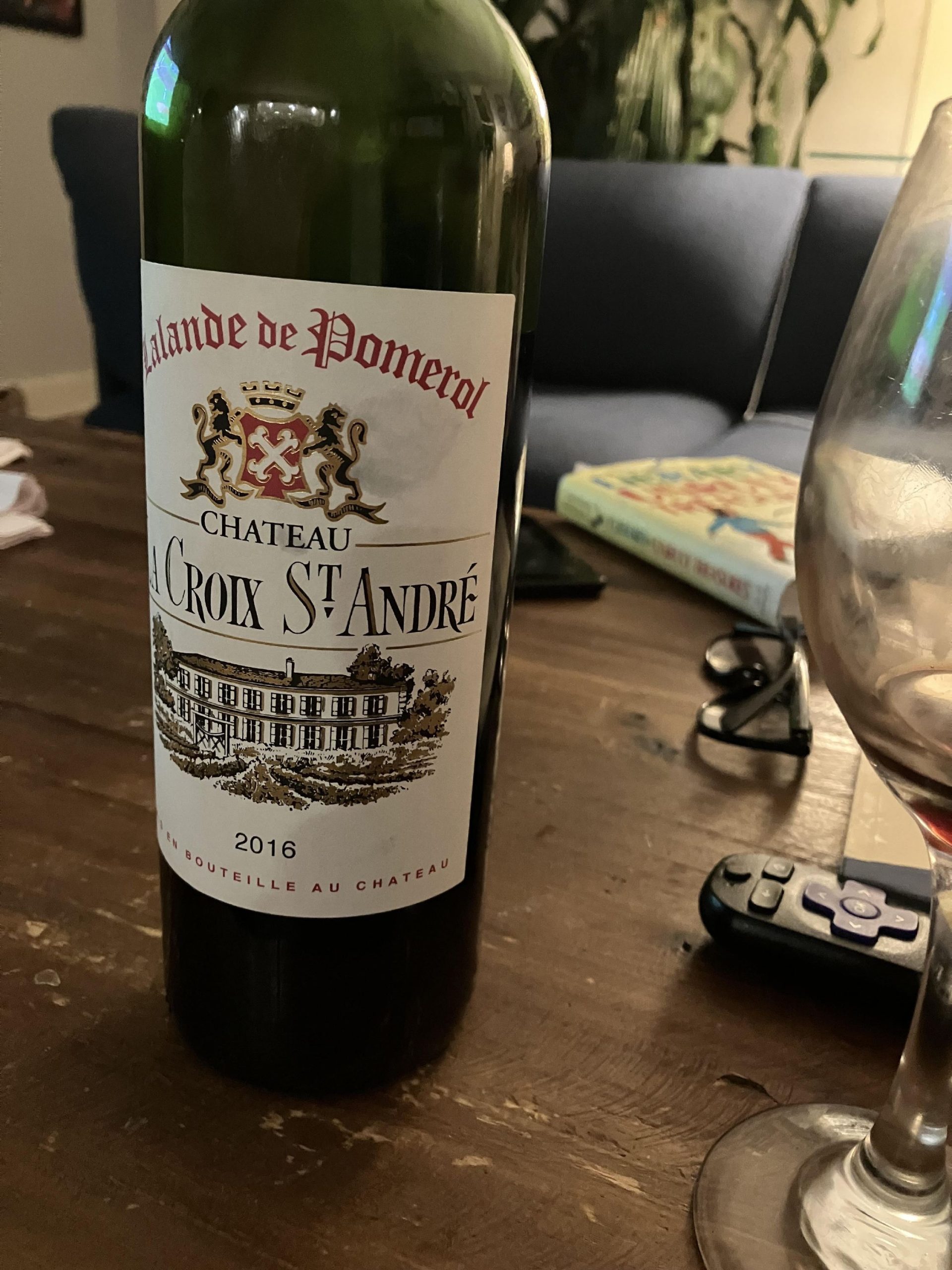
During Game 3 of the recent Red Sox/Yankees Wild Card series, I treated myself to a 2016 Laland de Pomerol Chateau La Croix St. Andres. It’s not a bank breaker. It’s about $30 a bottle. But it was a little pricier than I usually pay for an early October “Thursday on the couch” wine. It’s a Merlot heavy Bourdeaux. I was looking forward to drinking it. I was also looking forward to the Red Sox winning. But I was disappointed twice over. / Photo by Monte Belmonte
Cork taint is essentially just what it says it is. The cork taints the wine. How? The main culprit is 2,4,6-Trichloroanisole, or TCA, an organic compound that is a component found in some drinking water. It has sometimes been found in blood. But it is the main offender in creating the perception of something being “off” in a wine. If the cork in your wine bottle is made of actual cork from the bark of a tree, the material that has been used to stop up wine bottles for centuries, your wine is much more prone to be tainted by TCA hiding in said cork. If you have a plastic or composite cork or if you have what wine snobs call a “stelvin closure” (screw cap), your wine is less likely to experience the effects of TCA. It is possible for TCA to infect a whole winery and systemically taint the wine, but what is much more likely if your wine is ruined, is that it is the cork’s fault.
The wine industry estimates that as much as 1% to 7% of wine with corks is ruined by cork taint. That is a lot of loss. So much so that the eccentric California winemaking iconoclast, Randall Graham, held an actual mock funeral for the cork at Grand Central Station back in 2002. It was an attempt to lure the wine industry away from using actual cork and to embrace the screw cap. To a certain degree, his stunt was successful. There was a time when a screw cap on a wine was a surefire indicator of the juice inside being rot gut. But now there are many high quality wines from all across the world that come in bottles with screw caps. Although the world of European wine, in particular, has been slower to abort the cork.
How do you know if a wine is suffering from cork taint? It starts with the smell. To me, and many other wine snobs, cork taint smells like wet newspaper. If you are reading the print edition of The Valley Advocate, run it under the sink. Then let it sit outside in the sun for a bit. And then smell it. Look at that! Now we have an immersive experience. Who needs digital technology or the internet to get interactive? You can use good old fashioned print media to teach you about cork taint. Wet newspaper, wet cardboard, wet dog, wet basement. Something wet and mouldering means something is off. The wine is probably, as wine snobs will often say, “corked.”
Maybe you’ve been to a restaurant and the server has opened your bottle of wine in front of you and set the cork on the table. We are culturally conditioned to pick that cork up and smell it. Is this how you can tell if a wine is corked? Maybe if you are a master sommelier. But most people, myself included, can’t tell if a wine is corked by smelling the cork. If you look at the cork and the wine has left a stain nearing the top of that cork, it may mean that more oxygen than one might like has penetrated the plug. And oxygen is not something you want in that wine. At least, not until you are ready to drink it. Looking at the cork is going to tell you more about the wine than smelling the cork will.
If you want to know if a wine is corked, you must smell the wine itself. And if the wine smells like must, itself, your wine is probably corked. What do you do if your wine is corked? Put a cork in it and bring it back to the shop where you bought it. Now, I’ve spent enough time at the checkout counters of wine shops to witness people bringing back bottles of wine, claiming that they are corked. The wine purveyors are often very polite and either replace the “corked” bottle or offer a refund. And many times, I’ve asked the purveyor if I can smell the wine to see if it really is corked. Almost every time I’ve witnessed this, the wine wasn’t actually corked. Remember — you’re smelling for wet newspaper, wet cardboard, wet dog. If you smell that, bring the bottle back. What you are not to do is to bring a wine back to the hard working people who run wine shops and claim that something is wrong with the wine just because you don’t like it. “I don’t like it” does not equal “bad wine.” It equals someone’s bad choice.
Given the amount of wine that I drink and the number of years I’ve been drinking, I have run into surprisingly few examples of cork taint. The first half of the previous sentence may have much more grievous implications, health wise. But the second half seems in line with the industry research that says about 1% to 7% of wines have cork taint. Those percentages are just about on the money for me, especially given that not every wine I have purchased has had an actual cork. But recently, during Game 3 of the recent Red Sox/Yankees Wild Card series, I treated myself to a 2016 Laland de Pomerol Chateau La Croix St. Andres. It’s not a bank breaker. It’s about $30 a bottle. But it was a little pricier than I usually pay for an early October “Thursday on the couch” wine. It’s a Merlot heavy Bourdeaux. I was looking forward to drinking it. I was also looking forward to the Red Sox winning. But I was disappointed twice over.
Immediately, I smelled wet newspaper. (How’s your experiment going, by the way? Have you smelled your Valley Advocate yet?) Anyway, what do you think I did when I smelled the cork taint? I declared out loud to the rest of the family that “this wine is corked!” And then I proceeded to drink the whole thing while watching a Massachusetts-born player pitching for the Yankees evicerate the Red Sox playoff hopes. I was too lazy to get off the couch and bring it back to the store and I didn’t feel like opening anything else I had on hand. Also, I had the opportunity to complete my own experiment. Another thing to keep in mind about cork taint, it won’t hurt you. It smells bad, yes. It kills the fruit profile of the wine, yes. But from everying I’ve read, it won’t harm your person in any way. There was only one way to find out if corked wine was really innocuous when it comes to your gastronomic health. And I’m pleased to report, there were no ill effects from the cork taint. Ill effects of the Red Sox losing to the Yankees, on the other hand …
]]>For the Valley Advocate
While the Berkshire Theatre Critics’ Association will be doling out the “Berkies” for outstanding performances and productions early next month, three of the major Berkshire theater anchors are concluding the 2025 summer season with a diverse group of shows, each a winner in its own right. With work by established playwrights and new ones, and extraordinary stagecraft to bring ancient stories to life, the season closers have brought some of the most creative shows of the season to eager audiences. Williamstown Theatre Festival, a long-standing destination spot for theater mavens, has been redesigning their festival this year and asked not to be considered for any awards or reviews during this transitional year.
Theaters eligible to be considered for a Berkie are those within Berkshire County and within a 50-mile radius of Pittsfield, the center of the county. This range includes some, but not all theaters in the Pioneer Valley, southern Vermont, northern Connecticut and eastern New York State, which encompass only a part of The Advocate’s area of distribution, so if you’ve seen something you thought was outstanding and you wonder why it didn’t get a Berkie, don’t despair. There are fantastic productions all year long throughout our extended region.
Berkshire Theatre Group’s final production of the summer is the outstanding play, “Metamorphosis,” originally directed by Mary Zimmerman for the Lookingglass Theatre Company in Chicago. When the play moved to Broadway, in 2011, Zimmerman won a Tony for her direction. This show demonstrates that when we know change is certain, we transform into something else through love, and we are destined to go through many metamorphoses. The message is a hopeful one that resonates with the fear many people feel today, but the show gives us hope.

A scene from “Metamorphosis,” performed by Shakespeare & Company. / Photo by Tucker Bair
When “Metamorphosis” debuted, it was lauded as an extraordinary telling of the history of the world through Greek mythology in the epic poem by Ovid. Featuring a pool (think swimming pool or pond) on stage, actors emerge from water and play scenes in water for emphasis. This is a show with such visual power, it must be seen to be believed.
The intimate Unicorn Theatre is the venue for this show, which is running through Oct. 26. Superbly directed by Isadora Wolfe, with a cast of 11, all of whom play at least three characters, with lighting by Matthew E. Adelson, set design by Jason Simms and costumes by Amanda Roberge, this production is breathtaking in its beauty and meaning. You don’t have to be up on your Greek mythology to understand it, but it is a marvel of athletics, stagecraft and storytelling.
At Shakespeare and Company’s Elayne Bernstein stage, the moving “Mother Play: a play in five evictions,” which closed Oct. 5, gave a very adult look at a dysfunctional family savaged by low-income, alcohol, the sexual revolution and AIDS. This semi-autobiographical story of award-winning playwright Paula Vogel’s own family is tender, disturbing and full of grace and forgiveness. Is there any family who couldn’t benefit from coming to terms with how to forgive those closest to us who don’t live up to our expectations? How long has it been since you’ve seen a play in which the audience was so moved by a play’s ending, they had to take time to compose themselves before leaving the theater?
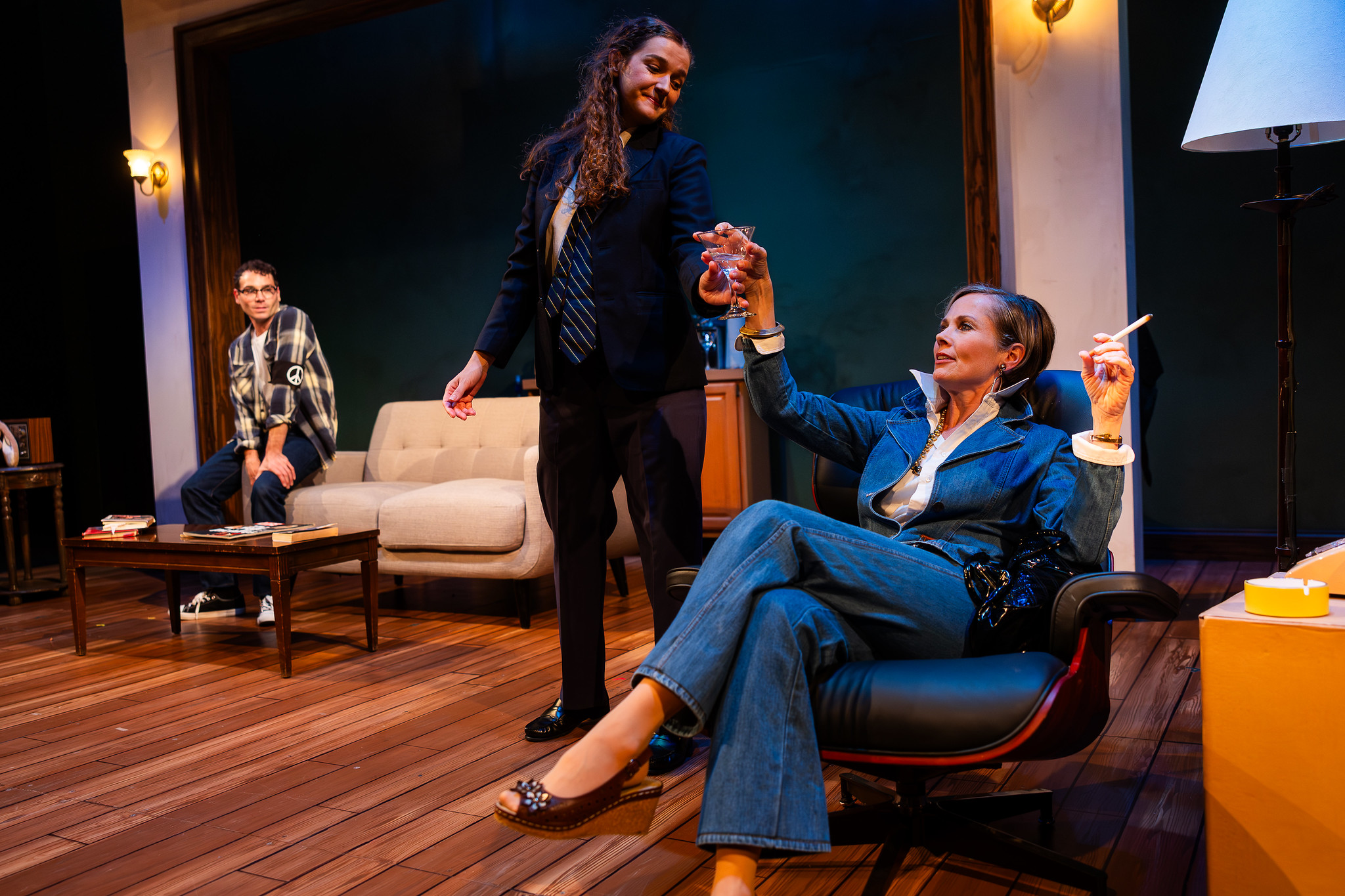
A scene from “Mother Play: an act in five evictions,” performed by Shakespeare & Company. / Courtesy of Nile Scott Studios
Vogel has made a name for herself with her deeply personal stories reflecting a certain time in history — in this case, 40 years in America spanning 1962 through the 1990s. “Mother Play” balances humor with truth, and what made this show stand out was the total commitment of the three actors; Tamara Hickey, Zoya Martin and Eddie Shields. Delicately directed by Ariel Bock, “Mother Play” continues the rich tapestry of Vogel’s work, and shows why she has become one of the most lauded living playwrights.
The final show at Barrington Stage Company this summer was the world premiere of a new play, “The Weekend: A Stockbridge Story,” by first-time playwright, Ben Diskant. Though name-dropping local places and familiar local situations in the Berkshires, the plot is essentially a love story, though much of the humor emerged from naming local places and invoking popular customs.
What makes “The Weekend” interesting is the structure Diskant employs to tell the story. Actors sometimes use third-person dialogue as they speak to the audience and then switch to first-person interaction with other actors. Though it took some time for my ears to adjust to this style, it ultimately serves its purpose well, since one of the characters is trying to write about a specific weekend he had that resulted in the type self discovery that changes the direction of one’s life. Past desires and present realities ground each character as they examine who they have become.
Making this a Stockbridge story may be a device that brings in local audiences, but the play is rich enough to stand on its own, rather than capitalizing on situational humor. I wouldn’t be surprised to see this play move to other locations with local foibles inserted in certain places, but more importantly, it does show the creativity of Diskant, a strong new millennial voice.
Other notable plays and performances
As the summer season comes to a close in the Berkshires, great theater continues with smaller companies bringing thoughtful, innovative productions to the region. Two performances, which benefit The Literacy Project in Greenfield, focus on the originality of local voices.
In “The Belle of Amherst” at the Amherst Woman’s Club, Louise Krieger seemingly channeled Emily Dickinson. Krieger’s command of the poetry and the sorrow and seductiveness of Dickinson shows audiences how fascinating and humorous one of the Valley’s most famous authors actually was.

“The Belle of Amherst,” Louise Krieger as Emily Dickinson. / Photo by Russ Ekstrom
The original 1971 script by William Luce was performed on Broadway in 1976, and heralded as one of the most interesting one-woman shows in decades. Using Dickinson’s own work, diaries and letters as material, the play has a distinctively local appeal as the character talks about her family, her poetry and life in Amherst. Set in the opulent Amherst Woman’s Club, the audience was made to feel that they were having tea with the authoress, and had been transported to Dickinson’s era. If you’ve missed Krieger’s earlier performances and couldn’t make it to this one, watch for her work. She is among the Valley’s very best.
Coming up, the Valley Players will be showcasing six readings of 10-minute plays written by local playwrights at the Black Birch Vineyard, 108 Straits Rd., North Hatfield, Oct. 25 and 26. These plays were competitively selected out of 30 submissions and directed by six directors working with 14 actors. Tickets may be scarce, but you can look for the at valleyplayers.org.
K and E Theater Group recently performed the challenging Stephen Sondheim’s (possibly) most challenging show, “Sunday in the Park with George” at the Center for the Arts (Oct. 10-12 and 16-18). The inspiration for the show is the pointillist painting, “A Sunday Afternoon on the Island of La Grande Jatte,” by Georges Seurat. As always, K and E featured exceptionally fine voices directed and choreographed by Eddie Zitka, making “Sunday” an unforgettable production.
]]>For the Valley Advocate
There are some bands whose music stand the test of time. Whether it’s their toe-tapping melodies or poignant lyrics, some songs always resonate with new audiences. In the late ’70s when rock and pop music were getting a little facelift with synthesizer-infused beats, new wave bands emerged. And one such band, whose signature sound continues to drive musicians (and enthusiasts like me), is The Cars.

Eddie Japan with Greg Hawkes. / Courtesy of Eddie Japan
Founding member and keyboardist for The Cars, Greg Hawkes, helped usher in those new wave sounds and paved the way for many other bands.
Beyond The Cars, Hawkes has collaborated with a number of artists, including cinematic rock pop band Eddie Japan. The band is Boston-based though some of the members are from right here in western Mass. Hawkes co-produced their 2017 album, “The Golden Age,” and even played on their most recent album, “Pop Fiction,” in 2023.
Eddie Japan, along with Hawkes, are currently on a small tour of about 10 dates playing the music of The Cars.
“Our first show with Greg was in August of 2019, so we are amazed and grateful that we are still at it six years later. For me, the biggest thrill of doing these shows has been to see how happy the fans are to hear the music again, and that they are able to meet and chat with Greg after the shows,” Eddie Japan vocalist David Santos said. “He is so gracious and generous with everyone, so each show is more than just a concert. It’s really become a great little community.”
Hawkes said that performing the songs many decades later with a new band isn’t much different, though he does enjoy hearing them sung from a female perspective by one of Eddie Japan’s vocalists, Emily Drohan.
“I know I can speak for the rest of the musicians in the band that we really get a thrill over nailing some of the very small and subtle details of these songs that hard-core fans in the audience will hear and recognize, whether it’s a guitar sound or effect, a drum pad sample or sound effect, percussion, etc.,” Eddie Japan drummer Chuck Ferreira said.
“Looking ahead, we are hoping to do more shows in 2026. The project typically hibernates for the winter and we tend to start up again in the spring. But at this point, we already have offers for next year,” Santos said.
Although their Nov. 7 show at the Iron Horse in Northampton has sold out, there are still tickets available to their show at The Kate in Old Saybrook, Connecticut, on Saturday, Nov. 8.
I was lucky enough to have a Saturday morning chitchat with the Rock & Roll Hall of Fame member recently.
Jennifer Levesque: Let’s go back in time for a little bit. Tell me about the music scene back when you were first starting with The Cars.
Greg Hawkes: Wow, wow. I mainly remember … my earliest memory about The Cars is when we started playing at The Rat in Boston in Kenmore Square and we started getting radio airplay before we had our record deal. WBCN’s Maxanne was playing “Just What I Needed,” a demo tape, and we just started building up a fanbase around Boston. It seemed like every time we played at The Rat the crowds would start getting bigger. By the summer there were lines outside the door, it was pretty crazy and exciting.
Levesque: Were there any bands you played with back then that made you feel starstruck?
Hawkes: Actually, we did do a couple of shows with Cheap Trick that I don’t know I would say starstruck, but we really liked them. I always thought that was a good bill and we did a few shows with them and seemed very compatible.
Levesque: Any shows you played that stood out?
Hawkes: The Live Aid show sort of comes to mind, because this year was the 40th anniversary, so I’ve been seeing a bunch of clips on my news page about it. That one was pretty exciting, but I think the biggest one that we ever played was the [1982] US Festival that was run by Steve Wozniak from Apple. I think that was a couple hundred thousand people there, it was huge.
Levesque: I was talking with Chuck (Ferreira) and he mentioned there is a book coming out about The Cars written by Bill Janovitz of Buffalo Tom. How does it feel to have a book written about your career by a fellow musician?
Hawkes: I think he was an excellent person to write it, since he does have that musician sensibility and knows what inner band dynamics are like. So yeah, I’m happy that he did it, I think he did a swell job.
Levesque: I’ll look forward to reading it when it comes out.
Hawkes: Yeah, yeah, which is very soon, I just got a copy of it myself.
Levesque: There’s also an anniversary box set/deluxe release coming up for the classic 1984 “Heartbeat City” album and you wrote the liner notes for. That’s a huge accomplishment! When is that due out?
Hawkes: I think in November, or before the end of the year, is what I’ve heard. There’s bonus stuff on it, plus a live show from the “Heartbeat City” tour is included, so it should be good.
Levesque: Can you tell the readers how your involvement started with Eddie Japan?
Hawkes: Let’s see, I met them first when I went to see The Motels at Johnny D’s in Sommerville and Eddie Japan was opening for The Motels. I had actually known their guitar player, Eric Brosius, from the band Tribe from earlier days in Boston. Then I ended up producing some stuff for Eddie Japan on “The Golden Age” CD.
Levesque: That album is amazing.
Hawkes: Yeah, it’s a good one. So then they did a show, I think at The Lizard Lounge, and they invited me to sit in at the end of their set, which I did, and we played a couple of The Cars songs and it was fun. Then a few months later they approached me with the idea of doing a whole set of The Cars songs, and uh, I gotta admit, it took me a while before I would agree to do it. I had to ponder the idea. And even then, I said okay, I’ll do one show and see how it goes, and then I’ve been doing them ever since. It’ll be fun to go back to the Iron Horse, I gotta admit.
To keep up-to-date with Eddie Japan with Greg Hawkes, visit eddiejapan.com.
]]>Staff Writer
A colorful exhibition of surrealist artworks layered with personal and cultural symbolism, “How to Bear the Unbearable Body: The Artwork of Emily Orling,” is up at the A.P.E. Gallery in Northampton through Saturday, Nov. 1.

Emily Orling in her studio in Belchertown. Her show, “How to Bear The Unbearable Body” is at the A.P.E. Gallery in Northampton through Nov. 1. Staff Photo/Carol Lollis
Though the exhibition will also feature some sculptures and assemblages, much of it will be a collection of artist Emily Orling’s large-scale oil paintings about motherhood, which are “layered, sanded, gouged, and repainted, revealing ghosts of earlier images beneath the surface,” according to a press release. “Figures emerge from decades of mark-making as sacred and grotesque, intimate and archetypal, depicting babies, mothers, children, and elders in moments of care, agony, and resilience.”
“My initial idea was, I just wanted to be a stay-at-home mom,” Orling said. “I just wanted to keep things simple and have some babies and make everything nice, and I very quickly realized that I was intellectually and creatively unsatisfied, and I needed more. I needed something more complex and deep to latch on to, and motherhood is a lot of drudgery and repetitive labor, and it was hard to only do that.”
Many of Orling’s works also feature a notable amount of empty space. In one painting, a child stands alone, wearing a red monster costume and an ambiguous, uncomfortable expression as they look at the viewer. In another, a child sits on a wooden chair in the corner of a canvas, nearly blending into the background, which is the same color as their all-white outfit. In another, a naked male figure falls through a white void, surrounded by a sparse collection of red flowers.
Orling said her interest in using emptiness is because she wants to remove “everything that might locate the paintings in this moment of time – or, really, in any place,” because to do otherwise would take away from the meaning of and focus on a figure itself.

Emily Orling and César Alvarez at their home in Belchertown. The painting behind them, called “Mary,” inspired the musical written by Alvarez called “Painting Mary,” which will be performed Oct. 17 as part of “How to Bear the Unbearable Body” at A.P.E. Gallery. Staff Photo/Carol Lollis
“I don’t want to call up any contemporary or specific objects that would position [a figure] in any part of time or space.” she said. “It’s just that this is the gesture of the body in that moment, and I want it to be working the way a hieroglyph would work, like a fundamental symbol that is explaining a feeling.”
Orling’s career has also taken her into the performing arts world: her work has been seen at venues like Lincoln Center, Soho Rep, Ars Nova, and Jacob’s Pillow, among others. She’s also earned Lortel and Drama Desk nominations for her work on the Off-Broadway show “Futurity,” written by her longtime partner and collaborator, César Alvarez, who she lives with in Belchertown.
As part of “How to Bear the Unbearable Body,” Alvarez and Orling will also host a number of performances at A.P.E. (“If you come to all the performances, you’re gonna win a fifth free performance. We’re gonna punch your card,” Alvarez joked.) Additional performances will include collaborations with Katrina Goldsaito and Fletcher Boote.
One of Alvarez and Orling’s performances is a public reading of a new musical, “Painting Mary,” on Friday, Oct. 17, at 7 p.m. The show is about Orling’s long process of creating a painting of the Virgin Mary, which will be on display during the show.
“Hacking a path through mental illness, artistic meltdown, and motherhood, the play turns into a musical turns into an opera turns into a piece of performance art,” the show’s event description said. “Mary arrives eventually. And the spirits talks [sic] to the plumber.”
That performance will also be a collaboration with the audience, in an unusual way: the last scene of that show is the opening night of the art exhibition itself.
“Coming to the opening is getting to be part of the event that is going to be inscribed in this play,” Alvarez said. “If you come to the performance, you’re really going to get to be part of the story of the work.”

César Alvarez and Emily Orling in Orling’s studio in their home in Belchertown. Staff Photo/Carol Lollis
Orling says that her artmaking, which has long been “a healing practice,” has also become, over time, “a spiritual practice.” Though she doesn’t practice a specific religious tradition and didn’t grow up in a religious household, she views her work as “spiritually charged” and her process as “a devotional act of recovery and intuitive making”: “Everything I make feels sort of channeled, but also it feels like it often demands to be painted,” she said.
One example: her painting “Earth School,” which shows three babies asleep on a decaying white background. It sat in Orling’s studio for months, untouched, even as an idea struck: “Every time I looked at it, I saw that I needed to paint these big, bubble green letters that said ‘Earth School’ at the bottom of the painting, and every time I looked at it, I was like, ‘God, that is crazy idea. I can’t do that. That looks weird. Why would I do that?’
“But I understood, after many months, that that was a message, that that was guidance, and I needed to listen,” she said.
Since then, Orling has learned “how to listen quicker and quicker to these intuitive hits that are calling forth the art that I need to make,” she said, “and when I do it, it’s very cathartic and it propels me forward.”
“The hope of the work is that the more mothers that can figure out how to share their voice,” Alvarez said, “the more we listen to mothers – and that goes all the way to Mother Earth – the more we listen to the consciousness of care … the more empathetic and caring and taken care of we are all going to be.”

Emily Orling in her studio in Belchertown. Staff Photo/Carol Lollis
“That’s really at the base of Emily’s work – what does it feel like to actually listen to a mother? Not a mother who’s performing being okay, but a mother who’s really trying to share what it’s like.”
“The work is difficult and dense and dissonant and scary and vulnerable,” he added. “And that’s what it’s like. And that’s real.”
The gallery is open 12 to 5 p.m. Wednesdays through Sundays, 12 to 8 p.m. Fridays, and closed Mondays and Tuesdays. For more information about Emily Orling and César Alvarez, visit emilyorling.com and cesaralvarez.net. For more information about the show and upcoming performances, visit apearts.org.
Carolyn Brown can be reached at [email protected].
]]>Staff Writer
It’s not often that you see tattoo art on display in an art gallery, but a University of Massachusetts alum will soon change that with an upcoming exhibition.
Alex Leon Sherker’s art show “Who Are You? Who Am AI?” will be at the Augusta Savage Gallery at UMass Amherst from Friday, Oct. 3, through Friday, Oct. 31, with an opening reception on Friday, Oct. 3, from 5 to 7 p.m.

It’s not often that you see tattoo art on display in an art gallery, but a University of Massachusetts alum will soon change that with an upcoming exhibition. / COURTESY MADDIE FABIAN
Though tattooing is obviously a key part of the exhibition, Sherker’s focus is more about the philosophical concepts behind tattooing as a means of building and representing identity rather than getting “too caught in the tattoo-ness of the show.”
“Tattooing is more than just the standard concept of the images,” Sherker said. “It’s more than just hearts and daggers and dragons and panthers; it’s whole mythologies of life and the human journey.”
“In a world, especially right now, where we’re saturated by icon and image, and we are driven to define ourselves, usually through icon or image, or ‘I am this’ or ‘I am that,’ or just to display ourselves as an identity, tattooing is absolutely a big part of that conceptually,” he added. “A lot of people are seeking tattoos now who never used to, but also, the imagery of tattooing has shifted and, culturally, for millennia, tattoos have given us images of everyday life or subject matter that sort of defines the self.”
The exhibition features 18 large-scale prints of black-and-white lineart pieces, each nearly life-sized at 2-feet-by-5-feet, hung up in a circle. Sherker wants guests to “treat the gallery like a meditation space and to treat each piece as a station along a wheel of meditation,” standing in front of each one and reflecting on what parts of it they identify with as they move through the gallery.

“The whole show is about layers of irony, layers of meaning, double meanings, all of that, because life is complex; identity is complex,” Sherker said. / COURTESY ALEX LEON SHERKER
“My intention with that was to give people enough of an open ground to search for themselves in as possible,” he said.
The images themselves are often hybridized in ways that combine religion and pop culture – one work, for example, features an image combining Snoopy and Manjushri, a Bodhisattva representing wisdom in Buddhism.
“Almost everything in it is hybridized in some way,” he said, “because we are all hybrid creations of the identities that we choose and that we assume. … Everything is what it is and something else, because we are, so much.”
The spiritual connection to tattooing is important to Sherker, who has long identified with the “wizard” moniker. (His Instagram handle is @wizardmountain; his Facebook page asks, “Ever been tattooed by a Wizard? Do you want to be?”) Sherker’s friends started calling him “wizard” as a joke – he has a thick white beard and is a fan of mysticism and the occult – “and then it stuck,” he said, “and it made sense.” He started to delve into the question, “What does it mean to be a wizard?”

“Tattooing is more than just the standard concept of the images,” Sherker said. “It’s more than just hearts and daggers and dragons and panthers; it’s whole mythologies of life and the human journey.” / COURTESY ALEX LEON SHERKER
As it turns out, being a tattoo artist ended up turning him into something of a shamanic figure, as he saw it: both a tattooer and a shaman “connect people to who they are or to help suss out who they are, and that’s the same role as an artist – or a good artist, anyway – to be a medium and a sort of mystic and to figure out the connections between the seen and unseen, known and unknown.”
“Galleries are sacred spaces; artworks are sacred objects, either because we make it so or because the artist made it so,” he said. A tattoo “can just be a tattoo; it can just be a picture, or it can be a really meaningful life-pivoting icon or talisman.”
“As a tattooer or as an artist, we’re given the opportunity to fill that sacred role,” he continued. “Whether we choose to or not or whether we know it or not, that’s a separate matter. I think that, by extension, the people who seek tattoos are seeking something sacred, but may not know it. They may think, ‘I just want a picture to remember my grandma,’ but that’s a sacred thing, and identity and our concepts of identity and who we are, that’s a sacred endeavor to find the self.”
The AI connection (as hinted at in the title) isn’t because the work was created by artificial intelligence, but because the ever-evolving nature of AI has created “an added layer of trying to navigate identity in a world where there are so many new definitions of identity,” and because Sherker created his images by hand, but with the help of software.
“That’s another layer – the whole show is about layers of irony, layers of meaning, double meanings, all of that, because life is complex; identity is complex,” Sherker said.
Sherker now lives and works as a tattoo artist in Austin, Texas, but he graduated from UMass in the ’90s. As a student, the New Africa House (where the Augusta Savage Gallery is) played a role in his education: he took classes in the building, gave a poetry reading in the gallery itself, and studied sculpture in a classroom in the building’s basement.
“It really is an important full-circle thing for me to come back to the school that I love so much, come back to the area that I love so much, where so many things began for me,” he said. “So many pieces of my identity began there, and to be able to come back with an exhibition exploring identity feels like a wonderful full circle.”
Admission to the show is free.
]]>Staff Writer
Park Hill Orchard in Easthampton will host its eighth biennial Art in the Orchard exhibition, a half-mile sculpture trail on the orchard’s grounds, until Sunday, Nov. 30. The orchard itself is open from 10 a.m. to 6 p.m. daily, but the artwork is available during daylight hours.

“Beetle in a Haystack,” by Dave Rothstein, at Park Hill Orchard, Thursday, Sept. 11, 2025, in Easthampton. Staff Photo/Daniel Jacobi II
The show features 34 works of varying sizes and mediums, including “Joy,” a popular piece depicting dancing starfish-like forms; “The Arches of Hampshire County,” a group of trellises decorated by local fiber arts group The Fiberistas; “Salutation,” a Brancusi-esque cast iron sculpture depicting a figure in a welcoming gesture; and “Erebus,” a sleeping dragon made of steel, iron, and recycled tools.
One of the most eye-catching pieces is “Beetle in the Haystack,” a life-size replica of a 1974 Volkswagen Super Beetle made of chicken wire, steel, aluminum, hay, and straw, which sits above and in the center a walkable hay labyrinth. In his audio tour segment, artist Dave Rothstein said, “Although it’s not high art, it is high up there, looking like it’s going to take flight. Hope you enjoy it, and it brings you a smile.”

“Four Elements Personified,” by John Collins, at Park Hill Orchard, Thursday, Sept. 11, 2025, in Easthampton. Staff Photo/Daniel Jacobi II
For Park Hill Orchard co-owners Russell Braen and Alane Hartley, art and fruit farming have a symbiotic relationship: “The sculpture show wouldn’t work if it wasn’t a serious commercial farm, and I don’t know if the commercial farm would sustain itself without having all the people come over, so it’s a two-way street,” Braen said.
It also made more sense to Braen and Hartley to exhibit sculptures than, say, paintings or photos because a sculpture has a physical presence.
“You’re on a farm, you’re picking apples, everything is three-dimensional. There’s texture, there’s smell, there’s taste, there’s movement, and I think the sculpture really lends itself to that same experience,” Hartley said.
Artist Eileen Travis, one of the Fiberistas, said Art in the Orchard is “such a wonderful space to create things for, and I think that because there’s intimate spaces and very large open spaces, it lends itself to such a large variety of sculpture that can be imagined for those spaces.”

“Joy,” by Michael Perusse, at Park Hill Orchard, Thursday, Sept. 11, 2025, in Easthampton. Staff Photo/Daniel Jacobi II
Park Hill Orchard also hosts other events, including Bread & Puppet Theater shows, yoga, poetry readings, and dance performances, but a sculpture trail is a benefit because it leads guests to have longer, more involved visits.
“A family with two children, it only takes 20 minutes to pick a bag of apples,” Braen said, “and they often spend a lot more time getting here than that. The art trail, as you can tell by walking around, takes two to four hours, so it ends up being a whole afternoon outing for people.”
“That’s the method to the madness,” Braen said. “Under the hood, it’s our marketing plan.”
Braen and Hartley have a background in migrant agricultural work, including apple picking and blueberry raking. The two are from the Washington, D.C. area, but Hartley’s family is from New England: her father and grandmother are from Massachusetts, and her mom is from upstate New York.

Long Tall Sally the giraffe, a part of the grapevine statue trio “Pegasus, Long Tall Sally, and Atlas,” by Malcolm White, at Park Hill Orchard, Thursday, Sept. 11, 2025, in Easthampton. Staff Photo/Daniel Jacobi II
“Even though I never lived here, it was just a matter of, ‘I belong in New England,’” Hartley said.
The couple moved to the area in 2007, at which point the orchard had been unattended for years: “You couldn’t see this building from the road,” Hartley said, pointing at the farmstand. “It was so, so overgrown.”
It took years for Braen and Hartley to clear the land and turn it back into a working orchard, where they now grow nearly 100 kinds of fruit.
When this reporter visited Art in the Orchard last week, it was a clear, sunny day, and there were a handful of guests, including a family with two young children and a local woman who’d brought her sister, who was visiting from Virginia, to see a piece her neighbor had created. Bees were buzzing around the fruit trees. Hartley called the orchard “a real destination place for people to show off our area.”

“Erebus,” by Trisha Moody, at Park Hill Orchard, Thursday, Sept. 11, 2025, in Easthampton. Staff Photo/Daniel Jacobi II
Since Art in the Orchard began in 2011, it’s hosted more than 400 sculptures and thousands of visitors. In that time, Braen and Hartley have given thousands of dollars in honoraria to artists, many of whom return to exhibit work in multiple shows.
“We get to meet a lot, both from the people who come to visit and from the people who show,” Hartley said. “Our world is just so much bigger than it would be if we were just doing pick-your-own.”
Admission to Art in the Orchard is free, though donations are welcome at the trailhead. For more information about Art in the Orchard, including how to reserve the wheelchair-accessible “Art Cart,” visit artintheorchard.org.
Carolyn Brown can be reached at [email protected].
]]>For the Valley Advocate
Along with Martin Luther King, Jr., Malcolm X, and Kwame Ture, Rosa Parks is one of the celebrated names of the civil rights movement: the Montgomery, Alabama woman who refused to move from her seat on a bus in 1955, sparking a historic bus boycott in that city that in turn helped jumpstart the push to end segregation across the Jim Crow South.

But outside of Parks, asks John Bollard, how many Americans today can name any Black activists besides Parks who protested segregation that persisted for decades on buses, trains, and planes, and before that on stagecoaches, steamboats, ferries and streetcars?
As Bollard, of Florence, notes, that list includes close to 100 Black Americans – including some with Valley connections – who fought for equality on public transportation as far back as the early 1830s.
In his newest book, “Protesting with Rosa Parks,” Bollard, a longtime writer, researcher and academic, has taken a deep plunge into period journalism, historical journals, court cases, letters and other sources to tease out stories of African Americans who risked physical assault, arrest, and substantial fines for defying efforts to confine them to segregated sections of transport.
Some of those profiled are well known, like Jackie Robinson, who, before he broke the color barrier in Major League Baseball in 1947, faced a court martial in 1944 when, as a U.S. army lieutenant, he refused to give up his seat on a Texas bus (he was acquitted of all charges). Frederick Douglass, the most important Black leader of the 19th century, was thrown off a train in eastern Massachusetts in the early 1840s for refusing to move from a carriage with white passengers.

Jackie Robinson, who, before he broke the color barrier in Major League Baseball in 1947, faced a court martial in 1944 when, as a U.S. army lieutenant, he refused to give up his seat on a Texas bus (he was acquitted of all charges). / Wikicommons/Harry Warnecke
There are also accounts of lesser-known folks whose struggles had a dramatic effect on U.S. history, such as Isaac Woodard, a just-discharged U.S. Army sergeant who was beaten and blinded by a South Carolina police chief in 1946 following an argument with a white bus driver. (Not surprisingly, the policeman, Lynwood Shull, was acquitted by an all-white jury of any charges in the assault.)
But U.S. President Harry Truman was so horrified by the episode that he ordered the country’s armed forces to be desegregated in 1948. And Bollard notes that Woodard’s case led, in a more roundabout way, to the Supreme Court’s famous Brown v. Board of Education decision in 1954 outlawing school segregation.
Yet many of the people he researched are largely unknown today, says Bollard, despite their actions representing important chapters in a longstanding history of protest before Rosa Parks.
“While I was researching this book, which involved some travel, I’d be in conversation with people and I’d ask them if they could name anyone other than Rosa Parks who had protested segregated seating,” he said during a recent phone call.
Only once, he says, did someone provide a name: Claudette Colvin, an Alabama teen arrested in Montgomery in 1955 (10 months before Rosa Parks) for refusing to give up her bus seat to a white passenger.
The young girl who asked him if he would be including Colvin’s story in his book “absolutely made my day,” Bollard said with a laugh.
Given the racial tension and inequality that persists in the U.S. today, he says, it’s important for this long history of protest not to be lost – perhaps especially now, when the Trump administration is actively promoting a revised historical narrative that minimizes negative aspects of the nation’s past such as slavery.
“I’ve had a lot of comments about the book from people who say ‘It’s very timely,’” said Bollard.

John Bollard, author of “Protesting with Rosa Parks,” in the Sojourner Truth Memorial Park. Staff Photo/Carol Lollis
Finding stories
Bollard, 82, has a deep background in historic Welsh poetry and literature, having written a number of books on those subjects and published several translations of medieval Welsh poetry. He has also taught English at a number of schools in the area, including the University of Massachusetts Amherst, and he once was a lexicographer for Merriam-Webster in Springfield.
But the inspiration for “Protesting with Rosa Parks” came from a stint in the early 2000s when he served as the executive managing editor of the African American National Biography Project, at the W.E.B. Du Bois Institute at Harvard University. As such, he says, he came across “a broad sweep” of stories of Black Americans, many of whom had faced incidents of racism and confrontation at some point over their seats on public transportation.
Bollard says he began work on the book about 14 years ago, pecking away at it for a time and initially thinking he might profile perhaps 20 people. “But I came across many others the more research I did,” he said.
And in the aftermath of the killing of George Floyd by Minneapolis police in May 2020, Bollard added, “I sort of woke up and said to myself, ‘You gotta get your ass in gear and get this book done.’”
It’s more than a little ironic and disturbing to read his accounts of Black passengers, such as Frederick Douglass, facing threats and violence for trying to sit in the same train carriages as whites in the early days of the railroad in Massachusetts, despite the state being a center of the abolition movement. Sometimes white passengers pitched in to throw Black passengers out of public transport.
Enforcement could be completely arbitrary, with some rail companies and train conductors rigidly separating Black and white riders and others leaving them be, even after laws were passed in the state in the late 1840s officially outlawing segregated seating.
Similar stories emerge in Pennsylvania, where an 1867 law was passed that disallowed the exclusion or expulsion of Black passengers from trains and streetcars. Yet shortly afterward, Bollard writes, a young Black schoolteacher, Caroline LeCount, signaled for a Philadelphia streetcar to stop, only to have the conductor pass her by and yell “We don’t allow (racial expletive) to ride!”
Undaunted, LeCount made a complaint to the Pennsylvania secretary of state, Bollard writes, which led to the conductor being arrested and fined $100 (about $2,200 today).
Among its stories, “Protesting with Rosa Parks” recounts how another seminal 19th century Black figure, Harriet Tubman, had her arm broken in 1865 while enroute to Auburn, New York, by a train conductor who refused to let her sit with white passengers, even though Tubman had a government pass for her work as a nurse tending wounded Union soldiers.
Harriet Tubman, the famous abolitionist and Underground Railroad “engineer” who helped scores of enslaved people to freedom in the mid 19th century. She suffered a broken arm when a white conductor and a number of men ejected her from a railroad car with white passengers in 1865, while enroute from Philadelphia to Auburn, New York. / Library of Congress
Sojourner Truth, the famed abolitionist who lived in Florence in the 1840s, also suffered an arm injury after being ejected from a streetcar in Washington, D.C., in 1865. And perhaps no one, says Bollard, fought harder for equality in transport seating than David Ruggles, the abolitionist, journalist, and bookseller who, before moving to Northampton in 1842, faced down a number of violent streetcar and stagecoach conductors and employees in and around New York City.
“He really created the model for protesting for your rights on public transportation,” said Bollard.

Civil rights activist Bayard Rustin who, in the late 1940s, began testing a 1946 Supreme Court decision banning racial discrimination on interstate travel by sitting in the white sections of buses in the South; he was repeatedly arrested as a consequence. / Library of Congress
Far from being repetitious, he adds, these individual accounts of Black Americans fighting inequality “never get boring – they’re never the same case. They’re all different, they’re all unique, they’re all inspiring.”
And as he notes in the book’s introduction, “Daily, mundane, malevolent acts lie at the heart of oppression … Experiencing something of that quotidian malice, even from a distance through the pages of a book, can bring us to a deeper understanding … (It) allows us to see history not as something that happened to ‘important’ people whom we learn about in school but rather as the combined experience of all of us.”
John Bollard will discuss “Protesting with Rosa Parks” Sept. 17 at 6:30 p.m. at the Bombyx Center for Arts and Equity in Florence. The event is free but advance registration is recommended at https://bombyx.live/. Bollard will also discuss his book Sept. 23 at 6 p.m. at the Tidepool Bookshop in Worcester.
Steve Pfarrer, a former arts writer for the Gazette, lives in Northampton.
]]>Staff Writer
The Northampton Jazz Festival will return on Friday, Sept. 26, and Saturday, Sept. 27, for live jazz at a variety of downtown Northampton venues.

This year’s Northampton Jazz Festival headliner will be New York Voices, at the Academy of Music on Sept. 27 at 7:30 p.m. After nearly 40 years together, the group is embarking on their farewell tour, “The Grand Finale.” / CONTRIBUTED
This year’s headliner will be New York Voices, a vocal jazz quartet that began as an ensemble at Ithaca College, at the Academy of Music on Sept. 27 at 7:30 p.m. After nearly 40 years together, the group is embarking on their farewell tour, “The Grand Finale,” which includes their performance in Northampton.
“We hope [audiences] like the energy of the music, the heart behind the music, the musicality behind the music, and the fun of it,” said New York Voices musical director Darmon Meader in an interview with Jazz Fest board member Ricard Torres-Mateluna. “People who really like harmony singing can get really excited about groups like ours, whereas jazz audiences sometimes aren’t really thinking that way, but we hopefully are bringing as many jazz elements to the experience [as possible], as well as the experience of a four-part harmony.”
Ruth Griggs, president of the Northampton Jazz Festival, said a vocal group was a good fit for the Pioneer Valley because the area itself already hosts a number of vocal groups in its communities and colleges.
Beyond that, the members of New York Voices “just bebop their fannies off,” she said. “They really sing hard, this quartet.”
Programming as part of Friday’s Jazz Strut, during which artists perform at breweries, bars, and restaurants, includes sets by the Amherst Jazz Orchestra, Bruce Kelley Trio, Jimmy Gavagan Trio, Stephen Page Trio, Beau Sasser Trio, Ethel Lee Trio, Scott Sasnecki & Stephen King Porter, and The Valley Moonstompers Society, plus a jam session led by Jahian Cooper-Monize with Miki Yamanaka.
“The Northampton Jazz Festival is unique in that it’s intimate,” Griggs said. “We have venues that hold 75 people – you can’t be that much more up close and personal with a jazz musician than being in a venue that holds 75 people. You see the musicians walking around; they don’t hide behind the stage.”
The programming for Saturday, Jazz Fest Day, includes an interactive workshop for kids at 33 Hawley at 11 a.m.; Miki Yamanaka at Click Workspace at 11:30 a.m. and 12:45 p.m.; the Expandable Brass Band, marching from 33 Hawley to Pulaski Park at 12 p.m.; Stacy Dillard Trio at the Parlor Room at 12 p.m. and 1:20 p.m.; Karyn Allison Quartet at the Unitarian Society at 1 p.m.; Mike LeDonne’s Groover Trio with Dave Stryker and Joe Farnsworth at Iron Horse at 2 p.m.; the UMass Vocal Jazz Ensemble & Friends at Pulaski Park at 2:30 p.m.; Tone Forest at Edwards Church at 3:30 p.m.; Zaccai Curtis at the Unitarian Society at 4 p.m.; and Ed Fast & Congabop at Pulaski Park at 5:15 p.m.
“The thing that I’m so excited about is, I’ve had so many people come up to me and say, ‘This is such a great lineup this year. I’m so excited about who’s coming to Northampton this year,’” Griggs said.
Griggs said this is also the first year that the Jazz Fest has had an artist – namely, Zaccai Curtis – perform the same year that they won a Grammy Award. Curtis took home “Best Latin Jazz Album” in February for his album “Cubop Lives!”

Zaccai Curtis (center) is the first artist to perform at the Jazz Fest the same year as winning a Grammy Award. Curtis took home “Best Latin Jazz Album” in February for his album “Cubop Lives!” / CONTRIBUTED
“That is amazing, to have a current Grammy Award winner,” she said. “That’s just not something that our wonderful little festival can often do.”
Pianist Miki Yamanaka last performed at the Jazz Fest in 2022, accompanying vocalist Ashley Pezzotti. This will be her first time playing a solo set at the festival – two, in fact. Yamanaka said she considers audience members part of her show because she never takes them for granted and added that she’s “super excited” to return this year: “Come have fun with me!”
Jack Frisch, host of the Valley Free Radio program “The Downbeat,” will also be doing a live broadcast of his show at Pulaski Park from 12:45 to 2:30 p.m. on Saturday. He appreciates that the festival allows him to introduce people to jazz: during his broadcast, he tells listeners and festival-goers about the musicians playing at the festival and where to find them, and he plays their music, too.
“The Northampton Jazz Fest has a great way of presenting a wide range of jazz, from the upcoming players to some of the well-established, well-known, world-renowned players, and that’s what I like about it,” he said. “There’s something there for everybody.”

Pianist Miki Yamanaka last performed at the Jazz Fest in 2022, accompanying vocalist Ashley Pezzotti. This will be her first time playing a solo set at the festival – two, in fact. Yamanaka said she considers audience members part of her show because she never takes them for granted and added that she’s “super excited” to return this year: “Come have fun with me!” / PHOTO BY MARTINA DASILVA
Bob Fazzi, a longtime Jazz Fest volunteer, said he appreciates being part of an event that brings people to Northampton and benefits businesses downtown.
“It’s really important for the community,” Fazzi said. “I see the Jazz Fest as being a wonderful resource for the community as a whole because they involve everybody in this, and they do it with such grace, and they really go out of their way to make it something special. Northampton really gains because of all these jazz musicians and all these jazz fans who come here to celebrate and enjoy the jazz.”
Admission to the Jazz Fest is free and open to the public, but tickets to the New York Voices performance are $35 to $60 (or $20 for students), not including fees, via aomtheatre.com or at the Academy of Music box office. Registration for the educational workshop (called “Ask Me About Jazz!”) is required. For more information about the Northampton Jazz Fest, including a full schedule, performer bios, and information about volunteering, visit northamptonjazzfest.org.
Carolyn Brown can be reached at [email protected].
]]>Staff Writer
Foodies, rejoice: Taste of Northampton is almost here again — and it’s even bigger than last year.
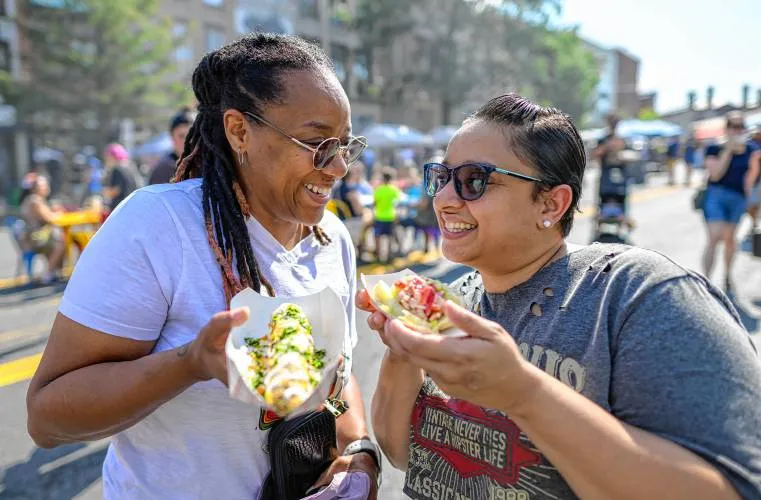
Keisha Moore, left, and Jesse Ortiz, both of Chicopee, dine on Mexican Street Corn and Lobster Sliders from Fitzwilly’s Restaurant during the Taste of Northampton last year. The event returns Sept. 13 and 14. / PHOTO BY CHRISTOPHER EVANS
The food festival Taste of Northampton will return this year on Saturday, Sept. 13, from 11 a.m. to 8 p.m. and Sunday, Sept. 14, from 11 a.m. to 5 p.m., in the Armory Street Parking Lot.
The event will feature dozens of local restaurants and food vendors; the culinary offerings will include pierogies, pizza, dumplings, gourmet burgers, gumbo, fried Oreos, tacos, pulled pork sliders, veggie lo mein, mac and cheese bites, beef bourguignon stew, peach cheesecake parfaits, Russian kebabs, crab cakes, hot dogs, and Herrell’s ice cream — among many others — and beers, wines, coffees, and non-alcoholic drinks.
Taste of Northampton will also have family-friendly activities and live performances. The musical lineup for the weekend includes Los Consentidos (“infectious Latin rhythms”), The Classicals (“guitar-driven rock” from western Massachusetts), Daisy Skelton (“London-based indie-pop artist with tender, honest songwriting”), The Hendersons Blues Band (“over 40 years of blues”), and Bongohead (“Cuban-American DJ and artist spinning an eclectic set blending global sounds”).
Jeffrey Hoess-Brooks, Taste of Northampton organizer and general manager of the Hotel Northampton, said that when he started working at the hotel 37 years ago, Northampton was known as a “restaurant mecca” within the Pioneer Valley. Nowadays, he said, what still makes the town a great place for an event like this is, “We just have such great restaurants in the area and restaurateurs that all work together and get along great and really want to make Northampton shine as a place for food.”
Karen Carswell, treasurer of the Downtown Northampton Association, said the festival is “all about that September magic in western Mass. The air shifting, school starting, and the community coming together. It’s a weekend filled with music, connection, and flavors that carry memories.”

Jeffrey Hoess-Brooks, a member of the board of the DNA and one of the organizers of the Taste of Northampton stands with Karen Carswell, a DNA board member, in the Armory Street parking lot where the taste will be held this year on Sept. 13 and 14. The event will have over 30 vendors as well as a kids zone. Staff Photo/Carol Lollis
She, like Hoess-Brooks, agreed that Northampton is a great place for a food festival because the town is “at the heart of western Mass’ incredible food system.”
“Our restaurants are connected to local farms, dairies, and food producers who supply some of the freshest ingredients in New England,” Carswell said. “From nearby fields to downtown kitchens, food here has a short trip and a long story, and it’s one that celebrates our farmers, distributors, and chefs all working together. It’s that connection between source and plate that makes eating in Northampton unforgettable.”
The festival’s history dates back to the 1990s and early 2000s, when it was a wildly successful four-day event and reportedly the model for other “Taste of” events in other New England towns.
“It was the biggest thing,” said Amit Kanoujia, owner of India House, which has been part of Taste of Northampton every year since the festival began. “It was something everybody looked forward to.”
By 2003, Kanoujia estimated, interest had dipped: “They just lost the groove.”
In 2019, local restaurant owners approached town officials about bringing Taste of Northampton back in 2020 — which was, of course, very unlucky timing.
After a two-year pandemic pause, Mayor Sciarra’s economic development team was able to bring back the festival, thanks to state grant funding. By that point, restaurant owners had been hit hard and were eager to bring in customers again.
From 2022 through 2024, Taste of Northampton was a one-day event, drawing about 10,000 people each year. In a 2022 op-ed in the Gazette, Sciarra credited the strength of business-government partnership and called the festival’s first year back “a triumphant success,” albeit with a few hiccups.

Hundreds of community members gathered on Main Street for the Taste of Northampton food festival last year. This year, the event returns Sept. 13 and 14. / FILE PHOTO/DAN LITTLE
“But in the end, the sea of happy faces and dancing in the street won the day,” she wrote. This year, Hoess-Brooks said, expanding the festival is a way of bringing it back to its heyday.
Kanoujia said what he’s most looking forward to about Taste of Northampton is “putting Northampton back on the map.”
“There’s been this notion that Northampton is no longer as vibrant as it used to be, and there’s nothing further from the truth,” Kanoujia said. “Northampton hasn’t lost a step.”
Now that the festival is a two-day event, organizers expect an even bigger turnout — an estimated 15,000 to 20,000 people.
“It’s gonna be a great weekend,” Hoess-Brooks said. “An amazing weekend.”
Admission is free, and dishes are typically $5 to $8 each. Parking is free throughout Northampton, minus the E.J. Gare Parking Garage. For more information about Taste of Northampton, visit facebook.com/tasteofnorthampton or instagram.com/taste_of_northampton.
Carolyn Brown can be reached at [email protected].
]]>