
View From a Hotel Window, 3/14/26: Tucson, AZ
Posted on March 14, 2026 Posted by John Scalzi 10 Comments

I didn’t get a shot when I got in — I was busy doing other things and then I was busy taking a nap — but here’s one to make up for the lapse. I’m in toen for the Tucson Book Festival, and if you come to it tomorrow (Sunday) I will have two panels and two signings. Come on down! And wear a hat, they’re having a lot of sun here.
— JS
The Big Idea: Cindy Cohn
Posted on March 12, 2026 Posted by John Scalzi 6 Comments

When you’re trying to get folks excited about their own digital rights, a lot will depend on the examples you give them to understand the fight. As the Executive Director of the Electronic Frontier Foundation, Cindy Cohn certainly has examples. But which ones to choose? In this Big Idea for Privacy’s Defender, Cohn offers up her choices and explains why they matter.
CINDY COHN:
Do we have the right to have a private conversation online?
In this age of constant, pervasive surveillance, both government and corporate, how do you get people to believe that they can and should have that right?
And how do you show that safeguarding privacy is part of safeguarding a free, open and democratic society?
In Privacy’s Defender, my Big Idea is that by telling some rollicking stories about my three big fights for digital privacy over the past 30 years, I might inspire people not only to understand why privacy matters, but to actually start fighting for it themselves.
The challenge was different for each of the three stories I told. The first one, about cryptography, was in many ways the easiest, since it had a pretty straightforward narrative. Before the beginning of the broad public internet, in the early 1990s, I led a ragtag bunch of hackers and lawyers who sued to fight a federal law that treated encryption – specifically “software with the capability of maintaining secrecy” – as a weapon. We argued that code is speech and put together a case based on the First Amendment. By pulling in help from academics, scientists, companies and others, and by the grace of several women judges who were willing to listen to us in spite of the government’s national security claims on the other side, we won.
Many other stories from the early public internet are about men and the products they built. This one is different: It tells how some scruffy underdogs beat the national security infrastructure and brought all of us the promise of a more secure internet. But it’s otherwise kind of a hero’s tale with a dramatic ending when I was called to DC to negotiate the government’s surrender.
The second and third stories don’t end in such clean wins, which perhaps makes them more typical of how actual change happens when you are up against the government.
The second set of stories are about the cases we brought against the National Security Agency’s mass spying, starting after the New York Times revealed in late 2005 that the government was spying on Americans on our home soil. The fight was pushed forward by a whistleblower named Mark Klein who literally knocked on our front door at the Electronic Frontier Foundation in early 2006 with details of how the NSA was tapping into the internet’s backbone at key junctures, including in a secret room in an AT&T building in downtown San Francisco. This is the most cloak-and-dagger of the stories, made possible both by Mark’s courage and that of Edward Snowden, who revealed even more about the NSA spying in 2013 because he was angry at watching the government lie repeatedly to the American people, including before Congress.
As a result, Congress rushed in to protect… the phone companies, killing our first lawsuit. Later, after Snowden’s revelations, lawmakers passed some reforms to some of the programs we had sought to stop, but not nearly enough. In the end, the Supreme Court supported the government’s argument that – even though the whole world knew about the NSA spying and that it relied on access to information collected and handled by major telephone companies – identifying which company participated would violate the state secrets privilege. But we had dramatically shifted how the government did mass spying: ending two of the three programs we had sued over, scaling back the third, and providing far more public information about what the government was doing. In writing my book, I wanted to tell the truth about the progress we made without sugarcoating that we had not succeeded at nearly the scale that we did in the cryptography fights.
The third set of cases had a similar trajectory – an early win in the courts and some reform in Congress but ultimately not enough. These were the “Alphabet Cases” – so named because we couldn’t even name our clients publicly, assigning the cases letters instead – that we brought from 2011 through 2022 to scale back a kind of governmental subpoena called National Security Letters (NSLs), which let the FBI require companies to provide metadata about their customers but gagged them from ever telling anyone what had happened.
Though an appellate court ultimately sided with the government, we did succeed in helping our clients participate in the public debate and use their own experiences as evidence to counter the government’s misleading assertions. We had increased the procedural protections for those receiving NSLs, including clearing the way to challenge them with standards that were not quite as stacked against them. And we had helped create a path for corporate transparency reports that at least gave some information to the public about how often these controversial tools were being used.
I wanted this book to bring readers with me into the actual work, the bumpy ride, the incremental progress of protecting privacy, especially in the courts, in hope that people will think about how they too can join the fight. What we worried about in the 1990s, and fought to prevent in the 2000s and 2010s, seems closer than ever: that surveillance becomes the handmaiden of authoritarianism. But even in our troubled times, I’m confident that we are not powerless and we can prevail if we are patient, smart, thoughtful and work together. The Big Idea is that privacy is not just a coat of anonymity that you throw on before doing something embarrassing – it’s a check against unbridled government power. And as it turns out, the actual work of protecting that privacy can make for a fun, exciting and surprising life.
Privacy’s Defender: Amazon|Barnes & Noble|Bookshop
Author socials: Website
Damn, It’s Windy
Posted on March 11, 2026 Posted by John Scalzi 20 Comments


We briefly had a Tornado Warning in our area, which fortunately was quickly downgraded to a Thunderstorm Warning. Not that we had to be warned about that, it was in fact happening, and it brought with it 80mph winds. It was those winds that just now took out our porch railing.
We’re fine and everything else is fine, minus the power being out, which is a thing happening all over town. If this is the worst that happened around here because of this storm, we’ll count ourselves lucky.
— JS
The Long and Short of It
Posted on March 9, 2026 Posted by John Scalzi 18 Comments

I promised Krissy that I would not buy any new guitars in 2025, and that was a promise I mostly kept (I did buy one guitar, but it was for her). However, it is now 2026, and last month I turned in two full-length books, and I thought therefore it might be okay to treat myself. That said, I pretty much have every guitar I might ever need, in most of the the major body shapes, so if I was going to get any more of them, they needed to fill a niche that was not otherwise occupied.
And, well, guess what? I found two stringed instruments that fit the bill! What a surprise! And as a bonus, neither is technically a guitar.
Small one first: This is an Ohana O’Nino sopranissimo ukulele, “sopranissimo” being a size down from the soprano uke, which is typically understood to be the smallest ukulele that one might usually find. The O’Nino here is seventeen inches long from stem to stern, and is absolutely dinky in the hand. Nevertheless, it’s an actual musical instrument, not a toy, and if you have small and/or nimble enough fingers, plays perfectly well. It’s not going to be anyone’s primary ukulele (I have my concert-sized Fender Fullerton Jazzmaster for that), but if you’re traveling — and I often am — and want to take along a physical music instrument — which I sometimes do! — then this is very much the travel-sized uke to tote around.
There are even smaller ukes available, but those do start being in the “is this a musical instrument for ants” category of things. I’ll stop with a sopranissimo.
Almost literally on the other end of the scale we have the Eastwood BG 64 Baritone Guitarlin. The one type of guitar I did not have in my collection was a baritone guitar (which adds an additional four frets to the guitar on the low end, allowing for a lower/heavier/twangier sound). This particular baritone is one of an esoteric variant of guitar known as a “guitarlin,” in which the guitar adds frets on the high end to be able to access notes that one would only usually find on a mandolin. So, basically, this instrument goes from baritone to mandolin over 35 frets, which is, to be clear, an absolutely ridiculous number of frets to have on a single instrument. I can already see the serious guitarists out there despairing about the intonation in the mando frets, but those people are no fun.
I was traveling when my guitarlin arrived and I haven’t yet been able to play around with it yet, but here’s a short video of the guy who helped design it fooling about with it:
(And yes, I got the one with the tremolo, because of course I did.)
Between these two instruments my collector itch has been scratched for a bit, and I look forward to messing around with both in the upcoming months. I won’t say I won’t get any other guitars ever, but at this point it’s getting more difficult to find where the gaps are in what I have, so I do imagine my acquisitions will slow down rather a bit. Let’s hope, anyway. I’m running out of room in the house for them. Although I guess I do have a whole church, don’t I. Hmmm.
— JS
There Is No Selling Out Anymore
Posted on March 8, 2026 Posted by John Scalzi 34 Comments

A couple of days ago the New York Times published an essay from writer Jordan Coley called “How Selling Out Made Me a Better Artist,” in which Coley discovers that all the less-than-amazing pay copy he’d written over the years, from marketing to puff-piece articles and everything in-between, actually made his creative and/or more serious journalism work better, not worse. The still-lingering debate of “art vs commerce” weighs heavily in the piece, as do issues of class and race (Coley is black and comes from a working class background, unlike many of his Yale University contemporaries), and how they both impact how one make’s one’s way in a creative trade.
I encourage you read to read the piece (the link above is a gift link so you can read it at your leisure). I don’t know Coley, or have read enough of his work to say anything about it one way or the other. But I certainly remember my freelance writing years (roughly from 1998 to 2010, when the novel gig finally become remunerative enough that it made sense to focus on it primarily), and my willingness not to be proud about how I was making money, because I had bills to pay and a family to support, and there was no financial support system for me to fall back on. My experience with freelancing certainly resonates with his.
In fact, if I do have any judgements to make against anyone in the “art vs commerce” debate, it’s with the sort of person who would look down on anyone who has to work for a living while also trying to write/create things of significance. One, of course, it’s an immensely privileged position to take, and one that is increasingly at odds with the reality of making a living in the writing field, or in the arts generally. It’s never been a great time to be a professional writer, ever, but these days the field is being aggressively hollowed out both from above (newspaper/magazine/Web sites laying off staff positions) and below (“AI” being used, usually poorly, for a gigs that writers used to do). Anyone who looks down their nose at someone else’s hustle to exist, can, genuinely, go fuck themselves. Short of writing hateful material, here in this capitalist hellscape, a gig is a gig.
Two, and as Coley points out in his essay, the experience of the hustle is in itself fertile ground for writing. It makes you develop a range of writing tools you can employ elsewhere, it puts you in situations that you would not have otherwise been and allows you to mine those experiences for later writing, and it makes you get out in the world and see it from the point of view of people who might not have come into your orbit and situation. That includes any day job, not just ones related to the arts. As a writer, and as a creator, nothing one ever does, professionally or personally, needs to be wasted. It’s all fuel for the creative engine.
With all that said, I think it’s important not to construct a strawman opponent, just to burn it down with self-satisfaction. Coley’s battle with “art vs commerce” was more about his own internal battle than it was against the opprobium of others. I have run across a few snobs in my time who seemed to look down at people who had to work for a living, but it’s only been a few. The vast majority of the creative folks I know are entirely comfortable with the idea that you have to pay bills, and sometimes that means doing less than 100% creatively fulfilling work in order to keep the proverbial roof over one’s head. Whether that has to do with me mostly working in genre literature, which has always been the domain of jobbing writers, is a question to be answered some other time.
The point is the internal discussion of “am I wasting my life paying bills when I should be making art” is these days as much if not more often the issue, than any external question about how one is spending one’s time. For myself, I tended to resolve this question as such: The fact of the matter is I am only really ever creative a few hours a day, three or four hours tops, and often less than that. So why not spend that creative downtime, you know, making money? Concurrent to this, the stuff that I was doing to make that money were frequently things I could bat out fast and with facility, enough so that often my train of thought was “I can’t believe how much I’m getting paid to do this.” I wasn’t cheating anyone or ever turning in bad product. It was just, you know, easy. I was delighted to make easy money! I would do it again!
Anyway: If you’re a writer or creator, never be ashamed of what else you do. It’s 2026 and this special flavor of gilded age we live in at the moment means that what qualifies as “selling out” has an extremely high bar. Making a living was very rarely “selling out” in any era. I think these days the phrase should be mostly reserved for writing things you absolutely don’t believe, for the sort of people you would in fact despise, with the result of your work is you making the world worse for everyone. Avoid doing that, please.
Short of that, get paid, have those experiences and develop new tools. All of it will be useful for the art you do care about. That’s not selling out. That’s learning, with compensation.
— JS
What If We Kissed Under the Chihuly
Posted on March 7, 2026 Posted by John Scalzi 15 Comments
This particular one is found at the San Antonio Public Library, and it’s a doozy. They tell me it’s disassembled every couple of years in order to clean it. I could never do that job. I would break everything and have to live in shame for the rest of my days.
In other news, today’s Pop Madness convention at the library was lovely. Martha Wells and I had a full room for our conversation, and my signing line went on for a while (thank you to everyone who stuck it out). Plus I ate some absolutely amazing empanadas. It was a good day.
— JS
View From a Hotel Window, 3/6/26: San Antonio
Posted on March 6, 2026 Posted by John Scalzi 21 Comments

Inspiring view, isn’t it.
I’m here in San Antonio specifically to be part of the Pop Madness Convention at the San Antonio Public Library tomorrow, March 7. I’ll be there along with Martha Wells, Robert Jackson Bennett, John Picacio and other cool folks, being on panels and signing books and all that good stuff. If you’re in the San Antonio area tomorrow, come down and see us!
And if you’re not in the San Antonio area tomorrow, I mean, have a good Saturday anyway, I guess.
— JS
The Big Idea: Randee Dawn
Posted on March 5, 2026 Posted by Athena Scalzi 4 Comments

If everyone only wrote what they knew, how many books would we be deprived of? Author Randee Dawn has some concerns about the age-old advice, and suggests writers should get out of their comfort zone in the Big Idea for her newest novel, We Interrupt This Program.
RANDEE DAWN:
There are many phrases writers long to hear: Your book is a best-seller! Your book changed my life! Your book is getting a Netflix adaptation! Your book props open my screen door!
Maybe not that last one.
But if there’s one phrase writers are a little tired of hearing is this: Write what you know.
What does that even mean? For years, I thought it was reductionist and stupid. I write speculative fiction. Spec fic is about dragons or distant planets or zombies or dragons and zombies on distant planets. I have yet to encounter any of those things. But isn’t that what imagination is for? Make stuff up!
Write what you know is a rhetorical piece of advice that sends young writers off on the wrong path, and often confuses older ones. It explains why twenty-two year olds write memoirs. They don’t know anything but their own lives!
But it can have value. My first useful encounter with understanding write what you know came when I plumbed my entertainment journalism past – including time at a soap opera magazine – to write a goofy first novel, Tune in Tomorrow (helpfully given its own discussion in The Big Idea in 2022). I knew what backstage on TV and film sets looked like. I’d spoken to thousands of actors, producers, and directors. It wasn’t so far a leap to imagine how things might be different if magical creatures were running things.
Then it came time to write the next story in the Tune-iverse. I’d used up a lot of Stuff I Knew. So what could come next to keep things interesting?
That was when I discovered that the advice isn’t stupid. It’s just not the only advice that matters. Writing what you know can – pick your metaphor – give you a frame, a recipe, or a direction to follow.
But writing what hurts gives you substance. Writing what hurts gets you into the subcutaneous zone.
With We Interrupt this Program (the next, also standalone, novel in my Tune-iverse), I tried to picture what the rest of the fae entertainment universe – run by the Seelie Court Network, of course – would look like. I imagined whole villages run by fae, populated by humans full-time, whose lives fit into neat little tropey stories. What if all the Hallmark movies were shot in the cutest, sweetest, village ever? What if there was a whole burg populated with humans who’d pissed the fae off and were being punished? What if a seaside town existed where a gray-haired older lady author solved cozy mysteries?
The latter one gave me Winnie, an older woman whose cozy mysteries about her TROPE Town neighbors were turned into movies for SCN. But Seaview Haven is in trouble when we meet Winnie, and she discovers she’ll have to write a really good story to fix matters. So she writes about a love affair with the town’s Seelie Showrunner/Mayor/Director.
But those who vet it say it isn’t good enough. It’s nice. She wrote what she knew. Then she’s told to write what’s hard.
The novel took me by surprise here. I hadn’t planned to make her write two important stories. The love story should be enough. But it was only good. It wasn’t great. Despite being supernatural, it felt mundane. Tropey.
In going deeper to find Winnie a hard story, I discovered I already had one based on events in my real life. I gave them to her. Sure, it’s about love. But it’s also about betrayal and writerly jealousy, the kind delivered with a stiletto and not a butcher knife. Frankly, I’m a little embarrassed it’s in there. It’s not an epic awfulness. I didn’t commit a crime.
Probably.
And in giving it to Winnie, the story worked for me. When she unveils her personal, painful moment, it folds into the story as if I’d planned it. We Interrupt remains slapsticky, punny, and full of lunatic moments. Hopefully, though, that’s why this moment – the hurtful story – hits the hardest.
Readers can sense when we’ve gone deep, and when we skate the surface. A writer always has to find a way to squint at their latest creation and ask if they’ve gone deep enough to make it hurt, no matter what the genre is. That’s what – if I’ve done it right – it means to stick the landing.
So let’s look at that old hoary advice once more. Yes, write what you know.
But don’t stop there.
After you figure out what you know, figure out what’s hard. What hurts. Pull out the stiletto, not the butcher knife … and get cutting.
We Interrupt This Program: Amazon|Barnes & Noble|Bookshop
Update, re: Secret Project at the Scalzi Compound
Posted on March 5, 2026 Posted by John Scalzi 22 Comments

We have an outline! Major characters, plot lines, and various important story beats all laid out. Now to start writing it all up. Very exciting stuff.
This is worth noting because this is the first time Athena and I are doing this, but it won’t be the last, since we’ll be using this process to develop other projects soon. This is what our little family business does, after all: Think of cool stuff that we can then develop into actual projects that will hopefully become things you can see and buy. This is, hopefully, the first of many.
— JS
The Big Idea: Lauren C. Teffeau
Posted on March 4, 2026 Posted by Athena Scalzi 3 Comments

Futuristic fiction doesn’t always have to be dystopian, and in fact author Lauren C. Teffau wanted to show readers a more hopeful narrative where people work together for the betterment of the planet and a goal of reaching a brighter future. Follow along in her Big Idea for Accelerated Growth Environment and see what a more optimistic future could look like.
LAUREN C. TEFFEAU:
We are living at the intersection of competing futures. Ones we thought were inevitable and others being forced down our throats by billionaires, technocrats, and foreign interests that are counter to our own. This fight over our collective future is happening while the climate crisis rages on, institutions are tested, and the informationsphere weaponized. It’s no longer a question of how to avoid the worst outcomes, but how bad those outcomes will be.
But I firmly believe optimistic stories about the future are our way out of the doomloop. Not because they’ll accurately predict what is to come, but because they give us something to work toward, together. To that end, I wanted to explore what an international response to the climate crisis would look like in my latest book, the eco-thriller Accelerated Growth Environment, and introduce a generation of readers to one possible future full of cooperation, resilience, and competency porn.
Such a goal is not completely out there. Once upon a time, the world came together to reduce ozone emissions in response to the discovery chlorofluorocarbons were punching a hole in the atmosphere. The effort was so successful, the ozone layer is on track to completely regenerate, according to Wikipedia, by 2045. That’s amazing, even moreso considering that level of international coordination seems impossible today. But maybe, just maybe, it’s something we can work toward in the years to come.
So imagine things change, and the political will is finally ascendant to tackle the climate crisis. Enter the Climasphere, a groundbreaking megastructure that can support nearly every biome on Earth and grow plants essential to rewilding efforts across the world, signifying a new era of climate cooperation. It’s also the high-tech setting for Accelerated Growth Environment. Principal Scientist Dr. Jorna Beckham just wants to focus on her research while her horticulture techs are on break following the grueling inaugural harvest.
She manages the habitat with the help of her trusty robot sidekick Savvy while Commander Kaysar sees to everything else. But when an explosion rocks the Climasphere, Jorna is the commander’s number one suspect. Her family belongs to a technology-adverse religion that believes the Climasphere’s genetically-altered plants are a rejection of God’s gifts to humanity. Jorna must clear her name if she wants to keep her dream job and any possibility of a future with the commander.
I’m honored Accelerated Growth Environment is the first acquisition and release from Shiraki Press, a new publisher specializing in hopepunk stories for a brighter future. Keep an eye out for more titles from them in the months to come.
And never forget we are capable of great things—we need to be. No matter all that has happened this year as we grapple with betrayals of the past and the predatory power grabs of the present, we must remember all the amazing things we can do in preparation of the future we will build together.
Accelerated Growth Environment: Amazon|Barnes & Noble|Bookshop|Shiraki Press
Indefinite Book Club Hiatus
Posted on March 3, 2026 Posted by John Scalzi 36 Comments
Today in “Things that ‘AI’ has ruined”:
No, I won’t be able to show up to your book club’s online/offline gathering, and the reason for this is simple: I, and likely every other author you might care to name, am so inundated with “book club” spam that it’s become impractical and often impossible to suss out the solicitations by actual book clubs with actual humans, from the literally dozens of “AI”-generated spam book club emails I get daily. I don’t have the time to attempt to sort the real ones from the fake ones, or to go through the multiple emails that might be required to assure myself that there’s not a money ask somewhere in there. Plus there’s the additional risk that if you respond to even one spam email, your name is added to the a list of potential suckers which is then itself offered up to other spamsters, thus continuing the cycle of bullshit.
Bluntly, I can spend my days sorting “book club” spam, or I can write books. One pays me money. The other does not. So until further notice, I’m not entertaining book club invitations from anyone, and I likely won’t respond to your invitation at all. I’m sorry but this is the reality of the moment.
To be clear, it’s not just your book club that’s being ruined by this crap. It’s also become exponentially more difficult to suss out legitimate convention/book festival invitations and paid speaking gigs from a sea of “AI”-generated asks that ultimately try to scam money from me and other authors (and from any other person who might even attend a convention or conference; writers aren’t special to scammers). I am fortunate to have actual publicists and a speaking bureau that act as filters for me (plus I have a working knowledge of actual conventions, at least here in the US), but a lot of writers don’t have that, and it’s become an actual stressor for a lot of them to sort the real stuff from the fake stuff. It also makes it harder for them (and other creatives) to effectively market themselves to actual humans who might actually read, and pay for, their work. It sucks for us all, some of us more than others.
If you’re a scammer who uses “AI” to try to defraud actual humans, please die in a fucking fire, thanks. For everyone else, sorry a flood of spam has ruined book clubs. It’s awful for every one of us.
— JS
The Big Idea: Kirsten Kaschock
Posted on March 3, 2026 Posted by Athena Scalzi 4 Comments

Does a mad scientist do what they do out of sheer love of the game, or because they can’t just up and quit doing the whole mad science thing? Do they love their work, or is it just unhealthy obsession? Author Kirsten Kaschock looks at some of fiction’s most well-known inventors in the Big Idea for her newest novel, An Impossibility of Crows, drawing parallels between herself, her main character, and all the truly mad creators of the past.
KIRSTEN KASCHOCK:
A crow the size of a horse.
The dream terrified me but not the way you’d think. I was drawn in. A little hypnotized. Even in the dream I wanted to understand how the thing came into being. And, in the dream, the crow wasn’t threatening me—just doing crow things.
The crow kept coming back, not at night, but in my wandering mind or whenever I saw an actual crow. I’d look at one walking in the snow or huddled in a tree and think to myself, “What if?” That’s when I started sketching the crow’s maker: Agnes Krahn.
I needed to know who would decide to build (I often call it building rather than breeding for reasons I can’t quite explain) a crow of such size and why? To figure that out, I started writing as if I were Agnes—a scientist, of course—commenting on her world in real time. The book had to be a diary. But because she was a scientist, an ex-chemist to be exact, Agnes also included her research in these pages. And then, other odds and ends kept arriving, including letters from Agnes’s long dead mother. It wasn’t until that moment that I realized that the book would be so closely linked to Mary Shelley’s Frankenstein—which is also epistolary and multivocal. But there was already a marked difference. Agnes, unlike Victor Frankenstein, is a woman.
How many other unhinged women scientists have found their way into literature? Fewer, I’d wager than their male counterparts. I imagined Agnes’s reasons for building Solo (the crow’s name is Solo) to be different than most of the mad scientists’ I have read, and more like Mary Shelley’s own backstory: never knowing her own mother, her loss of a child, a need to prove herself to the poets among which she found herself.
I knew Agnes wasn’t driven by ego or ambition, exactly. She isn’t selfless either. God no. But her obsession with increasing the size of the bird has a reason other than narcissism: she wants to provide her daughter with wings.
This is where Agnes and the character of Victor F. part ways. When I realized why Agnes was building Solo, she started to resemble other creators from other stories.
Agnes wants to give her daughter this crow, but what her daughter thinks or feels about this is irrelevant. Agnes is trying to provide an escape route for someone who—I learned while writing her—does not feel particularly trapped. But Agnes is oblivious to how her daughter perceives herself. In this way, Agnes is as monstrous as most mothers.
The model I used for their relationship is actually that of a father and son—Daedalus and Icarus. I’ve long loved this Greek myth, although it was taught to me as a tragedy of disobedience: warned about the dangers of flight, Icarus cannot help but fly too close to the sun. But what if the fault lies with Daedalus, who should have known his child better? In my novel, Agnes does not know her daughter at all. This is both their tragedy and another mystery I had to solve: Why doesn’t she? Writing a Gothic Horror novel turned into a bit of a rabbit hole… a Russian doll. The book kept asking me why things are the way they are. Why people do the things they do. And at the bottom of every version of Agnes I found another woman, another layer of hurt.
To be honest, this is why I write in the first place. To get to the under-questions, the ones below the surfaces of thought.
Solo, the crow, is in some ways a cipher: a darkness onto which I was reading human nature. But Solo is also very real. He is an immense crow, with all the intelligence of a crow (maybe more), and thus he is horrifying in his own right. That’s how we read each other, too. We know people as what they are to us, and only if we are incredibly lucky and attentive do we ever learn who they are beyond our needs, fears, and desires of them.
Agnes is the only one in the book who doesn’t see Solo as an existential threat, or not until it is too late. She may not admit it to herself, but as she builds him—he grows into a replacement for her daughter rather than a gift to her. She is Mary Shelley. She is Victor Frankenstein. She is Daedalus. And she is Gepetto. As she gets more and more drawn into her experiment, her attention to her family wanes and her devotion to the crow increases. I, myself, am married to a scientist. I am an artist. We have both done this with our work. We do this. Agnes is also him. And she is me.
Her madness I am familiar with: Agnes wants to create a life larger than her own. Somehow, she believes that Solo can free her from her guilt and grief.
The big idea in An Impossibility of Crows is this: when you bury your feelings they don’t stay dead—and when they rise up, they may find a form beyond any you can hope to control. I began writing with a single frightening image. I moved quickly from there to considering the crow’s creator. Then, in seeking to understand Agnes, I progressed through a series of models towards my own reasons for making.
I had a teacher once who said that writers only write about three things: sex, death, and writing. And then there’s this old joke: if it’s not one thing, it’s your mother. I think many things can be true at once. Nothing is ever Solo. And everything is.
—-
An Impossibility of Crows: Amazon|Barnes & Noble|Bookshop
New Cover: “Valley Winter Song”
Posted on March 2, 2026 Posted by John Scalzi 7 Comments
I woke up this morning and there was a whole new blanket of snow on the ground. Which I don’t love! Here in March! But I guess it is still technically winter for another three weeks, and also, it made this particular cover song I was working on more appropriate. The original is from Fountains of Wayne, which is best known for “Stacy’s Mom,” although songs like this one are rather more in line with the songwriting typical of the group. This is one of my favorites, and a little bit of a deep cut. But deep cuts can be good sometimes. Enjoy.
— JS
Sampling Some Smackin’ Sunflower Seeds
Posted on February 27, 2026 Posted by Athena Scalzi 9 Comments
 I used to eat sunflower seeds when I played softball as a kid, and I can’t say I’ve ever eaten them since. For some reason, I was getting advertisements for Smackin’ Sunflower Seeds on Instagram. In that moment, I thought, you know what, sunflower seeds sound kind of good to snack on right now.
I would say in my life I’ve only had regular sunflower seeds, ranch, and BBQ flavored, so when I saw Smackin’s array of flavors, I was certainly intrigued. I am someone who believes variety is the spice of life, so of course I couldn’t choose just one flavor. I went ahead and bought a variety pack that included all their flavors (except the OG Original), and my dad and I gave them all a try.

I let my dad pick the first flavor we tried, and he chose “lemon pepper.” These definitely had a strong flavor, as advertised, and the taste actually reminded me a lot of a steakhouse. The peppery-ness wasn’t overwhelming, and my dad and I gave these ones a 6.5/10.
Up next, we went for a classic: Ranch. The ranch flavor reminded me a lot of a Hidden Valley Ranch seasoning packet, like the kind you mix into dips or salad dressings. Surprisingly, the ranch flavor was very subtle, which is certainly something that ranch never is. You get a Cool Ranch Dorito and that shit is RANCHED UP. In the case of these seeds, I could’ve used more ranch flavor. They were kind of weak, but the flavor that was present was good. These were a 6/10 from both of us.
We switched to a sweet flavor, their Cinnamon Churro. This flavor was actually really nice, it wasn’t just straight cinnamon, it had that nice churro-vanilla sort of flavor. I will say that the flavor wasn’t very long lasting, though. Like it wore off very quickly. The taste, while it lasted, was very nice and not too sweet, with just a little bit of saltiness to have a nice sweet-and-salty factor. This was a 7.5/10 from my dad and a 7/10 from me.
My dad wanted to get the Cheddar Jalapeno out of the way, since he feared it would be really hot and we’re not exactly known for loving spicy stuff. I’m happy to report that while these ones do have a real kick with a heat that lingers just a touch, it has a really nice actual jalapeno flavor and isn’t just hot to be hot. While there’s not so much of the cheddar flavor present, if you’re someone who likes a little bite in their snack, this one would be a great pick for you. I wouldn’t eat a whole bag, but they were pretty tasty. These were a 7/10 from both of us.
Onto Dill Pickle, which was one I was very excited for. Lemme just say, these bad boys were picklelicious. These had a super solid, bold pickle flavor that was very enjoyable and not too acidic, just had that nice dilly briny taste. These ended up being in my top two favorites overall, and we both gave them an 8.5/10.
Over to the Cracked Pepper, I was curious how this would compare to the Lemon Pepper. If you are someone who puts so much pepper on their steak or eggs that people around you are sneezing to high heaven, then this is the flavor for you. These were so peppery, like pretty overwhelmingly so. I honestly didn’t care for them, and gave them a 4/10, but my dad gave them a 6/10.
Next up was the Backyard BBQ. I do love barbecue chips, so I was looking forward to see how these compared flavor-wise. The BBQ was super bold! Just one seed was absolutely packed with BBQ flavor, and it was very tasty! More long-lasting flavor and very strong, these were super good and ended up being another favorite. My dad gave them an 8/10 and I gave them an 8.5/10.
Back to the sweet ones, we tried the Maple Brown Sugar. Like the Cinnamon Churro, they were really nice but not long-lived. They’re a bit subtle, like not a huge amount of maple flavor or anything, but still pretty good. My dad gave them a 7/10 and I went with a 6.5/10. The rating would be a lot higher if the flavor lasted longer or was stronger.
Starting to wrap up our sunflower adventure, Sour Cream and Onion was next. These tasted so classic and recognizable, like if you enjoy sour cream and onion chips, these are for you because they taste absolutely spot on. They honestly reminded me a lot of Philadelphia Cream Cheese Chive and Onion flavor. These were a 7.5/10 from both of us.
The final flavor before trying the mystery flavor was Garlic Parmesan. These were super garlicky, but didn’t offer up a whole lot of parmesan flavor. The garlic really stole the spotlight here, but it was still a tasty flavor, earning it a 7/10 from both of us.
Finally, the mystery flavor! I truly had no idea what to expect. Do you know how DumDums make their mystery flavors? Well, I can only assume that Smackin’ does the same thing, because the mystery flavor tasted exactly like the Cheddar Jalapeno and Ranch mixed together. It was like the Cheddar Jalapeno but less hot, and somehow even better! The mystery flavor earned an 8/10 from both of us.
Well, there you have it! Eleven flavors of sunflower seeds. The only one I didn’t get to try that I would’ve loved to is Cheeseburger! Honestly, these were pretty solid sunflower seeds. It felt kind of nostalgic to eat them, even if they are kind of tedious to get through. I felt like one of those dogs that has a “slow down” bowl because you can’t just plow through them like chips or crackers.
Anyways, if you’re interested in trying some for yourself, I have a 10% off code for you! Yippee!
Which flavor sounds the best to you? Do you eat sunflower seeds often? Let me know in the comments, and have a great day!
-AMS
The Big Idea: Bernie Jean Schiebeling
Posted on February 26, 2026 Posted by Athena Scalzi 2 Comments

Like blue eyes, height, or left-handedness, how much of our temper and ill manners can we contribute to our genetics? Author Bernie Jean Schiebeling explores the breakage of inherited anger, and what it’s like to fall victim to the temperament our parents passed unto us in the Big Idea for their newest novel, House, Body, Bird.
BERNIE JEAN SCHIEBELING:
My great-grandfather was not a good man.
Without getting into too many details, he was angry and abusive, so much so that my great-grandmother was able to divorce him in the late 1920s without too much trouble. After the divorce, my great-grandfather left—possibly fled—and then committed a string of burglaries across Kentucky and Tennessee while working as a door-to-door salesman. Many years later, my father met one of his ex-colleagues, who said the man had been incredible at sales. Less so at stealing, since he kept getting caught. “And,” he said, pointing at my dad’s breakfast plate, “I can tell you that you take your scrambled eggs the same way. So much pepper.”
Dad never met my great-grandfather (even Grandpa hardly knew him, since he was just a toddler during the divorce). But they both liked peppery eggs, and so do I.
Other echoes persisted too. Anger sometimes exploded from my grandfather, though less than the previous generation. My dad is calmer than his father, and I am calmer than him. Still, rage sometimes rises in me with the inevitable force of a king tide. I hear the ocean rushing in my ears—
—And I breathe through the impulse. I don’t have to do this. I don’t have to continue this tradition that—I hope—none of us wanted.
Inheritance is never clean. We gather too much over the course of a life, too many objects imbued with too many memories, to ever pass on an uncomplicated story to our descendants. In most cases, this is a gift, the last we give to our loved ones. Sometimes, however, it is a weapon, sharp-edged and dangerous to hold, and we have to figure out how to carry it anyway, or how to put it down in a way that hurts no one else. This is the big idea of House, Body, Bird.
The idea was larger than I expected. I didn’t mean for this to be a novella; I thought it would be a short story too long to sell to most markets, like most of the work I have in my drafts folder. I was about 15,000 words deep by the time I realized I was writing a book.
In retrospect, I shouldn’t have been that surprised. Stories find their ideal length through their subject matter, and the more I thought about House, Body, Bird’s family and their home-slash-haunted-dollhouse-museum, the more I realized that the sheer amount of stuff in main character Birdie Goodbain’s inheritance—both dollhouses and the history behind those dollhouses—needed to show up on the page. I started including imagery wherever I could: descriptions of dolls, of difficult memories, of how haunted the body becomes from those memories. In the story’s earlier scenes, I wanted to crowd Birdie, make her tuck her elbows in as she navigated the rambling, watchful house.
Of course, this is only the first half of the difficult-inheritance-problem, the “Someone has willed me a weapon” half. I still had to find a good way to explore the second half of “Thanks, I hate it.” Birdie couldn’t stay scared. Thankfully, I had a solution; I just needed to reorganize some clutter.
When I first started writing the would-be short story, I had alternated between two point-of-views for Birdie, third-person limited and first-person. This created emotional whiplash as Birdie went from a meek third-person POV ruminating on the house’s creepiness to a furious first-person POV bashing through the walls with a meat tenderizer. By grouping all the third-person scenes together and following them with the first-person ones, Birdie had much cleaner character development. It’s relevant that the switch in perspective happens once Birdie commits to escaping and seizing her freedom. In that moment, she moves from third-person, where an unseen narrator observes and objectifies her (like a doll!), to first-person, where she narrates her experiences. While imagery had pushed up against the margins in the third-person section, Birdie’s opinions, observations, and memories pepper her own telling of the story. She gets space to breathe.
In keeping with the novella’s spirit of excess, Birdie’s sections are interspersed with ones from the haunted house’s point of view. Originally, this was useful because it allowed me to reference the previous Goodbain generations with a level of detail that wouldn’t have been possible for Birdie, but the house eventually became the story’s second emotional heart. Although I worried about overwriting throughout the drafting process, a maximalist approach to storytelling was what I needed for House, Body, Bird.
It’s funny—early on in the story, Birdie’s messed-up dad tells her, “We build, and build, and build.” The Goodbain family built and built and built their house as a way to create a family narrative worth passing on, as an attempt to build livelihoods and lives and love, and I did the same thing. I built and built and built the story to understand how Birdie’s family history loomed over her, and how she could create a new, more loving life in response to it.
House, Body, Bird: Amazon|Barnes & Noble|Books-A-Million
Oh, Look, an Airport
Posted on February 26, 2026 Posted by John Scalzi 7 Comments

Strange how I keep ending up at one.
This time, however, not on business. Visiting friends because now that the novel is in I can do that. I’ll be traveling on business very soon, however, first to San Antonio and then to Tucson. The life of an author is strangely itinerant.
— JS
The Big Idea: Jeff Somers
Posted on February 25, 2026 Posted by Athena Scalzi 5 Comments

Five funerals may seem like a lot, but this number is actually cut down considerably from author Jeff Somers’ original idea of 26 deaths. Put on your best black tie and follow along the Big Idea for his newest choose-your-own-adventure, Five Funerals.
JEFF SOMERS:
WHEN I was 14 years old—chubby, prone to wearing tie-dye t-shirts for no known reason, and gifted with inexplicable levels of confidence—I wrote a novel in just under three months. Nothing’s impossible when you have no job and live on a diet of Cookie Crisp cereal and RC Cola, and the whole writing thing is so fresh and new, you haven’t yet developed a nose for your own bad writing. Writing novels sure is easy, I thought, and for a long time I actually believed that.
35 years later, I was staring up at a poster of Edward Gorey’s The Gashlycrumb Tinies that I’ve had since college. If you’re unfamiliar with The Gashlycrumb Tinies, it’s a parody of old-fashioned alphabet books depicting how 26 blank-faced, Dickensian children die via gorgeous, intricate drawings and a series of simple rhymed couplets. I’ve been fascinated by it for most of my adult life, and I wondered what those doomed little urchins were like, how the full story of their freakish deaths would actually play out.
In other words, I wanted to write a novel about them. As with most of my thoughts, this seemed pretty brilliant to me (the inexplicable levels of confidence have only inexplicably increased with age), and somewhere in the background there was 14-year-old Jeff whispering yeah, and writing novels is easy!
Five years later, I’d filled a hard drive with trash.
It was a problem of structure: If you do the math, in this story, 26 people have to die in horrible, hilarious, darkly whimsical ways. Is 26 deaths in a single novel a lot? It is! Especially when each death needs to have unique elements and a lot of focus and page-time.
I tried structuring it like a detective novel, with one of the characters trying to figure out why all their old classmates were dying. But this quickly became repetitive—there’s a reason detective characters usually don’t investigate dozens of separate murders. You either wind up with a 1,000,000-word novel or you have to cut some corners.
I tried a draft where the deaths happened in chronological order. But this approach got tedious, because I was introducing characters just to kill them. While this was a lot of fun, it didn’t feel like a novel, like a complete story. The collapse of this draft did give me an idea, however: Short stories.
Anyone who has ever talked writing shop with me, or attended one of my Writer’s Digest workshops, knows that I am an enthusiastic short story writer (and reader), and that I regard short stories as the general cure for all writing woes. Any time I run into any sort of writing challenge, from writer’s block to Oh No I’ve Created an Insurmountable Plot Paradox (Again), my immediate solution is to stop trying to write a novel and start writing short stories about the universe and characters. This almost always works and, even when it doesn’t, I usually end up with some good short stories out of the deal. (As all working writers know, short stories are worth tens of dollars in today’s economy.)
So, I started writing stories about each character’s death, as an exercise. I didn’t worry about narrative cohesion, or pacing, or tying the story into the main novel at all. I just had fun writing 26 stories about people dying in variously hilarious, tragic, and sad ways extrapolated from Gorey’s work.
As I did this, I realized what the problem had been all along: Five Funerals isn’t a story about a bunch of kids who die and maybe deserve it. Well, it is that, but it’s also a story about loss. And memory. And how we hold people we’ve lost touch with in a kind of amber in our memories, unchanging and eternal. It was a story about that moment when you hear that someone you used to know—someone you maybe used to love—has died.
In those moments, we experience something strange: That person who’s been preserved in our head suddenly (and violently) transforms. After years or decades of being young and alive in your memory, they’re abruptly aged up—and gone. It’s a sobering, disorienting experience, and I realized that’s what I wanted Five Funerals to be—a funny, dark, hilarious story that mimicked that sense of the past rushing forward to catch up with the present.
The short stories I’d been writing evolved into a choose-your-own-story engine, disrupting the reader’s groove and forcing them to reckon with the sudden, unwanted knowledge that this character had died. And since no one experiences time or loss the same way, readers can choose how they experience it here: When a name is flagged with a footnote in the novel, you can choose to flip to the story it’s pointing to—or not. If you do, you might find out how that character died, or discover a bit of funny or heartbreaking backstory.
You can keep following the chain of deaths, or you can return to the story where you left off. Or you can ignore all the footnotes and just read the book straight through, or randomly, or in sections. Just like we all grieve in our own way, you can read Five Funerals in your own way.
The end result, I think, is a book that explores how time slowly strips those yellowing old memories away, replacing them with the harsher truth of death and loss. Even if those losses are sometimes so weird and unexpected that you have to laugh.
Five Funerals: Amazon|Barnes & Noble|Bookshop|Apple Books|Kobo|Ruadán Books
Author socials: Website|Instagram|Bluesky|Threads
Additional links: Animated cover on Instagram and on Bluesky.
I Have Just Learned Exciting Things I Can Tell None of You About, So Instead of Sharing That News, Here is a Picture of a Cat
Posted on February 25, 2026 Posted by John Scalzi 32 Comments

I mean, I feel strongly that you will all be happy with a picture of Saja licking his adorable little lips regardless of context, so this is a low-risk maneuver anyway.
I will tell you all about the exciting things one day, I promise you. Just not today. But look! Kitten!
— JS
The Big Idea: Danielle Girard
Posted on February 24, 2026 Posted by Athena Scalzi 3 Comments
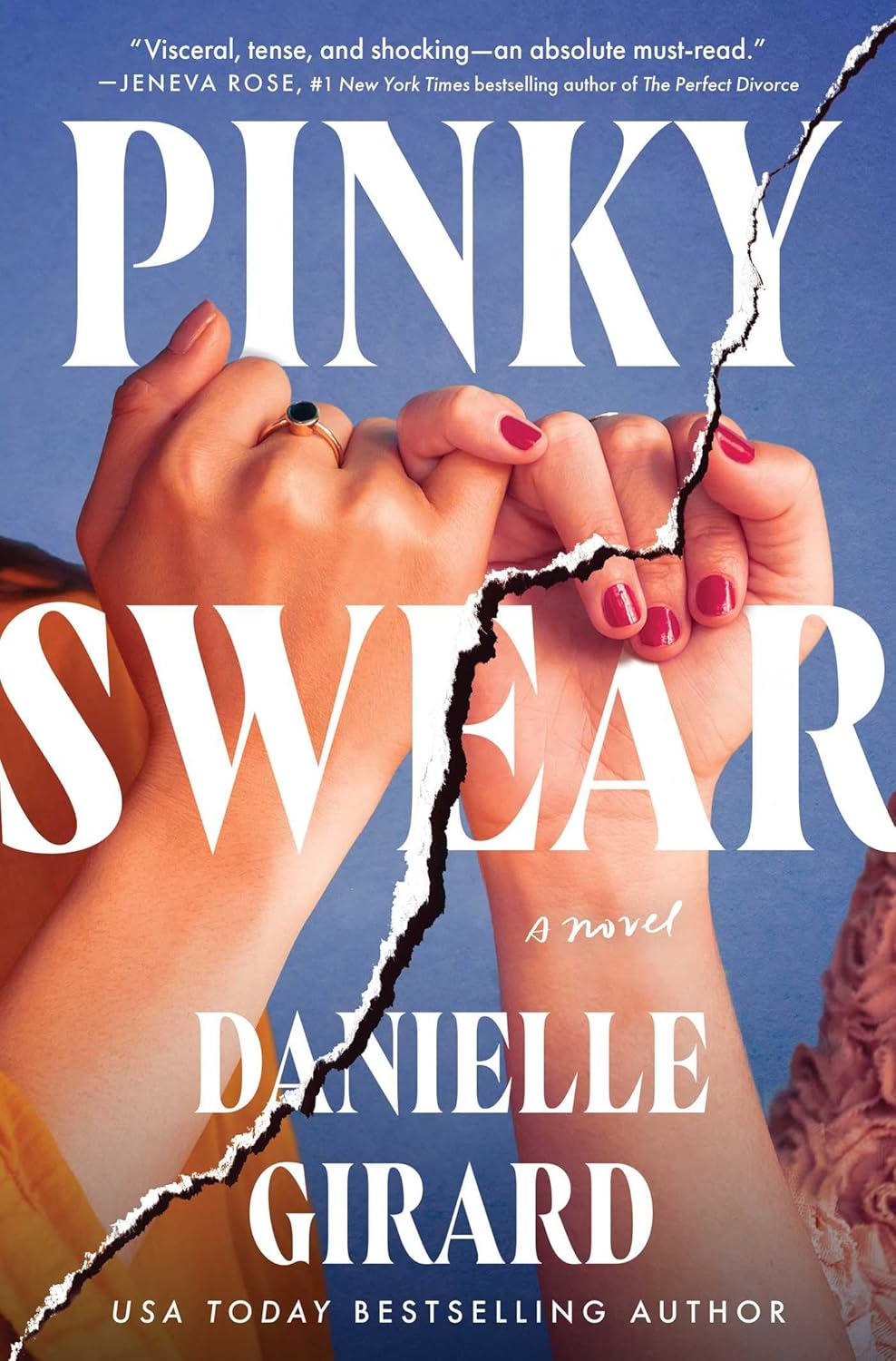
Motherhood is a term that has many meanings, and looks a little different for everyone. It is also something that comes with a lot of questions, and though she may not have all the answers, author Danielle Girard explores these ideas in the Big Idea for her newest novel, Pinky Swear.
DANIELLE GIRARD:
Most of my novels have begun with a dramatic, explosive scene—gunfire, explosives, or at the very least, a murder. But the premise that caught me by the throat for my latest novel, Pinky Swear, was quieter and in so many ways, much more terrifying.
Pinky Swear is a story about a woman whose best friend agrees to be her surrogate and then, four days before the baby is due, disappears. It was the emotional immediacy of that hook that made it so compelling to write. Not only is the protagonist confronting her fear of losing a child (and one she’s never met) but also the abandonment of her best friend, and the persistent doubts about whether their decades-long friendship was a fraud.
What I didn’t expect initially was how the story opened up issues of motherhood itself. The most obvious ones are the grief of infertility and the question of what motherhood really means when biology refuses to cooperate. But beneath those is the larger theme of what makes a woman a mother? Is it biology? Pregnancy? Blood? Or is it intention, sacrifice, love, and the willingness to show up no matter the cost?
My father was an OB/GYN and, when I was growing up, babies and pregnancies were everyday dinner conversations—the joys and also the heartaches. Today, we seem to live in a culture that often defines womanhood and motherhood by a body’s ability to conceive, carry, and give birth. Infertility can feel like the unspoken failure at every baby shower, in every passing comment and well-meaning reassurance that doesn’t quite land.
In Pinky Swear, the protagonist has already endured that loss. Her inability to carry a child isn’t just a medical fact; it’s an emotional wound that reshapes how she sees herself and her place in the world. Turning to surrogacy is an act of hope, but also an act of profound vulnerability. She must trust another woman not only with her future child, but with her deepest wish.
In this dynamic, the story, rather unexpectedly to this author, became a conversation between devotion and betrayal, selflessness and selfishness. The pregnancy, like motherhood itself, carries an undeniable power, binding the two women together in ways that are both intimate and irreversible. The surrogate’s disappearance forces both the protagonist and the reader to confront uncomfortable truths: that love can coexist with resentment, that good intentions can sour, and that even lifelong promises—such as pinky swears made in childhood—can break under the weight of adult realities.
Writing this book meant sitting with uncomfortable questions. If you can’t carry your own child, are you somehow less entitled to motherhood? If another woman brings your baby into the world, where does ownership of that child’s love begin and end? And if a child is taken from you at the last possible moment, can you still call yourself a mother?
Pinky Swear asks readers to sit with the ache of unmet expectations and the messy, often painful reality of female relationships. It asks us to reconsider the stories we tell about motherhood, and to expand them beyond biology into something more human, more forgiving, and truer — that being a mother isn’t about carrying a child inside your body, but about the deep, resilient power of love, no matter the cost.
As I hope readers will do when they read Pinky Swear, I found myself asking not just what I hope I would do in such circumstances, but who I would be. Bitter or resilient. Closed off or open-hearted. Defined by loss or transformed by it. When the story ends, I believe the protagonist finds herself exactly where she was meant to be, and I hope readers will agree.
—-
Pinky Swear: Amazon|Barnes & Noble|Bookshop
Trying Out A New Recipe: Ash Baber’s Bolo Gelado de Brigadeiro
Posted on February 23, 2026 Posted by Athena Scalzi 20 Comments
I can honestly say I’ve never heard of Bolo Gelado de Brigadeiro, or any of the words that make up this Brazilian dessert’s name, but when I came across the reel of Ash Baber making it on Instagram, I knew I wanted to give it a whirl.
Determined to try this chocolatey confection for myself, I went over to his website and took a look at the recipe. When you first look at this recipe, it looks very long and decently complicated. There’s three different sections, each with their own list of ingredients. While there are a lot of ingredients, if you look at them individually they’re really not that wild, it’s just that there’s a lot of them. What is wild is that there is butter, eggs, and oil, as well as white sugar, brown sugar, and sweetened condensed milk, so it really ends up feeling like you need a ton of stuff to make one cake.
You have to make the brigadeiro, make the cake, make the milk soak, and put it all together.
So, was it worth the hassle? How long did it really take? And, of course, how many dishes did I make in the process?
Let’s start with the cost of ingredients. Like I said, nothing was too out of the ordinary, so everything was easily attainable from my local Kroger. The only thing I would say I don’t regularly have on hand on this list is buttermilk, and it’s a 50/50 chance on whether or not I have heavy cream on hand. However, I happened to be out of a lot of things I normally have, so I had to buy some stuff for this recipe I generally would’ve just had.
I bought two cans of condensed milk, and I buy the Eagle brand one, so those were $3.49 each. Usually I have at least one can of sweetened condensed milk on hand, but I still would’ve had to buy one anyways since the recipe calls for two. I only bought a pint of the Kroger brand buttermilk, so it was just $1.29. For the Kroger brand heavy cream, I went ahead and bought a quart, so that was $5.99. Normally I have plenty of butter, but I was completely out so I got two 2-stick packs of Vital Farms Unsalted Butter. I also normally have vegetable oil, but I was down to about one tiny splash, so I bought a new 40oz Crisco Vegetable Oil for $4.79.While I did have eggs, the recipe calls for six (which seems like a lot) so I had to buy a new pack, and I bought Pete & Gerry’s Organic Free Range eggs for $6.99, but you could easily cut down on this cost by buying the Kroger brand large white eggs for $1.79. Also, this one is optional, but I bought Simple Truth Chocolate Sprinkles for $2.69.
All of that came out to $28.73. Not horrible but not cheap, either.
After acquiring the ingredients, it was time to make the brigadeiro:

I know this is only the first photo of many, but I forgot to include the actual chocolate in the photo. It was Ghirardelli. And then upon making I came extremely close to forgetting to put in the condensed milk. I was very scatterbrained apparently.
This part, while easy, was definitely time consuming. I felt like it took longer than I expected for the mixture to thicken up, but I also feel like maybe I didn’t make it hot enough at first. I think I was nervous to burn the cream so I tried to keep it pretty medium-low, but it wasn’t really thickening up much until I turned it up a bit. Technically the recipe doesn’t say how long it takes, but it took me about thirty minutes, and I was constantly stirring it, so that was tedious.
After it had thickened up to the point that I can only describe as “probably good enough,” I set it aside to cool a bit before putting some cling wrap over top and putting it in the fridge to chill.
Here’s the layout of ingredients for the cake portion:

Thankfully, this was basically just “throw everything in your stand mixer bowl and whip it together.” I put the cocoa powder and instant espresso powder (I know the recipe calls for instant coffee, but I assume this recipe can only benefit from the substitution) in the bottom of the stand mixer bowl first, then poured the hot water over it and whisked it into a smooth, thick paste:

I tossed everything else on top of it and got to mixin’. Here’s what we were looking like before the addition of the eggs and the buttermilk:

This was pretty damn gloopy, and weirdly grainy.
And after the addition:

The mixture was much more airy and light now, more like a fluffy texture. Almost mousse-like, but not quite at that level of lightness.
I opted to mix the flour in myself rather than with the stand mixer, because the bowl was honestly really full and it was a lot of flour. I didn’t want it to go exploding everywhere in the stand mixer.
When I started mixing the flour in, tiny clumps of flour started appearing all throughout the batter, like they didn’t quite mix in right. Definitely was starting to wish I had sifted the flour. I beat the clumps out best I could and poured it into the cake pan, then put it in the oven for one hour at 350 degrees Fahrenheit. There was so much batter in the pan that I was worried not even an hour would cook the cake all the way through, but when I used a knife to test it fresh out of the oven, it came out perfectly clean.
Putting that aside to cool, it was time to make the milk soak, which is just milk, cocoa powder, and sugar.
Once the cake and milk soak were both cooled, it was time to take the brigadeiro out of the fridge and put the whole dang thing together. Here’s the brigadeiro all thickened up:

Gawd dayum was this thicc. Rich and fudgy and oh so chocolatey. It was honestly incredible, but I was sure I was about to bend my spoon trying to mix it around. Handle with caution.
The cake cut in half easily, as it was very tall and made two very nice layers. I put the bottom layer in the cake pan I had baked it in, then poured half the milk soak over it. Scooped half the brigadeiro onto the first layer and smoothed it out over the surface, then slapped the top layer on top and poured the rest of the milk soak over it (I docked the top a bunch with a fork so the milk could go into the holes), and slathered that bad boy in the rest of the brigadeiro. There was so much brigadeiro on top, the cake pan could barely even contain my creation, the fudgy topping starting to spill over the sides.
The instructions say to let this puppy sit in the fridge overnight, and though it was hard not to slice right into it, I managed to let it rest in the fridge.
Once I took it out (it was heavy) and put sprinkles on top, it was glorious:

In the moment, I thought that was plenty of sprinkles, but looking at it now, I totally could’ve put more. It looks a little sparse.
I was eager to cut into it, and here’s the cross section:

My parents and I tried this cake at the same time and oh my gosh. It was probably the best chocolate cake I’ve ever had. I don’t even really like chocolate cake that much, but this one was so moist and rich, dense and fudgy and absolutely decadent. It was the kind you could only take a small slice of, and even then I needed some milk with it. It is not for the faint of heart, but it is for the fat of ass.
I had four of my friends try this cake and they all said it was incredibly banger, and even “dangerously good.” I was feeling pretty good that this turned out so yummy.
I will say this cake slides around a lot. The layer of brigadeiro in between the top and bottom cake layer make this thing slip and slide all over itself, and you can end up with a very slanted, divided cake if you aren’t careful. Cutting into it is messy, frosting it is messy, divvying it up into Tupperwares to give to other people is messy. But boy is it delicious.
For the dishes portion of this recipe test, this recipe is unique because it isn’t measured with cups and the like. You can measure everything on a digital scale, which made everything so much easier and made me use considerably less dishes. I used one bowl to weigh the brigadeiro ingredients in, one pot to cook the brigadeiro in, a rubber spatula to mix it, and another bowl to put in the fridge after it cooked. For the cake I used my stand mixer bowl, one attachment of the stand mixer, one whisk, a teaspoon, a tablespoon, and one rubber spatula to put it into the cake tin. I guess you can also count the cake tin in that, too. Oh, and a bowl for the eggs because I always crack eggs into a separate bowl first instead of straight into the cake batter. Finally, I used one small pot for the milk soak, a tablespoon, and another rubber spatula.
So, was it all worth it? The large ingredient list, the time that went into it, the dishes, and the cost (roughly, prices will vary for you, obviously).
I think yes! But this is definitely something to make for special occasions, or maybe for something like the holidays, when you need something to feed a lot of people. This cake makes a lot of cake.
I honestly liked making this cake and I’m very happy with the result. The dishes really weren’t so bad, and the praise you’ll get for how good this tastes outweighs the considerable effort of making it.
Have you heard of this dessert before? Do you usually like chocolate cake? Let me know in the comments, and have a great day!
-AMS


Whatever Everyone Else is Saying