The post Xynteo spin-off ‘PoweringAI’ launches to revolutionise European AI infrastructure through industrial transformation appeared first on Xynteo.
]]>PoweringAI today announced its official launch as a pioneering pan-European data centre development venture. Designed to disrupt the status quo, PoweringAI accelerates the delivery of AI-ready digital infrastructure by transforming industrial-scale, powered sites into high-performance compute hubs.
PoweringAI is born as a strategic spin-off from Xynteo, the specialist advisory firm dedicated to accelerating sustainable impact and value creation. Xynteo itself is backed by funds advised by Leon Capital LLP, a specialist European investment firm. While traditional developers continue to navigate the complexities of power and land, PoweringAI launches with a 350 MW pipeline of advanced projects. The model focuses on the sophisticated repurposing of legacy industrial and port assets into integrated “energy park + data centre” developments, bridging the gap between heavy industry and the digital future. In doing so, it reactivates underutilised land, creating local employment in communities that powered Europe’s industrial past.
“We are unlocking a category of sites that have remained inaccessible to the broader market. By tapping into Xynteo’s industrial incumbent relationships, coupled with more than a year’s worth of investment in IP and expertise with site origination and development, we are creating a platform that delivers commercial success at the intersection of power and compute.”
Michael Youtsos, Partner at Leon Capital and Chair of PoweringAI
“As Europe’s energy transition accelerates, the intersection of power, industry, and compute will define the next decade of infrastructure investment. PoweringAI is uniquely positioned to build that bridge—delivering sustainable, powered data centre sites with deep industrial integration.”
Alex Rabbetts, Senior Advisor, Data Centres, PoweringAI
PoweringAI’s origins within Xynteo reflect the company’s commitment to coalition-driven systems change, now applied to one of Europe’s most urgent infrastructure priorities.
“This spin-off is a natural evolution of Xynteo’s mission—turning complex industrial challenges into scalable opportunities for good growth, with local job creation, and circular reuse of legacy assets. PoweringAI is building the development engine Europe needs to deliver AI infrastructure at speed, with quality, and with industrial legitimacy.”
Rasmus Lundsgaard Nielsen, Partner and CEO of Xynteo
PoweringAI is set to become the definitive platform for repurposing Europe’s industrial heartlands into next-generation digital infrastructure, ensuring the continent remains competitive in the global AI race.
About PoweringAI
PoweringAI (wearepowering.ai) is a pan-European data centre development platform focused on repurposing powered brownfield industrial and port sites into integrated “energy park + data centre” campuses. Spun out of Xynteo and backed by Leon Capital, the venture launches with a near-500 MW pipeline of AI-ready development opportunities across Europe.
Learn more about us at https://wearepowering.ai, or click here.
About Xynteo
Xynteo is a specialist business advisory firm, based in Europe and India, on a mission to help global organisations and investors accelerate sustainable impact and value creation. Our work goes beyond ‘just strategy’ to transform complex decarbonisation, energy transition and circularity challenges into practical, actionable pathways for commercial success. By forging long-term partnerships with our clients, leveraging our expertise and extensive alliance ecosystem, we empower companies to identify, realise, and scale opportunities at all stages of their value-creation journey.
Learn more about us at www.xynteo.com
About Leon Capital
Leon Capital is a European investment firm that invests in and builds middle-market B2B services platforms that enable resilient, scalable development across strategic sectors.
Learn more about us at www.leon-capital.com
The post Xynteo spin-off ‘PoweringAI’ launches to revolutionise European AI infrastructure through industrial transformation appeared first on Xynteo.
]]>The post India Exchange 2026: Three imperatives for building the Green Corridor appeared first on Xynteo.
]]>A verse in the Bhagavad Gita has stayed with me for a long time. It speaks of the responsibility to act with integrity, discipline, and conviction—without being paralysed by uncertainty.
“karmaṇy-evādhikāras te mā phaleṣu kadācanamā karma-phala-hetur bhūr mā te saṅgo ’stv akarmaṇi”
I opened the India Exchange 2026 with those words, and over the two days that followed, I watched senior leaders live them out.
The backdrop was significant: the India-EU Free Trade Agreement had just moved decisively into focus, and the India–UK FTA was gathering momentum. As European Commission President Ursula von der Leyen put it, this was about bringing together “Indian skills, services and scale with the UK/Europe’s technology, capital and innovation.” In one sentence, she described the design of the India-UK/Europe Green Corridor.
But design is not delivery. And that gap—between the architecture of ambition and the reality of execution—was exactly what India Exchange 2026 set out to close. Three messages emerged with clarity.
Governments enable, industry implements. Together, they transform.
Free Trade Agreements are thousands of pages of painstakingly negotiated commitments. They are a signal of intent, of trust, of political will. But a signal is not a system. That distinction matters. Governments are the enablers: they set the policy architecture, open the doors, and reduce the friction. But the outcomes—the projects, the partnerships, the actual flows of capital, technology, and talent—are built by industry. Without both roles playing in concert, the potential unlocked by these agreements remains just that: potential.
What India Exchange 2026 demonstrated is what happens when the two roles align. The political architecture is in place. The question now is whether industry is ready to act as the architect of what comes next to layer a real operating structure on top of the frameworks, and convert agreements into action. The Green Corridor is that structure. It is a construction project, and industry is the builder.
On the eve of the Exchange, a delegation of senior leaders spanning metals and mining, energy, clean mobility, circularity, finance, and clean technology—from India, the UK, and Europe—met the Hon’ble President of India, Smt. Droupadi Murmu, at Rashtrapati Bhavan. Led by Padma Bhushan Smt. Rajashree Birla, the delegation—which included senior leaders from Xynteo, Aditya Birla Group, Hindalco Industries, UltraTech, Thermax, Volvo Group, Bayer CropScience, Energy Efficiency Services Limited, Leon Capital, and Origination Foundation—briefed the President on the intent and ambition of India Exchange 2026, and presented a compendium of actionable pathways to operationalise the Green Corridor: moving beyond dialogue to lighthouse projects, cross-border alliances, and commercially viable collaborations. It was a moment that captured the essence of this first message—government as enabler, industry as implementer, and the corridor as the shared destination.
Complementary capabilities must flow—capital, technology, talent, and innovation.
The complementarity between India and the UK/Europe is real and well-documented: technology and capital on one side, market scale and talent on the other. But complementarity alone does not create projects. It creates possibility. Turning possibilities into projects requires architecture.
The rules of the game for deploying capital don’t change overnight; trillions of dollars sit outside India. The question is whether they are flowing to the right places, in the right form, at the right time. Returnable capital deployed to de-risk nascent sectors, close ecosystem gaps, and create the market conditions that allow private capital to follow at scale.
But capital is only one dimension. 99.45% of new electricity generation capacity coming online this year is renewable—not because it is the right thing to do, but because it is the cheapest. The economics of transition are winning. What is needed now is the architecture to channel that momentum across all its dimensions: bankable pipelines, regulatory certainty, technology transfer mechanisms, and the talent pathways that allow innovation to move between geographies.
The Green Corridor aims to become that architecture—a structured, credible pathway for the full range of complementary capabilities to flow between the UK/Europe and India’s most critical transition sectors.
Systemic transformation demands purpose and a business case.
Partnership is the new leadership. It is a statement that has been true for a long time and is now simply undeniable. This philosophy is core to how we think at Xynteo. Systemic transformation does not happen through individual effort, however well-resourced. It happens when purpose and business case align and when that alignment is pursued collectively.
Purpose is what drives individuals, but business value is what drives change at scale. The two are not in tension. They are the same argument, made differently to different audiences. The leaders who are winning are those who have stopped choosing between them and started building systems that create value across the entire stakeholder ecosystem.
We designed India Exchange 2026 around three objectives: unlock cross-border growth, incubate lighthouse projects, and shape a private-sector narrative that turns FTA frameworks into bankable outcomes. The conversations over those two days gave us the raw material for all three.
The next step is London. The Green Corridor is being built—one partnership, one project, one committed leader at a time. No ambition is too large to be pursued collectively.
More on Xynteo ExchangeThe India Exchange 2026, presented by Aditya Birla Group in collaboration with Xynteo, was held on 24-25 February in New Delhi, as part of building the India–UK/Europe Green Corridor. We are immensely grateful to our Strategic Partners, Mahindra Group Hindustan Unilever, Marico Innovation Foundation, Khaitan & Co, and JSW Cement, for their vision and support in making this possible.
For further information, follow us on social media (LinkedIn I Twitter), or Contact Us to find out how we can help your leaders and organisation create people and planet-positive impact.
The post India Exchange 2026: Three imperatives for building the Green Corridor appeared first on Xynteo.
]]>The post Europe’s industrial legacy holds the answer to its digital future appeared first on Xynteo.
]]>Europe wants to triple its data centre capacity within a decade, yet the electricity grid it depends on is not nearly ready. Across the EU’s core markets, grid connection queues now average seven to ten years, according to the International Energy Agency (IEA), against a typical two-year build cycle. Dublin and Amsterdam have already paused new projects, and Amazon Web Services (AWS) has warned that delays are “challenging our growth aspirations” across the continent.
The instinct has been to look forward: build new grid, reform permitting, lobby Brussels. But there is a faster route hiding in plain sight. Across Europe’s post-industrial landscape sit large, powered sites (former manufacturing complexes, energy facilities, heavy industrial estates) already connected to high-voltage infrastructure with contracted capacity. The most expensive, time-consuming element of any data centre development already exists.
There is complexity in developing these industrial sites. Powered industrial land typically comes with fragmented ownership, legacy environmental liabilities, outdated planning designations, and corporate owners whose core business lies elsewhere. The gap between “powered site” and “data centre-ready site” is wide, technical, and commercially dense.

PoweringAI, a European data centre development platform, has been launched to close it. Spun out of Xynteo and backed by Leon Capital, the venture launches with a near-500 MW pipeline of AI-ready development opportunities across Europe. It works as a specialist development partner with industrial landowners, often major corporates whose legacy estates represent significant untapped value, bringing the development capability, energy expertise, and operator relationships needed to unlock sites that would otherwise remain stranded—and in doing so, reactivates underutilised land and creates local employment in the communities that powered Europe’s industrial past.
In a market where the binding constraint is no longer capital, land, or demand, but time to power, Europe does not need to wait a decade for new grid. It needs to unlock the grid it already has.
For more information, visit PoweringAI.
For further information, follow us on social media (LinkedIn I Twitter), or Contact Us to find out how we can help your leaders and organisation create people and planet-positive impact.
The post Europe’s industrial legacy holds the answer to its digital future appeared first on Xynteo.
]]>The post Integrating high-integrity carbon markets into the global decarbonisation journey appeared first on Xynteo.
]]>The global climate conversation has shifted from whether we should act to how we can execute at scale. As organisations move toward 2030 and 2050 climate targets, the margin for error is shrinking. Delivering on these commitments will require credible mechanisms that both reduce emissions and remove carbon from the atmosphere.
Moving beyond “either/or” to integrate carbon removals into corporate strategies
The most fundamental principle of a credible climate strategy is the recognition that carbon removal is a supplement to—not a substitute for—deep and rapid emission reductions. While the priority remains cutting emissions, most climate models show that emission reductions alone cannot reach net zero by mid-century. Across nearly every global value chain, organisations will face residual emissions that will be nearly impossible to eliminate entirely within the 2030 and 2050 horizons.
Addressing these residual emissions is one of the defining challenges of the net-zero transition. Carbon removals will play a critical role, not as a substitute for decarbonisation, but as a necessary complement. At the same time, simply reaching “neutral” is no longer enough; to return to safe climate levels, we need to remove the “legacy” carbon that is already warming our planet.
Carbon markets, when built on a foundation of high integrity and quality, provide the essential commercial vehicle needed to bridge this gap, allowing businesses to maintain momentum and achieve their climate goals without compromising on their long-term growth or economic viability.
Building high-integrity carbon markets for strategic impact
The path forward requires a transition to a high-integrity market that integrates carbon removals into corporate strategy without slowing down current decarbonisation efforts. This requires a diversified portfolio of pathways:
- Natural solutions: Leverage biological processes such as reforestation, soil carbon sequestration, and ecosystem restoration to remove carbon while delivering biodiversity and community benefits.
- Technological solutions: Focus on engineered approaches such as Direct Air Capture (DAC), bioenergy with carbon capture, and mineralisation—technologies capable of delivering durable, long-term carbon removal.
We believe carbon markets are a valuable lever for businesses to achieve net zero without compromising on true, in-value-chain decarbonisation. Doing so requires sound principles backed by data and experience navigating a complex landscape. At Xynteo, we help turn these commitments into tangible commercial value by prioritising quality and systemic orchestration.
Xynteo is your end-to-end partner in transformation
Xynteo is not a traditional consultancy. We have over 20 years of experience helping global organisations turn systemic challenges into value creation. Our approach is defined by being:
- Dynamic doers: We don’t stop at strategy; we design operating models and help you secure financing to turn pilots into pathways.
- Systemic orchestrators: We leverage our coalition expertise to unite capital, supply, and demand – solving market challenges too complex to do alone.
- Commercial creatives: We design bespoke commercially viable carbon solutions and products that turn sustainability from a cost into a competitive asset.
Our DNA is rooted in partnership. By collaborating with market leaders, technical experts, and ecosystem partners, we ensure our work is grounded in real market dynamics and technical rigour.
“Throughout the project, the Xynteo team felt like an extension of ours. They brought a great balance of flexibility and expertise—adapting quickly to our evolving needs, offering sharp technical insights, and helping us navigate complex market dynamics. Their responsiveness and collaborative spirit made the entire process highly productive and enjoyable.”
Sustainability Solutions Director at a global technology company in the payments sector
How we can help from exploration to execution
We support your organisation through a modular service model that guides you from initial diagnosis to long-term implementation:
- Decarbonisation diagnosis: Quickly assessing your decarbonisation ambition and mapping residual emissions to identify exactly where carbon credits play a role over time.
- Carbon credits strategy: Defining the role of credits within your wider strategy and developing procurement models to forecast demand.
- Carbon sourcing and portfolio design: Identifying and evaluating high-quality sourcing pathways using bespoke screening tools to assess integrity and delivery readiness.
- Carbon markets offering/product design: Shaping pathways that create strategic value, new revenues, or specific customer offerings.
- Delivery, implementation and capital raising: Designing governance models and capital structures to support the execution and scale-up of your initiatives.
We utilise a “Double-Diamond” approach to enable rapid insight, moving from broad discovery to deliverable, investable action.
The window for high-quality engagement is open. Whether you are an “Explorer” starting your journey or an “Operator” ready to finance at scale, we provide the strategic clarity and execution readiness to turn your climate ambition into a competitive asset.
Get in touch with our team to discuss how Xynteo can help your organisation:
For further information, follow us on social media (LinkedIn I Twitter), or Contact Us to find out how we can help your leaders and organisation create people and planet-positive impact.
The post Integrating high-integrity carbon markets into the global decarbonisation journey appeared first on Xynteo.
]]>The post International Women’s Day 2026: Beyond the short term, why giving is the ultimate strategy for sustainable value appeared first on Xynteo.
]]>As we mark International Women’s Day 2026, the theme “Give to Gain” invites us to lean into a concept that is as ancient as it is disruptive: the power of reciprocity. In a corporate world often obsessed with the immediate—the quarterly result, the short-term win, the linear path to an outcome—the idea of “giving” can sometimes feel like a distraction; but in truth, giving can multiply our gains—both soft and hard.
I am often drawn back to a handful of ideas that challenge our conventional understanding of success. One is the motto of the Royal Military Academy Sandhurst: Serve to Lead. Another is the principle at the heart of John Kay’s book Obliquity: Why Our Goals Are Best Achieved Indirectly—the idea that our most complex goals are often best pursued through an indirect route rather than a linear one.
And then there is the concept of paying it forward—which, alongside serve-to-lead and Obliquity, shares something fundamental: all three are about the long term, and all three are about an indirect route to an outcome. That is precisely what makes them counter-cultural in most workplaces, and precisely what makes them so important.
Put in the context of gender equality and gender dynamics in the workplace, the way I process and absorb these concepts is actually quite simple. When we fixate only on short-term metrics, we miss the broader, more powerful shifts that occur when we invest in the long-term health of our ecosystem, and gender equality in a sense that is broader than looking only at representation needs exactly that kind of systemic shift.

Giving as leadership
So what does “Give to Gain” actually look like in practice? For me, it starts with leadership—full-fat, 360-degree leadership. It means always making time and space to think about the environment you want to create, not just the outcomes you want to deliver. It means making people feel heard. It means being genuinely cognisant of what people are navigating outside of work, because in order to enable someone to be the best they can professionally, you have to have some awareness of the environment they are operating in personally. And it is true that for women in the workplace, that “environment” is very often more complex.
This is where giving locks back into sustainable value creation. To create sustainable value, you have to think long term. To think long-term, you have to take into consideration the broader, softer dimensions of what it means for a business—and an individual—to be truly successful. You are giving attention now in order to create value further down the line. You are divorcing short-term utility from long-term impact.
The discomfort of the mirror
The IWD 2026 call to action is clear: give your support by calling out stereotypes, challenging discrimination, questioning bias, and celebrating women’s success. In principle, nobody disagrees with any of that. But in the day-to-day, it can get a little uncomfortable.
Holding up a mirror to bias in a high-stakes meeting is rarely welcomed in the moment. Allyship is embraced in principle, but when it actually plays out—when someone is sitting uncomfortably in a room having their assumptions challenged—it can be difficult to receive constructively. We have to accept that this discomfort is part of the process of change, but it is not a reason to stop.
The more we do it, the more it becomes normalised. The more normalised it becomes, the less it needs to be called out as something exceptional. We hold up the mirror now so that, eventually, we won’t have to.
That is the give. The gain is a world of work where these behaviours are simply how we operate—not a special effort, not an act of allyship, just the baseline.
For further information, follow us on social media (LinkedIn I Twitter), or Contact Us to find out how we can help your leaders and organisation create people and planet-positive impact.
The post International Women’s Day 2026: Beyond the short term, why giving is the ultimate strategy for sustainable value appeared first on Xynteo.
]]>The post Compendium of low-carbon alternatives: Case studies demonstrating market-ready solutions appeared first on Xynteo.
]]>The question is no longer whether we can decarbonise construction, but how fast we can move from pilots and promises to proven, scalable solutions on real sites.
The Compendium of Low‑Carbon Alternatives, developed with Build Ahead coalition partners across India’s construction value chain, brings together seven real‑world pilots that demonstrate what is possible today. Spanning airports, highways, commercial IT parks, residential towers and public infrastructure, these case studies move beyond theoretical modelling to show how high‑SCM concretes, recycled aggregates, industrial‑waste cladding and other alternatives perform under real project constraints—on strength, durability, cost, and embodied carbon.
This report equips developers, material producers, infrastructure owners and financiers with empirical evidence to accelerate adoption. It quantifies embodied carbon reductions at material and building level, validates performance parity with business‑as‑usual mixes, and distils practical lessons on mix design, QA/QC, supply‑chain readiness and policy enablers. By focusing on market‑ready solutions that align with current codes, commercial parity and site‑level realities, the compendium offers a pragmatic roadmap to embed low‑carbon materials across portfolios—turning early pilots into a pipeline towards a net‑zero, climate‑resilient built environment.
Suman Jagdev
Partner, Xynteo; Programme Director, Build Ahead India
Milan Kaur
Manager
Smriti Viswesvaran
Consultant

The post Compendium of low-carbon alternatives: Case studies demonstrating market-ready solutions appeared first on Xynteo.
]]>The post India’s Green Hydrogen Test: Scale or Stall appeared first on Xynteo.
]]>India’s green hydrogen journey has moved from “idea” to “activity.” Over the last couple of years, the country has seen a wave of project announcements, early pilots, and growing interest from manufacturers. But as the dust settles, a clear picture is emerging: India is becoming supply-ready, yet the market is still demand-constrained. The next phase will be won not by who announces the biggest project, but by who can convert ambition into bankable, executed deployments.
A large pipeline, small conversion into real projects
On paper, India’s green hydrogen pipeline looks massive. Over 380 projects have been announced, adding up to about 13 million tons of planned capacity. Yet execution is still thin. Only around 35 projects are currently under implementation, and more than 90% of these are demonstration projects, valuable for learning, but not the same as large-scale commercial deployment1.
Even within these projects, the capacity being built is a small slice of what has been announced: roughly 230+ kilotons of hydrogen production is under implementation, which is around 2% of the total announced volume.
This does not mean the market is failing. It simply reflects a typical early-stage pattern: first comes enthusiasm and announcements, then comes the harder work of customer contracts, permits, engineering, financing, and infrastructure.
Supply chains are forming ahead of demand
One of the most positive signs is the speed at which the industrial ecosystem is taking shape. Electrolyser and fuelcell manufacturers are preparing for scale, with more than a dozen electrolyser original equipment manufacturers (OEMs) already visible. New entrants and large industrial groups are entering the space, and several are planning manufacturing capacity, even though demand is not fully predictable yet.
The ecosystem is also expanding beyond electrolysers. Hydrogen truck development pilots are underway with major vehicle manufacturers, and storage players are adapting existing technologies for hydrogen use.
The core insight here is important: manufacturing is scaling up before demand is certain. That can be a strength—India builds capabilities early and reduces dependence on imports. But it can also create risk – If demand grows slowly, manufacturers could end up with underused capacity, weakening margins and slowing future investments.
Demand and infrastructure remain bottlenecks
What is holding the market back is not the basic ability to produce hydrogen. It is the market pull needed to justify big investments.
Right now, there are limited announcements of truly largescale demand in hard-to-abate sectors such as green steel, heavy trucking, chemicals, and broad pipeline-enabled industrial use. Without anchor buyers and long-term contracts, hydrogen developers are hesitant to commit to final investment decisions at scale.
Infrastructure is the other missing piece. Hydrogen requires systems for transport, storage, and handling. Shared pipelines, storage hubs, and port infrastructure will be essential to reduce costs and support scale. Until these are in place, projects remain fragmented and expensive.
Policy support is strong but competition is intense
Policy actions have played a critical role in kickstarting the sector. Incentives, auctions, and early demand-creation mechanisms have helped projects take shape and improved visibility for some segments.
However, intense competition is creating new risks. With a large number of developers (100+)2 chasing limited early opportunities, price bids are becoming aggressive. Some projects are being proposed without sufficient technical and financial groundwork, increasing execution risk.
Technology is progressing, but execution readiness matters more
Public sector pilots have helped validate early technologies, from fuel-cell applications to integrated hydrogen production systems. Private players are now building on this foundation, often partnering with global technology providers for initial deployments.
In short, the technology works. The next challenge is scaling it commercially through better standards, testing infrastructure, financing frameworks, and procurement pathways.
Capital is shifting toward long-term, patient money
Green hydrogen projects are capital-intensive and infrastructure-heavy. That means the next phase will be shaped by long-term investors, blended finance, and patient capital rather than short-term venture/promoter equity funding alone.
Four actions to unlock scale
- Create bankable demand through mandates in fertilizers, refining, steel, and heavy transport, supported by longterm offtake agreements.
- Accelerate shared infrastructure such as pipelines, storage facilities, and port systems.
- Improve project bankability through blended finance, risk-sharing mechanisms, and clear policy timelines.
- Stabilize manufacturing and the supply chain by linking incentives to deployment and supporting early utilization.
The bottom line
India’s green hydrogen ecosystem is taking shape quickly. Manufacturing readiness is improving, early pilots have demonstrated viability, and policy is pushing in the right direction. But the path to scale now depends on predictable demand, shared infrastructure, and financing that matches real-world risk.
1 https://nghm.mnre.gov.in/project?language=en
2 https://nghm.mnre.gov.in/project?language=en
This article first appeared in Hydrogen India Newsletter, March 2026 Vol III, Issue 2
For further information, follow us on social media (LinkedIn I Twitter), or Contact Us to find out how we can help your leaders and organisation create people and planet-positive impact.
The post India’s Green Hydrogen Test: Scale or Stall appeared first on Xynteo.
]]>The post Xynteo and Carbonaires join forces to support organisations navigating the growing demand for high-quality carbon credits appeared first on Xynteo.
]]>Xynteo and Carbonaires announce a strategic partnership to support organisations engaging with high-quality carbon markets, integrating strategic sustainability advisory with deep carbon market and asset expertise to enable rigorous, practical decision-making and execution.
The partnership brings together Xynteo’s long-standing experience in strategic sustainability advisory and implementation expertise with Carbonaires’ specialised capabilities in high-integrity carbon assets, project due diligence, and offtake and project finance structuring. Together, the organisations will support clients across carbon market cycle—combining technology, finance, and design-led approaches with a shared focus on quality, integrity, and real-world impact.
“Carbon markets are a critical component for many organisations’ climate transitions. By partnering with Carbonaires, we combine complementary capabilities to help organisations move from carbon market strategy to confident, practical execution.”
Rasmus Lundsgaard Nielsen, Partner and CEO, Xynteo
Carbonaires brings deep expertise in assessing and managing carbon assets to help buyers and institutions navigate the evolving voluntary carbon markets. Xynteo contributes over two decades of strategic advisory experience across sustainability challenges, helping organisations integrate carbon markets into broader transition and value-creation strategies.
“Working with Xynteo strengthens our ability to unlock practical solutions for high-quality carbon offtake and finance. Together, we combine rigorous carbon asset expertise with strategic frameworks to help organisations invest in and scale credible removals.”
Rasih Ozturkmen, Co-Founder and Managing Partner, Carbonaires
Uncertainty around carbon credit quality and the complexity of market mechanisms have historically challenged organisations seeking to deploy capital with confidence. By aligning strategic advisory and rigorous carbon market expertise, the Xynteo–Carbonaires collaboration aims to provide clients with both contextual strategy and detailed operational support – from initial market assessment through diligence, offtake structuring, and transaction execution.
In 2026, the partnership will deliver a series of open, collaborative events and thought leadership initiatives. These sessions will be open to external participants and designed to convene corporates, financial institutions, and project developers around practical carbon market insights.
About Xynteo
Xynteo is a specialist advisory firm, based in Europe and India, on a mission to help global organisations and investors accelerate sustainable impact and value creation. Xynteo combines strategic insight with deep operational, commercial, and techno-economic expertise to help clients design and implement credible, values-based strategies.
For more information, please visit: www.xynteo.com
About Carbonaires
Carbonaires is a specialist provider of carbon asset expertise, focused on ensuring high-integrity outcomes in carbon markets. With core strengths in project due diligence, offtake structuring, and credit assessment, Carbonaires helps organisations and investors navigate both voluntary and compliance carbon markets with confidence and transparency.
For more information, please visit: https://carbonaires.com
Media contacts
Xynteo
Zara Khan
Marketing Business Partner
[email protected]
(91) 8939013419
Carbonaires
Erdem Celik
Founding Partner
[email protected]
(44) 7740542050
The post Xynteo and Carbonaires join forces to support organisations navigating the growing demand for high-quality carbon credits appeared first on Xynteo.
]]>The post India Exchange 2026: Global Leaders Commit to Building the India–UK/Europe Green Corridor appeared first on Xynteo.
]]>Xynteo convenes senior leaders from business, finance, and technology sectors across India and Europe to move the India-UK/Europe Green Corridor from ambition to action—with concrete partnerships, investable mechanisms, and a mandate for scale.
Xynteo, supported by Aditya Birla Group and powered by Hindalco Industries Limited, convened the India Exchange 2026 in New Delhi on 24–25 February, bringing together senior leaders from business, finance, technology, and civil society across India, the United Kingdom, and Europe to propose and advance an India–UK/Europe Green Corridor—a cross-border, industry-led platform designed to accelerate industrial decarbonisation, clean mobility, and circularity at scale.
The India Exchange 2026 was instrumental in mobilising participants to collectively define the Green Corridor’s vision, mission, and outline its framework in the context of the recent Free Trade Agreements negotiations between India and the UK/Europe.
On the eve of the Exchange, a delegation of senior leaders from across metals and mining, energy, clean mobility, circularity, finance, and clean technology sectors—from India, the UK, and Europe—led by Padma Bhushan Smt. Rajashree Birla, Chairperson, Aditya Birla Centre for Community Initiative and Rural Development, met the Hon’ble President of India, Smt. Droupadi Murmu, at Rashtrapati Bhavan. The delegation, which included senior leaders from Xynteo, Aditya Birla Group, Hindalco Industries Limited, UltraTech, Thermax, Volvo Group, Bayer CropScience, Energy Efficiency Services Limited, Leon Capital, and Origination Foundation, briefed the President on the intent and ambition of the India Exchange 2026 and presented her with a compendium on actionable pathways to operationalise the proposed Green Corridor, moving beyond dialogue to the implementation of lighthouse projects, cross-border alliances, and commercially viable collaborations between businesses in India and the UK/Europe.
“The India Exchange 2026 marked a meaningful shift for the Green Corridor from intent to action. Business leaders from India, the UK, and Europe are now not just aligned on the vision, but committed to delivering it. Innovators and start-ups are already seeding the lighthouse projects that will define this corridor. Most importantly, we leave with something concrete: partners on board, collaborative projects underway, and the Green Corridor no longer an ambition on a page, but a collaboration in motion.”
Satish Pai, Managing Director, Hindalco Industries Limited
“Now, with trade agreements in place and geopolitical alignments shifting, there is a rare window for a deep, strategic partnership between India, the UK, and Europe. This is where the Green Corridor comes in. Building on the foundations already laid, the Green Corridor is designed to catalyse commercially viable collaborations, technology transfer, and investment flows that deliver climate and people-positive impact at scale.”
Vipul Kumar, Partner and Managing Director India, Xynteo
India marks the first leg of a two-part Exchange; later this year, participants will reconvene in London to build on the foundations laid in New Delhi—broadening collaboration across geographies, formalising the Green Corridor’s governance structure, and advancing the partnerships, pilots, and capital commitments seeded at this Exchange. Together, the two Exchanges are designed to establish the Green Corridor as a lasting, cross-geography coalition that works towards a green industrial future shared between India and the UK/Europe.
Key discussions at the India Exchange 2026 centred around the strategic architecture of the Green Corridor—its design principles, governance framework, and core mechanisms for translating cross-border collaboration into viable projects; how collaborative platforms such as the Green Corridor can turn the India-UK and India-Europe FTA frameworks into bankable projects and industrial scale outcomes; the importance of setting intentions and vision to building lasting organisations, and how that can become the principle to build the Green Corridor between India and the UK/Europe; how corporates can navigate regulatory uncertainty, geopolitical changes, capital diversions, and continue to build on their sustainability vision; how corporates and founders can access transition capital better; and how corporates can create forward-leaning architecture that aims to convert the biggest blockers to technology access into accelerants for progress.
Notable speakers at the event included Mrs Birla, Satish Pai, Managing Director, Hindalco Industries Limited, Harsh Mariwala, Founder and Chairman, Marico, Ajay Mathur, Former Director General, International Solar Alliance, Ashish Bhandari, MD and CEO, Thermax Limited, Atul Satija, Founder and CEO, The/Nudge Institute, Chandrajit Banerjee, Director General, Confederation of Indian Industry, Kamal Bali, President and MD, Volvo India, Kartikey Hariyani, Founder and CEO, Charge Zone, Riddhima Yadav, Former Vice President, Brookfield Asset Management and Advisor, All Aboard Fund, Shalabh Tandon, South Asia Regional Head of Operations and Climate Change, International Finance Corporation, Simon Wiebusch, CEO & Country Divisional Head, Bayer CropScience, Dr. SSV Ramakumar, Greenko Group, Chief Technology Officer and Executive Vice President of AM Green, and Wen-Yu Weng, Executive Lead – Critical Mineral, Ellen MacArthur Foundation.
About Xynteo
Xynteo is a specialist advisory firm, based in Europe and India, on a mission to help global organisations and investors accelerate sustainable impact and value creation.
In a market dominated by traditional consultancies, Xynteo is disrupting the status quo. Our work goes beyond ‘just strategy’ to transform complex decarbonisation, energy transition and circularity challenges into practical, actionable pathways for commercial success. By forging long-term partnerships with our clients, leveraging our expertise and extensive alliance ecosystem, we empower companies to identify, realise, and scale opportunities at all stages of their value creation journey.
Our tailored solutions help organisations achieve meaningful, measurable results. We unlock systemic challenges through collaboration, devise sustainable value strategies, bring to life economically viable transformation, and generate impact across the investor portfolio lifecycle.
For more information, please visit: www.xynteo.com
Media Contact
Zara Khan
Marketing Business Partner
+91 8939013419
The post India Exchange 2026: Global Leaders Commit to Building the India–UK/Europe Green Corridor appeared first on Xynteo.
]]>The post From declaration to execution: Why the India Exchange 2026 matters now appeared first on Xynteo.
]]>In the last week, the EU–India Free Trade Agreement (FTA) has entered the global conversation, the way the UK-India FTA had a few months earlier—not just as a trade milestone, but as a signal of how geopolitical, economic, and climate priorities are beginning to converge. At their core, both agreements recognise a simple truth: India and the UK/Europe are deeply complementary. Indian scale, skills, and speed, meeting UK/European capital, technology, and innovation can create a powerful engine for growth.
Why this matters now
Trade agreements, however ambitious, do not execute themselves.
What determines whether this moment translates into real impact is what happens next—how capital is deployed, how technology is scaled, how partnerships are structured, and how leaders collaborate across borders and sectors. This is the context in which we are convening a two-part Exchange, with the India Exchange 2026, presented by Aditya Birla Group in collaboration with Xynteo, to be held on 24-25 February in New Delhi, as part of building the India–UK/Europe Green Corridor.
More on India Exchange 2026We are immensely grateful to our Strategic Partners, Mahindra Group Hindustan Unilever, Marico Innovation Foundation, Khaitan & Co, and JSW Cement, for their vision and support in making this possible.
The Green Corridor is an operational construct rather than a diplomatic one. It exists to move from intent to implementation—especially in sectors where the stakes are highest: industrial decarbonisation, clean mobility, and circularity.
One of the clearest lessons from working with large incumbents across sectors is that incrementalism is no longer sufficient. Pilots have their place, but they cannot deliver transformation at the pace or scale the moment demands. What is required is a dual shift: rewiring the core business from within—how capital is allocated, how assets are run, how value chains are designed—while simultaneously building ecosystems beyond the organisation. Partnerships with technology providers, startups, investors, governments, and peers are no longer optional; they are foundational.
At the same time, the transition itself is changing in nature. For years, sustainability was framed primarily through the lens of efficiency—using fewer resources, reducing emissions, optimising processes. That focus, while necessary, is no longer enough. In a world defined by climate volatility, supply‑chain disruption, and social fragility, resilience and regeneration have become commercial imperatives. Businesses must now actively rebuild natural and social capital, not merely extract from it, if they are to remain viable over the long term.
This is where the Green Corridor becomes especially relevant. What we are seeing now is a shift from high‑level declarations to concrete execution. Capital is beginning to move. Technologies are ready to scale. Talent is increasingly global. The India–UK/Europe axis is emerging as a vital pipeline—one that can demonstrate how regional blocs collaborate to solve global decarbonisation challenges. In short, the Green Corridor is about execution, not declaration.
Why part one is in India
India sits at the confluence of scale, ambition, and possibility. We are still building a large part of our future infrastructure, industry, and cities. Unlike many developed economies, our story is not primarily about retrofitting what already exists. It is about building new—and building right.
If Europe offers a powerful laboratory for retrofitting legacy systems, India can be the global demonstration of what it means to grow fast and grow sustainably. The choices we make in the next decade—in energy, mobility, manufacturing, materials, and finance—will shape not just India’s trajectory, but the global climate outcome.
Turning ambition into action, however, requires alignment across three interconnected levers. Capital must be structured in ways that de‑risk early adoption and reward long‑term outcomes. Breakthrough technologies must be deployed at scale, particularly in hard‑to‑abate sectors. And markets must be created—through policy, procurement, and demand signals—for sustainable products and services to compete and win.
The India Exchange 2026 has been designed with this in mind. Across two days, leaders will move from inspiration to co‑creation to execution—defining opportunity roadmaps, shaping partnerships, and identifying projects that can travel the corridor from idea to implementation.
Ultimately, none of this works without leadership that is willing to evolve. The next era of growth will favour leaders who are comfortable with radical collaboration, long‑term systems thinking, and the humility to learn from founders, innovators, and younger organisations that are often closer to the edge of change. The challenges we face are too complex and too expensive to solve alone.
The India Exchange is an invitation to lead differently—and to build, together, the mechanisms that turn momentum into measurable impact.
Why part two is in London
If part one is about grounding the platform in India’s realities and opportunities, part two in London is about activating the other half of the equation.
London—and more broadly, the UK and Europe—is where a powerful combination of capital, technology, regulatory innovation, and industrial decarbonisation experience already exists. Over the past two decades, these economies have made significant progress in renewable energy deployment, circular economy models, and low-carbon industrial pathways.
But to truly move the needle, those capabilities must connect with markets like India, where demand is surging and green solutions can scale dramatically.
At the London Exchange, we aim to formalise the Green Corridor platform, deepen cross-border partnerships and launch the first wave of collaborative projects.
Why this is Xynteo’s passion project
At Xynteo, our “secret sauce” has always been coalitions. We exist to bring together unlikely partners—and then help them work on concrete, shared problems that no single organisation can solve alone.
The India–UK/Europe Green Corridor, and the two-part Exchange that will launch it, is a natural extension of that DNA—we do what we know how to do best: find the spaces where real progress is still possible, and build the coalitions needed to unlock it.
For further information, follow us on social media (LinkedIn I Twitter), or Contact Us to find out how we can help your leaders and organisation create people and planet-positive impact.
The post From declaration to execution: Why the India Exchange 2026 matters now appeared first on Xynteo.
]]>The post India Exchange 2026: Building the India-UK/Europe Green Corridor appeared first on Xynteo.
]]>In the recent weeks, the EU–India Free Trade Agreement (FTA) has entered the global conversation, the way the UK-India FTA had a few months earlier—not just as a trade milestone, but as a signal of how geopolitical, economic, and climate priorities are beginning to converge. At their core, both agreements recognise a simple truth: India and the UK/Europe are deeply complementary.
Now is the time to create a trusted platform, a Green Corridor, led by pioneering industry partners and their leaders, that accelerates impact—commercially and environmentally—through strategic collaboration between India-UK/Europe, marking a significant shift from high‑level declarations to concrete execution.
View ProgrammeRealisation of the Green Corridor
The Green Corridor will be realised via a two-part Xynteo Exchange—a high-impact convening to catalyse India–UK/Europe partnerships that unlock capital, technology, and markets for inclusive, sustainable growth. Both the India and London Exchanges will be leveraged to build an operational corridor.
The India Exchange
24-25 February, 2026
We aim to inspire commitment and mobilise core partners to collectively define the Green Corridor’s vision, mission, and prioritise key themes and tools to unlock shared growth and impact.
The London Exchange
August/September 2026*
We aim to broaden collaboration, formalise the
Green Corridor’s structure, move from dialogue to action, and establish the Corridor as a lasting, cross-geography coalition.




The India Exchange 2026
Day 1
Setting the tone for the India Exchange 2026 and the Gala Dinner
- Senior government leaders and architects of the India–UK Free Trade Agreement come together to set the tone for India Exchange 2026 and highlight the urgency of the Green Corridor and the potential of the India–UK/EU collaboration
- This will be followed by a sit-down gala dinner and a networking session
Participants: A select group of senior leaders from global businesses, philanthropy, policy-makers, technology leaders and investors
Date: 24 February, 2026
Venue: Travancore Palace, New Delhi
Time: 1630-2100 hours
Day 2
Bringing together leaders to experience the potential of the Green Corridor
- THE SQUARE – To inspire: Keynote, CEO leadership panel, fireside chat, leadership talks
- THE STUDIOS – To create: Co-creation workshops to define the corridor framework and opportunity roadmap
- THE TANK – To scale: Technology showcase with exhibits and pitch sessions across climate tech
Participants: 150+ CEOs and sustainability leaders from global businesses, private equity, philanthropy, start-ups, policy shapers, trade and think tanks
Date: 25 February, 2026
Venue: Andaz Hotel, Aerocity, New Delhi
Time: 0930-1700 hours
Focus Sectors
Industrial Decarbonisation
Clean Mobility
Circularity
*to be confirmed
About Our Sponsor
With a rich legacy spanning over 165 years, Aditya Birla Group is a story of enriching lives, pioneering change, and leaving an indelible mark globally. Their success aligns with our philosophy of being A Force for Good. Operating in over 41 countries, they’re a powerhouse of innovation and customer-centricity.
Their businesses have flourished into global leaders in key industries, including aluminium rolling, viscose staple fibre, carbon black, cement, financial services, fashion, hospitality, jewellery, entertainment, and more. Today, they are a US$65 billion global conglomerate with a market capitalisation of over US$ 100 billion.

Watch Glimpses of Xynteo Exchange 2024
The post India Exchange 2026: Building the India-UK/Europe Green Corridor appeared first on Xynteo.
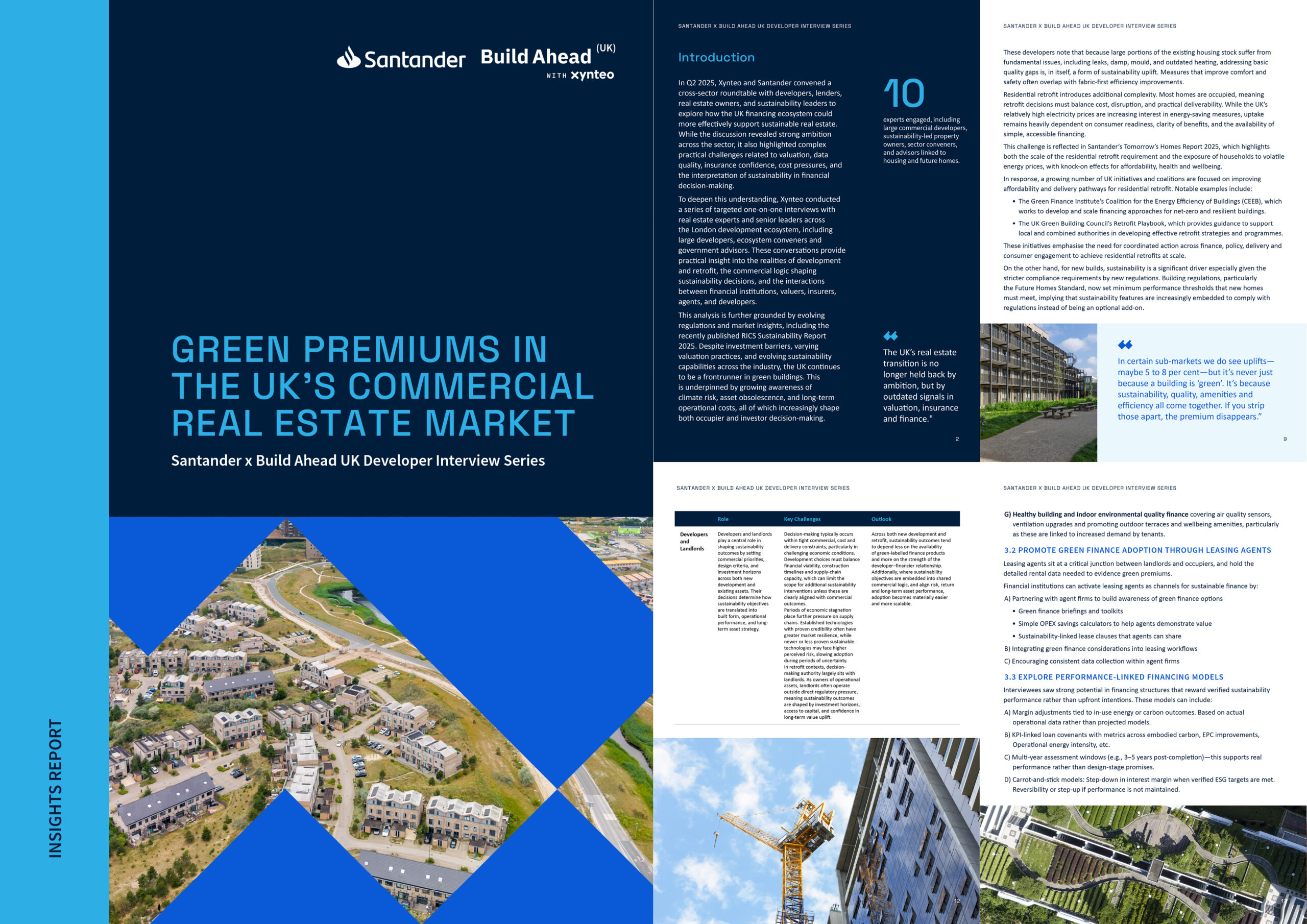
]]>The post Green premiums in the UK’s commercial real estate market: A Santander x Build Ahead UK developer interview series appeared first on Xynteo.
]]>This report distils learnings from a cross‑sector roundtable and deep‑dive interviews with senior leaders across London’s development ecosystem. It explores how sustainability is currently understood and valued in commercial and residential markets, where green premiums are emerging, and why misaligned definitions, data gaps, and traditional financing structures can limit adoption. The report examines the roles of developers, landlords, valuers, insurers, leasing agents, and financiers—and how their interactions shape both sustainability ambition and delivery on the ground.
This report equips stakeholders across the UK built environment to better align sustainability with commercial logic. It presents concrete opportunities for the finance ecosystem to support adoption—from thematic, outcome‑based decarbonisation products and performance‑linked financing models, to stronger valuation capability, more confident insurance underwriting, and activating leasing agents as conduits for green finance.
By translating sustainability into clearer signals, shared evidence, and scalable pathways, the report charts how the market can more consistently recognise and reward sustainable value.
Charles Cooper
Manager
Shaiyra Devi
Principal
Abhishek Ramnath
Consultant
The post Green premiums in the UK’s commercial real estate market: A Santander x Build Ahead UK developer interview series appeared first on Xynteo.
]]>