Inspiration
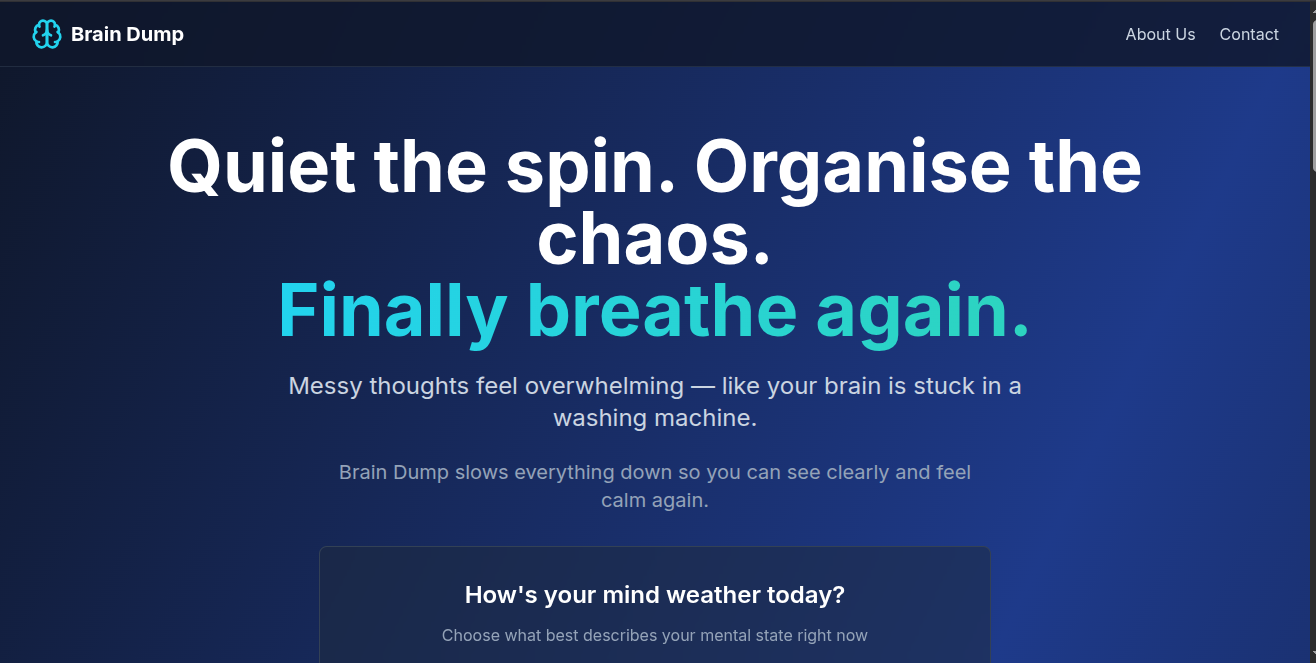
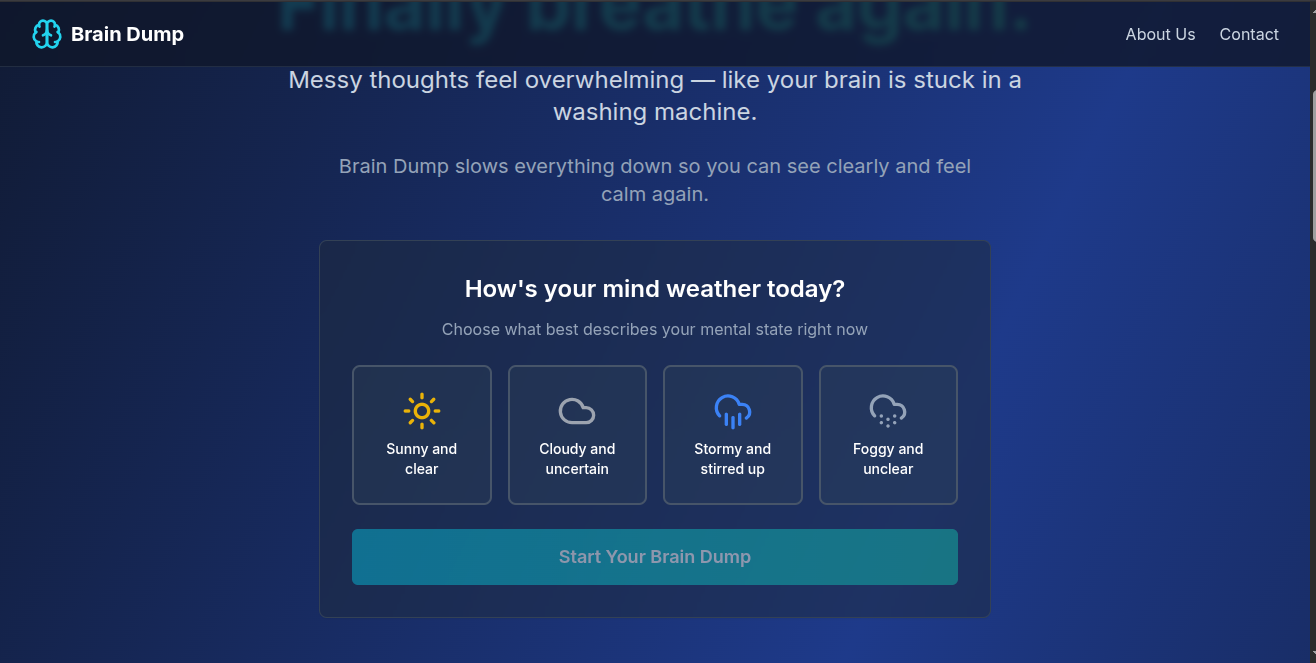
Mental overwhelm doesn't need more journaling apps it needs a way to slow down racing thoughts and see them clearly. We built BrainDump after realizing that when your mind feels like a washing machine, the last thing you want is a blank journal page. You need structure, guidance, and a way to organize the chaos.
What it does
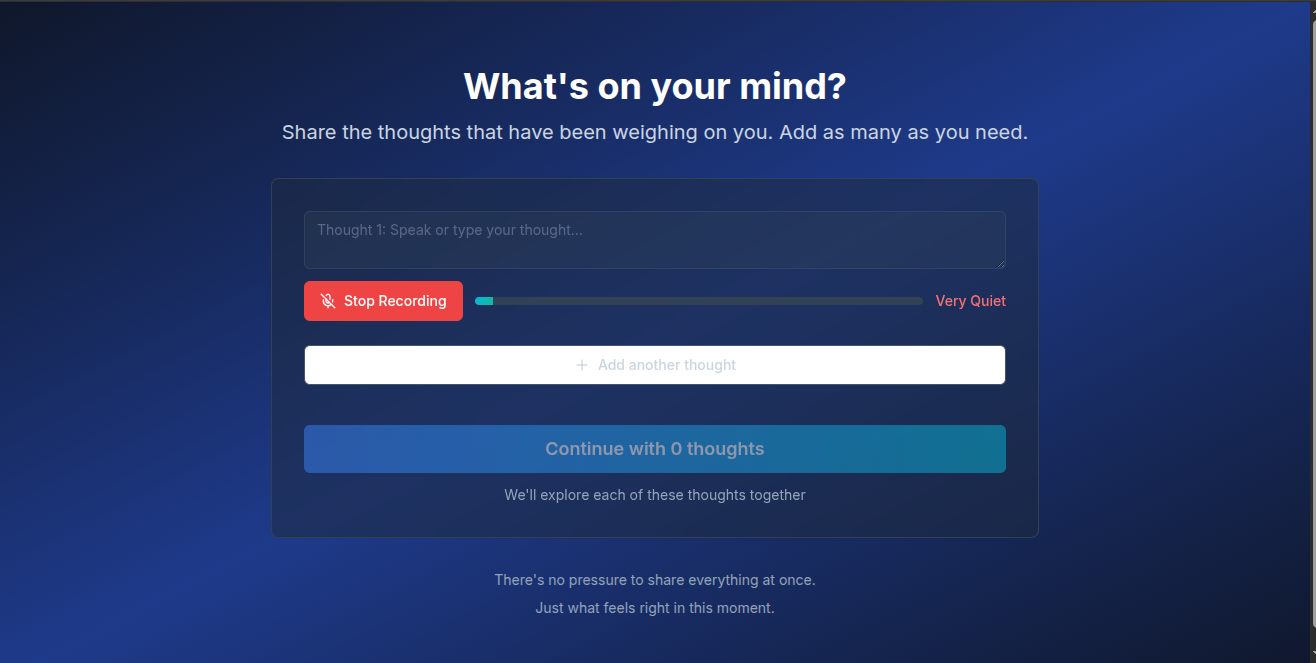
BrainDump helps users process overwhelming thoughts through a guided reflection framework. Users dump their thoughts via voice or text, then answer 5 focused questions for each thought (change vs. accept, helps vs. hurts, emotions, truth, intensity). AI categorizes the thoughts and creates an interactive bubble visualization, showing patterns and themes the user might have missed. Voice narration guides the entire process, making it accessible when typing feels impossible.
How we built it
Frontend: Next.js 13.5 with TypeScript and Tailwind CSS for the UI AI Integration: OpenAI GPT-4 for thought categorization and insights, Whisper for speech-to-text transcription Voice: ElevenLabs text-to-speech for guided question narration Audio Processing: Web Audio API and MediaRecorder for real-time voice recording with visual feedback Storage: Client-side localStorage for privacy and instant access Architecture: Sequential reflection flow (input → session → thoughts → complete) to prevent overwhelm
Challenges we ran into
Smart sentence splitting - Voice dumps needed to be intelligently split into discrete thoughts without breaking mid-sentence Audio synchronization - Coordinating voice narration playback with UI state transitions while keeping the flow natural Real-time audio visualization - Processing audio levels from MediaRecorder while recording for meaningful visual feedback Categorization accuracy - Tuning GPT-4 prompts to provide nuanced, compassionate insights rather than generic keyword matching Privacy-first architecture - Balancing AI processing needs with keeping user data local and secure
Accomplishments that we're proud of
Voice-first experience that actually works smoothly—recording, transcription, and narration feel natural Sequential reflection framework that prevents overwhelm by focusing on one thought at a time AI categorization that genuinely understands emotional nuance and themes Interactive visualization that makes abstract thoughts tangible and explorable Privacy-focused design with no accounts, no tracking, and local storage
What we learned
Voice UI requires careful state management—audio playback, recording, and transcription all need to coordinate seamlessly Mental health apps need compassionate language engineering, not just technical features localStorage can be powerful for privacy-first apps when used correctly Real-time audio visualization significantly improves the recording experience Sequential flows beat all-at-once dumps when users are already overwhelmed
What's next for BrainDump
Session history - Track patterns over time while maintaining privacy Export functionality - Allow users to save insights as PDF or markdown Offline mode - Full PWA support for use without internet Custom reflection questions - Let users adapt the framework to their needs Multi-language support - Expand beyond English for global accessibility Thought connections - Visualize relationships between recurring thoughts across sessions
Built With
- nextjs
- typescript

Log in or sign up for Devpost to join the conversation.