
Automatic detection and prediction of cybersickness severity using deep neural networks from user’s physiological signals
Authors: Rifatul Islam, Yonggun Lee, Mehrad Jaloli, Imtiaz Muhammad, Dakai Zhu, Paul Rad, Yufei Huang, John Quarles
Published at 2020 IEEE International Symposium on Mixed and Augmented Reality (ISMAR)
Abstract:
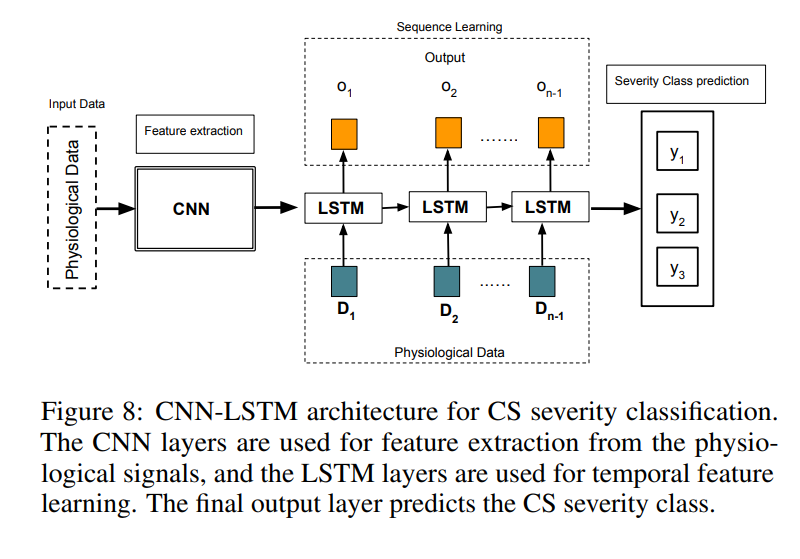
Cybersickness is one of the primary challenges to the usability and acceptability of virtual reality (VR). Cybersickness can cause motion sickness-like discomforts, including disorientation, headache, nausea, and fatigue, both during and after the VR immersion. Prior research suggested a significant correlation between physiological signals and cybersickness severity, as measured by the simulator sickness questionnaire (SSQ). However, SSQ may not be suitable for automatic detection of cybersickness severity during immersion, as it is usually reported before and after the immersion. In this study, we introduced an automated approach for the detection and prediction of cybersickness severity from the user's physiological signals. We collected heart rate, breathing rate, heart rate variability, and galvanic skin response data from 31 healthy participants while immersed in a VR roller coaster simulation. We found a significant difference in the participants' physiological signals during their cybersickness state compared to their resting baseline. We compared a support vector machine classifier and three deep neural classifiers for cybersickness severity detection and prediction in two minutes' future, given the previous two minutes of physiological signals. Our proposed simplified convolutional long short-term memory classifier achieved an accuracy of 97.44% for detecting current cybersickness severity and 87.38% for predicting future cybersickness severity from the physiological signals.
@INPROCEEDINGS{9284761, author={Islam, Rifatul and Lee, Yonggun and Jaloli, Mehrad and Muhammad, Imtiaz and Zhu, Dakai and Rad, Paul and Huang, Yufei and Quarles, John}, booktitle={2020 IEEE International Symposium on Mixed and Augmented Reality (ISMAR)}, title={Automatic Detection and Prediction of Cybersickness Severity using Deep Neural Networks from user’s Physiological Signals}, year={2020}, volume={}, number={}, pages={400-411}, doi={10.1109/ISMAR50242.2020.00066}}