

# PYTHON
import fill_voids

img = ... # 2d or 3d binary image
filled_image = fill_voids.fill(img, in_place=False) # in_place allows editing of original image
filled_image, N = fill_voids.fill(img, return_fill_count=True) # returns number of voxels filled in
// C++
#include "fill_voids.hpp"
size_t sx, sy, sz;
sx = sy = sz = 512;
uint8_t* labels = ...; // 512x512x512 binary image
// modifies labels as a side effect, returns number of voxels filled in
size_t fill_ct = fill_voids::binary_fill_holes<uint8_t>(labels, sx, sy, sz); // 3D
// let labels now represent a 512x512 2D image
size_t fill_ct = fill_voids::binary_fill_holes<uint8_t>(labels, sx, sy); // 2D
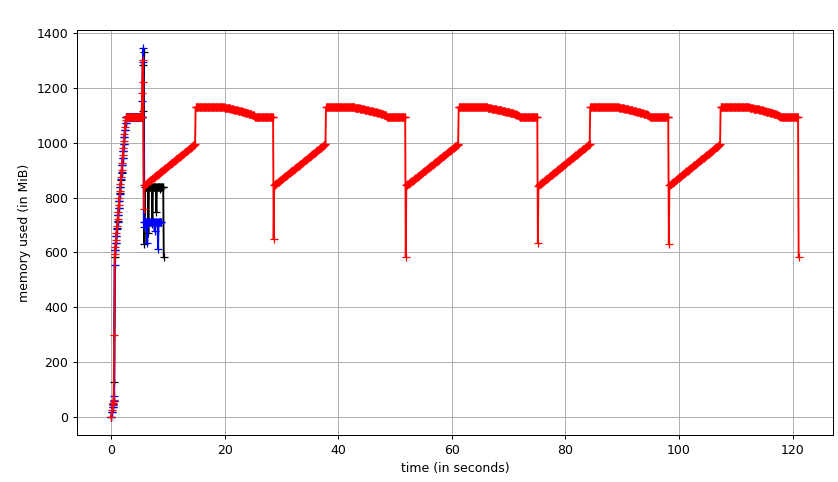
Fig. 1: Filling five labels using SciPy binary_fill_holes vs fill_voids from a 512x512x512 densely labeled connectomics segmentation. (black) fill_voids 1.1.0 (blue) fill_voids 1.1.0 with `in_place=True` (red) scipy 1.4.1. In this test, fill_voids (`in_place=False`) is significantly faster than scipy with lower memory usage.
This library contains both 2D and 3D void filling algorithms, similar in function to scipy.ndimage.morphology.binary_fill_holes, but with an eye towards higher performance. The SciPy hole filling algorithm uses slow serial dilations.
The current version of this library uses a scan line flood fill of the background labels and then labels everything not filled as foreground.
pip install fill-voidsIf there's no binary for your platform and you have a C++ compiler try:
sudo apt-get install python3-dev # This is for Ubuntu, but whatever is appropriate for you
pip install numpy
pip install fill-voids --no-binary :all:- Raster scan and mark every foreground voxel
2for pre-existing foreground. - Raster scan each face of the current image and the first time a black pixel (
0) is encountered after either starting or enountering a foreground pixel, add that location to a stack. - Flood fill (six connected) with the visited background color (
1) in sequence from each location in the stack that is not already foreground. - Write out a binary image the same size as the input mapped as buffer != 1 (i.e. 0 or 2). This means non-visited holes and foreground will be marked as
1for foreground and the visited background will be marked as0.
We improve performance significantly by using libdivide to make computing x,y,z coordinates from array index faster, by scanning right and left to take advantage of machine memory speed, by only placing a neighbor on the stack when we've either just started a scan or just passed a foreground pixel while scanning.
For multi-label void filling, see https://github.com/seung-lab/fastmorph/