
SQL provides recursive joins using recursive CTEs to work with hierarchical data such as employee-manager or parent-child relationships.
- It is used to handle hierarchical or tree-structured data.
- It repeatedly joins a table with itself using recursion.
- It is implemented using recursive CTEs (WITH RECURSIVE).
Syntax:
WITH RECURSIVE cte_name AS (
    -- Anchor Query: Select the root or starting point
    SELECT columns
    FROM table
    WHERE condition

    UNION ALL

    -- Recursive Query: Join the CTE with the table to fetch related data
    SELECT t.columns
    FROM table t
    INNER JOIN cte_name cte ON t.column = cte.column
)
Example of Recursive Join in SQL
Let's understand Recursive Join in SQL with an example. First, we create a demo SQL database and table, on which we will use the Recursive Join command.
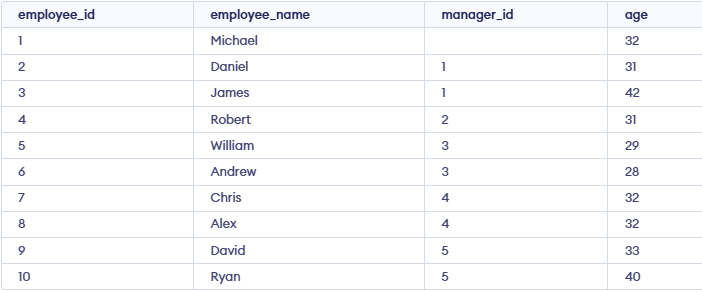
Now, we will use a recursive join to get a list of all employees and their managers, starting with Michael (employee with employee_id = 1).
Query:
WITH RECURSIVE employee_hierarchy AS (
    -- Anchor query: Start with Michael  (employee_id = 1)
    SELECT employee_id, employee_name, manager_id, age
    FROM employees
    WHERE employee_id = 1

    UNION ALL

    -- Recursive query: Join the employees table with itself to get the employees reporting to each manager
    SELECT e.employee_id, e.employee_name, e.manager_id, e.age
    FROM employees e
    INNER JOIN employee_hierarchy eh ON e.manager_id = eh.employee_id
)
SELECT * FROM employee_hierarchy;
Output:
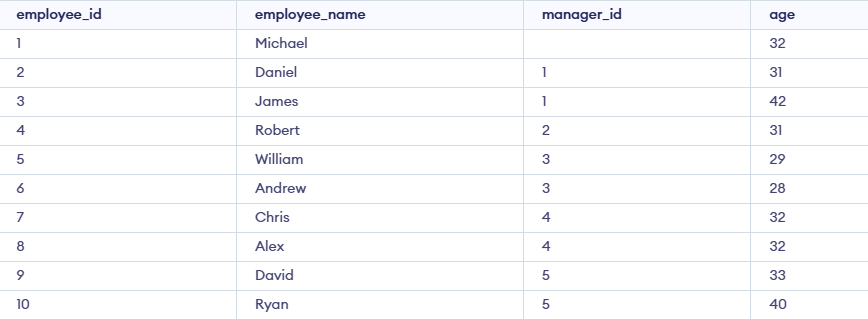
- The anchor part selects Michael as the starting point.
- The recursive part joins the employees table with the employee_hierarchy CTE to find all employees who report to the previous level of employees.
- The process repeats until all employees who report to Michael (and indirectly to others) are listed.
Applications of Recursive Joins
Here are the applications of recursive joins:
- Hierarchical Data Representation: Recursive joins are commonly used to represent and query hierarchical structures, such as employee-manager relationships, organizational charts and bill of materials.
- Parent-Child Relationships: Recursive queries help retrieve data that represents parent-child relationships, such as categories and subcategories in a product catalog.
- Graph Traversal: Recursive joins are also used for traversing graphs or networks, such as social networks or transportation networks.