
SQL provides the EXISTS operator to check whether a subquery returns at least one row. It is useful for filtering data based on the presence of related records.
- It checks if a subquery returns one or more rows.
- It returns TRUE if data exists, otherwise FALSE.
- It is commonly used with subqueries.
Example: First, we create a demo SQL database and tables, on which we use the EXISTS command.


Query:
SELECT Name
FROM Customers c
WHERE EXISTS (
    SELECT 1
    FROM Orders o
    WHERE o.CustomerID = c.CustomerID
);
Output:

Syntax:
SELECT column_name(s)
FROM table_name
WHERE EXISTS (
    SELECT column_name(s)
    FROM subquery_table
    WHERE condition
);- EXISTS: The boolean operator that checks if a subquery returns rows.
- Subquery: A nested SELECT query that returns data for evaluation.
- Condition: The condition applied to the subquery.
Examples of SQL EXISTS
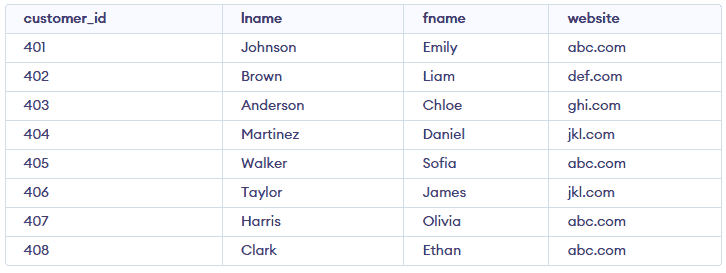
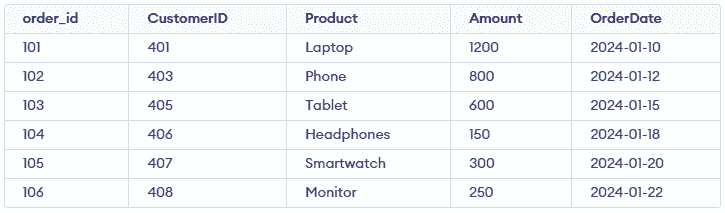
Consider the following two relation "Customers" and "Orders".
Example 1 : Using EXISTS with SELECT
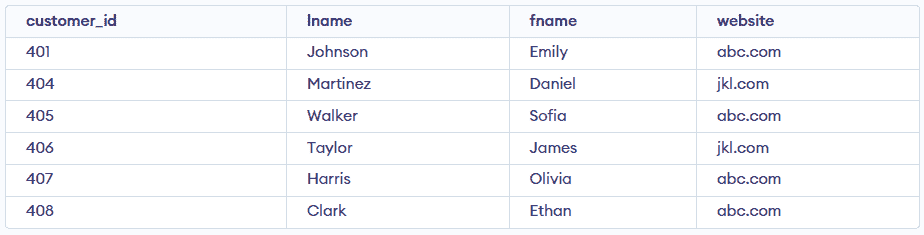
To fetch the customers whose website is shared by at least one other customer in the same Customers table.
Query:
SELECT c1.*
FROM Customers c1
WHERE EXISTS (
    SELECT 1
    FROM Customers c2
    WHERE c2.website = c1.website
      AND c2.customer_id <> c1.customer_id
);
Output:
Example 2 : Using NOT with EXISTS
Fetch last and first name of the customers who have not placed any order.
SELECT c.lname, c.fname
FROM Customers c
WHERE NOT EXISTS (
    SELECT 1
    FROM Orders o
    WHERE o.CustomerID = c.customer_id
);
Output:

Example 3 : Using EXISTS Condition with DELETE Statement
Delete record of all the customer from Order Table whose website is 'abc.com'.
DELETE FROM Orders
WHERE EXISTS (
    SELECT 1
    FROM Customers c
    WHERE c.customer_id = Orders.CustomerID
      AND c.website = 'abc.com'
);
SELECT * FROM Orders;Output:

Example 4 : Using EXISTS Condition with UPDATE Statement
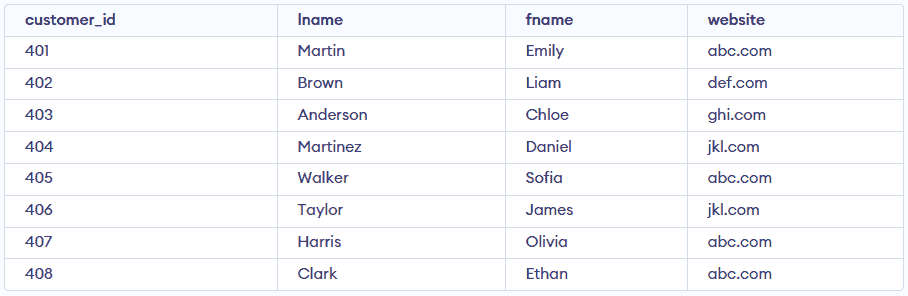
Update the lname as 'Martin' of customer in Customer Table whose customer_id is 401.
UPDATE Customers
SET lname = 'Martin'
WHERE EXISTS (
    SELECT 1
    FROM Customers c2
    WHERE c2.customer_id = 401
      AND c2.customer_id = Customers.customer_id
);
SELECT * FROM Customers;Output:
EXISTS vs. IN
Here is the detailed comparison between EXISTS and IN:
EXISTS | IN |
|---|---|
Checks if at least one matching row exists in a subquery. | Checks whether a value is within a list or subquery result. |
Stops searching once a match is found (more efficient for large data). | Compares the value against the entire list/result (may be slower for large data). |
Works well with correlated subqueries. | Works best with small fixed lists or simple comparisons. |
Handles NULL values safely. | Fails or behaves unexpectedly if the list contains NULL. |
SELECT * FROM Customers c WHERE EXISTS ( SELECT 1 FROM Orders o WHERE o.CustomerID = c.customer_id ); | SELECT * FROM Customers WHERE customer_id IN ( SELECT CustomerID FROM Orders ); |