This is NOT the original codebase for the paper "Less is More: Recursive Reasoning with Tiny Networks". The original codebase is available here.
This is the JAX implementation of the original codebase for the paper: "Less is More: Recursive Reasoning with Tiny Networks". TRM is a recursive reasoning approach that achieves amazing scores of 45% on ARC-AGI-1 and 8% on ARC-AGI-2 using a tiny 7M parameters neural network.
This is my experiment of using Antigravity to do this job. The code still requires polishing and testing, I'm not 100% sure it works exactly as the original code. From what I see, the training process is still unstable and the model does not converge.
Because of the lack of GPU resources, I paused training the models.
I'm open to contributions if you want to help me improve it.
Tiny Recursion Model (TRM) is a recursive reasoning model that achieves amazing scores of 45% on ARC-AGI-1 and 8% on ARC-AGI-2 with a tiny 7M parameters neural network. The idea that one must rely on massive foundational models trained for millions of dollars by some big corporation in order to achieve success on hard tasks is a trap. Currently, there is too much focus on exploiting LLMs rather than devising and expanding new lines of direction. With recursive reasoning, it turns out that “less is more”: you don’t always need to crank up model size in order for a model to reason and solve hard problems. A tiny model pretrained from scratch, recursing on itself and updating its answers over time, can achieve a lot without breaking the bank.
This work came to be after I learned about the recent innovative Hierarchical Reasoning Model (HRM). I was amazed that an approach using small models could do so well on hard tasks like the ARC-AGI competition (reaching 40% accuracy when normally only Large Language Models could compete). But I kept thinking that it is too complicated, relying too much on biological arguments about the human brain, and that this recursive reasoning process could be greatly simplified and improved. Tiny Recursion Model (TRM) simplifies recursive reasoning to its core essence, which ultimately has nothing to do with the human brain, does not require any mathematical (fixed-point) theorem, nor any hierarchy.
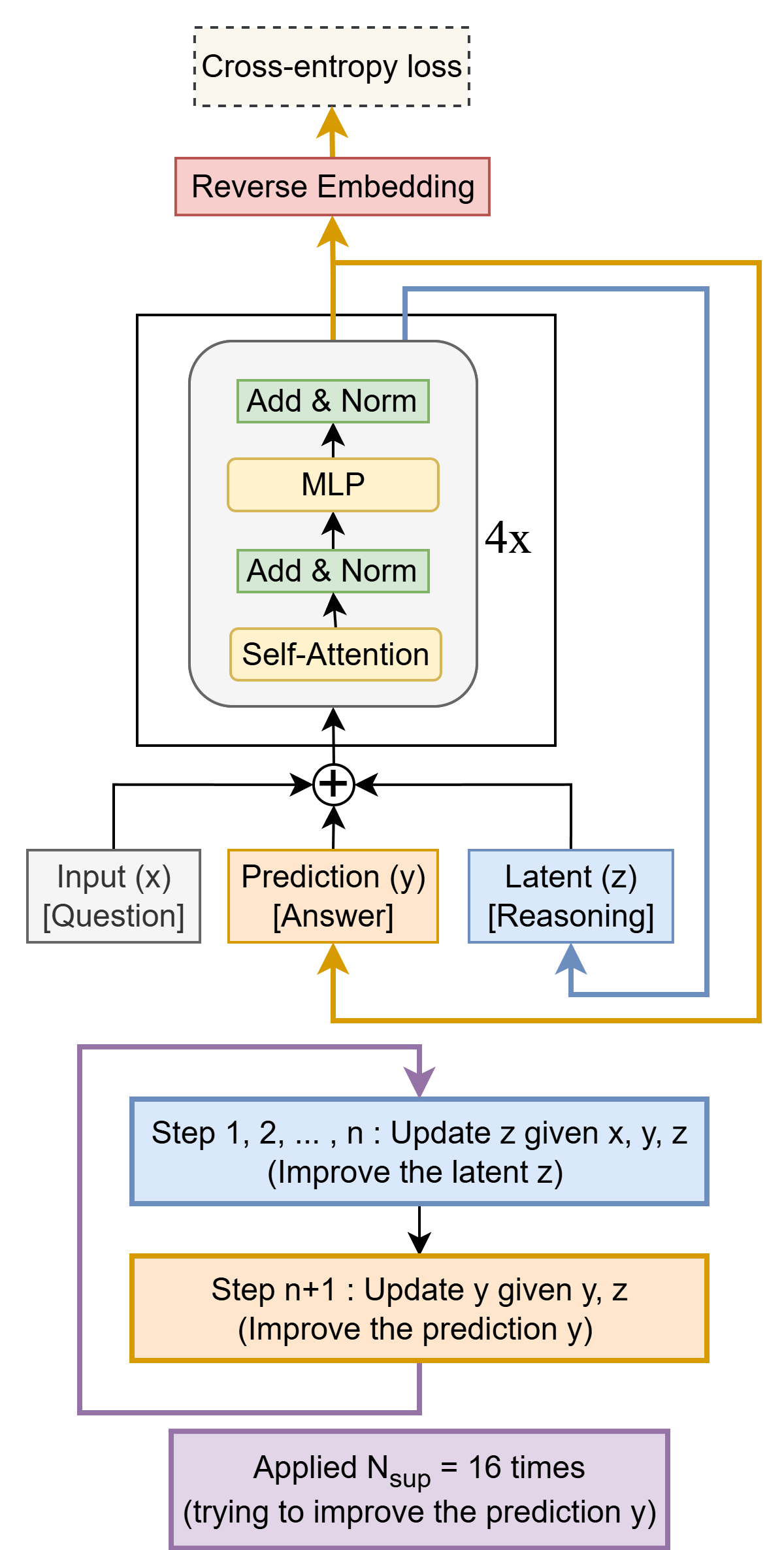
Tiny Recursion Model (TRM) recursively improves its predicted answer y with a tiny network. It starts with the embedded input question x and initial embedded answer y and latent z. For up to K improvements steps, it tries to improve its answer y. It does so by i) recursively updating n times its latent z given the question x, current answer y, and current latent z (recursive reasoning), and then ii) updating its answer y given the current answer y and current latent z. This recursive process allows the model to progressively improve its answer (potentially addressing any errors from its previous answer) in an extremely parameter-efficient manner while minimizing overfitting.
- Python 3.10 (or similar)
- Cuda 12.6.0 (or similar)
pip install --upgrade pip wheel setuptools
pip install --pre --upgrade torch torchvision torchaudio --index-url https://download.pytorch.org/whl/nightly/cu126 # install torch based on your cuda version
pip install -r requirements.txt # install requirements
pip install --no-cache-dir --no-build-isolation adam-atan2
wandb login YOUR-LOGIN # login if you want the logger to sync results to your Weights & Biases (https://wandb.ai/)# ARC-AGI-1
python -m dataset.build_arc_dataset \
--input-file-prefix kaggle/combined/arc-agi \
--output-dir data/arc1concept-aug-1000 \
--subsets training evaluation concept \
--test-set-name evaluation
# ARC-AGI-2
python -m dataset.build_arc_dataset \
--input-file-prefix kaggle/combined/arc-agi \
--output-dir data/arc2concept-aug-1000 \
--subsets training2 evaluation2 concept \
--test-set-name evaluation2
## Note: You cannot train on both ARC-AGI-1 and ARC-AGI-2 and evaluate them both because ARC-AGI-2 training data contains some ARC-AGI-1 eval data
# Sudoku-Extreme
python dataset/build_sudoku_dataset.py --output-dir data/sudoku-extreme-1k-aug-1000 --subsample-size 1000 --num-aug 1000 # 1000 examples, 1000 augments
# Maze-Hard
python dataset/build_maze_dataset.py # 1000 examples, 8 augmentsrun_name="pretrain_att_arc1concept_4"
torchrun --nproc-per-node 4 --rdzv_backend=c10d --rdzv_endpoint=localhost:0 --nnodes=1 pretrain.py \
arch=trm \
data_paths="[data/arc1concept-aug-1000]" \
arch.L_layers=2 \
arch.H_cycles=3 arch.L_cycles=4 \
+run_name=${run_name} ema=True
Runtime: ~3 days
run_name="pretrain_att_arc2concept_4"
torchrun --nproc-per-node 4 --rdzv_backend=c10d --rdzv_endpoint=localhost:0 --nnodes=1 pretrain.py \
arch=trm \
data_paths="[data/arc2concept-aug-1000]" \
arch.L_layers=2 \
arch.H_cycles=3 arch.L_cycles=4 \
+run_name=${run_name} ema=True
Runtime: ~3 days
run_name="pretrain_mlp_t_sudoku"
python pretrain.py \
arch=trm \
data_paths="[data/sudoku-extreme-1k-aug-1000]" \
evaluators="[]" \
epochs=50000 eval_interval=5000 \
lr=1e-4 puzzle_emb_lr=1e-4 weight_decay=1.0 puzzle_emb_weight_decay=1.0 \
arch.mlp_t=True arch.pos_encodings=none \
arch.L_layers=2 \
arch.H_cycles=3 arch.L_cycles=6 \
+run_name=${run_name} ema=True

run_name="pretrain_att_sudoku"
python pretrain.py \
arch=trm \
data_paths="[data/sudoku-extreme-1k-aug-1000]" \
evaluators="[]" \
epochs=50000 eval_interval=5000 \
lr=1e-4 puzzle_emb_lr=1e-4 weight_decay=1.0 puzzle_emb_weight_decay=1.0 \
arch.L_layers=2 \
arch.H_cycles=3 arch.L_cycles=6 \
+run_name=${run_name} ema=True
Runtime: < 36 hours
run_name="pretrain_att_maze30x30"
torchrun --nproc-per-node 4 --rdzv_backend=c10d --rdzv_endpoint=localhost:0 --nnodes=1 pretrain.py \
arch=trm \
data_paths="[data/maze-30x30-hard-1k]" \
evaluators="[]" \
epochs=50000 eval_interval=5000 \
lr=1e-4 puzzle_emb_lr=1e-4 weight_decay=1.0 puzzle_emb_weight_decay=1.0 \
arch.L_layers=2 \
arch.H_cycles=3 arch.L_cycles=4 \
+run_name=${run_name} ema=True
Runtime: < 24 hours
This repository also includes a fully functional JAX/Flax implementation of TRM, optimized for TPU training (v3-8, v4, etc.).
Key Files:
pretrain_jax.py: Main training script (feature parity withpretrain.py).models/trm_jax.py: JAX implementation of the TRM architecture.
Running on TPU (Sudoku Example): The JAX implementation supports Data Parallelism (Sharding) and Gradient Checkpointing (Remat) out of the box for efficient memory usage.
# Ensure you have jax[tpu] installed
pip install -r requirements.txt

run_name="pretrain_jax_sudoku"
python3 pretrain_jax.py \
    arch=trm \
    data_paths="['data/sudoku-extreme-1k-aug-1000']" \
    evaluators="[]" \
    epochs=50000 \
    eval_interval=5000 \
    lr=1e-4 \
    puzzle_emb_lr=1e-4 \
    weight_decay=1.0 \
    puzzle_emb_weight_decay=1.0 \
    arch.L_layers=2 \
    arch.H_cycles=3 \
    arch.L_cycles=6 \
    +run_name=${run_name} \
ema=TrueIf you find our work useful, please consider citing:
@misc{jolicoeurmartineau2025morerecursivereasoningtiny,
      title={Less is More: Recursive Reasoning with Tiny Networks},
      author={Alexia Jolicoeur-Martineau},
      year={2025},
      eprint={2510.04871},
      archivePrefix={arXiv},
      primaryClass={cs.LG},
      url={https://arxiv.org/abs/2510.04871},
}
and the Hierarchical Reasoning Model (HRM):
@misc{wang2025hierarchicalreasoningmodel,
      title={Hierarchical Reasoning Model},
      author={Guan Wang and Jin Li and Yuhao Sun and Xing Chen and Changling Liu and Yue Wu and Meng Lu and Sen Song and Yasin Abbasi Yadkori},
      year={2025},
      eprint={2506.21734},
      archivePrefix={arXiv},
      primaryClass={cs.AI},
      url={https://arxiv.org/abs/2506.21734},
}
This code is based on the Hierarchical Reasoning Model code and the Hierarchical Reasoning Model Analysis code.
Google AI Developer Programs team supported this work (porting to JAX) by providing Google Cloud Credit